


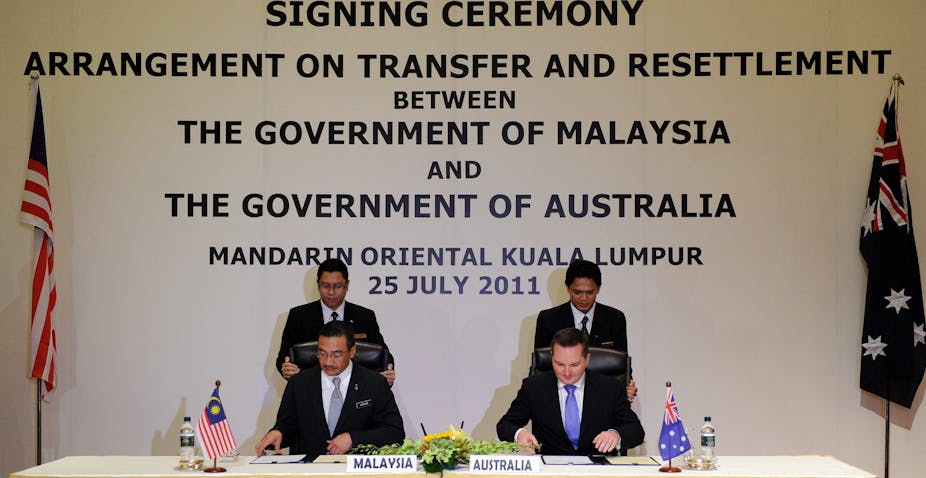
Later today the Australian Government plans to put the Migration Legislation Amendment (Offshore Processing and Other Measures) Bill 2011 to a vote in the House of Representatives. Without it, the government’s controversial “Malaysian Solution” is in tatters. So, what does this controversial Bill actually say?
It undermines several protections built into the Migration Act 1958, which, with Australia’s unique policies of indefinite mandatory detention and offshore processing, are already weak by international standards.
Rejecting international obligations
The Bill would add a new “purpose” to the Migration Act which would provide for offshore entry persons to be taken from Australia to “a country designated by the Minister… as an offshore processing country.”
The “only condition” for such a designation would be “that the Minister thinks that it is in the national interest to designate the country to be an offshore processing country.”
The Minister’s decision “need not be determined by reference to the international obligations or domestic law of that country.” A more blatant rejection of Australia’s international obligations to protect refugees is hard to imagine.
Slap in the face
The Bill would also amend sections which say Australia has protection obligations under the Refugees Convention to certain non citizens – ie refugees. It would change the wording to “obligations in respect of” refugees.
This may sound like a fine distinction, but to an international lawyer it is a slap in the face.
No longer does the Australian Government accept that it has obligations to those fleeing persecution. It considers it merely has obligations which somehow vaguely relate to such people, which may or may not compel us to protect them in reality.
Suspending natural justice
The Bill specifies that the rules of natural justice do not apply to decisions regarding the designation of offshore processing countries.
Natural justice encompasses principles such as the right to a fair hearing and the right to challenge a government decision. In fact, natural justice is already denied by the Migration Act in respect of other kinds of decisions, such as cancellation of visas on character grounds or the refusal of temporary safe haven.
These are decisions with serious consequences for those affected, and are precisely the types of decisions which should be subjected to the highest standards of fairness and justice, rather than the lowest.
Reasonable force?
The next little nugget from this Bill is an authorisation for officers (including soldiers) to use “necessary and reasonable” force in implementing the Government’s transfer policy.
Unfortunately, the victim of any unnecessary or unreasonable force shunted off to a third country is not likely to be in a strong position to take action against the authorities once removed.
Not content with a wholesale reworking of the protection regime in the Migration Act, the Bill also amends the Immigration (Guardianship of Children) Act 1946 to ensure that the Minister’s obligations as legal guardian of unaccompanied minors do not interfere with removal under the Migration Act.
International obligations
This Bill is cynical and antipathetic to Australia’s international obligations.
The Government’s justification (stated in the Bill itself) is that “people smuggling, and its undesirable consequences including the resulting loss of life at sea, are major regional problems that need to be addressed.”
Yet the sole criterion for the designation of an “offshore processing country,” it specifies, is the (Australian) national interest. The justification implies altruism; the Bill expresses only self interest.
A couple of vague (non-binding) references to international obligations were inserted after Opposition protests, although the Coalition’s stance overloaded irony detectors everywhere.
Onshore processing
The defeat of this Bill (which seems certain in the Senate, and is looking very likely in the House), should not be lamented.
A return to onshore processing, despite the reported hyperbolic warnings of the Immigration Department, is unlikely to spell the end of society as we know it. Rather than merely “restoring power to the executive,” as the Minister would have it, the Bill would effectively rewrite the rules after the umpire’s decision in the High Court.
It would in fact increase the power of the executive and allow it (once again) to interpret its international obligations extremely narrowly, if not sidestep them entirely.
If Australia is serious about the need for regional solutions and other reforms to the international system of refugee protection (and there is a case to be made for this), the proper course is to advocate change at the international level, rather than to undermine the system through dubious bilateral arrangements and weaselly amendments to the Migration Act.