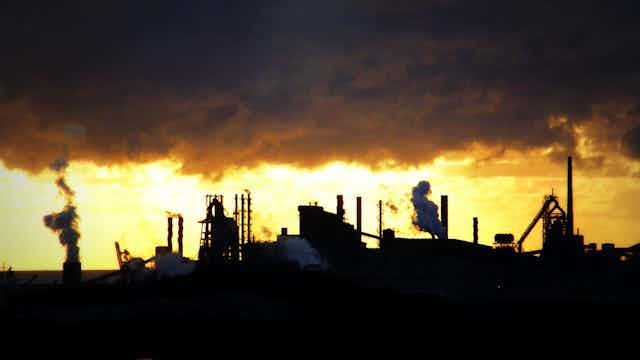
Ever heard of “environmental justice”? No? It links social and environmental discrimination. Still doesn’t sound familiar? Well if you’ve seen the movie Erin Brockovich – which examines how a single mother fought against a Californian utility that polluted the environment – you’ve watched a movie about environmental justice.
“Environmental justice” describes efforts to fix the pollution burden faced by marginalised groups. Such groups usually lack social, economic, and political power. They include indigenous people, poor people, immigrants, homeless, elderly, non-white people, people with disabilities, unemployed, sole-parents and the like.
Earlier this year the Victorian Environmental Defenders Office quietly released a potentially groundbreaking report on environmental equity in Australia. Until now, Australia has paid little attention to environmental justice, but this report has the potential to radically alter Australia’s planning landscape.
What is environmental justice and where did it come from?
The environmental justice movement began as an offshoot of the US civil rights movement in the United States in the late 1970s, but has since grown internationally. At first, it was a grassroots response to pollution in communities. “People of colour” (African-Americans, Latinos, Asians and others) lived in neighbourhoods hosting noxious land uses such as waste dumps and polluting factories.
They fought against corrupt businesses, discriminatory land use zoning, biased decision-making and unequal law enforcement. They used protests, community rallies and direct political action to achieve their goals.
In 1991, the National People of Color Summit in Washington DC adopted Environmental Justice Principles. Since then, researchers have demonstrated that marginalised people are significantly more likely to inhabit polluted, dangerous, or otherwise unhealthy places. Scholars have documented hundreds of cases of environmental injustice.
Marginalised Australians in contaminated areas
Until recently, Australia has not had a recognisable environmental justice movement. This is surprising. Nearly every Australian city has contaminated industrial areas that are close to working-class neighbourhoods. These places have extensive air, soil and water pollution. Marginalised and vulnerable people also live nearby. They include recent immigrants, indigenous people, homeless, unemployed, and the working poor. Such groups also lack easy access to environmental benefits like parks and green space.
In Australia, the plight of poor and marginalised people who live in toxic and polluted neighbourhoods has typically been identified as a “social justice” or “public health” issue, not as an environmental concern.
Like its US counterpart, the Australian environmental movement has mostly been white, middle-class, and concerned with protecting so-called wilderness areas. But Australia may now be on the cusp of embracing environmental justice, thanks to the Victorian EDO’s environmental justice report.
The report is based on detailed research. It discusses three Australian case studies: a toxic dump in Tullamarine; indigenous involvement in the Murray-Darling Basin Plan; and coal seam gas and desalination plants in rural Australia.
The report suggests that environmental justice is not recognised in the same way here as in the United States. But it also acknowledges that this might be about to change. The report gives particular attention to the problems with Australia’s environmental planning and environmental enforcement systems. And it makes recommendations for how these problems might be remedied.
The evidence is in, time for action
Australian scholars have also begun to investigate environmental justice issues. There are now several excellent studies demonstrating that Australia has environmental justice problems. These problems include coal seam gas and coal dust pollution, climate justice, exposure to asbestos and lead, pesticide contamination, remote indigenous settlements, and access to green space.
For example, in 2003 Mariann Lloyd-Smith and Lee Bell documented a chemical fire in a toxic waste dump in Bellevue, Western Australia. They investigated how local authorities dismissed residents concerns about health impacts. Annemarie De Vos and Jeffery Spickett also examined the same fire from an environmental health perspective. Both studies found lax enforcement of environmental laws, poor regulation, haphazard monitoring and very poor follow-up with residents. The Australian Broadcasting Corporation has followed the case in a report on Stateline in 2006, and in a Four Corners story.
Australian planning and environmental regulatory systems have left a legacy of harm in our cities, towns and rural areas. This harm has affected both nature and people. Asbestos roofs, soil and water contamination, air pollution and toxic waste dumps exist in every state.
Planning law changes are taking us backwards
Recent changes to state planning laws in Queensland, and forthcoming changes in New South Wales, mean that environmental injustices are likely set to increase.
State Governments are looking to wind-back environmental regulations to boost land and property development (so called cuts to “green tape”). They are also changing the powers of local government to investigate and monitor environmental problems. And they are cutting funding to independent watchdogs protecting the public interest, watchdogs like the Environmental Defenders Office.
Without these independent organisations monitoring government actions, who will? Environmental injustice is a problem in Australia, so what are we going to do about it?
Anthony Nolan
Ruminant
I agree wholeheartedly that the concept of 'environmental justice' is long overdue attention in Australia. However, I prefer the altogether blunter term 'environmental racism' to describe the way that marginalised peoples are given the shaft by government and business. The outstanding example of environmental racism in Australia is undoubtedly what was done to the Aboriginal community of Baryulgil, NSW, by James Hardie.
See the paper on this subject by Moerman and van der Laan (pdf):
http://apira2010.econ.usyd.edu.au/conference_proceedings/APIRA-2010-066-Moerman-Accountability-asbestos-and-indigenous-rights.pdf
Jason Byrne
Senior Lecturer - Environmental Planning at Griffith University
Dear Anthony - thank you for your comment. The term environmental racism has typically been used in the USA to refer to the disproportionate exposure of people of colour (non-Whites) to environmental harm, and conversely to their comparatively poor access to environmental benefits. Environmental justice picks up multiple 'axes' of difference including: ethnicity (religion, culture, language), gender, income, disability, migrant-status, and many other ways in which people can be marginalised and socially excluded. There is no doubt in my mind that Australian Aboriginals have suffered environmental racism, in many ways. There is also little doubt that other social groups have suffered environmental injustices in Australia. Clearly there is much work to be done on this important topic. Jason
Gerard Dean
Managing Director
Mr Byrne,
The Australian Aboriginals live in marginalised areas because you live on their stolen land.
Are you going to right the wrongs of the past and give them your land back?
Gerard Dean
Comment removed by moderator.
Gerard Dean
Managing Director
Oh dear Mr Nolan,
Now you slime James Hardy. We should note that not only the asbestos manufacturers knew of the dangers of asbestos, so too did Australia's state and federal governments.
It wasn't until the 1980's that most asbestos was banned, although car brake linings were exempted for several years. I suggest that a government who knows something is wrong and does nothing to correct it via legislation is just as culpable as the nasty James Hardy.
Try and think next time you write.
Gerard Dean
Jason Byrne
Senior Lecturer - Environmental Planning at Griffith University
Dear Gerard, you identify very pertinent concerns about environmental governance and accountability. You also point to some tricky issues regarding to Native Title, Aboriginal Sovereignty and past wrongs - including genocide. We absolutely need Australians to engage with these problems - but it is important to do so in a respectful, courteous and enabling way.
Socio-spatial marginality can manifest in places like northern Australia - but also in inner city locations. We need an open and rigorous…
Read moreSarah Clement
PhD Candidate
Thank you for covering this issue. When I moved here from the US five years ago, any time I asked a question about environmental justice issues in Australia, I was told that it didn't exist. Granted, I come from a place in the US (Detroit area) where the environmental justice issues practically smack you in the face, and the problems are more hidden here; but I couldn't believe that the issues were non-existent. I'm looking forward to reading the EDO Vic report and learning more about environmental justice issues here.
Jason Byrne
Senior Lecturer - Environmental Planning at Griffith University
Dear Sarah, thanks for your positive feedback. I lived in the USA for about 8 years - doing my PhD - and saw daily examples of environmental injustice and environmental racism in both Baltimore (where I lived for a year) and Los Angeles. I too was surprised to find that comparatively little has been written about EJ in Australia. I have written a bit about gentrification and the East Perth redevelopment project with my colleague Donna Houston. And there are a bunch of public health and pollution studies on that are directly relevant but they don't use the term. Very little compared to the several thousand studies compiled by the US EPA!
Jason Byrne
Senior Lecturer - Environmental Planning at Griffith University
Other relevant links in this topic which have recently appeared on The Conversation include:
https://theconversation.edu.au/air-pollution-from-coal-seam-gas-may-put-public-health-at-risk-10819
https://theconversation.edu.au/environmental-defenders-under-attack-why-funding-must-be-restored-10484
https://theconversation.edu.au/queenslands-big-step-back-from-environmental-assessment-9238
https://theconversation.edu.au/scales-of-justice-tipping-against-the-community-in-queensland-10171
James Jenkin
EFL Teacher Trainer
Jason, I was inspired to read about this 'grassroots response to pollution in communities'. Environmentalism does not have to be, as you say, a 'white middle-class' thing.
But then you list Australia's 'environmental justice' problems: 'coal seam gas and coal dust pollution, climate justice, exposure to asbestos and lead, pesticide contamination, remote indigenous settlements, and access to green space'.
Apart from asbestos and lead, these aren't the concerns of workers in Altona or Claymore. Rather, these are the concerns of those white middle-class Greens who have never lived near an environmental problem in their life.
David Arthur
n/a
"Apart from asbestos and lead, these aren't the concerns of workers in Altona or Claymore. Rather, these are the concerns of those white middle-class Greens who have never lived near an environmental problem in their life"
Mr Jenkins, with your urban superiority ideology, the entire populations of cities such as Broken Hill and Mt Isa are irrelevant. Out of sight, out of mind?
Jason Byrne
Senior Lecturer - Environmental Planning at Griffith University
Dear James, thank you for your insights.
You draw attention to some of the environmental harms mentioned in my article - but there are many more that I have touched on - and linked directly to working class neighbourhoods and workplaces. There is only so much that one can do in 800 words!
I welcome your comments and hope that this conversation can expand to include many more issues that Australian planners, health professionals, policy-makers and politicians can do more to address.
Jason
David Arthur
n/a
It's an ill bird that fouls its own nest.
Matthew Thredgold
Software Engineer/Secondary Teacher
Urban air quality and the pollution caused by unnecessarily burning solid fuels, especially wood, is an environmental justice issue too. Woodsmoke pollution doesn't discriminate. It harms all.
The toxicity of woodsmoke isn't another inconvenient truth to fashionably deny. Denial of the real science of the toxicity of woodsmoke is equally as delusional as denying anthropogenic climate forcings. See http://www.samharris.org/blog/item/the-fireplace-delusion for a succinct column on the topic.
Jason Byrne
Senior Lecturer - Environmental Planning at Griffith University
Dear Matthew, thanks for commenting on this article.
Indoor air quality is indeed a massive environmental justice issue - especially in the developing world. There are some amazing studies out there showing that every year many women and children die from poor indoor air quality.
In the so-called developed world, volatile organic compounds from glues, solvents, paints and other sources are also very harmful. Many workers are disproportionately exposed to this harm.
It is definitely time for Australia to catch up on environmental justice.
Gary Goland
Gary Goland is a Friend of The Conversation.
Researcher
Hi everyone. I welcome the article and reference to some of the significant media events that have occurred here in the last little while. The big miss with our disconnected political leaders and public administration is any reference to risk that we live and work with. No evidence and therefore it doesn’t exist. A legal game-play. We do have Health Mapping now; Australian Health Map - Health & Wellbeing. It is possible to join the dots, but our public health system chooses not to, and researchers funding is threatened if they dare. I am part of a group, the People’s Environment Protection Alliance Inc. and have put the need for EPAs to get some understanding of industry fallout by surveying people living around licensed sites. Maybe. It would be good to have the support of others to assist drive this beginning to those making the decisions.
Jason Byrne
Senior Lecturer - Environmental Planning at Griffith University
Dear Gary - the mapping link you are provided is very useful. Environmental justice is a community driven process, so any information that the broader community can readily use to identify problems, and mechanisms to exchange information, will be very helpful to developing an effective movement in Australia.
It seems that the issue is beginning to gather some momentum with workshops held in Melbourne and Brisbane. I understand that another is planned in Sydney early next year. In the meantime, the Australian Wild Law alliance is assembling some useful information that can be accessed here:
http://www.wildlaw.org.au/
Thanks so much for commenting.
Jason
Gary Goland
Gary Goland is a Friend of The Conversation.
Researcher
Many thanks for taking the time and trouble to respond Jason. While accepting that environmental justice is essentially community driven, we do in fact pay EPAs approximately $50M a year in each state of Australia, for environmental regulators to see risks are minimised. We get very little for our money. Polluters that pay license fees get a far better deal. They are able to set the standards they work to, without any reference to OH&S or local public health issues. We have discovered this by…
Read moreJason Byrne
Senior Lecturer - Environmental Planning at Griffith University
Gary, if you send me your email address, I'll put you in touch with some researchers who have been researching environmental justice problems in Botany Bay, Sydney - and who are absolutely interested in this as a public health issue.
My contact is: Jason.Byrne@griffith.edu.au
Jason
Judith Olney
Ms
I wonder if the asbestos used extensively in public housing would come under the banner of environmental justice?
In my town the majority of public housing is built of asbestos sheeting, and the tenants, who are mostly those on welfare or working poor, are not given any warning of the dangers of this product when they enter into a tenancy agreement.
Tenants are also not told how to make these houses safe to live in, and how to avoid exposure to any asbestos fibres released into the air when…
Read moreJason Byrne
Senior Lecturer - Environmental Planning at Griffith University
Dear Judith, you have identified an important environmental justice issue. In the United States (as will no doubt be the case here too) lead paint has proven to be a major environmental justice problem. Many older houses have lead paint which can crack and peel over time. The dust and fragments can get into people's bodies and if ingested by young children can lead to problems with mental development and physical health. But asbestos would seem to be a potentially large problem in Australia. It is…
Read more