

A hell of an incentive for murder: a rationalist’s guide to suicide

The Holy Roman Empire, 1704: Agnes Catherina Schickin slits the throat of a seven-year-old boy. 1746: Johanna Martauschin smashes the skull of a small child. 1753: Sophia Charlotte Krügerin cuts the throat of a nine-year-old boy. 1761: Eva Lizlfelnerin steals a baby and throws it into a river to drown…

M98v3mbk-1349999422
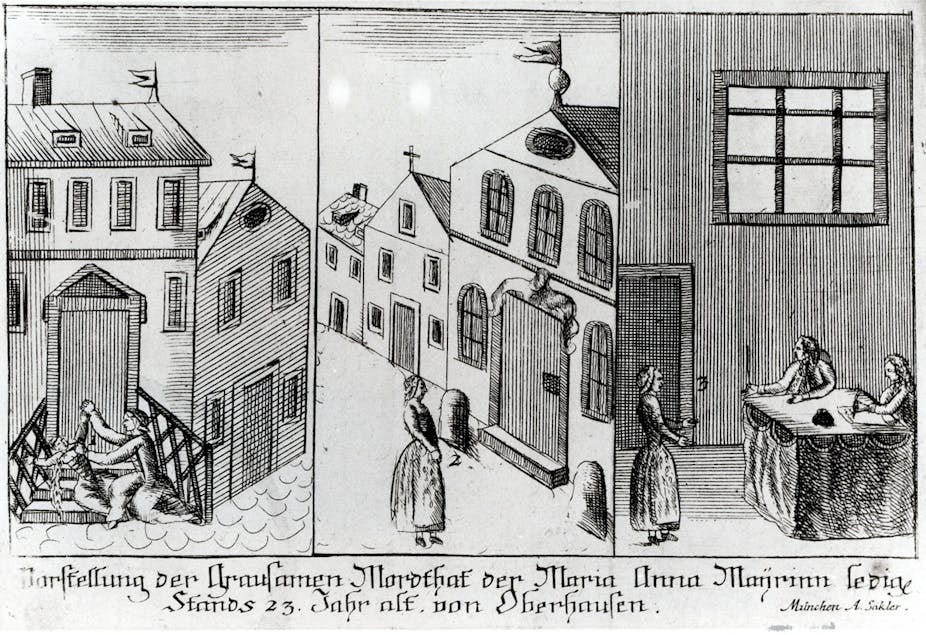
1783: Maria Anna Mayrin murders a three-year-old girl, turns herself in and is sentenced to death. Stadt- und Staatsbibliothek Augsburg, Graphic, Verbrecher etc.

The Holy Roman Empire, 1704: Agnes Catherina Schickin slits the throat of a seven-year-old boy.

1746: Johanna Martauschin smashes the skull of a small child.

1753: Sophia Charlotte Krügerin cuts the throat of a nine-year-old boy.

1761: Eva Lizlfelnerin steals a baby and throws it into a river to drown.

These tales are true, blood-curdling, and perhaps more chillingly still, are the stories of people whose behaviour can be considered rational.

They are four of 300 “suicides by proxy” (the bulk of which occurred in the 1700s), researched and described by Professor Kathy Stuart in her article on the topic, as well as her interview on This American Life, and upcoming book Suicide by Proxy: Crime, Sin and Salvation in Enlightenment Germany.

Kathy’s article is subtitled “The Unintended Consequences of Public Executions in Eighteenth-Century Germany”. I prefer to think of it as an example of the unintended consequences of incentives.

What’s rational?

Let’s get something out of the way. When I say these acts were rational, I don’t mean rational as in “reasonable” or “sensible”, as the term is often used colloquially. I mean rational in the way economists or rational choice theorists use it.
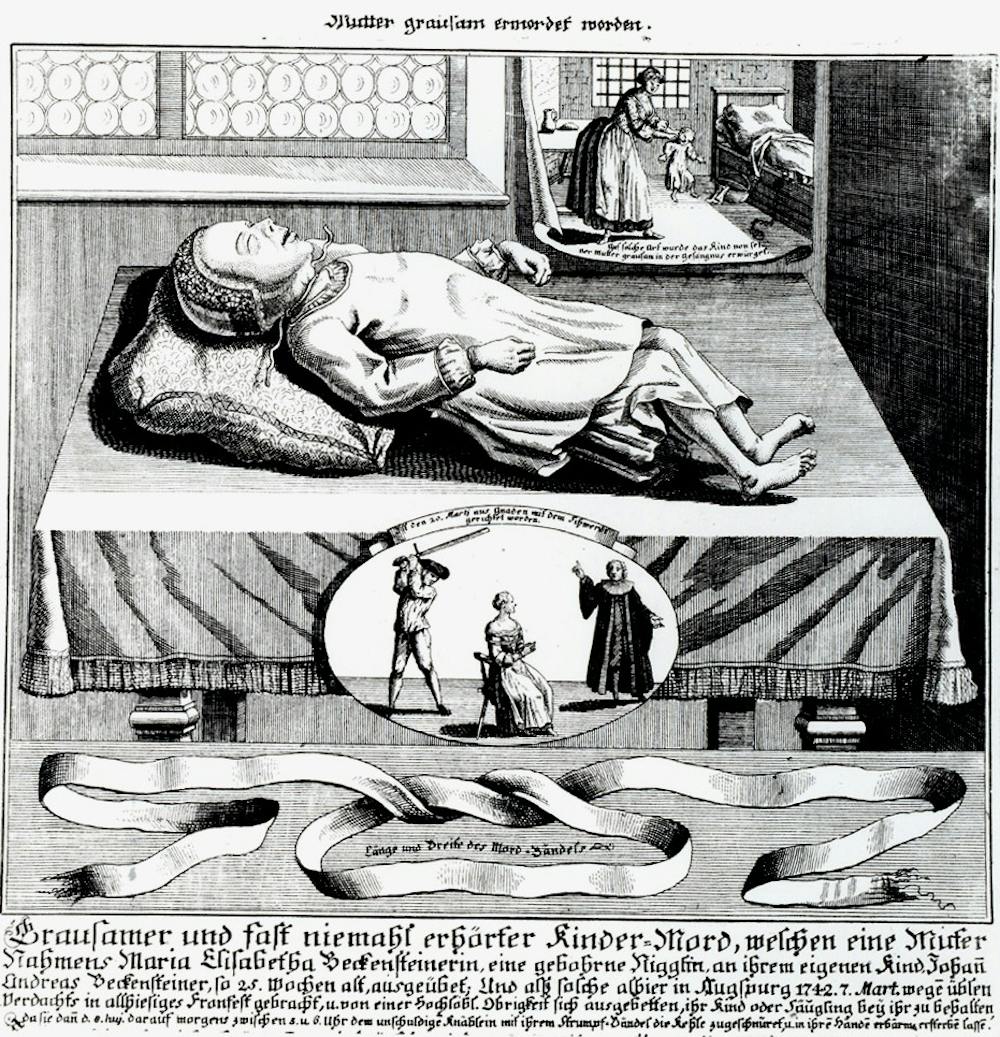
1742: Prison inmate Maria Elisabetha Beckensteinerin strangled her own two-year-old child so that she could be executed Stadt- und Staatsbibliothek Augsburg, Graphic, Verbrecher etc

If you’ve ever taken an economics course, or read an economics text for thrills, or been pinned down at a party after unwittingly asking an economist what they do, you’re probably familiar with the idea of people being “rational” as meaning that they weigh the marginal costs and benefits of each possible action before choosing the one that gives them the largest benefit relative to the cost. Criminologists will recognise the approach in Becker’s work on rational crime, and political scientists will likely be familiar with rational choice theory.

And if you were taking a good course, reading a good book, or chatting with smart economist? Well, then you’ll know that while it’s assumed people will respond to incentives that affect these costs and benefits, the result might be different than you would imagine.

The law of unintended consequences

Suppose you face a rat plague. Getting private citizens to help catch rats might help keep numbers down, but they might be reluctant to help given the risk of disease. So, if you increase the benefits of hunting rats by, say, offering a bounty on rats, the rational response would be for more people to go out and catch rats, right?

When this was tried in Australia, Vietnam and Peru, amongst other countries, some people responded rationally, but not in ways that reduced the rat population; they bred rats. This ensured they had a ready supply to cash in for payment.

Another well known example relates to car accidents in the US. In the late 1960s, legislation was passed to make a range of safety devices (including seatbelts and padded dashboards) mandatory in all cars, in the hope of reducing deaths from car accidents. In 1975, Charles Peltzman proposed that although these measures would make passengers safer in the event of an accident, they technically reduced the costs of driving recklessly, making it more likely that some people would take more risks while driving. His research suggested that while there were fewer deaths per car accident, there were more car accidents, and that these effects had offset each other.

Of additional concern was that the number of pedestrians killed in car accidents went up; as Steven Landsburg puts it in his accessible overview of Peltzman’s research “pedestrians, after all, gain no benefit from padded dashboards”.

Such behaviour is rational and the consequences, while not necessarily predictable, can be explained or understood after the fact in terms of rational responses to incentives.

Religion, rules and rationality

What, then, made the behaviour of Stuart’s child-murderers rational, in an economic sense? Stuart explains that in the Holy Roman Empire, suicide was a mortal sin. Kill yourself, and there would be no confession, no salvation – just eternal damnation. But this rule, with this most substantial of spiritual costs, didn’t have quite the intended effect.

Kill someone else knowing you will be executed for murder, turn yourself in, ask forgiveness before your execution, and you could effectively kill yourself and still get to heaven. And if you kill an innocent child, who hasn’t yet sinned, the child goes to heaven too, before growing up to “learn damnation”, as one 18th century jurist put it.

So, regardless of the intentions, the religious rule didn’t put a stop to suicides among the pious, and wrought terrible consequences for hundreds of children. The seven-year old killed by Agnes Schickin to bring about her own hell-free demise is analogous to the innocent pedestrian in this more twisted and macabre example of unintended consequences.

The problem for policy-makers

These suicides by proxy also demonstrate the difficulty policymakers can face when trying to tweak incentives. Responding to this spate of child murders, Stuart notes that policymakers made the executions more painful, but cases persisted. Even when the death penalty was removed, cases continued for some time before petering out.

Why the slow response to the changed incentives? Was it just that old habits die hard? Was information about the change in the laws slow to travel, or undermined by rumours that execution could still be expected?

I’d wager that what remained clear was the strong religious rule that suicide meant eternal damnation, that murder did not, and that if there was even a chance of execution then people would still be willing to chance it.

I’d also wager that if the church had preached far and wide that they’d no longer grant absolution to murderers, it might have stopped people from killing the children (though not from killing themselves). But then, I’d be making a prediction about how a rational agent will respond to a change in incentives. And this can be a fool’s errand.

Images courtesy of Kathy Stuart.

If you or someone you know needs help contact Lifeline’s 24-hour helpline on 13 11 14, SANE Australia on 1800 18 7263 or the Beyondblue Info Line 1300 22 4636.

Join the conversation

13 Comments sorted by

  1. Evan Chalk

    Weather Observer

    I've heard of the convicts on Sarah Island following the same logic: murder another prisoner, get sent back to Hobart with access to a priest before the trial and then on to the open arms of skyfairy.

    report
    1. Mike Pottenger

      Lecturer, Statistics & Political Economy at University of Melbourne

      In reply to Evan Chalk

      Interesting! And, I guess, not surprising. Just as the same responses and problems to the incentive structures with bounties in rat plagues manifest themselves independently in different countries and times (see the Freakonomics podcast linked to in the piece above, which also looks at the same problem in colonial India with cobras - giving rise to the great name 'the cobra effect' - and also with wild pigs in the US), so it would be reasonable to expect that a structure of incentives like that described above would result in similar kinds of behaviour if put in place in a different context. Thanks for the tip - I'll have to read up on Sarah Island, clearly!

      report
  2. John Bryan

    Retired

    Witty, pithy, interesting, informative - well done.

    report
  3. Michael Leonard Furtado

    Doctor at University of Queensland

    Mildly entertaining and full of airy persiflage! The Catholic Church, and I suspect most non-fundamentalist others, doesn't maintain a horror list of sins that attract absolution or otherwise (as used to be the case) but deals with these matters humanly and pastorally. It follows that suicide statistics being much more complex and regarded as relating to a disorder of the personality or mind or even of tragic and immutable personal circumstances of injustice, the realm in which to properly address…

    Read more
    1. Mike Pottenger

      Lecturer, Statistics & Political Economy at University of Melbourne

      In reply to Michael Leonard Furtado

      Thanks for these comments.

      On the complexity of suicide statistics, my reading of Kathy's work is not that all suicides in the Holy Roman Empire at that time were suicides by proxy as a result of church policy (which I agree would be an overly simplistic way of looking an inherently complex information), but that there nonetheless remained a stark, recurring trend of suicides by proxy. These were referred to as indirect suicide, or 'mittelbarer', and Kathy reviews an array of primary evidence…

      Read more
  4. Lee Naish

    Senior Lecturer at University of Melbourne

    Interesting. The role of incentives, and rational reaction to them, is crucial to Australia's policy on "boat people". However, I've not seen the role of rationality examined in this debate. Its pretty clear that the people smugglers act in a rational way, but I'm not convinced that most boat people act in what would be considered a rational way, given all the facts. Maybe they don't have all the facts, maybe they are desperate and traumatised, and maybe their culture is even less based on rationality than ours. If they do not act rationally, the current policy has "no advantage".

    I'm also concerned that policy debates are often dominated by rationality (assuming everyone acts in their own self-interest) rather than doing the right thing.

    report
    1. Mike Pottenger

      Lecturer, Statistics & Political Economy at University of Melbourne

      In reply to Lee Naish

      I take your point regarding policy debates (though there's actually a pretty big literature on how, why and when rational actors can successfully achieve collective interests - the late Elinor Ostrom was excellent on this).

      I'm not an expert on people smuggling, so I don't have much to add on the topic of refugees and people smugglers, though I'd agree that not having all the facts (imperfect information, as economists would call it) and desperation and trauma would clearly make a big difference…

      Read more
    2. Michael Leonard Furtado

      Doctor at University of Queensland

      In reply to Lee Naish

      Lee illustrates my point much better than I did. Rationality, in my view, has almost nothing to do with morality. Its been argued recently that Gillard's recent departure from her notes to address the elephant in the room exemplifies this (though it might have been intentional). It also has powerful implications for policy as her rise in the polls demonstrates. If we analysed asylum seeker policy in these terms we might well have a very different and, arguably, morally superior and more effective…

      Read more
  5. Mark King

    Senior Lecturer, Psychology and Counselling and Researcher, CARRSQ at Queensland University of Technology

    Just a caution about your example citing Peltzman (a side issue, I know) - while it is true that a perceived increase in safety may be "traded off" by increasing risk in other areas, the important point is that you are dealing with perceived rather than actual risk and safety. This is why replacing winding road with a freeway can lead to higher speeds and more traffic but less crashes - drivers compensate for the perceived increase in safety, but not so much as to completely offset the actual increase in safety. There are also examples where the relationship goes the other way. If we didn't have these differences it would be easy to argue (as some people do) that there is no use in trying to do anything about safety as the benefits would always be traded off.

    report
    1. Mike Pottenger

      Lecturer, Statistics & Political Economy at University of Melbourne

      In reply to Mark King

      "the important point is that you are dealing with perceived rather than actual risk and safety"

      Absolutely - a really good point.

      Also, unless I'm mistaken, there's an article somewhere which suggested that the Peltzman effect dissolved after a few years thanks to changes in public opinion and socialised behaviour surrounding driving that influenced perceptions of acceptable or responsible behaviour, so there's not necessarily a reason to believe that such reactions or effects will be immutable. Though now I say it out loud, I'm wondering if I just imagined that one... *starts rummaging around external hard drives*

      report
  6. Kim Peart

    Researcher & Writer

    I wonder if the lesson of this excellent article might be applied to our problem with climate change.

    For some decades we lived beneath the shadow of the bomb and became a bit numb to the implications of a nuclear winter.

    With a suicide pact between the two great powers ~ Mutually Assured Destruction ~ we all lived in the shadow of this pact and really still do, where the society threatens the death of others, en masse, which may result in our death and even the death of the Earth.

    This…

    Read more