A lose-lose proposition: what’s really happening when women negotiate

The “equal pay for equal work” dream is yet to become a reality. Not only do women earn, on average, 17.6% less than men, there are worrying signs that this wage gap may be starting to increase. What this means is that women accumulate less wealth over their careers and retire with less savings than…

5yvw3786-1333585876
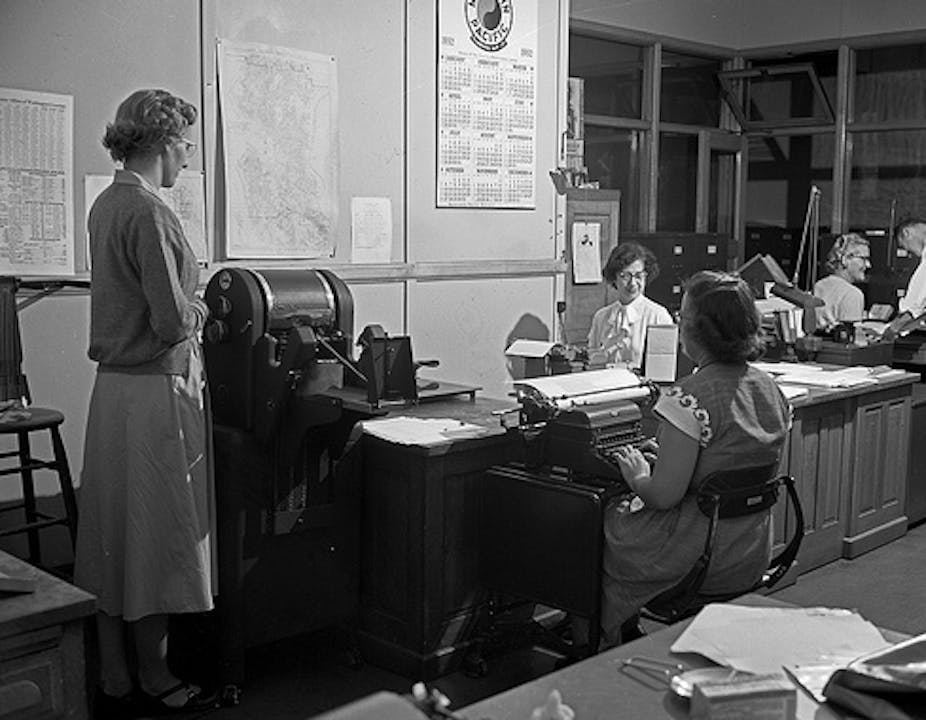
Negotiations by women at work continue to be influenced by traditional gender attitudes. Flickr/Seattle Municipal Archives

The “equal pay for equal work” dream is yet to become a reality. Not only do women earn, on average, 17.6% less than men, there are worrying signs that this wage gap may be starting to increase.

What this means is that women accumulate less wealth over their careers and retire with less savings than men, relative to men in the same profession. Although salary is a clearly measurable career outcome, it is important to remember it is one only of the benefits that shapes women’s career outcomes.

The ability to obtain non-financial benefits such as administrative support, access to resources, access to influential networks, and developmental opportunities also affects women’s ability to be promoted and advance in their careers – yet women also obtain fewer of these resources than men.

Can this gender gap in economic capital be attributed to differences in how men and women negotiate? Certainly, that’s where part of the answer to this gap can be found.

Research consistently shows that women are more reluctant than men to initiate negotiations. And, when they do initiate negotiations, they undervalue their work. Women place less value on their work than men, setting lower targets for themselves before they start a negotiation.

As a result, they start a negotiation asking for less than men. They accept the first offer made to them, showing reluctance to negotiate a better deal. And, seemingly in anticipation of women’s lower aspirations, their negotiation opponents also offer them less than they offer to comparably qualified men. Each of these actions erodes women’s economic capital.

Is getting tough the answer? Recent research suggests that becoming more competitive is not a winning strategy for women. While they may close the economic capital gap, they risk opening a social capital gap, as illustrated by the research of Fiona Greig and Bowles, Babcock and Lai.

When women negotiate, they are perceived as more pushy, less likable and undesirable work colleagues. This loss of social capital has long-term consequences for women’s economic outcomes: a negative reputation is likely to spillover and impede problem-solving in future negotiations.

The accumulation of trust is a particularly important social outcome for organisational relationships. In day-to-day work relationships, trust is integral to building and maintaining the networks that women need to access the resources necessary for job performance and career progression.

In negotiations, trust underpins negotiators’ willingness to engage in information sharing and problem-solving, behaviours that are central to negotiators’ ability to build mutually beneficial outcomes. How, then, can women improve their economic outcomes without eroding trust?

I address this question in my research with Professor Carol Kulik of the University of South Australia. We have found that how women negotiate, and who they negotiate with, is critical to the accumulation of trust over the course of a negotiation.

Men appear relatively immune to whether women implement a competitive or an accommodating strategy. However, other women are highly sensitive to the gender-congruence of a female negotiator’s strategy: trust increases when female negotiators’ conform to gender stereotypes by implementing an accommodating strategy, but decreases when violating gender stereotypes by competing.

We have also found that women can preserve trust if they open negotiations by highlighting their “niceness” – their ability to work with others, and to foster team relationships – rather than their competence. By building a rapport first, they buffer themselves against the stereotype-incongruent action of highlighting their individual achievements and accomplishments.

Women need to think carefully about how they will negotiate for improved economic outcomes. While strategy is unimportant when they negotiate with men, it is critical that they work within gender stereotypes when they negotiate with other women.

However, the responsibility for preserving social capital while growing economic capital should not rest solely on the shoulders of women. Organisations can also take actions that reduce the shock value of women negotiating.

Research by Lisa Barron; Bowles, Babcok and McGinn; Ely and Meyerson; and Rousseau, Ho and Greenberg shows that when organisations provide clear guidelines on what is negotiable and when it is appropriate to negotiate, the gender gap in economic outcomes is removed.

By legitimating the act of negotiating, these strategies also remove the risk of incurring losses in social capital. Organisations that create a more inclusive and collaborative culture that encourages problem-solving rather than hard bargaining can also change the perception of what it takes to be an effective negotiator.

By shifting the perception of what it takes to negotiate effectively, this economic and social backlash against women can be reduced.

You can listen to Mara talk about this topic in detail here.

Articles also by This Author

Sign in to Favourite

Want to follow The Conversation?

Sign up to our free newsletter to get the day's top stories in your inbox each morning, with a special wrap on Saturday.

Spinner
Help evidence based journalism become the norm and donate

Join the conversation

20 Comments sorted by

  1. Dale Bloom

    Analyst

    I can’t access the link to “17.6% less than men,” to see whether that is just another furphy or piece of misinformation regarding gender from a university academic, but the following is intriguing.

    “Men appear relatively immune to whether women implement a competitive or an accommodating strategy. However, other women are highly sensitive to the gender-congruence of a female negotiator’s strategy: trust increases when female negotiators’ conform to gender stereotypes by implementing an accommodating strategy, but decreases when violating gender stereotypes by competing.”

    So it appears the main difficulties women are likely to have, will be with other women.

    That is what I always thought, and the reason why so many surveys have found women prefer a male boss.

    report
    1. Mat Hardy

      Lecturer in Middle East Studies at Deakin University

      In reply to Helen Westerman

      More shoddy editing!

      The 17.6% difference...is that representing overall income for all males and females? ie. it's not comparing a male and the female doing the same job, but rather indicative of the types of jobs that males and females tend to be employed in? (eg. more women in minimum wage retail jobs.)

      report
    2. Grumphy

      logged in via Twitter

      In reply to Dale Bloom

      Some guy (always a guy!) pulls this line in every gender thread, and every time they fail to acknowledge that patriarchy =/= men. And really, there are enough unreconstructed sexist men and non-sexist women in the workplace that you still can't handwave your own gender out of debates like this.

      We've got a long way to go before the wages gap can reasonably be reduced to a simple issue of the proportion of your life spent in employment. And yes, there's plenty of research out there that takes account of the impact of childrearing, and still finds a gender-based wage gap. Instead of disingenuously 'asking questions' about the methodologies used in this field, why don't you look up some papers?

      report
    3. Lorna Jarrett

      PhD candidate, science education; Physics teacher

      In reply to Grumphy

      Because Dale doesn't look up papers. If you ask him to, he starts on about how all sociological research is driven by the Man-Hating-Feminists who have some secret agenda for world domination (whose manifesto, interestingly, is published freely on hate-websites but nowhere else).

      Said Man-Hating Feminists apparently run all Universities and dominate what goes on in them (cue confusion from those of us who've spent a lot of time in universities and have never actually met any). etc. etc. etc. ad nauseum.

      report
    4. Dale Bloom

      Analyst

      In reply to Lorna Jarrett

      Lorna,
      The article did leave out highly relevant data from the OECD report, that would impact upon the amount of money earnt by women in their lifetime.

      I include some of it here.

      “Women are having less children
      Women have postponed having children
      A considerable number of children live in sole-parent households
      Divorce rates are on the rise
      Marriage rates are going down

      “However, men are often still the main earner in couple families as women often work part-time and tend to have lower wages than their husbands. “

      http://www.oecd.org/dataoecd/23/31/44720649.pdf

      I would conclude that there is much more to it than how to negotiate for a pay rise.

      report
    5. Lorna Jarrett

      PhD candidate, science education; Physics teacher

      In reply to Dale Bloom

      “However, men are often still the main earner in couple families as women often work part-time and tend to have lower wages than their husbands. “

      Quantify "often". Let's see %, +/- , then that statement will start to mean something.

      Anyway the point of the article was about gender differences when people negotiate for pay rises, or other benefits - which is demonstrably real.

      report
    6. Dale Bloom

      Analyst

      In reply to Lorna Jarrett

      Lorna
      And "Men appear relatively immune to whether women implement a competitive or an accommodating strategy."

      Which means men are quite unbiased, but in terms of "women accumulate less wealth over their careers and retire with less savings than men, relative to men in the same profession", then there are many factors that are involed in that.

      report
    7. Hugo Freeman

      Student

      In reply to Lorna Jarrett

      To clear up that confusion you had about never meeting a Man-Hating Feminist, I'll have you know that I have met a few and contrary to their name they didn't hate me! And I'm straight!!! What times we live in.

      Perhaps Dale should look at the flip side and consider how males react to other males in conjunction with this quote. I'm no academic but from personal observation men do compete with each other and when the other is accomodating (sometimes referred to a 'rolling over' in guy talk) men are quick to take advantage. The fact that males are immune to women's negotiations does not make them unbiased toward them. That point could just be suggesting that they don't feel threatened by them.

      report
    8. Lorna Jarrett

      PhD candidate, science education; Physics teacher

      In reply to Hugo Freeman

      While the Man-Hating Feminist remains elusive, I've met lots of feminists who're men. And most of them are straight!!! What times indeed.

      Do men not feel threatened by "competitive" women in the way that they would if the behaviour came from a man; do they not perceive the behaviour as competitive at all; or do they actually enjoy it - perhaps they find it flattering?

      Maybe there are sufficiently few women carrying out negotiation in these mens' working lives that they don't get to experience the different kinds of approach. So we'd need to know what sectors the research was carried out in, and what the proportions of males and females were.

      Looks like a PhD thesis to me. Only not mine :)

      report
    9. In reply to Dale Bloom

      Comment removed by moderator.

    10. Tim Hawes

      Mr.

      In reply to Grumphy

      The part he quoted does tend to suggest that women are more likely to affect other women's social capital based on negotiation style, no? As in, women seem to expect that other women follow the archetype or gender role, or at least that a failure of this for women has greater consequence than with men.

      I wouldn't draw the bow so far as the 'prefer a male boss' thing, I think the article points out that economic capital is typically lost for women through negotiation with men.

      But it is interesting that in at least one aspect social capital is correlated more with opinion of other women than men. Wouldn't this suggest the importance that women have in the workplace as power brokers of social capital?

      report
  2. Terry Mills

    lawyer retired

    During my working career I was always committed to the principle of equivalent reward for equivalent effort and equivalent achievement. I have seen many situations where people in ostensibly the same job - both male and female - have received significantly different rewards mainly because the ultimate criterion for determining that reward is performance in the form of bottom line results and these are not necessarily consistent between employees. Obviously I'm talking about the private sector where performance is inevitably linked to value in terms of profit delivered.
    I have never, in over forty something years, in the financial services sector seen gender adopted - consciously or otherwise - as a determinant for income reward.
    I understand that there is no such gender based discrimination in areas of government employment so I am wondering if the author can more specifically identify the rogue industries (and employers) so that the discussion can be more closely targeted.

    report
  3. Lorna Jarrett

    PhD candidate, science education; Physics teacher

    '“niceness” – their ability to work with others, and to foster team relationships – rather than their competence'.

    Sorry but I always thought ability to work with others and foster team relationships, WAS part of of being competent.

    report
  4. Tim Paton

    Automotive Engineer

    I would love to see some research on the salary gap, decoupled from time spent out of the full-time workforce.

    Somebody who takes a 5 year break from their career should, logically, re-enter the workforce at a less senior position than a colleague who worked right through the same period. This is true whether that "break" is as radical as taking a complete break from paid work, moving to a part-time position, or whether it is as subtle as accepting more flexible and accommodating roles and not…

    Read more
  5. Martijn Boersma

    Research Associate, University of Technology Sydney

    In my opinion, both women and men would benefit from organisations providing clear guidelines on what is negotiable with regard to employment.

    Indicating clear negotiating boundaries would not only mean that less experienced female and male negotiators would have a better change at getting a good deal, but it would also become less likely that some individuals receive disproportionate amounts of compensation.

    A measure like this would level the playing field, without undermining healthy competition based on skills.

    report
  6. David Boots

    logged in via email @hotmail.com

    'While strategy is unimportant when they negotiate with men, it is critical that they work within gender stereotypes when they negotiate with other women.'

    So it is women causing other women to lose their 'social capital'?

    'Recent research suggests that becoming more competitive is not a winning strategy for women.' But only when against other women.

    How is this is the fault of men?

    report