
A rocket scientist’s view of the stockmarket

The last Space Shuttle recently returned to Earth. That reminded me that 45 years ago I was undertaking a PhD in physics at Australian National University, investigating the re-entry of the space shuttle. A fellow college student was doing his doctoral research in economics and was convinced that the…

Dvyzvzzw-1346041345
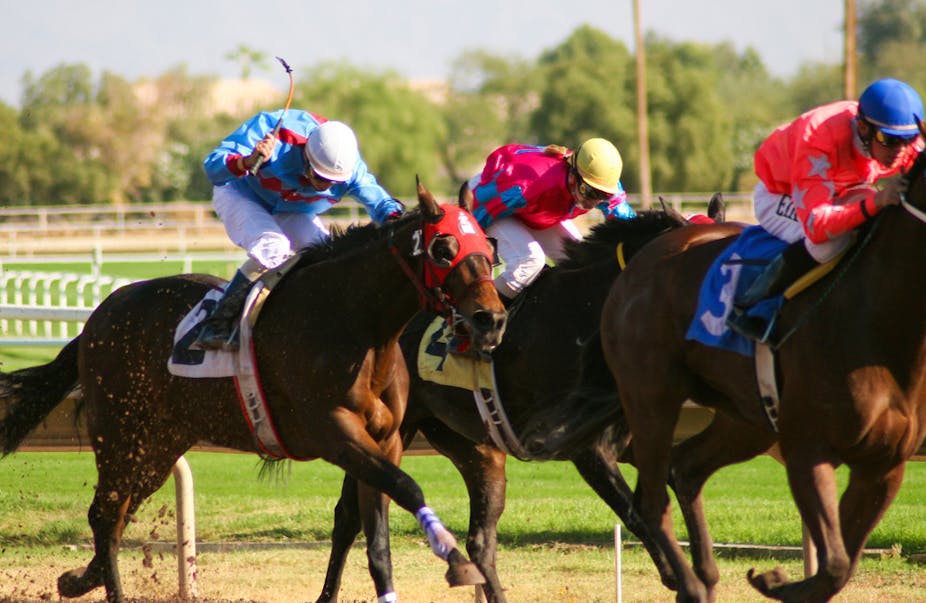
College day betting lead to a fascination with the stockmarket for this physicist. Dan Raustadt Flikr

The last Space Shuttle recently returned to Earth. That reminded me that 45 years ago I was undertaking a PhD in physics at Australian National University, investigating the re-entry of the space shuttle. A fellow college student was doing his doctoral research in economics and was convinced that the easiest way to make money was gambling on horses. This provided us with a diversion from our doctoral research. We collected lots of data on horse racing. We found that it seemed possible to make money because other punters wanted a quick return on their investment. People would rather have twenty returns of $1 than one return of $20. So by betting on a certain class of horses quoted at long odds, it was possible to make a modest profit. We obtained our PhDs and moved on.

Recently I discovered that another researcher had apparently discovered the same phenomena and related phenomena that we had, gave it a name (Prospect Theory), won the Nobel Prize for Economics in 2002 and also became the author of an excellent bestselling book: Thinking, Fast and Slow.

As we considered that gambling on horses was not a noble (or Nobel) profession, we moved on to the stockmarket with our modest capital and our ways parted. This paper reflects on my findings about the stockmarket from an academic perspective and notes the role “rocket science” played in those observations. My interest and the perspective of this paper are in long-term investment, not day trading.

Forecasting

As one wise physicist said “prediction is very difficult, especially about the future”. I reasoned that the best judge of the future was the past. Hence, at the start, I looked for companies whose value had increased by 20% over both the last year and by twenty per cent per year over the last three years. This data was readily available in most investment magazines. This proved reasonably successful and required little effort except trawling through the data of the more than 2000 stocks listed on the Australian share market to find stock that met the criterion. Recently, spreadsheets have greatly assisted that task.

There is a related method that uses the past to predict the future which is called a “chartist” approach. With this approach one simply draws the graph of stock prices against time and extends it into the future (extrapolation). Of course the price will jump and to obtain a smoother curve, people take a moving average over an appropriate period. Suggested periods are 5 days (a week) and 21 days (a month).

I developed an approach, similar to graphing, with relatively new companies. It was suggested that in times of early growth, the growth of the company follows a graph like that shown in figure 1. The company grows slowly at first and then takes off and grows very quickly until finally reaching a saturation point. I came across this type of graph during my doctoral research. In the sixties, we used photographic emulsions to record the data. The graph that specifies the emulsion is called a Characteristic curve and is a graph of the density of the photographic emulsion against the light intensity falling on the emulsion (expressed as a logarithm). This graph had the same shape as the one displayed in Figure 1.

Figure 1. A graph of price against time for new companies.

Peter Logan

From my doctoral research I had the equation for this curve and so it was quite easy to match a stock growth curve and come up with the equation. This was done using a statistical package and 2 or 3 years of data. The statistical package also tells us if the equation is a good fit to the data and, if so, one can predict future behaviour and the apparent “saturation” value.

Fundamentalist approach

The other approach is called the fundamentalist approach. If the current fundamentals of the company are poor, the past performance is immaterial. Analysts using this approach have a number of favourite parameters to calculate and criteria that must be met. These include: return on equity, return on capital, earning yield, price to earning ratio, price to net tangible assets, earnings per share growth and earning stability. These definitions can be found on Wikipedia.

Analysts believe that, from past experience, it had been seen that the increase in share price had been related to a particular one of these parameters or a combination of parameters. Using the selected criteria, one can obtain a list of appropriate companies, but then one has to determine how to rate the companies on the list. It is straightforward if only one parameter is involved, but what happens if there is more than one relevant parameter? A statistical analysis can provide the most important parameters and their weightings.

A recent analysis I carried out on Australian shares showed that the important parameters were the ‘return on equity’, the ‘earning yield’ and to a lesser extent the ‘price per net tangible assets’.

A mixture of approaches

There is, of course, no reason to only use fundamental parameters in the statistical analysis in the previous section; one can use past performance as well. This results in an equation that combines both approaches and the statistics gives the relative weightings. When this analysis was done, the important three parameters for Australian shares were found to be the ‘return on equity’, the ‘earning yield’ and the ‘return over the last twelve months’.

Behaviour of the markets

The normal (or Gaussian) distribution was developed for measurements in physics, but can be applied to other situations. However one situation where it cannot be applied is the behaviour of the stockmarket The distribution of the daily variation of the stock index has a tail that is longer than that of the Normal distribution. For example the chance of a price movement of three standard deviations on a normal distribution is about one in 370 whereas it has occurred fourteen times in a recent 750 days period in the ASX. Unfortunately, Black and Scholes used the normal distribution in their famous equation and Scholes won the Nobel Prize in 1997. Scholes’ investment company “Long-Term Capital Management”, which used their equation, collapsed in 1998.

The phrase “black swan” was coined by scholar Nassim Taleb after hedge Long Term Capital Management collapsed after an unexpected Russian government debt default. Image from www.shutterstock.com

Zipf’s Law

Due to a chance meeting with an anthropologist in Papua New Guinea, I used my mathematical model for the behaviour of a shock front to explain the behaviour of different village populations in the rural areas of developing countries (Physics for Anthropologists). As a result, I came across Zipf’s Law, which says that one expects the second largest entity to be half the size of the first, and the third largest is one third the size of the first and so on. So the nth largest entity is an nth the size of the largest one.

A recent analysis of the top 200 Australian companies found that the Market Capitalisation (MC) can be expressed as a damped power law distribution, called the Zipf-Mandelbrot Law.

How big a portfolio?

It is universally agreed that you should invest in more than one company. A Bloomberg report noted a recent Finnish study that found a direct link between IQ and equity market participation. Tobin won his Nobel Prize in 1981 for his “don’t put your eggs in one basket” portfolio theory. Glossy business magazines tend to suggest ten to twelve companies, whereas Mandelbrot in his “The Mis-behaviour of Markets: A Fractal View of Financial Turbulence” commented that conventional wisdom holds that, if picked correctly, thirty different stock can provide an optimal portfolio, whereas he found you need three or four times that number for optimal performance.

Sign in to Favourite

Want to follow The Conversation?

Sign up to our free newsletter to get the day's top stories in your inbox each morning, with a special wrap on Saturday.

Spinner
Donate and become a friend of The Conversation

Join the conversation

21 Comments sorted by

  1. Kim Peart

    Researcher & Writer

    The dream of the horse and the stock is, sadly, disconnected from the needs of Nature.

    I wonder if it would be possible to apply some science to the prospects for human survival in a cosmic setting, which allows a return to a sustainable human presence on Earth.

    If Stern's observations on the matter is accepted ('A Blueprint for a Safer Planet' ~ 2009), we will need to include equity in the deliberations, as he asserts that the environmental (sustainability) or climate change problem will not…

    Read more
    1. Spiro Vlachos

      AL

      In reply to Kim Peart

      Kim the article is about the stockmarket.

      report
    2. Kim Peart

      Researcher & Writer

      In reply to Kim Peart

      Spiro Vlachos ~

      Is there no way to connect the stockmarket with reality?

      The Earth has growth limits, but financial gymnastics enabled by the use of carbon energy are delivering an increasingly unsustainable human presence on Earth, along with extreme wealth and extreme poverty.

      Can we not speak to this reality?

      I see the potential for growth beyond Earth, infinite growth across the Solar System and among the stars on a foundation of stellar energy.

      It would be helpful if stockmarket thinking connected with this reality.

      We are like the Easter Islanders with their rock-exchange, building bigger statues year by year, but forgetting the ecological foundation that enabled their rock-exchange.

      One day, their unsustainable bubble simply burst.

      Is it time to get real yet?

      Kim Peart

      report
    3. Spiro Vlachos

      AL

      In reply to Kim Peart

      Kim, me thinks you require assistance form a non-economist type professional.

      report
    4. Kim Peart

      Researcher & Writer

      In reply to Kim Peart

      The economist Nicholas Stern in his 2009 book ~ 'A Blueprint for a Safer Planet' ~ suggests that "We are gambling with the planet." (p.3), describing the carbon crisis as "the biggest market failure that the world has ever seen." (p.7).

      If every "economist type professional" could begin by taking responsibility for connecting the human economy with the Earth's ecology, then it will swiftly become abundantly clear, that if growth is wanted, our game needs to be lifted beyond Earth, where growth is unlimited, along with stellar energy.

      Liberated of connection with reality, the economic type people drive the game of draining the planet of life and resources, totally disconnected from principles of sustainability, as we head toward needing the wherewithal of 3 Earths to keep our game going.

      We have quite a bubble blown ever larger day by day by the carbon energy economy, that must one day, burst.

      Kim Peart

      report
  2. Colin MacGillivray

    Retired architect

    Tobin won his Nobel Prize in 1981 for his “don’t put your eggs in one basket” portfolio theory.
    How about putting your eggs in every basket- index funds- very fees and no maths or predictions (or rocket science.)
    And only 25% of your portfolio in that basket.

    report
  3. Byron Smith

    PhD candidate in Christian Ethics at University of Edinburgh

    Coming up next, a linguist's view of astrophysics, a musician's view of political economy and a nuclear scientist's view of Egypt during the Third Dynasty.

    report
  4. Comment removed by moderator.

  5. R. Ambrose Raven

    none

    Surreal. Could someone let Peter know that for thirty years the stock-market (and many of the listed companies) were enjoying a debt-driven asset-price bubble?

    Australia's stock-market has fallen 9.6% a year for the past five years; it will take another five years rising at 12% annually to get back to 2007.

    Peter is doing exactly as Marcus Padley wrote: "The sharemarket is fantastic at raising up its winners and forgetting its losers. That's why people write and buy books like 'How I Made $2 million in the Stock Market', not 'How I Blew my Kids' Education Trading CFDs'. You are only going to hear one side of the success story in finance."

    Peter is essentially saying that success is certain if you follow the model. Did you design the ratings agencies' RDO models, Peter?

    report
  6. Jason Kemp

    logged in via Twitter

    An entertaining read but unfortunately the fast thinking approach has dominated the analysis here and the slow thinking is better done by many others.

    When it comes to predictions there are 2 key factors against us ( simple version)

    1. Our brains want to see patterns often where they dont exist. Read Daniel Kahneman on this one http://www.dialogcrm.com/blog/2012/06/05/daniel-kahneman-on-thinking-fast-slow/

    2. Correlation of factors is not the same as causation.

    For a much better analysis…

    Read more
  7. Trevor S

    Jack of all Trades

    “There are three kinds of people who make predictions on the market –
    Those who don’t know;
    those who don’t know they don’t know;
    those who know darn well they don’t know and get big bucks for pretending they know”

    Burton Malkiel

    report
  8. Comment removed by moderator.

  9. Lennert Veerman

    Senior Research Fellow, School of Population Health at University of Queensland

    Interesting, but I miss mention of the crucial difference between the stockmarket and, say, the trajectory of a spacecraft approaching Earth. While the spacecraft only has to deal with the laws of physics, which are stable and predictable, the trajectory of stocks is determined by what traders think the stocks will do in the future. The latter is much less stable and predictable.

    The kind of analyses described here are done by professionals on a continuous basis; it's them you have to beat. And if they are wise, they base their expectations on more than extrapolations of the past, as is advocated here. I'd hope that actual knowledge of markets and companies contributes substantially to predictive power. Purely statistical approaches (such as those described here) will always be chasing the facts, it would seem.

    report
    1. Lennert Veerman

      Senior Research Fellow, School of Population Health at University of Queensland

      In reply to Lennert Veerman

      To add: stockmarkets are unpredictable because the traders influence each other with their buying and selling, and because they use much the same information with the same inaccuracies.

      report
  10. Spiro Vlachos

    AL

    Very good article. It seems that the assumption of normality in models such as the fundamental approach and Black-Scholes seem to be best practice in the absence of more tractable versions of the other models you have stated. The LTCM model failed in the presence of a "tail event" in 1998. In the presence of such tail events, a precise outcome would require us to relax the normality assumption, which brings problems of tractability. These models would not and need not deliver precise outcomes, and forecasts using such models would be what is considered as "one-sided", or satisfying some minimum return threshold. The fundamental approach is the easiest to use as it encompasses the behaviour of the market, including traders reactions, and singles out the most important parameters, as you have stated.

    report
  11. Ngoc Luan Ho Trieu

    logged in via Facebook

    Share prices in the stock market denies all economic theories of producer and consumer pricing behavior. Approaching the stock market with those theories only gets frustration in returns. It's time for economists and financial analysts to develop a body of theories on stock market prices. These theories should be free from dependency on assumptions underlying consumers and producers theories. Share prices move according to market laws which should be scientifically explained like many laws in physics. For the moment the chartists', the fundamentalists' and statistical analysts' approaches to share prices achieve some successes for some stocks, but not universally and sometimes by fluke. Furthermore, one should be aware of stocks in the market launched by crooked CEOs who take advantage of dinkum but naive investors in a market system loosely regulated by authorities.

    report
  12. Pat McConnell

    Honorary Fellow, Macquarie University Applied Finance Centre at Macquarie University

    Don't wish to a pedant or party pooper but Tobin did not receive his Nobel Prize for filling baskets with eggs but for theories of future capital investment. That idea came from Nobel Laureate Harry Markowitz whose work on Portfolio Theory Tobin expanded. Tobin was a great economist whose ideas on the Tobin Tax on financial markets might, if implemented, have saved us all a lot of money.

    It is interesting to note that Harry Markowitz quite early on realized that his Portfolio Theory was incomplete…

    Read more
  13. Daryl Deal

    retired

    When you can buy and sell shares you do not own, and in some cases do not exist in the real world, using "put and call" option! It's a complete mugs game of a tiny minnow swimming among the assorted tank full of sharks and predatory piranha living on the fringe.

    Occasionally , you have the biggest "Great White" sharks of the "Stock Market" make a massive cleanup on the insider trading margins of selling high what you don't have or own and then buying the same items, when the share price tumbles.

    Such is life.

    report
  14. David Bentley

    logged in via LinkedIn

    This is all well and good, but really, having been in and around "the market" now for a few years (more than some, less than others), in my opinion there are only two good rules to follow:

    1) The first one is as stated above: do not put all your eggs in one basket....and that is as true of putting a stock portfolio together as it is for diversifying your broader portfolio of personal assets - houses, shares, cash, superannuation etc. Even the best stocks get smashed when the market drops 50…

    Read more
  15. Theo Pertsinidis

    Theo Pertsinidis is a Friend of The Conversation.

    ALP voter

    Things that are true meet a great many different tests very well.

    The digital age has brought opportunity to trade for more people. The risk profile of people therefore may be more spread.

    Example, look at the quality of written material on the internet. The internet has made available a platform for anybody to publish.

    Read My Thoughts at https://sites.google.com/site/theopert

    Everybody has a risk profile and that changes as success or failure plays on the emotions. Professional traders…

    Read more
  16. Sean Walker

    Business owner

    Predictions can be based on charting, fundamentals and a combination of both, but the key driver of a market is Sentiment - stock markets are driven by fear and greed.

    report