In recent years, urban branding has become highly popular. Shifts in global, national, and local economic bases have forced cities and nations to market themselves internationally as cultural hotspots.
As cities with distinct cultures and recognisable architectural features are often more popular than those without them, some that lacked those unique features have gone as far as to reconstruct their architecture in an attempt to “reinvent” themselves. Recent examples include Bilbao, Singapore, Taipei, Kuala Lumpur, Shanghai, Beijing, Dubai, Abu Dhabi and Qatar.
In an attempt to show themselves as progressive, nations often look forward in stylistic terms when they try to establish their cities on the world stage. But one small European nation has curiously reversed this trend in an attempt to revive its “lost” history, prompting CNN to describe its capital as a “theme park”.
Skopje 2014, Macedonia
On February 1 2010, in an ambitious and uncanny revivalist attempt, the Macedonian government commissioned the reconstruction of the entire central district of its capital city in a quasi-baroque style.
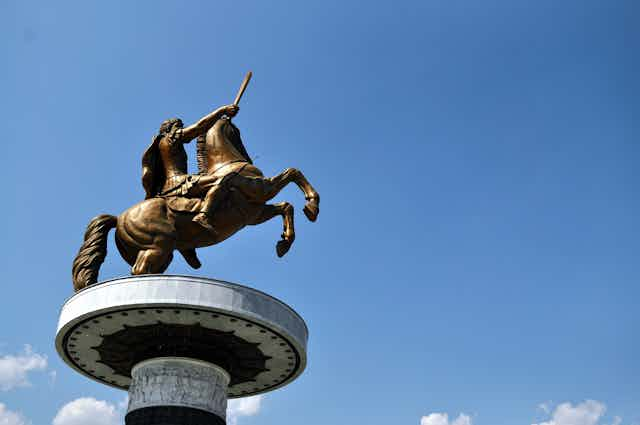
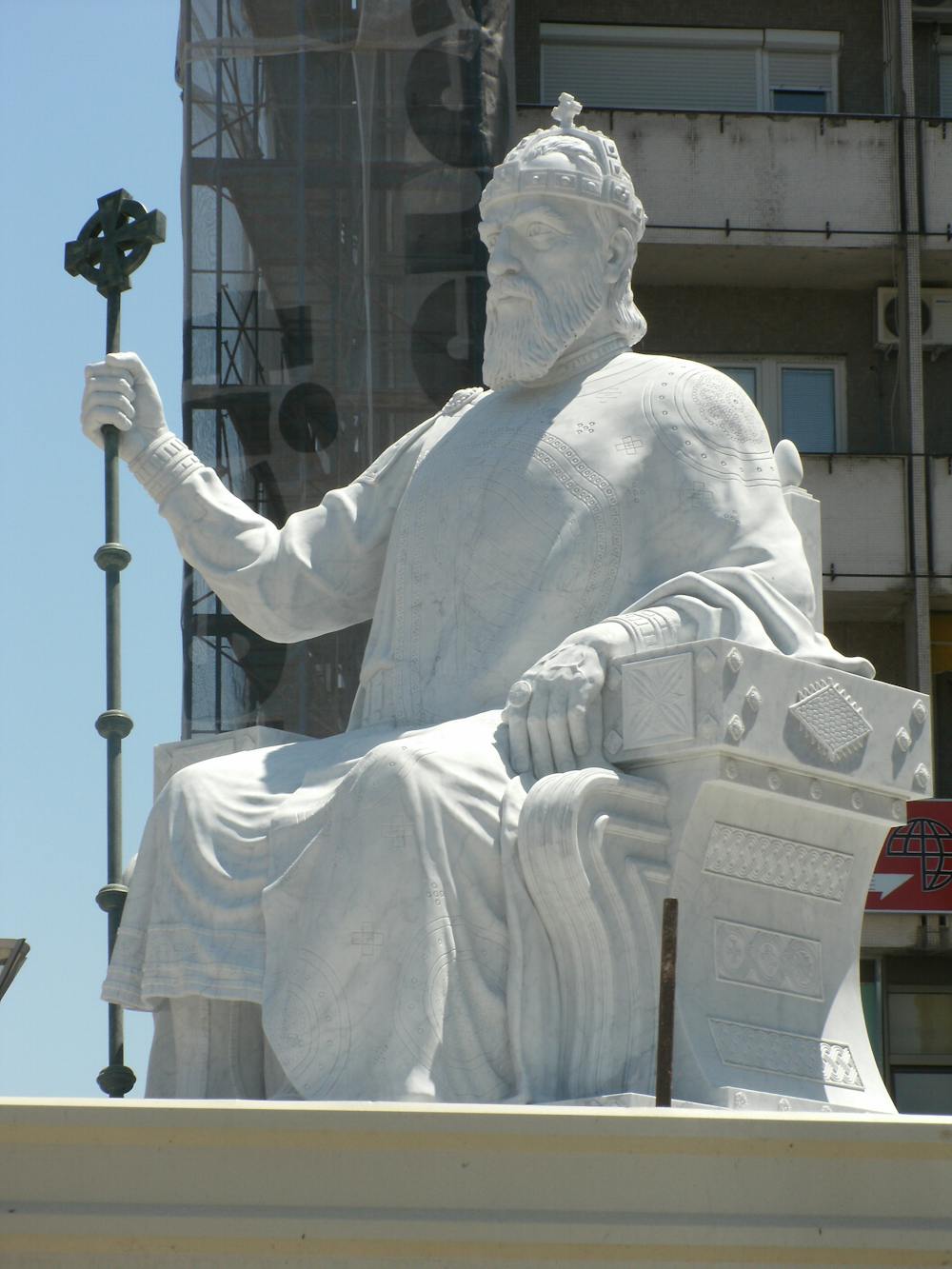
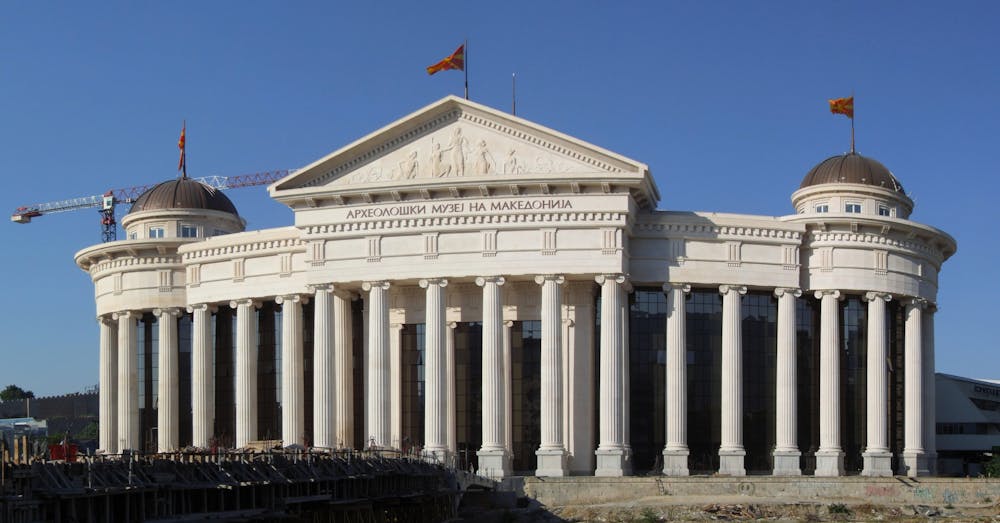
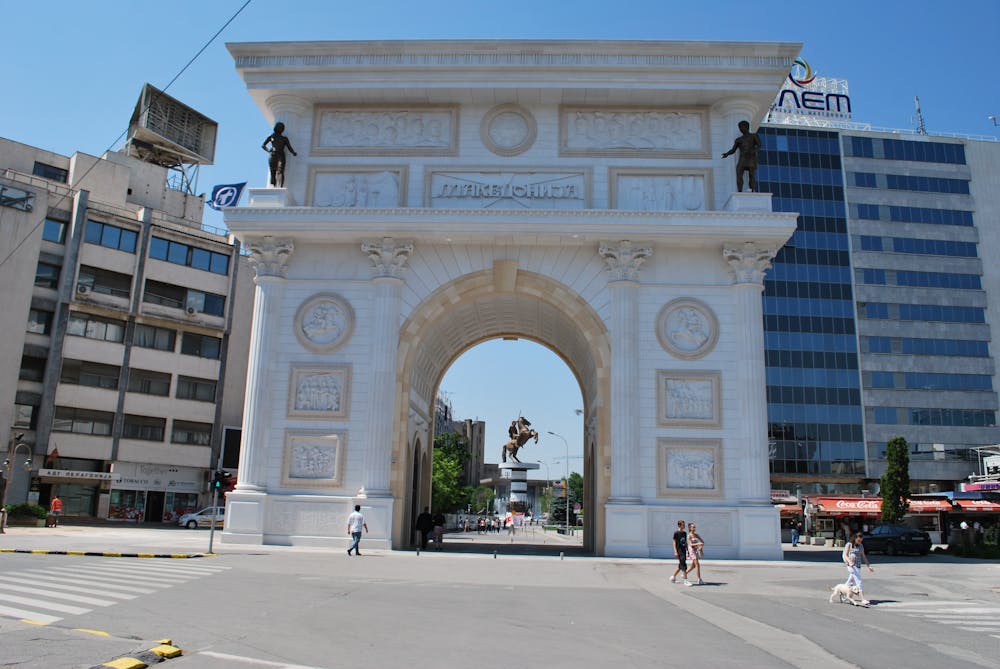
The project, which was called “Skopje 2014” includes the commission of countless sculptures of art and monuments of historical figures, a wax museum, range of new government buildings built in a neoclassical style, Crystal Palace-like update on the parliament, new bridges, an Arch of Triumph, fountains, and a gigantic statue of Alexander the Great, to name a few.
Even the surrounding buildings built in the 1970s have been given a “facelift” by incorporating baroque elements on their facades. In order to complete the “look”, the government ordered a new fleet of vintage-looking double-decker buses to replace the regular bus fleet. This is a type of development that one might expect to see in Las Vegas, but not in Europe.
Skopje 1963, Yugoslavia
What makes this even more curious is the fact that Skopje has been under a major reconstruction once before. Except then Skopje was setting the world trends, rather then reversing them. When a massive earthquake in 1963 destroyed the city, a decision was made that Skopje should be rebuilt as a utopian, futuristic metropolis.
In an international competition, the Japanese architect Kenzo Tange, famous for his award-winning urban plan for Tokyo, was selected to apply the same design principles to Skopje.
Among a number of new iconic buildings, the small city also featured a landmark deconstructionist opera house that could rival the Sydney opera house in appearance, and a modern Museum of Contemporary Art where Picasso himself donated one of his works. In the period between 1970s to 1990s (until Macedonia’s independence from Yugoslavia), Skopje had all the hallmarks of a truly unique, cosmopolitan city. But not any more.
Why the change? The reasons behind Skopje 2014 are mostly political. Macedonia has two major external problems. On one hand, it is an aspiring EU candidate member country that never seems to come on the EU agenda for enlargement. On the other, the country still struggles to defend its right to a sovereign national identity.
Fortress Europe
As the EU becomes stronger and its internal borders become lower, its external borders become higher.
Countries that want to join the EU, but do not share a “European” identity, culture, and common core values, are faced with what some analysts call “fortress Europe”. These countries are not likely to become EU members until they thoroughly change. The EU already has problems imposing its own “umbrella” identity over the range of nations it represents, each with its own distinctive cultural identity. Dealing with new identities only further complicates things for them, and this is something that they are not willing to entertain.
From this perspective it seems that Macedonia has no other alternative than to create an image that presents a “genuine” but forgotten European state, and not as just another “barbaric” state lurking outside the EU’s borders. At the same time, in the face of the pressure from the neighbouring states (Greece in particular), it appears that Macedonia is also trying to inscribe its identity in stone, concrete and steel, in order to preserve it.
Implications
From a political point of view, Skopje 2014 makes sense because its purpose is to strengthen the national identity and to help the country build its pan-European image.
But this point of view doesn’t take into consideration other cultural or economic factors. As the originality and authenticity of the place is becoming progressively more “packaged”, the result becomes an imitation that exceeds the original to the point that the original no longer matters. A parallel to this can be made with the “imaginary world” of Disneyland — a place that tries to bring imagination and fiction together as reality. Amusing, yes; but hardly genuine.
Also, spending a fortune on buildings and monuments with no “Return On Investment” factor, during a global economic crisis, makes no real sense — regardless of how noble the idea is.
Therefore, most critics rightly argue that the funds spent on this project could have been better invested in infrastructure, technology, production facilities, hospitals, schools and libraries. Building monuments and landmark buildings can be instrumental in developing national identities, as well as in attracting visitors or investors.
The problem is that with Skopje 2014, Macedonia risks the faith of Easter Island if it spends all its resources on building massive monuments that can eventually bring them to ruins.
Mat Hardy
Lecturer in Middle East Studies at Deakin University
I suspect that a lot of this quest for identity has more of an intended audience within the Balkans than in Brussels. The discovery and promotion of medieval heroes and victories has been a common path since the break-up of Yugoslavia, as the new mini-states seek to prove their historical, and thus contemporary, legitimacy to themselves and their erstwhile occupiers.
Gjoko Muratovski
Head of Department: Graphic Design
This is quite a typical feature for nearly all post-colonial or post-communist countries and can be witnessed throughout the world. The Macedonian case is quite complex in terms that it is intended to work on three levels: internally (for domestic audiences), regionally (within the Balkan region), and internationally (Europe and beyond).
At the moment there are government sponsored ads that run on CNN that use the the 'new' architecture to promote Macedonia as a quintessential European business and tourism destination.
Riste Ajtov
Start-up Evangelist
The Disneyland analogy is absolutely spot on. Despite the fact that certain aspects of the Macedonian identity have been selectively neglected in the past, the point where the original inspiration for the project has been exaggerated to the boundaries of imagination, has long since come and gone.
It is quite natural for a nation, which feels threatened or discriminated, to revert to an even more nationalistic posture and for this, I personally blame Brussels and the indecisiveness and division of the European experiment. However, it is absolute lunacy for local or national governments to specify instead of choose, exterior designs of buildings. Architecture should be left to the archtects.
& since the author had a direct influence in this rebranding of my country I expect a follow up post explaining the reasons for the current outcome.
Gjoko Muratovski
Head of Department: Graphic Design
Actually, the report that I prepared included what things need to be considered when rebranding a nation. Development of the infrastructure in the capital city and the introduction of landmark buildings and monuments is one them. The current outcome, however, was never recommended in the report. If anything, I believe that Skopje should have expanded the Kenzo project and use that as a model for urban development.
Comment removed by moderator.
Spiro Vlachos
AL
As a decendent of individuals from Macedonia, Greece, I find it flattering that a national identity could be borne out of the desire to reflect the culture derived from Alexander the Great, King of Greece in antiquity. Given that citizens of Skopje are linguistically near identical to the Bulgarians, and Skopje was once a province of Bulgaria (see statue of Tsar Samuil, of the First Bulgarian empire 10th century AD), this is the identity that should be inscribed in stone, cement or whatever. The…
Read moreGjoko Muratovski
Head of Department: Graphic Design
The whole region has an extremely intertwined history that spans for thousands of years. This makes it impossible for any nation to claim an exclusive right to any part of that history. Greece and Macedonia are not unique in this. The region is so small, that the divides that the nations are creating between themselves are artificial. And because of this, all of the countries in the region have disagreements with each other in one form or another. Ideally, these issues should be resolved by an international…
Read moreSpiro Vlachos
AL
Gjoko, you make very good sense in your first paragraph below.
But, since the languages of Bulgaria and Skopje are same enough to understand each other, and the two countries share the same history (statue of Tsar Samuil), comparing the two countries to Greece and Turkey is an incorrect analogy. Ljubco Georgevski, the founder of the current ruling party in Skopje had even applied for and was granted Bulgarian citizenship in 2006. Even historical events such as the Battle of Kleidon in 1014 are…
Read moreGjoko Muratovski
Head of Department: Graphic Design
Spiro, the thing about Ljubco Georgievski is correct, but you also need to know that because of that there is a great deal of animosity towards him in Macedonia. He is a political outcast with less than 1% approval rating, which is an indication that the vast majority doesn't share the same ideas as him.
In regards to the language. I am also proficient in Macedonia, Bulgarian, Serbian and Croatian and while these languages are similar, they are also distinctively different - just as Spanish…
Read moreSpiro Vlachos
AL
Thanks for the response. I hope to see the place when it is finished. I understand that the country has low debt, but so did Greece at one stage.
Hank Z
logged in via email @hotmail.com
What a joke, 'FYROM' have no connection with Alexander The Great or the Ancient Greek Kingdom of Macedonia. 'FYROM' are Bulgarian/Slavs and speak Bulgarian, they arrived in Europe 1000 years after Alexander the Great, they have NO rights to be called Macedonians, since the Ancient Macedonians spoke Greek and claimed to be Greek.. Macedonia is a province in Northern Greece a big part of Greece's histroy and culture, the real birth place of Alexander The Great.. 'FYROM' in the 1940s renamed their tiny country from 'Vardarska Banovina' to what it is today..
Gjoko Muratovski
Head of Department: Graphic Design
As I mentioned in one of my earlier posts, this is not really an issue that can be discussed off hand and is better to be left to historians, archeologists and ethnographers. Since I am neither, I can only provide expert opinion on the issues that are directly within my domain of expertise. I am trying to keep this discussion neutral and I am not really interested in going into such things as who is wrong and who is right.
My personal opinion is that every nation and every person should have a right to define its own identity and believe in whatever they want to believe. Including you.
Hank Z
logged in via email @hotmail.com
Historian and Oxford academic, Robin Lane Fox, described Macedonia as a Greek Kingdom and not a Slavic/Bulgarian country like 'FYROM'.
http://www.youtube.com/watch?v=kBoO5qHmYuw
Gjoko Muratovski
Head of Department: Graphic Design
Hank, I think that you are missing the point of the article and you are stirring the discussion in the wrong direction.