


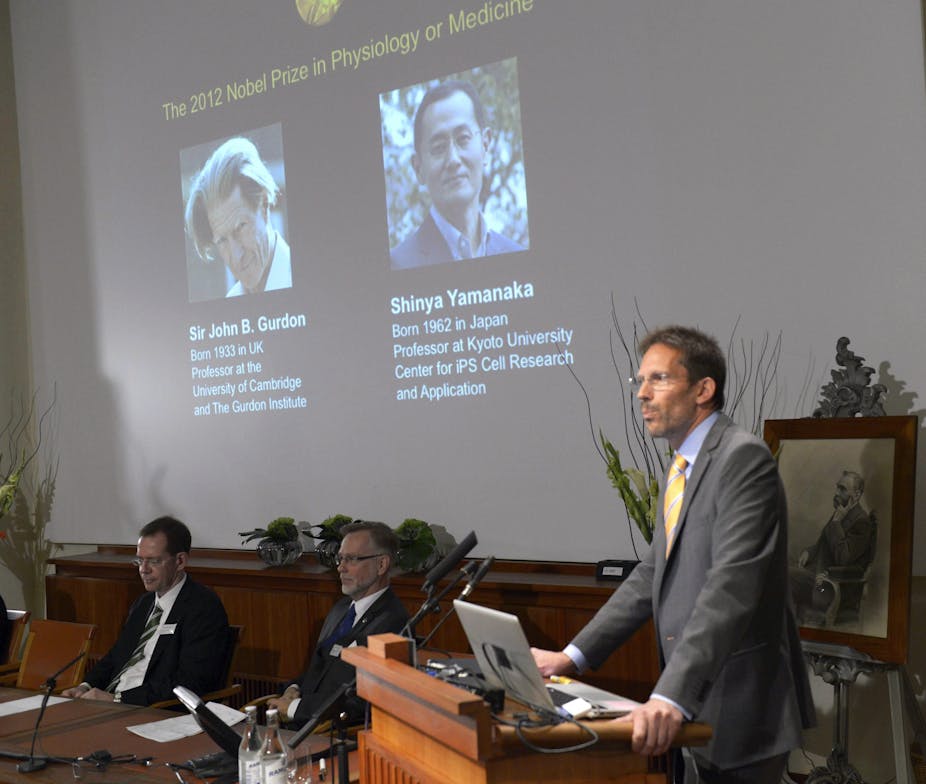
Scientist Shinya Yamanaka was born in 1962 – the same year that fellow scientist John Gurdon made a discovery that eventually led to the cloning of mammals.
Fifty years later, the two men have been awarded the Nobel prize in medicine for their work in revolutionising our understanding of the way cells and organisms develop.
It was Sir John’s work that eventually helped underpin the cloning of mammals, such as Dolly the sheep.
Professor Yamanaka used a simple technique to prove it was possible to reprogram mature cells in mice to become stem cells. It is hoped that one day this understanding will open the door to treating diseases, such as Parkinson’s.
“My own personal belief is that we will in the end understand everything about how cells actually work,” Sir John told the Nobel prize website.
He added that his discovery, which was initially viewed as controversial, helped to answer the question: Should basic science be supported if there isn’t an immediate benefit to health?
“Of course I’m biased but I would always hope that basic science would be supported because so often it happens that the practical or therapeutic benefit comes along quite a long time after the initial discovery.”
Martin Pera, program leader of Stem Cells Australia, said the prize should help focus people’s thinking on the importance of basic research, and that because of the work scientists now had technology they could use to study the function of human genes, to develop new drugs, model genes and for toxicology.
“The stem cell research community worldwide is thrilled with the news that the prize went to Gurdon and Yamanaka.”
Professor Pera said Sir John set the conceptual framework in the field by showing that the genome doesn’t change as cells mature.
“It was a long time before that conceptual advance was turned into something with enormous practical benefits.”
Professor Pera said Professor Yamanaka gave scientists a new way of generating cell lines with the property of embryonic stem cells.
“My goal, all my life, is to bring this stem cell technology to the bedside, to patients, to clinics,” Professor Yamanaka told the Nobel Prize website.
Professor Pera said the work opened up enormous horizons for cell therapy.
“The connectedness of the work of these two scientists is a very important lesson in that by studying phenomena we know are interesting in a biological sense we will open the door to practical applications.”