
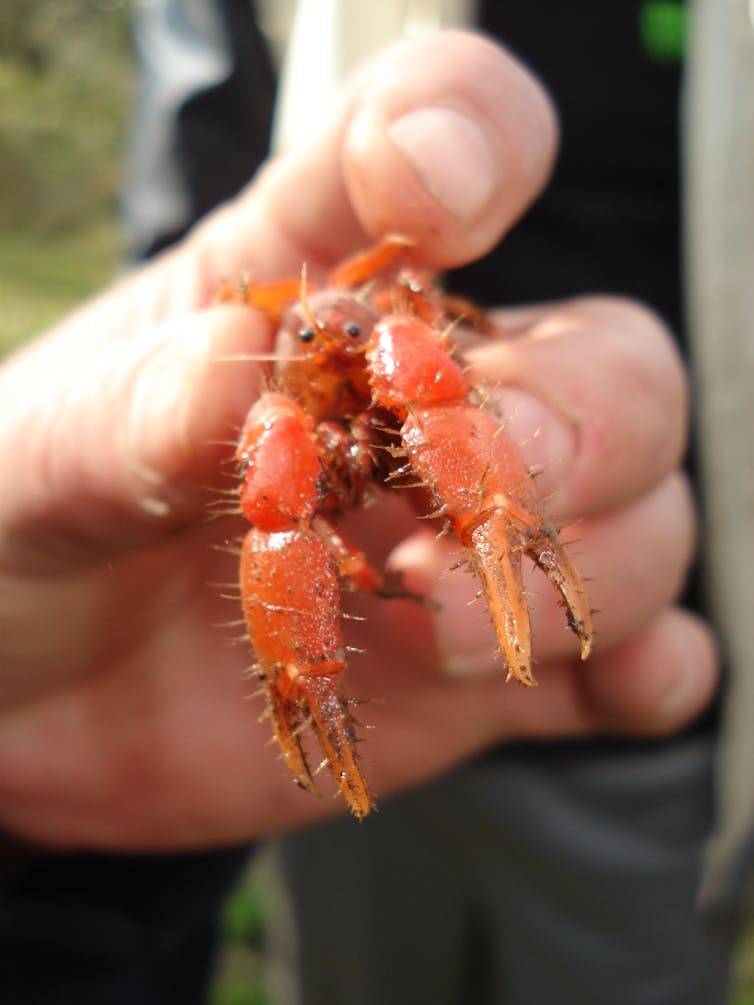
Everyone knows what a yabby is, don’t they? Well, you would be surprised. Those charming little critters with nippers in your local dam may belong to the species Cherax destructor, also known as the common yabby, but they may also be juvenile spiny crayfish (genus Euastacus), adult burrowing crayfish (genus Engaeus) or another species within the genus Cherax, including gilgies, marron and redclaw.
As a scientist who has worked on Australian freshwater crayfish for decades, the diversity of common names in this group is one of the most frustrating part of the job. It is not that I mind people using the vernacular or that I refuse to use it myself, it is just frustrating to be labelled an idiot by well meaning locals.
Here is a typical scenario: I am poking around in a creek in some remote location, with my laminated scientific collecting permit tucked into the field kit, and a farmer or fisher or curious teenager asks me what I am doing. The answer is simple, I am trying to collect the rare and beautiful species (insert scientific name here) for the purposes of research.
But how do I explain it to someone who thinks that species is a yabby, craybob, lobster or gilgie? If I use the scientific name I sound like a wanker, and if I use the word yabby I will be lying (becuase I almost never go in search of Cherax destructor). Invariably, whatever word I use I will stand corrected by the local, who has lived their whole life calling that species (insert “common” name here). And at that point I lose credibility. Doubt and suspicion floods their eyes. How can I be a crayfish expert if I do not even know the “correct” name for their local crayfish?
My own humiliation is only the tip of the iceberg. Because many species of freshwater crayfish have limited distributions and are therefore rare and threatened, it is dangerous when the locals consider them to be “common”. It is even more dangerous if they think they are yabbies, because the fishing regulations for yabbies are quite generous (you can kill and eat 200 per day).
On the other hand, any species in the genus Euastacus (also known as spiny crayfish, which includes the mighty Murray cray) are protected from fishing if they are under a certain size. People who assume that all small crayfish are yabbies may be scooping up endangered species to use for bait. It happens all too often and is one of the threatening processes for the group. Extinction by obscurity. The assumption that an unknown crayfish is “just a yabby” is dangerous for the crayfish.
The surprising and important fact that most Australians do not know is that there are almost 140 species of freshwater crayfish in Australia, in 10 genera.
The genus Cherax includes the yabbies, gilgies, marron and redclaw, but also a couple of dozen other species that have no common name at all. The genus Euastacus are usually known as crays (but so are marine lobsters in Adelaide, and that is another group entirely) and there are currently 50 different species.
Burrowing crayfish live underground most of the time, and they belong to the genus Engaeus if found in Victoria aor Tasmania, the genus Engaewa in Western Australia, or the genus Tenuibranchiuris near Brisbane.
Two additional genera are found only in Western Victoria, and three more in Tasmania, one of which (Astacopsis) is the largest freshwater crayfish in the world. All of them are special, and none of them can be described using their common names.
One species of Astacopsis is also known as the Giant Freshwater Lobster, a great common name that confuses me by using a word for a freshwater creature that is normally used only for animals found in the ocean. I guess Tasmanians don’t like to follow the rules.
The point I am trying to make is that if you are lucky enough to have a creek or river or swamp near you that is full of creatures that look like yabbies, take a moment to consider the possibility that they may instead be the critically endangered Euastacus robertsi (which are purple underneath) or the critically endangered Cherax leckii (which looks just like a yabby). In some locations, such as Fitzroy Falls, you can catch yabbies in the same net as a critically endangered Euastacus. It is your responsibility to learn how to tell them apart.
Most people do not plan to do any harm to these beautiful and amazing creatures, but most people do not think they are doing any harm when they set out to have a feed of yabbies. Just bear in mind that not all crayfish are yabbies.
Some of them are rare and beautiful and have no common names at all.
Grendelus Malleolus
Senior Nerd
"I''m looking for freshwater crustaceans"
Susan Lawler
Head of Department, Department of Environmental Management & Ecology at La Trobe University
That would mean admitting that I could be looking for freshwater prawns, shrimps, crabs, or even microcrustaceans: amphipods, Copepoda and water fleas. Their scientific names are even more beautiful: Macrobrachium, Triops, Syncarida.
The problem is that I would be lying, and I am a terrible liar. I only collect the above by accident.
Grendelus Malleolus
Senior Nerd
True! A broad order of brush. Many seem somewhat less snackable to boot.
Chris Riedy
Associate Professor at University of Technology, Sydney
Great clarification Susan - I've wondered about this!
Growing up in the Blue Mountains, we would discover these beautiful 'yabbies' with blue markings in the rock pools and creeks on the way down to the Grose Valley. We used to lure them out with bits of sausage so we could look at them. They were fascinating creatures.
Then, I moved to Sawtell on the north coast of NSW and we used to pump up 'yabbies' from the estuary to use as bait. They looked completely different and I never understood why they had the same name. Now I get it!
Bernie Masters
environmental consultant at FIA Technology Pty Ltd, B K Masters and Associates
Did you forget to mention koonacks in your article? :-)
More seriously, are you aware of the MSc research done at UWA in the 1990s by Jim Goodsell who looked at osmoregulation and physiology in marron, yabby and koonack, finding that each species has a digestive system that is adapted to different salinity levels? The koonack lives in very low salinity swamps in south west WA and has a long gut so that it maximises its ability to extract salts from its food. At the other end of the scale is the yabby with a short digestive system which allows it to survive well in higher saline conditions as the animal's need for salt can be readily met from such a digestive system.
Eric Glare
HIV public speaker and volunteer
"It is your responsibility to learn how to tell them apart."
Well I'm none the wiser after reading this -not so much as a link. Seems you come across plenty of interested locals but after the first greetings it is down hill from there. Do you carry in your field kit a laminated picture panel of the different species grouped according to their relationships? Not for you, for them.
You are explaining that there is an information vacuum but, despite your decades of field research, you seem to suggest that it someone else's responsibility to educate the locals you come in contact with - and you're still afraid of being heard as a wanker. Often that 'you're a wanker' attitude is recognition of scientist and the start of a connection and an information exchange. Build bridges.
Susan Lawler
Head of Department, Department of Environmental Management & Ecology at La Trobe University
We often did not know what species would be in a particular location. That is how research works. You won't have the answer before you ask the question, so no, I did not have photos of animals that had not yet been described.
Because it is illegal kill protected species, it is your responsibility to know if you are catching Cherax destructor or something rare and endangered. There is plenty of information about C. destructor.
I recommend the website aabio.com.au and the books you can buy there.
Eric Glare
HIV public speaker and volunteer
Of course you don't know what you are going to find until you look but you knew enough to put in a research proposal and you had it in your "typical scenario". I was suggesting a panel of the most likely, most common yabbies and yabbie-non-yabbies. And even then it doesn't have to have local species on it to serve as an example and a conversation piece.
What I was really trying to get across was your negative attitude to your stakeholders -farmers and other people whose land you are on or give…
Read moreSusan Lawler
Head of Department, Department of Environmental Management & Ecology at La Trobe University
The Fisheries department that issues fishing permits in your state or territory is the place to find out what you can and cannot eat. The species are so different from one state to the next that a comment on a national forum like this would merely confuse.
I have spent many hours talking to interested locals and sharing what information that I had. I know that fishers are the folk who are most likely to get the word out, they are often passionate about protecting our native fauna.
Educating…
Read morePeter Ormonde
Peter Ormonde is a Friend of The Conversation.
Farmer
Not just stakeholders Ms L - eyes and ears and local educators.
Back in the days when I had some connection with running threatened species recovery programs I would be most wary of the protection afforded by secrecy and ignorance. I am reminded of a contractor running his d-9 dozer straight though a bit of a puddle .... looked like a dozen other puddles. This one had 200 Corroboree Frogs in it. Now whose fault is that?
You clever folks can't really blame us yokels for dumping stuff into…
Read morePeter Ormonde
Peter Ormonde is a Friend of The Conversation.
Farmer
Doc L,
Perhaps if you have access to a public laminator - your might find it worth all our whiles to pop up the odd sign where you find something nice... nothing too detailed but something that screams out THIS IS NOT A BLOODY YABBIE might educate the locals and save the odd tasty bbq ingredient.
Even if it just says - we have found [insert some sort of name and pic] These are rare and endangered and are NOT YABBIES. If you catch one, put it back. Thanks". I thin you'll find most people will do that.
Even better some public fund might run to giving you and your minions some real signs ... cause I'll guarantee you that if it looks like a yabbie around here it goes in the pot. Jest iggnerunt hicks rather than malevolent cray loathers. Maybe some of that fishing licence money. Especially around camping grounds.
Would be a pity to lose them. Pretty things.
Bernie Masters
environmental consultant at FIA Technology Pty Ltd, B K Masters and Associates
Peter, nice idea in theory but, being an ex-fisheries inspector, my experience is that such signage would act as a magnet for people who don't give a toss for the law or for our biodiversity protection. Much better is to make it more difficult for people to access areas containing rare crayfish - fences, growth of dense vegetation around the edge, closing tracks, etc.
Peter Ormonde
Peter Ormonde is a Friend of The Conversation.
Farmer
I guess I just mix with a nicer class of yabbier Bernie...
But as a rule I try to give folks the benefit of the doubt - so rather than assuming they'll all be bastards - or even any of them - I'd like to make bastardry a deliberate informed choice.
And if they are ever caught knowingly taking something special - they do gaol time and a heck of a lot of community service time putting up signs and catching spiney things for Ms L. And maybe have B for bastard branded on their foreheads.
Sad that the only way to protect something is to hide it from everyone.
Susan Lawler
Head of Department, Department of Environmental Management & Ecology at La Trobe University
Hi Peter, unfortunately, our experience is that anything we do not hide from the public gets damaged, especially in remote locations. It may be curiosity rather than malice, but we have to replace many data loggers/artificial substrates/nets each year for no good reason. Signs saying DO NOT TOUCH just makes it worse. We bury them among the blackberries if we can.
My hope is that you can help by educating a few locals yourself. "Hey, did you know that not all yabbies are yabbies?" would be a great conversation starter.
Peter Ormonde
Peter Ormonde is a Friend of The Conversation.
Farmer
Oh no leaving stuff lying about - any sort of stuff - is just asking for strife... they'll pull it to bits just from sheer idle curiosity. But I don't think equipping the locals with the fact that the local creeks carry something special and rare will precipitate a craze for catching crays.
Even a simple sign saying not all yabbies are yabbies. And apparently none of them are crustaceans. But that will just add chaos to an already confused picture. No one knows this hidden world of claws and carapaces you inhabit Ms L.
Otherwise the only thing really protecting them is luck and camouflage. All we'll be left with is stuff with scuttling claws on floors of silent seas if we are reduced to sneaking them through into some future of sorts.
Dale Bloom
Analyst
Love it.
Please, where is a good website that shows Australian freshwater yabbies/crayfish etc.
Susan Lawler
Head of Department, Department of Environmental Management & Ecology at La Trobe University
Website showing Australian freshwater crabs and yabbies is
http://www.aabio.com.au/
Peter Ormonde
Peter Ormonde is a Friend of The Conversation.
Farmer
Are these different species just geographically distinct? Do they interbreed when put together? I can understand them getting confused.
Susan Lawler
Head of Department, Department of Environmental Management & Ecology at La Trobe University
Seem hybrids have been created, but generally they know who they are and do not get confused. At one site you might find spiny crags in the rivers, yabbies or other Cherax species in the dams, and borrowers living in holes in the bank. Or you might have one spiny cray in the main river and another cray species in the creeks feeding the river.
In the irrigation districts of central Victoria, we have Murray Crays in the irrigation channel, yabbies in the dams, and Swamp yabbies living underground in the wet soil. When the floods come they get all mixed together and the big ones eat the little ones. Swamp yabbies seem to really enjoy having yabbies for lunch.
Peter Ormonde
Peter Ormonde is a Friend of The Conversation.
Farmer
Thanks Susan ...
The creeks here are full of yabbies ... not sure which type - will have a close look. There might even be more interesting things with spines and the like.
But we've also got "bullrouts" - Notesthes robusta- stonefish - in pristine rivers fed by rainforests and peatmoss swamps and 30 miles from the closest salt water. Yet they are apparently the same fellas as one gets off the Barrier Reef.
I walked all over these creeks when I was a kid - never seen or heard of 'em. I suspect they're new. But it makes one think twice about chasing yabbies and the like when the local council goes sticking big warning signs up all over the place.
Dale Bloom
Analyst
Thank you.
After spending years diving on coral reefs, I found one of the most enjoyable things to do on a hot day, was climb up a mountain and go snorkelling in rock pools looking at all the tiny freshwater creatures while surrounded by rainforest.