


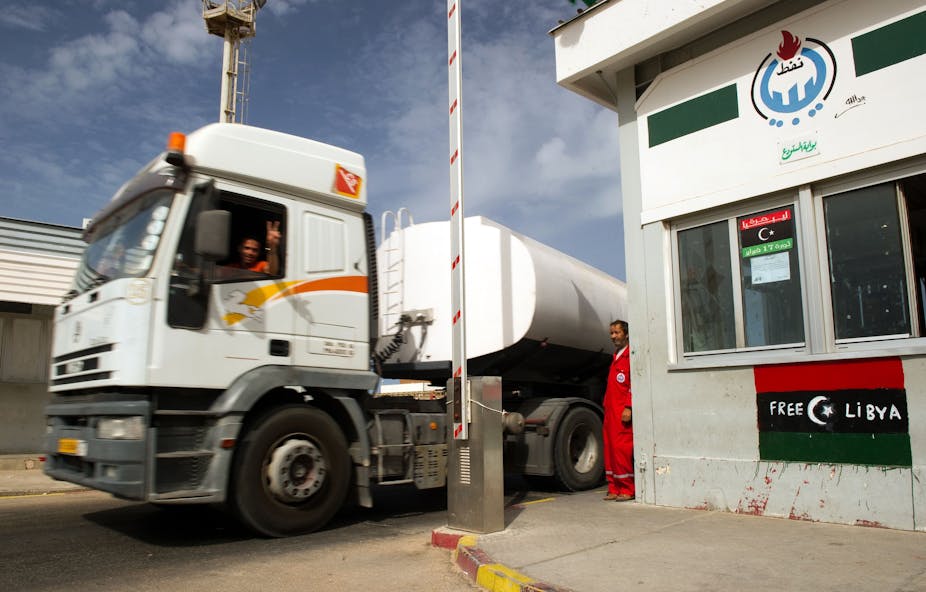
With the collapse of Muammar Gaddafi’s autocratic regime, the transitional government in Libya is prompting hopes for a new era of democracy in the country.
While a swift transition to democracy is certainly desirable, a question arises: to what extent is democratisation going to help the economic development of Libya?
This question has a complicated answer.
Peace and stability are prerequisites for economic development. Yet there is some disturbing evidence that the establishment of democratic pillars, such as free and competitive elections and constitutional arrangements that limit the authority of the executive, are not necessarily conducive to the stabilisation of peace.
Oxford University economist Paul Collier and his colleagues have analysed peace duration in a large number of post-conflict countries.
They conclude that rapid democratisation, which is at the root of post-conflict recovery strategies pushed by the international community, contributes very little to the probability of maintaining peace.
Other factors, including the growth of per-capita incomes, seem to be much more conducive to peace than democracy.

It is also difficult to find a link between the advancement of democracy and economic progress.
Most studies fail to identify a positive, significant and robust relationship between democracy and income growth, or between democracy and development. In a well-known paper written 15 years ago, American economist Robert Barro argues that the relationship between democracy and economic growth is “non-linear”.
He provides evidence of an inverted U-shape effect of democracy on growth. At initially lower levels of democracy, increasing democracy promotes faster growth. But past a certain level of democracy, increased democracy depresses growth.
Because Libya is emerging from a situation of almost perfect autocracy, it would appear to be below the threshold level of the inverted U-shape relationship – and would therefore benefit from a surge in democracy in the near term.
Still, one has to be careful before concluding that democratisation will bring about better economic conditions for everybody.
The future of Libya depends on how democratisation impacts on the country’s use of its vast natural resources – what is often referred to as the “resource curse”.
If democracy generates certain conditions that are necessary to overcome the curse, then a virtuous cycle of political and economic development will be established and the country will emerge as a prosperous nation.
But if those conditions are not realised, then a vicious spiral of bad politics and bad economics will condemn the country to a new phase of poverty, autocracy, and possibly violent chaos.
Most economists would agree that Libya is a textbook example of the resource curse.
Its large oil endowment has led to a form of dependency that fosters rent-seeking and bad governance while preventing the development of other economic sectors – manufacturing in particular – and precluding most of the population from sharing in the wealth.
To open a way out of the curse, democratisation must be instrumental in curbing corruption and misrule.

This requires reforms to introduce effective checks and balances in decision making and real competition in the executive recruitment.
If these conditions are in place, politicians will be more accountable to the people and one can hope for significantly greater transparency in the use of revenue from natural resources.
In other words, strong democratic institutions that foster electoral competition, transparency and accountability would break the corruption-resource nexus and hence create the conditions to overcome the resource curse.
Recent research by economists Sambit Bhattacharyya and Roland Hodler provides evidence that this has indeed been the case in several countries.
So, while the conclusion that democracy automatically reduces corruption is not warranted (and we do observe some widespread corruption in countries that are generally regarded as fully democratic), the change in regime provides a window of opportunity for Libya to transform the curse into a potential blessing.
What should the new Libyan government do in this respect?
A good start would be to create a public fund (as done in Alaska or in Norway) where oil revenues are saved.
The money in this fund could then be invested in foreign assets and dividends used to finance public investment and support reforms. It could also be used to pay direct annual cheques to all residents (the so-called Alaskan model).
Clearly, it takes a genuinely far-sighted and benevolent government to do that.
Will the Libyan Spring result in such a type of government? We do not know yet.
But the decisions that the new government will soon make on the use of the oil revenues will surely signal its willingness to be fundamentally different from the old regime.