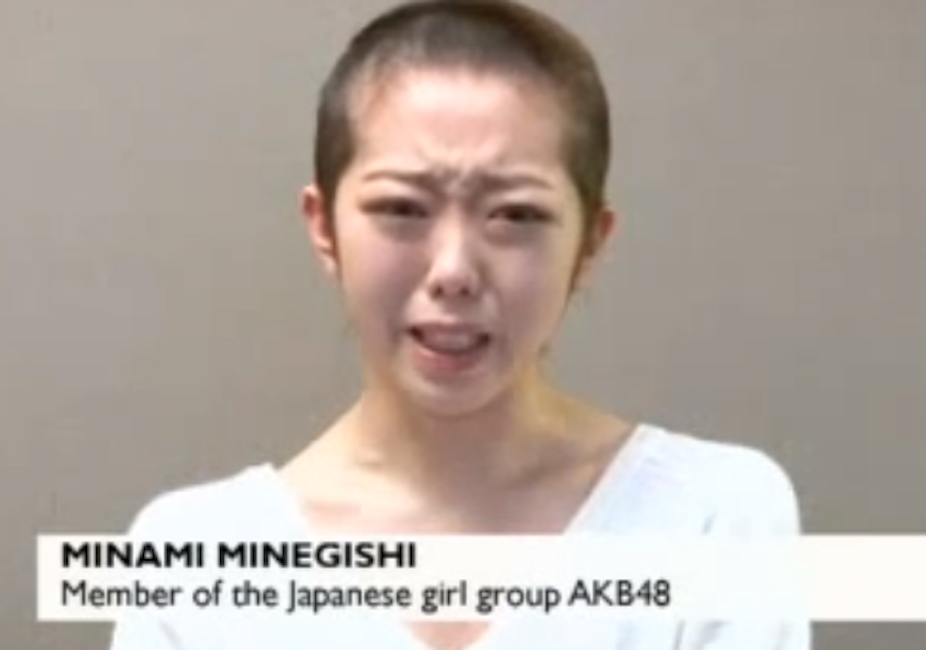
Japanese pop star Minami Minegashi made headlines worldwide after shaving her head and making an dramatic public apology on Youtube for violating her pop group AKB48’s strict no dating policy.
While shocking to many in the West, such behaviour is relatively normal in the sometimes bizarre world of Japanese popular culture
During a recent visit to Osaka, Japan, I visited one of my favourite haunts, Junkudo bookshop. Waiting in line at the checkout, I looked at the displays above the cashiers, usually reserved for Japanese popular fiction. This time I was surprised to see rows of young girls in bikinis, all soft focus and dewy eyed, staring down at me. The caption at the bottom of these books read AKB48. AKB48 are Japan’s most popular all-female pop group.
While girl and boy groups are de rigeur across Asia, AKB48 has the novelty factor of consisting of 61 members. These members are ranked in order of when they joined, ranging from first generation “senior” members to “kenkyūsei” (trainee) members. Also unlike similar offerings in J(apanese)-pop AKB48 have their own theatre where they daily perform. The concept, dreamed up by the group’s producer Yasushi Akimoto, is that the girls are relatively relatable and readily available for concerts and promotional meet and greets, “idols you can meet every-day".
Having lived in Japan between 2009 and 2011, I was aware of AKB48’s superstardom, but I did not pay much attention to what I deemed typical bubblegum J-pop. On my most recent visit a fortnight ago I noticed the group’s popularity had boomed. My friend’s female children all had favourite “team-members” and could imitate AKB48’s dance routines on cue. The group was everywhere but seemed to have two distinct marketing campaigns.
One was aimed at the pre-adolescent girl market. AKB48 graced the covers of magazines, advertised sweets and a myriad other “pre-teen” products and were even featured in video-games. The other market appeared to be directed at an older male audience. This was who the soft-porn books at Junkudo were aimed at. This incarnation of the group relied on the girls’ “sexy” image and played on popular Japanese sexual stereotypes, particularly the “sexy schoolgirl”. A recent campaign for Wonda instant coffeE featured AKB48 members, legs splayed and wearing thigh high boots with super short school uniforms, popping out of salarymens’ coffee cans.
This is, again, hardly groundbreaking in J-pop, nor Western pop either. But the particular mechanics of the J-pop industry and the recent “sex scandal” involving a senior member of the group, Minegishi Minami, expose some of the harsher realities of J-pop and its attitudes towards women. J-pop groups are usually bound to a particular jimusho (management company), or in AKB48’s case, a series of managers, with Akimoto at the top. These relationships are, like those in a kaisha (company), hierarchical and based on age. Most J-pop group members are initiated into the jimusho at a young age at around 14 years old. Also unusual are the strict terms of contract to which J-pop stars are obliged. In particular, male and female pop stars are restricted from dating, or doing anything which appears “unwholesome” such as taking drugs or drinking.

The parameters of what qualifies as “unwholesome” are particularly strict, with pop stars having to maintain an ingratiating naiveté and child-like image. While this is true for both male and female stars, it’s when stars “break the rules” that the sexist nature of the jimusho system becomes visible. “Stars behaving badly” is a staple of gossip press the world over, and Japan is no different. In 2009, Tsuyoshi Kusanagi, member of boy band SMAP made Japanese headlines when he was arrested after running drunkenly around a Tokyo park completely naked.He held a press conference and made a public apology then went on to promote the band’s latest film soundtrack. When Manabu Oshio, a pop-star and actor fled a hotel room with a dead hostess in it, he was only charged with drug possession and the dead hostess was never mentioned again.
Compare these with the most recent “scandal” involving 20-year-old Minegishi Minami. On 31st January 2013, it was announced that Minegishi would be demoted from senior status in the group to trainee because she had stayed the night at the home of fellow J-pop-star, Shirahama Alan. Within hours, Minegishi had shaved her head and made a public apology on AKB48’s YouTube channel crying and saying that she does not expect forgiveness for her “thoughtless … behaviour”.
Unlike the stage-managed apology of Kusanagi for his drunken run, Minegishi’s statement is utterly affecting, particularly because of her shaved head. Shaving a woman’s hair is a key signifier of shame, most notably it was used to humiliate women who slept with Nazis. In Japan, young women’s hair is cut short (though not shaved) in years nine and ten to maintain their modesty at the onset of puberty. The members of AKB48 all have long hair.
Minegishi claims that it was her own decision to shave her head in order to display ‘"contrition" for her “lack of self-awareness”. Though it might have been her own choice, it was made in the context of the AKB48 jimusho, a company focused on controlling the representation of its female pop group’s bodies. For her apparent deviance from the cute, sexy, attainable, starlet image, Minegishi’s body had to bear the shame of her act. Unlike Kusanagi, she was not allowed the dignity of a press conference. Her apology, and her shaved head, had only one purpose, to completely strip Minegishi of all dignity and rationalise her demotion.
It is interesting that some Japanese fans went on in an official Q&A after the incident, to ask AKB48’s theatre manager Togasaki Tomonobu if Minami “really reflected on her actions” after she was seen “having fun” with other senior group members.
But ex-AKB48 member, Nakanishi Rina, debuted as a porn star in 2010 and barely a ripple occurred.
It seems that so long as your body and sexuality is on public display for others it’s okay, but to be a woman with a private sex life is not.
Bronwyn OBrien
logged in via Twitter
I have been following the K-Pop scene for quite a while and it seems to be a very similar system to J-Pop. I have heard interviews with popular girl group Girls Generation where they've have said openly they they are not allowed to date and they can't eat much. Even the boy bands are not allowed to date as far as I know. (In fact many have to hint that they may be into each other}!
The Asian music industry is a whole other world. I've heard stories of cruelty, sexual harassment and 'slave contracts'. It seems that in Asia,entertainers are treated the same as any manufactured product by the companies they work for. Whilst I appreciate the discipline and commitment that these artists endure to be skilled at what they do, I think their superiors need to accept that these people are human beings who need human relationships just like anyone else.
Rosemary Overell
Lecturer in Cultural Studies at University of Melbourne
Hi Bronwyn,
Yep - K-pop runs on a similar jimusho system and both J- and K-pop have strict 'image' rules regarding weight, style etc. What's also interesting is what fans think of this - I know that a lot of K-pop fans write detailed fan-fic 'shipping' members of girls and boys groups!
rosemary.
Bronwyn OBrien
logged in via Twitter
Interesting to note too, that while it seems that many girl groups in Asia have this cutsie/sexy look targeted towards young girls and men, many boy groups have an androgynous look. Look at the Japanese Visual Kei bands. Some of those guys wear more make up than Lady Gaga! (Korean boy bands can be quite effeminate too).
Great article! Interesting to read the comments too.
P.S. Apparently they're 'shipping' One Direction in fan fics now too!
Pat Moore
gardener
Thanks Rosemary. An insightful & illuminating documentation of a peculiar social pathology. If this westernized Japanese pop culture was a patient upon the analyst's couch what would the diagnosis be do you think?
I would suggest a mass social hysteria/phallusteria with rabid sexism thrown in causing this despicable & pathological public shaming/victimization. It appears to be a culture that badly requires individuation? For its individuals to separate from the judgemental male-dominated herd…
Read morecaroline norma
lecturer, RMIT University
AKB48 are a product of Japan's sex industry, and their concert hall is located in Japan's largest pornography district, Akihabara. They started out on late-night TV shows to live audiences of men where they would play 'games' generally involving sexualised poses and having water thrown on their t-shirts. They've recently been marketed to wider audiences, but their fan base is still overwhelmingly men in their 20s and 30s. Hardly any women/girls attend their concerts. Reading their online fan forums…
Read moreRosemary Overell
Lecturer in Cultural Studies at University of Melbourne
Hi Caroline,
This is very interesting and thanks for the links. Actually, my PhD research on grindcore music in Japan involved a bit of semiotic analysis of gig fliers - and they would regularly employ pornographic imagery.
Alongside the prevalent porn culture in Japan, there is also institutional misogyny. I was stalked and harrassed when I lived in Osaka and, when I went to the police, I was not taken at all seriously and accused of 'leading on' my stalker.
Further, as you most likely know, domestic violence laws in Japan are abysmal and almost always rule in father of the husband who is usually the perpetrator of the violence.
caroline norma
lecturer, RMIT University
Thanks for this reply, Rosemary. How terrible to hear of your experience with the police, especially when the anti-stalking law was introduced with so much fanfare. Obviously it's not being implemented. You're exactly right about the domestic violence laws--I've got friends working as social workers in Japan and they tell me it's rare a perpetrator would be brought before court. They're expected to find shelter housing for women and their children, but don't get any support from police in charging perpetrators or allowing women to stay in their own homes. Let's work together on 'Institutional misogyny in Japan' research project one day! We'd have so much to write about unfortunately...
Chris Booker
Research scientist
You did a PhD on Japanese grindcore!? Wow, that would make for interesting conversation. But seriously, I know some metal blogs that might be keen to hear about what you found.
Rosemary Overell
Lecturer in Cultural Studies at University of Melbourne
Sounds good Caroline - nice to meet you!
Rosemary Overell
Lecturer in Cultural Studies at University of Melbourne
Hi Chris,
Glad to hear you are enthused about grind! I have a book in publication from my thesis - should be out by the end of the year! If you would like to read more about my work, email me and I will send through some of my articles!
Rosie.
Livi H
student, Anthropology Major, Japanese Minor
Though your opinion on the subject matter appears insightful at a first glance, you have many untrue facts and are continuing the stereotype that Japan is a foreign concept that is oh so different from the West.
First, To claim that Japan's pop-music industry is "bizarre" neglects the fact that the entertainment industry in many Western countries can be seen as equally bizarre. Take the recent fascination with reality shows such as "Toddlers and Tiaras" and "Extreme Couponers". Both shows create…
Read moreRosemary Overell
Lecturer in Cultural Studies at University of Melbourne
Hi Livi,
Thanks for your comments and I am glad that, as a feminist, you recognise some of the issues with the dominant representations of AKB48. I certainly wasn't trying to perpetuate the "oh so different" Orientalist stereotype typical of lay accounts of Japan.
The use of the word 'bizarre' is problematic, I admit. However, I am writing for a popular Western / Australian audience who are not familiar with the machinations of J-pop. For them, most likely, the jimusho system might appear bizarre…
Read moreAree Jones
Lecturer
Just want to point out I did a quick internet search on Manabu Oshio, and he was sentenced to almost 4 years prison time for contributing to the death of the hostess in his apartment (apparently he supplied her with ecstasy and failed to get her medical assistance) and the drug possession charge so I'd hardly call that a situation where the hostesses death was "never mentioned again." He was also dumped by his management, his wife and his record label.
You're obviously trying to make a point, and there's no doubt women and men are held to different standards in Japan and everywhere else, but a little fact checking would be good.
Rosemary Overell
Lecturer in Cultural Studies at University of Melbourne
Hi Aree,
Thanks for your comment - I am aware of this - but I still feel the emphasis in the judgement was placed on the drug possession and use as the 'shameful' crime, rather than his lack of regard for the hostess. I do appreciate your point however, and I should have checked more recent sources.
Rosie
Hiroya Sugita
Special Appointment Professor
I'm a Japanese political scientist who did PhD at Flinders on the Australian Democrats in the early 1990s. I've been teaching Australian studies and comparative politics in Japan.
Until around a year ago, I have no interest in the AKB48 group. Like many left-intellectuals, I rather had a negative view. Sure, some of their music videos are disturbingly sexual. However, to infer the group as a part of sex industry is quite offensive and defamatory. And for most of the ordinary Japanese, Akihabara…
Read moreRosemary Overell
Lecturer in Cultural Studies at University of Melbourne
Hi Hiroya,
Thanks for your comments. I love your idea that AKB48 might be understood through a political party framework. This isn't just novel - the election of members really does echo a party system - as does their 'foreign relations' policy. Also interesting your remark about Naoto and his pilgrimage - I think that is an excellent comparison.
I too agree that the reporter who 'broke' the story invaded Minegishi's privacy.
However I just want to make two points:
I just want to point…
Read moreHiroya Sugita
Special Appointment Professor
Thank you for your reply. I'm sorry for not distinguishing your original article and comments made by a reader.
I certainly am aware Japan is fundamentally misogynist society. Look at the parliament. As a result of the December election, only 7.9% of the Lower House members are women and this puts Japan on 169th in the world ranking. You have to go to places like Nigeria, PNG, Myanmar the Pacific or the Gulf States if you search for a companion!
I also think Japan is too tolerated for underage porns and violence. Victims of DV are still found gilty if strike back.We need a classification system like Australia. There are (male) J-pop groups such as Pornographitti or Mr Children (they are not aware of any implications)...
I would also like to note that I wrote Jaanese names with the order of family name first and fiven name second as they are called in Japan.
Hiroya Sugita
Special Appointment Professor
Thanks for comments.
I forgot to mention one interesting aspect concerning the AKB's sexual imaging. One of the most sexually explicit and (for me) disturbing musical video is for their best selling CD, 'Heavy Rotation' (you can watch on YouTube).
This music video was filled by an up-and-coming female director, Ms Ninagawa Mika. One of the stars of the AKB, Ms Oshima Yuko who is most prominently featured in the video including the opening sequence, told in the documentary film that, in addition to the director, almost all the crew were women and it made the members more relaxed and drop the guards more than otherwise.
All women team produced soft porn? What do you think about this?
Pat Moore
gardener
Some very interesting professional responses constellating around this essay on a popculture phenomenen, especially Prof Sugita 's explanations.
Are not the softporn underage videos the point of praxis that functions as titilation for the older male audience and as grooming mechanism of the impressionable & pliable adolescent female audience into a sexist misogynst culture?