Alpha Centauri exoplanet is the closest ever – how was it found?

Earlier this week, a Swiss-based team searching for planets outside our solar system (exoplanets) published a paper in Nature announcing the detection of an Earth-mass planet orbiting the star Alpha Centauri B. The idea that one or more planets might orbit the star system closest to Earth (albeit more…

5fb6w64g-1350535419
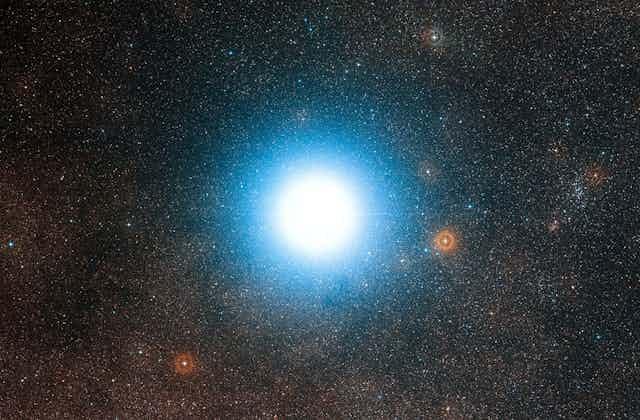
Alpha Centauri is the closest star system to our own sun and appears to be home to at least one planet. EPA/Davide De Martin/ESO

Earlier this week, a Swiss-based team searching for planets outside our solar system (exoplanets) published a paper in Nature announcing the detection of an Earth-mass planet orbiting the star Alpha Centauri B.

The idea that one or more planets might orbit the star system closest to Earth (albeit more than 4 light years away) has been a favourite subject of science-fiction writers for decades. It is no surprise, then, that the tantalising combination of “Earth-mass” and “Alpha Centauri” has piqued substantial interest among astronomers and the general public.

The candidate planet – creatively named Alpha Centauri Bb – is only 0.04 Astronomical Units (AU) away from its host star – that is, 0.04 times the distance between Earth and the sun – making it ten times closer to its star than Mercury is to our sun.

This means the planet should be ludicrously hot, ruling out any chance of life existing there. It also has the fortunate effect of ensuring no artists are tempted to add oceans when drawing the planet for press releases.

No walk in the park

As with all things worth doing, the detection of Alpha Centauri Bb was very challenging, not least because of a phenomenon known as “stellar noise” or “jitter”.

Like our sun, Alpha Centauri B is not a perfectly homogeneous, static sphere. The signal from the star oscillates and rotates over time, with starspots – regions of intense magnetic activity – moving in and out of view with different periods depending on their latitude on the star.

All of these effects combine to produce a jittering effect in the velocity signal from the star – an effect that can overwhelm the tiny signals from terrestrial-mass planets in orbit around it. In the case of the signals from Alpha Centauri B and its candidate planet, the latter has an amplitude of 0.5 metres per second (m/s), while the star itself has intrinsic noise of about 1.5m/s.

Cleaning up the signal

The new paper in Nature – published by Xavier Dumusque from the University of Geneva and colleagues – describes these effects and outlines the methods used to remove the unwanted variabilities in the high-precision data.

But these aren’t the only observational problems specific to the Alpha Centauri binary system.
ESO

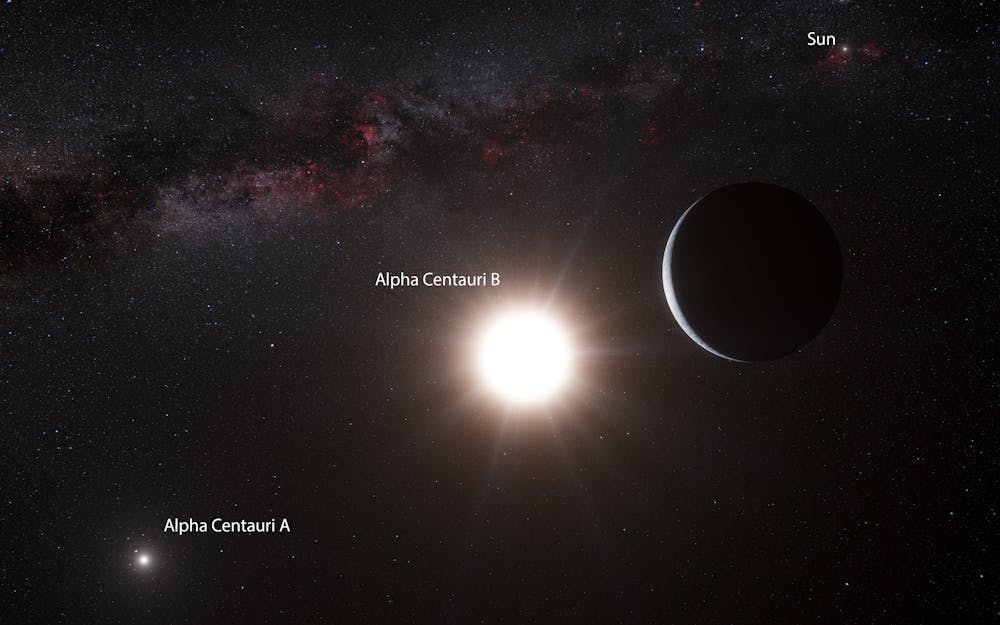
Most obviously, there is another whoppingly bright star very close to Alpha Centauri B: Alpha Centauri A. The two stars orbit each other with a binary period of 79.91 years. The velocity signal due to the binary orbit must be removed when analysing the velocities of one component.

Worse yet, the A and B components are separated on the sky by only 5 arcseconds (there are 3,600 arcseconds in 1º). This results in light from Alpha Centauri A contaminating the light from Alpha Centauri B, especially in poor observing conditions.

To correct for the noise sources and extract the signal of the candidate planet, the Swiss team employed a model with 23 free parameters – that is, 23 variables to describe the various noise sources. One worry is that by introducing so many variables, the process might have introduced artificial signals which could be misinterpreted as planetary in origin.

Confirming the results

An Earth-mass planet orbiting Alpha Centauri B is an extraordinary claim and one which requires extraordinary evidence. Fortunately, there are at least two other teams intensively observing the Alpha Centauri system in search of low-mass planets: one at the Cerro Tololo Inter-American Observatory (CTIO) in Chile and another at the Mount John University Observatory in New Zealand, of which I am a member.

Both teams have amassed a vast number of high-precision radial-velocity observations of Alpha Centauri B – that is, observations of the velocity of the star straight towards and away from Earth. With these measurement, both groups are in a position to confirm or refute the claim made by the Swiss researchers.

If confirmed, the presence of an Earth-mass planet around Alpha Centauri B would not be wholly surprising. The impressive results from the exoplanet-hunting Kepler spacecraft indicate small planets are extremely common. It may turn out that, given a suitably long and intensive observing campaign, we discover that most stars host one or more rocky planets.

The accelerating pace of discoveries of low-mass planets (we’ve found more than 800 since 1995) highlights the need for dedicated telescopes to apply exactly this sort of observing strategy for the nearest and brightest stars.

Such observing campaigns, carried out over many years, would be well-suited to the detection of potentially habitable Earth-mass planets that orbit their stars in 200-400 days.

And if you think the discovery of a non-habitable Earth-mass planet has gotten people excited, wait until we find one that is capable of sustaining life.

Sign in to Favourite

Want to follow The Conversation?

Sign up to our free newsletter to get the day's top stories in your inbox each morning, with a special wrap on Saturday.

Spinner
Help evidence based journalism become the norm and donate

Join the conversation

12 Comments sorted by

  1. Brad Stringer

    logged in via Twitter

    I love that there are people out there capable of working this stuff out. Thanks for the article.

    report
  2. terry lockwood

    maths teacher

    Bb to a musician is 'B flat'. Just in case anyone is inspired to write a song about it.

    report
  3. Chris Booker

    Research scientist

    I have to say that as a biologist I find this perennial search for an 'Earth-like' planet suffers from an astounding logical fallacy - and yet it seems to get repeated endlessly on documentaries and projects setting out to find these planets.

    The fallacy goes something like this:

    1. We are on Earth.
    2. Life has evolved on Earth.
    3. As far as we know, there is no life on other planets in our solar system, at least at present.
    -> Therefore, in the rest of the entire Universe, only planets…

    Read more
    1. Roger Carter

      Librarian

      In reply to Chris Booker

      I think you are right about this.... but the science he describes here is beautiful and elegant anyway!

      report
    2. terry lockwood

      maths teacher

      In reply to Chris Booker

      "Therefore, in the rest of the entire Universe, only planets like Earth must be capable of sustaining life."

      Don't think anyone is saying 'must be' but maybe the best bet when it comes to looking. If we were to detect any life form at all, one like ours may be the most easily recognised.
      But if there is some other non DNA/RNA life form out there, are we sure it doesn't exist on earth already? Have we looked? If we wanna spot alternative life forms out there, maybe we should hone our skills here first? (I am not holding my breath however.)

      report
    3. Ron Chinchen

      Retired (ex Probation and Parole Officer)

      In reply to Chris Booker

      I'm not a scientist Chris but I read a lot and Astronomy has been a lay interest for me for over five decades. Further I try to keep up with scientific articles on how life developed here on Earth, how hard it was to be created and what chance that it could develop elsewhere.

      In the end you may be right, but I suspect not. And that's not just whimsical thinking. One of the flaws in human thinking is the belief that we are in some way special, unique, a once off. We, in our arrogance (and that…

      Read more
    4. Martin Bouckaert

      logged in via Facebook

      In reply to Chris Booker

      I don't think that life is what this article is about. Save for the last paragraph which I interpreted to mean "it'll be exciting when we find a planet that we might actually be able to live on," which is not an entirely unreasonably expectation (a planet like earth might be extremely rare, but if it happened once... why can't it happen again?). This article doesn't suggest that life cannot possibly exist on a planet not like earth (albeit, it does suggest the Alpha Centauri Bb is too close to its sun to support life, but this is possibly more of an assumption than a logical fallacy, and one made knowing that it's probably a planet that we can't live on).

      report
    5. Ron Chinchen

      Retired (ex Probation and Parole Officer)

      In reply to terry lockwood

      I suspect, Terry, he was talking about life like our life.

      Almost assuredly there exists life of a different nature (excuse the pun) out there. And we already know of different life forms here such as anaerobic life and who's to say prions arent another form of life.

      I was certainly being conservative in my response, but it could be that life is teeming elsewhere in the Universe and that if we scratch beneath the surface of Mars or go skinny dipping in the underworld oceans of Europa, Ganymede…

      Read more
  4. Rajan Venkataraman

    Citizen

    Thanks for the article Dr Wittenmyer
    It's great to learn about the science and skill that goes into this kind of research. It's also good of you to share with the general public some of the passion that drives the effort.
    Regards

    report
  5. Arthur James Egleton Robey

    Industrial Electrician

    At the South Pole there is descending air and ice.
    Place a circular rail on the ice. Build a bridge over the rail on the diameter. Make the diameter as large as possible.
    The bridge is on wheels and rotates about the center of the circle.
    Water is sprayed from the bridge to build a giant convex lens of clear ice.
    The lens is polished to perfection.
    Aluminium is sprayed on the Ice.
    Carbon fibers are sprayed onto the aluminium. Piezo crystals are placed on the carbon layer.
    A supporting frame…

    Read more
  6. Ettore Greco

    logged in via Facebook

    New and old Science
    A new and Progressive Science shows how Wavevolution, or the transformation from waves to atoms, is the connecting link that closes the circle of science to open new horizons never seen before.
    The bureaucracy of traditional science prevents the recognition of any event unless certain criteria are first met. The problem of this science is buried deep right in the compilation of these "laws" or criteria introduced by a few scientists in the name of all science and from their…

    Read more