
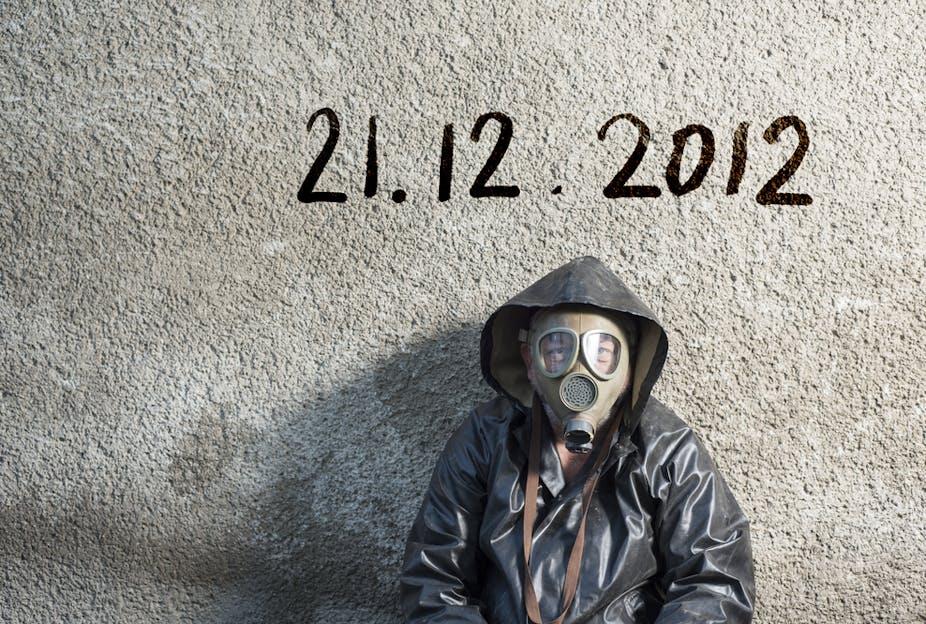
Apocalypse myths show our fear of the world as we know it

If you believe the hype, the end of the world has finally come. The Mayan calendar’s “long count” began on 13 August 3114 BCE and will end today on 21 December 2012. Why do people believe the world will end? For some this is just the Mayan equivalent of the dawn of the new millennium, but for others…

Jphw4hqm-1354859991
Why do so many people believe in the Mayan apocalypse myth? Apocalypse image from www.shutterstock.com

If you believe the hype, the end of the world has finally come. The Mayan calendar’s “long count” began on 13 August 3114 BCE and will end today on 21 December 2012. Why do people believe the world will end?

For some this is just the Mayan equivalent of the dawn of the new millennium, but for others the end of the long count signals the end of the world. Fuelled perhaps by disaster movies like “2012”, and intimations of an approaching Armageddon, around one in ten people worldwide think the world will end in 2012, while 9% of Australians think this.

The idea that the world will end in 2012 is of course a myth, but myths can tell their own stories. British author Karen Armstrong in her beautiful book “A Short History of Myth” argues that myth enables us “to live more intensely” in the world. It’s not delusion, nor is it scientific truth, rather myths reflect the world in which we live.

The 2012 doomsday phenomenon tells us that people are uncertain about their futures. The world as we know it is changing – global warming is changing our ecology, the economy seems more precarious, we feel less certain. The myth is a way for people to express their fear about these changes and the uncertainty they bring.

Sociologist Adam Possamai recently pointed out that the writers of post-apocalyptic fiction no longer feel the need to give a reason for the apocalypse. It is taken for granted that the contemporary reader will understand that there are plenty of plausible causes of apocalypse. This was never the case in previous generations.

There are many websites, books, and articles about the end of the Mayan long count in 2012. Part of what I read in this literature is an attempt to find other ways to live well in a time of potentially apocalyptic change. Some people discover the courage to live in a world that is uncertain. They discover hope in a time of loss and sadness. They discover it is possible to live well with less.

Joseph Gelfer has argued that there are some questionable forms of cultural appropriation in the 2012 movement, such as those who make money from books and tours based on indigenous prophecies of a 2012 catastrophe. However, I think there is something else important going on.

The year 2012 will be much like any other year of course, but the deeper anxiety that underlies the 2012 myth will remain. The myth in fact demonstrates a failure to adequately engage with the changes ahead.

It would be easy to dismiss those who embrace a mythical apocalypse as delusional, but in my view, their belief in the myth is understandable. It is much harder to tell a more complex, ambivalent story that acknowledges change and loss along with growth and discovery.

Mainstream Australia is still struggling to understand the idea of living well in the context of long term and massive economic, social, and ecological change – problems that are unlikely to go away after today.

So what does happen when nothing happens on 21 December 2012?

If we look at historical examples, when prophecy fails people don’t stop believing. The Jehovah’s Witnesses have predicted the second coming many times – and they still exist. American social psychologist Leon Festinger’s study of “The Seekers” in “When Prophecy Fails” demonstrates that it can actually serve as a moment to re-invigorate a group or movement. The same thing will happen with 2012, but in a more diffuse way.

When nothing happens today, there will simply be another revelation, another turning point, another intimation of apocalypse. But it is also an opportunity to start a discussion about the changes that are taking place in our society and address the fears the behind the myth.

Articles also by This Author

Sign in to Favourite

Want to follow The Conversation?

Sign up to our free newsletter to get the day's top stories in your inbox each morning, with a special wrap on Saturday.

Spinner
Become a friend of The Conversation and donate

Join the conversation

31 Comments sorted by

  1. Steve Drummond

    Retired (self funded)

    According to a famous playwright, Julius Caesar was told to "Beware the ides of March" (15 March).
    On the way to the forum Big J turned to the guy and said
    "See the Ides of March has come"
    and the soothsayers reply "Yes come, but not gone"

    report
  2. Steve Drummond

    Retired (self funded)

    No wonder our retail sector is going so badly, I did not see one "End of the World" sale.
    Would have been the perfect opportunity to use the line "Choose carefully, no refunds accepted"

    report
  3. Melvinvines

    logged in via Twitter

    Jehovah’s Witnesses have NOT predicted the second coming MANY times. Where do you get such misinformation from? The Bible informs us that the Earth will remain forever. It is the current system of things with all its problems that will end. The end of an age / the end of a system of things - Not the end of the world.

    For more accurate information of the prophetic expectations of JW's see:

    "How Prophecy Succeeds: The Jehovah’s Witnesses and Prophetic Expectations" - George D. Chryssides…

    Read more
    1. Paul Richards

      strategic foresight

      In reply to Melvinvines

      Melvinvines commented; "Jehovah’s Witnesses have NOT predicted the second coming MANY times."

      You are quite right JWs have never set a date in recent times and the comment is justified. However that does not dismiss the belief they are waiting for the 'system' to collapse and divine retribution exacted on those opposing this prophecy and JW belief concerning the 'end of days'.

      To those who are unfamiliar with Melvin's differentiation, he means;

      "JW live day in day out with the probability of 'Armageddon' or 'end of days' coming at anytime."

      This is a far more sophisticated scenario and not to be confused with prediction.

      Is it really different?

      This articles quoted prediction scenario are falsifiable with time decay.
      The JW scenario is not and is unfalsifiable.

      Fear of divine punishment is still fear and in context of what Douglas Ezzy has written. Even if he made an minor error in understanding the expectation of things hoped for.

      report
  4. George Greenwood

    Retired

    Well 21 December 2012 has arrived in Australia and nothing has happened.

    I suspect the rest of the cosmos has not heard of the Mayan calender so is ignoring it.

    That just leaves a few "End of the world" tragics looking for another date. I suggest they give up or pick a date 3.5 billion years into the future. That's fairly safe and no one is likely to remember or be bothered.

    Perhaps, if predicting apocalypse wrongly was a mandatory capital offense enforceable at the time of the prediction's failure, there would fewer such predictions.

    report
    1. David Heasley

      Contracts manager

      In reply to George Greenwood

      Your all missing an important point..
      The Mayan calendar did not contain leap years! allow for that and we are several years too early.......

      report
    2. Peter Ormonde

      Peter Ormonde is a Friend of The Conversation.

      Farmer

      In reply to George Greenwood

      George ... solay years, leap years ... these are but mere factual quibbles. The big one of course is whether the Mayans took the international date line into account. It's still yesterday there isn't it?

      God they were clever those Mayans. And the Dalai Llama is really cool for his age.

      So party on dudes.

      report
  5. Russell Walton

    Russell Walton is a Friend of The Conversation.

    Retired

    The "End of the World" has happened on many occasions in history, notably to the Maya, Aztecs, Western Romans and Eastern Romans, it's a really matter of perspective.

    There's nothing new about doomsday predictions, Christianity was predicated on an imminent End of Days, which apparently, has been postponed indefinitely, an excellent example of the paradoxical re- invigoration of fantasies after prophecy failure. Europeans also became rather alarmed as the year 1000 approached.

    Most people in history have usually been living hand to mouth and been in danger of attack and annihilation by predatory neighbours, the End was always close. Modern anxieties hardly register compared with those of our ancestors, with one exception, I grew up when the Cold War was at its height, the Apocalypse was much closer than anyone realised at the time. Current problems are relativity insignificant compared to the era of MAD.

    People just get bored, Armageddon is an interesting diversion.

    report
  6. Russell Walton

    Russell Walton is a Friend of The Conversation.

    Retired

    "Joseph Gelfer has argued that there are some questionable forms of cultural appropriation in the 2012 movement, such as those who make money from books and tours based on indigenous prophecies of a 2012 catastrophe."

    That seems a remarkably patronising attitude, the Maya were the most advanced civilisation in the Americas, cultural appropriation and tourism is a very long Western tradition.

    report
  7. Kenneth Mazzarol

    Kenneth Mazzarol is a Friend of The Conversation.

    Retired

    It must be obvious that if we continue moving massive amounts of material from one point to another, Australia to China, Earth must eventually become unbalanced to such an extent that she will break from her orbit and gently slide away into the surrounding abyss and we will know nothing about it. Just another inconsequential episode in the history of the Universe for future life forms to wonder about.

    report
    1. Peter Ormonde

      Peter Ormonde is a Friend of The Conversation.

      Farmer

      In reply to Kenneth Mazzarol

      That'd be one of those "tipping points" everyone is talking about lately then.

      Strangely I woke up this morning. I was surprised. I was even more surprised to realise that this new dimension/universe I have been dropped into looks a lot like my old one.... same dogs, same wagging greeting, same coffee smells, similar looking house - though untidier than I remember it.

      This is rather disappointing - to discover that eternity is just same old same old ... but lots of it.

      I've been gypped. I knew I should have converted to some religion with a decent pension plan.

      report
  8. Terry Rout

    logged in via Facebook

    Note the awards for the IgNobel Prize for Mathematics in 2011:
    MATHEMATICS PRIZE: Dorothy Martin of the USA (who predicted the world would end in 1954), Pat Robertson of the USA (who predicted the world would end in 1982), Elizabeth Clare Prophet of the USA (who predicted the world would end in 1990), Lee Jang Rim of KOREA (who predicted the world would end in 1992), Credonia Mwerinde of UGANDA (who predicted the world would end in 1999), and Harold Camping of the USA (who predicted the world would end on September 6, 1994 and later predicted that the world will end on October 21, 2011), for teaching the world to be careful when making mathematical assumptions and calculations.

    (see http://www.improbable.com/2012/12/19/a-calculating-look-at-the-end-of-the-world/)

    report
  9. Greg Boyles

    Lanscaper and former medical scientist

    I believe that people are getting confused between 'the world' ending and 'their world' ending.

    While the end of 'the world' wont happen for another billion years or so when our sun goes red giant, many civilisations have ended in 'appocalypse', most often in the form an invasion or civil war.

    While most people living at the 'zenith' of a civilisation will inevitably dismiss those who fear an 'appocalypse' and nut jobs and that it will never happen, history as shown over and over again that such fears at any particular time in the life of a civilisation are not entirely unfounded..

    report
    1. Peter Ormonde

      Peter Ormonde is a Friend of The Conversation.

      Farmer

      In reply to Greg Boyles

      I'm actually very much afraid of "appocalypse" ... and the portents are all around us:

      "Our road's are getting more and more conjestured."
      "We are standing fermly by our principals"
      "There having a laurgh...."
      Send all the ileggals back were they cum from

      and lastly,

      Let's go it alone, shut the gate on everyone and tell these reffos to bugger off as well. Tow 'em back. Sterilise 'em all.

      Yep, we're well on the way to that apocalypse I'd reckon. At last we are in agreement.

      report
    2. Andrew Smith

      Education Consultant at Australian & International Education Centre

      In reply to Greg Boyles

      Similar to those who proclaim immigration (from Asia) and modest population growth are going to be the end of Australian society, culture, environment, employment, affordable property, health system, social security benefits, infrastructure, agricultural sector, AFL/NRL, English language, our unique "culture" and "identity".

      report
  10. Peter Ormonde

    Peter Ormonde is a Friend of The Conversation.

    Farmer

    Editors!

    I am shocked - and appalled - AGAIN! Like totally.

    Breathlessly opening my morning "headline email" from the Conversation, I saw with horror that the End Of The World ranked only second place in your editorial priorities after the Budget Surplus disappearance. This reflects a very managerial approach to the apocalypse if you don't mind me saying... too much "business as usual" for my liking, yes indeed.

    Worse, I realised that I would have the rest of eternity to sit here fuming about it.

    report
  11. David Clerke

    Teacher

    And where does the Club of Rome and its offspring "Global Warming/Climate Change/Weather Extremes fit into the apocalyptic myths?

    report
    1. Paul Richards

      strategic foresight

      In reply to David Clerke

      Peter Ormonde commented ; "I vaguely remember something about prophets never being believed in their own land." Ask any 'futurist' or 'foresight practitioner' if they are believed in our era.

      Prophets today are those who have evolved through theocratic belief system. We call them 'futurists' who practice 'strategic foresight' using science, science fiction, projections, quantum physics, metaphysics, just to graze a few of the 'tools'. Generally these modern era 'prophets' make us feel uncomfortable…

      Read more
    2. Peter Ormonde

      Peter Ormonde is a Friend of The Conversation.

      Farmer

      In reply to David Clerke

      @ Paul.

      Strewth ... Gene Roddenbury... Gene was a very sharp chap - sharp enough to get extremely clever scientific advisors especially in his later years. http://www.goodreads.com/book/show/296672.Star_Trek

      Either that, or by then enough those asccursed Trekkie nerds had been tinkering around in the parents' basement long enough to whip up a few of the gadgets Star Trek suggested... or at least see the opportunities that such technology offered.... unchecked portability

      Dick Tracey. The…

      Read more
    3. Felix MacNeill

      Environmental Manager

      In reply to David Clerke

      They don't and that's not what they predicted and what they did and do say is based on evidence rather than superstition.

      report
  12. Chris Borthwick

    Writer

    Melvinvines says
    "Jehovah’s Witnesses have NOT predicted the second coming MANY times. Where do you get such misinformation from?"

    Well.... Take, say, 1914, following which date certain.... corrections were issued....
    "CHANGES IN "SCRIPTURE STUDIES"
    We call attention to a few slight changes which have been made in four pages of Vol. II. and six pages of Vol. III., "STUDIES IN THE SCRIPTURES." These are all trivial and do not alter the real sense and lesson, but conform to the facts as we have…

    Read more
  13. Lynne Newington

    Lynne Newington is a Friend of The Conversation.

    Researcher

    I believe people have a need to touch a spiritual reality, for want of a better word.
    I recall when the faithful were travelling from near and far, when the "divine essence", was making itself known in a little place outside of Castlemaine.
    Both diocesan bishops from either side never stood up and warned them of it's spurious beginnings, the vulnerable bringing their children of all shapes and form, [literally], for healing and special blessings with masses by visitng clergy giving it further…

    Read more
    1. Paul Richards

      strategic foresight

      In reply to Lynne Newington

      Lynne Newington commented ; "I believe people have a need to touch a spiritual reality, for want of a better word."

      Could not agree more, as for "Sickening" it is an understandable reaction.

      Although these people just have unevolved values. Let me explain, Claire graves Spiral Dynamics refers to them as being on beige, purple, red or blue levels, but there are over twenty other theories with parallels. SD is just easier to grasp of all of these. [reference below].
      Some have said to me they…

      Read more
  14. Lynne Newington

    Lynne Newington is a Friend of The Conversation.

    Researcher

    That's an interesting analysis Paul, I seem to recall something similiar from sometime ago, I will go back and see if I can locate it.
    I suppose my sickening mentality comes from seeing the vulnerable being exploited, by those in leadership roles.
    Altho I believe Denmark Professor Uffe Schjoedt's The Power of Charisma, the sight of those desperate mothers with children and the spurious beginnings of theso called apparitions.
    The same thing happened when an Italian family asked me to accompany them and their five year old terminally ill daughter to the Phillipines. Within two day's I could see it was fake, that was sickening for me too. My dilemma was, to convince the parents and bring the child home before it was too late.
    The exercise cost them thousands.

    report
  15. Greg Boyles

    Lanscaper and former medical scientist

    "Similar to those who proclaim immigration (from Asia) and modest population growth are going to be the end of Australian society, culture, environment, employment, affordable property, health system, social security benefits, infrastructure, agricultural sector, AFL/NRL, English language, our unique "culture" and "identity". "

    Population growth at any level us ultimately unsustainable. As soon as you learn this fundamental truth the better off we will be as a society.

    Modest population growth…

    Read more
  16. Juan Vesa

    student

    i dunno. i think it could show the opposite. that people know things are bad all over and want it all to end, but they think they're powerless to do it. i suppose this makes them rely on some great and overriding force to do it for them.

    report
  17. Comment removed by moderator.