
Are babies the ultimate addiction?

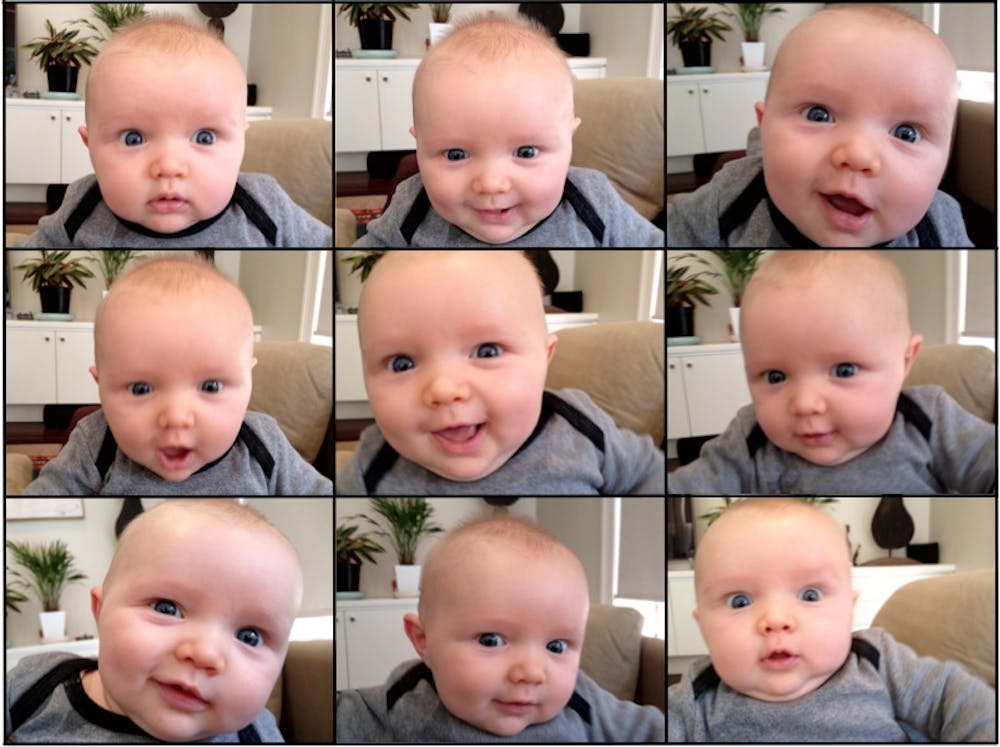
Max – finger on the trigger of his mum’s brain’s reward centre? Olivia Carter

I hated being pregnant – nausea, back pain, severe exhaustion … and I looked like a hippo.

The labour and birth were even worse.

These days I’m woken throughout the night by a screaming baby and coughing toddler. I carry a constant smell of baby vomit and in the last week have needed treatment for my bad back and shoulder. Of course, we can’t forget the stinky nappies and endless loads of washing.

So, given this picture of hell, how can it be that having children is the best thing that’s ever happened to me? I love it. I obviously love my kids, but what I find most remarkable is how much I am enjoying this period of life.

As a scientist, I’m pathologically rational. So I have been trying to understand how an overwhelming positive could result from the combination of so many negatives. But as I look at my little baby Max, I think I have the answer: I am addicted.

People often talk figuratively about how “rewarding” children can be. But are children also rewarding in a literal sense? Certainly not in a financial sense! But what if you go past money and material possessions and look deep into the middle of the brain – where the purest feelings of emotional positivity are generated?

After the chaos of breakfast has past and I finally get some one-on-one time with little Max, I find I just cant help myself:

Daa boodle doodle kikik … Daa boodle doodle kikik … Ahh boo … Ahh boo …

Max rolls his huge eyes over to me and starts to chuckle. Ahh, Jackpot!!

It’s funny to think a few years ago I was working 70 hours a week as a research and teaching fellow at Harvard University, and now all my physical and mental energies are consumed by trying to make a three-month-old baby smile.

So could it be that my baby is tapping directly into my brain’s reward center? I figured somebody must have studied this. Sure enough, an apply titled study – What’s in a smile? Maternal Brain Responses to infant Facial Cues – recently found that baby smiles do indeed activate exactly the same brain networks as those affected by drugs such as cocaine or a jackpot at the pokies.

I guess if you think about it, the sole evolutionary purpose of the brain’s reward network is to promote behaviour that increased the chances of passing on ones genes by producing fit and healthy offspring (the system is hijacked by addictive drugs and other harmful addictions).

So essentially, every smile from Max is sending a little message to my brain saying: “That was good, Mum – do it again!”

Join the conversation

27 Comments sorted by

  1. Comment removed by moderator.

  2. Dale Bloom

    Analyst

    I can’t understand how children are raised for rewards.

    I changed just about every nappy when I was at home, and washed the baby in the afternoon, and played with the baby, and when it was older, it wouldn’t eat anything unless it sat on my knee at the table and ate from my plate.

    But, as a father, there were very few or no rewards, and it was all done because it needed to be done.

    report
    1. Regan Forrest

      logged in via Twitter

      In reply to Dale Bloom

      I would like to see evidence (preferably peer-revirewed) of this statement. Otherwise, to judge you by your own standards, I can only assume you've made this story up.

      report
    2. Dale Bloom

      Analyst

      In reply to Regan Forrest

      A little difficult to prove, but ask me a question about changing nappies, washing babies, playing with babies, and feeding babies (except breast feeding) and I will give you an answer.

      As well, I painted the room, made the change table (and a very good job I might add), bought all the equipment such as nappy buckets, baby bath and pram, and of course paid for everything.

      Looking after babies is not that difficult. Billions of people have raised children now, and I would recommend to fathers to look after their babies, and they don’t really need the mother.

      As for rewards, well children go through all sorts of stages, and I think if someone enters into parenthood expecting appreciation or rewards from their children, they could be sadly disappointed. So best not to expect appreciation or rewards.

      report
  3. Ian Ashman

    Manager

    Olivia, great article, thanks.

    Why does your article make me think of toxoplasmosis making mice do what the cats what them to?

    report
  4. Nick Stafford

    writer

    Dear Olivia

    It is beautiful to read of a newish parent luxuriating in the overwhelming joy of loving and being loved by a child, thank you.

    However, as someone who is drug addicted, and has been for 30 years, I found your essay, unintentionally flippant, and it upset me.

    You mention that as a scientist you are "pathologically rational". I put it to you that there is nothing remotely rational, or scientific, about using the term "hijack" to discuss the ways we interact with your brain/bodies…

    Read more
    1. Olivia Carter

      Senior Research Fellow and Lecturer at University of Melbourne

      In reply to Nick Stafford

      Nick thank you for your thoughtful comment. Everything you say is true. Yes all positive activities and everything you enjoy will necessarily involve the reward circuitry. The description of drugs "hijacking" the reward system is actually a very common description used in the literature. The term is not meant to suggest that the drug is somehow a conscious agent but rather a technical fact that the reward system "codes" things in terms of better or worse than expected. In the case of addictive…

      Read more
    2. Dale Bloom

      Analyst

      In reply to Nick Stafford

      I would agree with both Nick Stafford and Gil Hardwick

      It is actually a dangerous area for a parent to have children, so that the parent can get some type of “high” from their children.

      As a quick example: - Tickling the baby can make the baby giggle, which then pleases the parent. But continually tickling the baby becomes an annoyance to the baby.

      So the parent should do what is best for the child, and shouldn’t be expecting much back from the child.

      Also, where are the men in the baby’s life.

      These articles make men and fathers look totally irrelevant and superfluous, and its all about the mother and “her” baby, or “women and their children”.

      report
  5. Comment removed by moderator.

    1. Gil Hardwick

      Anthropologist

      In reply to Gil Hardwick

      PS, just waiting for all the RED marks to clock up against my critique, to demonstrate thatit bites, as it certainly should bite.

      The more the merrier, proves the point being made.

      report
    2. Olivia Carter

      Senior Research Fellow and Lecturer at University of Melbourne

      In reply to Gil Hardwick

      I am happy to report that my Husband Ned also gets lots of smiles and those smiles presumably also activate his reward network. He works 4 days a week and is a very hands on father.

      I must say that I have been amazed how people have interpreted my articles from a feminist slant. Particularly with this article..... I hoped that it would have been quite clear that the effect of smiles would also capture the hearts of non-biological parents, other relatives and anyone else that enjoys cuddling a…

      Read more
    3. Laura Coulter

      Practitioner

      In reply to Gil Hardwick

      Gil, no red marks - but just wanting to clarify...are you suggesting that motherhood narrative can only be legitimate or worthwhile when it makes reference to the father? I'm not at all sure that this is what you are suggesting, but this is how your post reads to me. My apologies if I have mis-interpreted.

      On a more general note, I wholeheartedly agree with some of the suggestions made that the mens' stories are deeply absent in the parenting discourse. However, I would have thought it more legitimate that men create their own narrative, rather than relying on women to do it for them?

      What is interesting to me about a section of fathers'/ mens' stories about parenting, is that some of it is largely focussed on complaining about how men are absent from motherhood narratives...ironically the result is that men are sometimes absent from their own narratives as well.

      Curious huh?

      report
    4. Dianna Arthur

      Dianna Arthur is a Friend of The Conversation.

      Environmentalist

      In reply to Gil Hardwick

      Gil (and Dale)

      To paraphrase Lady Bracknell:

      "To receive one red mark may be regarded as a mistake, to receive multiple indicates incompetence."

      A little self-reflection goes a long way and I am speaking as someone who has had to experience a long dark night of the soul.

      report
    5. Regan Forrest

      logged in via Twitter

      In reply to Gil Hardwick

      *sigh*

      I wasn't seriously expecting peer reviewed literature Gil. Dale has a track record of accusing anyone who speaks from personal experience as "making things up" if their experiences don't tally with his world view. I was trying to point out what a ridiculous expectation this is on a forum such as TC.

      This point was obviously too subtly made and thus lost on the literal-minded.

      report
    6. Dale Bloom

      Analyst

      In reply to Dianna Arthur

      Dianna Art
      You have written nothing relating to the article, but just more (hidden) abuse from you.

      Write something relating to the article, and we will see how competant you are.

      report
    7. Dale Bloom

      Analyst

      In reply to Laura Coulter

      Laura Coulter
      Probably the father’s narrative is missing because their narative is so often pushed out by “women and their children” type articles, and by organisations such as this “WOMEN'S & CHILDREN'S HEALTH RESEARCH INSTITUTE”

      http://www.wchri.com.au/index.html

      Children are being systematically connected to women only, and the father is irrelevant. A sign of the times.

      It would be interesting for your thoughts about the actual article, and whether parents should have children so that the children reward the parents.

      report
    8. Dale Bloom

      Analyst

      In reply to Laura Coulter

      Laura Coulter
      Probably the father’s narrative is missing because their narative is so often pushed out by “women and their children” type articles, and by organisations such as this “WOMEN'S & CHILDREN'S HEALTH RESEARCH INSTITUTE”

      http://www.wchri.com.au/index.html

      Children are being systematically connected to women only, and the father is irrelevant. A sign of the times.

      It would be interesting for your thoughts about the actual article, and whether parents should have children so that the children reward the parents.

      report
    9. Laura Coulter

      Practitioner

      In reply to Dale Bloom

      Dale,

      Touche. There's a little link on the home page here that says "become an author". If you genuinely believe there is a lack of fatherhood narratives, then I'll look forward to seeing what you come up with (as opposed to simply criticising women for writing about their own experiences, rather than yours).

      My thoughts about whether parents should have children so they can feel rewarded? Um...that's a question which assumes Olivia's article said that it in the first place. Which I don't think…

      Read more
    10. Dale Bloom

      Analyst

      In reply to Laura Coulter

      Laura Coulter
      Thank you for your reply.

      On a broader scale, the article brings into question “why do parents have children”, and this becomes very relevant with the overpopulation issue.

      At a practical level, I don’t think someone should expect young children to be always doing something that the parent finds pleasing. For example: - A baby will sometimes cry, and will not necessarily be smiling all day, and any would-be parent would have to get used to that idea.

      The ultimate “high” from some parents must be this

      https://theconversation.edu.au/little-miss-innocent-anxious-adults-await-australias-first-child-beauty-pageant-1209

      In that situation, the parent is probably getting the reward, and the child is simply trying to please the parent, which is not fair on the child.

      The issue of men being left out of the lives of children, is certainly demonstrated by articles on children, that leave fathers out.

      report
    11. Dale Bloom

      Analyst

      In reply to Regan Forrest

      "Dale has a track record of accusing anyone who speaks from personal experience as "making things up"

      Excuse me, but I don't accept article after article from a taxpayer funded academic, who has had minimal life experience, who never references anything , or ever refers to any peer reveiwed research, and continuously does "make things up", if that is what you are referring to.

      report
    12. Regan Forrest

      logged in via Twitter

      In reply to Dale Bloom

      Dale you have also accused fellow commenters of making things up.

      In case your memory is failing you (or because I know you will demand evidence), I present exhibit A:
      http://theconversation.edu.au/masterchef-and-menstruation-how-the-media-hijacks-womens-fertility-8106

      Commenters (NOT the author) shared all kinds of anecdotes based on personal experience that they had no reason to lie about. But nonetheless you accused them of "making things up". So why shouldn't one apply the same standard to your own comments?

      report
    13. Dale Bloom

      Analyst

      In reply to Regan Forrest

      Whatever.

      It is concerning that a taxpayer funded academic relies on asking mysterious “friends”, reading feminist text, and watching commercial TV as their main sources of research data.

      There seems to be few studies run in Australia on rewards for children, and most research studies linked to in this government website have occurred elsewhere.

      http://www.earlychildhoodaustralia.org.au/feelings_and_behaviours/promoting_positive_behaviours/praise_and_rewards.html

      Studies on rewards for parents seem to be even less prevalent, and nothing from Australia.

      Perhaps you could do a paper on it, but please try and incorporate some scientific research into the paper, although it may appeal to a certain group to incorporate everything except scientific research.

      report
  6. Dianna Arthur

    Dianna Arthur is a Friend of The Conversation.

    Environmentalist

    Olivia

    Congratulations. Enjoyed reading your responses to your new stage in life. The ability to share our stories is one of the most wonderful experiences of being human.

    As someone who requires drugs, I do not believe my in-house reward system has been co-opted at all. However, that is just my unique situation and does not apply to all. Thinking here about drug-addicted mums and dads who place their next fix above the needs of their children - they need help not condemnation.

    report