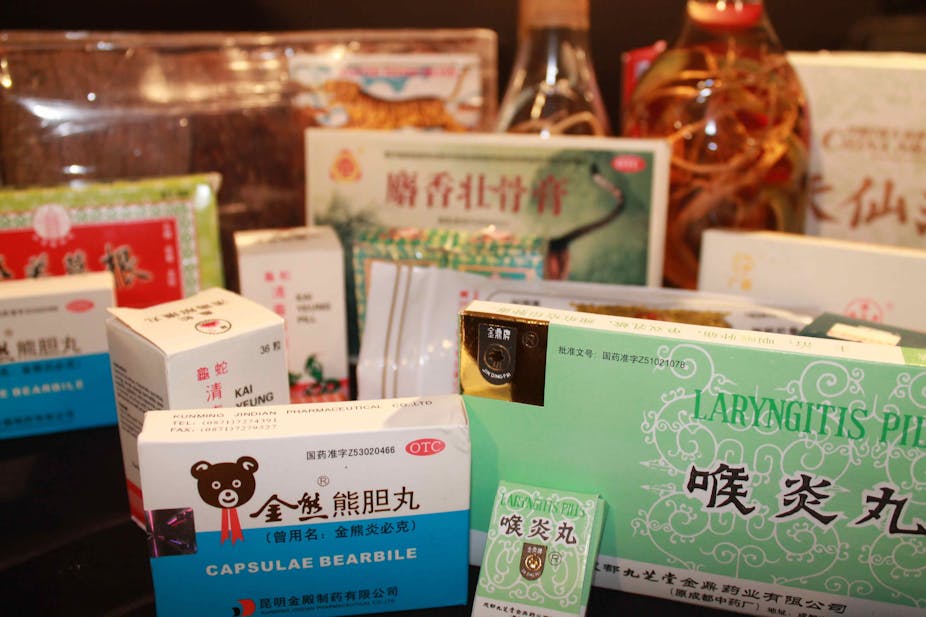
There are polarising views on the subject of complementary and alternative medicines (CAM). This website has recently published numerous article about the efficacy and regulation of CAM, the placebo effect and whether universities should train practitioners.
We don’t intend to cover this well-trodden ground. Rather, we’re sharing the results of research into the legality, safety and honesty in the labels of some traditional Chinese medicines (TCM).
Mystery ingredients?
When you buy a food product at the supermarket, you expect the manufacturing standards to be high; the product to be safe; and the ingredient list to accurately depict what’s in the product – regardless of whether it is locally grown or imported.
Surely the same or an even greater level of honesty is expected of medicines. Few would argue that consumers shouldn’t be provided with accurate information about medicinal products before deciding to ingest them.
This is especially important for CAM because the majority of herbal medicines are self-prescribed and administered. And because traditional Chinese and other herbal medicines are commonly processed into powders, pills or teas it’s difficult to reliably identify all their ingredients.
We set out to investigate the biological origins of traditional Chinese medicines by examining the DNA signatures of animals and plants contained within 15 medicines. The aim of our research, published today in the journal PLoS Genetics, was to see if new DNA sequencing technologies were effective in providing detailed audits of the plant and animal ingredients within selected products.
The results of the genetic audit don’t make pretty reading: we found this collection of traditional Chinese medicines routinely contain undeclared plants and animals, some of which are illegal.
What’s in a horn?
One product labelled 100% “Saiga Antelope Horn Powder” contained DNA of Saiga antelope (an endangered species protected by the Convention on International Trade in Endangered Species of Wild Fauna and Flora (CITES)) – so this ingredient was accurately declared.

But DNA from sheep and goat were not mentioned on the packaging but were found in significant amounts. What’s not known is whether products from sheep and goats were intentionally added as bulking agents or were accidentally introduced during the manufacturing process.
This traditional Chinese medicine also contained 13 different families of plants that were not declared. Clearly, the manufacturer’s claim of 100% Saiga antelope horn is false.
The dangers of plants
Unravelling the origins of the plants within traditional Chinese medicines represents a more challenging task than the identification of animals. This is because of both the sheer number of species used and the fact that plant DNA databases are a work in progress.
Within the 15 traditional Chinese medicines we tested, we detected 68 distinct families of plants encompassing scores of plant species. Clearly these products are complex blends of plant material – perhaps more complex than manufacturers realise, and certainly more complex than what’s declared on the list of ingredients.
Of particular concern to consumers is that some of the traditional Chinese medicines contained undeclared Ephedra and Asarum species. These plants can contain chemicals that are toxic in the wrong dose – but none of products with them actually listed a dose.
Ephedra is classed as a poisonous herb and products containing its extracts have been banned by the United States drug regulator, the Food and Drug Administration (FDA), since 2004.

Plants in the genus Asarum often contain Aristolochic acid, a known nephrotoxin (damaging to the kidneys), hepatotoxin (damaging to the liver) and carcinogen. Research published this week provides strong evidence of the link between Aristolochic acid in herbal medicines and the high incidence of urinary tract cancers in Taiwan.
To complement our genetic identification of Asarum, we conducted a metabolomic audit (capable of detecting chemicals in the traditional Chinese medicine) in a product labelled “laryngitis pills”. We were able to confirm the presence of Aristolochic acid.
We also detected the presence of DNA from the soy and nut families of plants, which may be of concern to consumers who have allergies. And again, the plants were not declared in the ingredient list of the products.
Concerns for consumers?
The issue of undeclared constituents has implications for consumers with religious beliefs or cultural practices (such as vegetarianism) that prohibit the eating of certain substances. Tianbao pills, for instance, contained cow DNA, and taking these pills may violate religious or cultural strictures (for instance, Hindus).
This problem is likely to grow as traditional medicines are increasingly being used by an ever wider cross-section of Australian society.
It’s manifestly obvious that herbal medicines should be carefully evaluated for legality, accurate disclosure of ingredients and pharmacologic activities. We advocate for the development and uptake of a combined genetic and metabolite auditing program to improve consumer safety.
Such a program could help regulate the herbal medicine market and, if implemented, would put manufacturers and importers on notice to accurately declare contents of traditional Chinese medicines and other CAM.
There’s a commonly held belief that because CAM are “natural”, herbal remedies, they’re healthy. This is clearly not so, and nor does it necessarily follow that traditional medicines are safe because they have a long history of use.
A recent opinion piece in the journal Nature said, “if TCM is to take its place in the modern medicine cabinet, then it must develop ways to prove itself”.
We concur and believe it applies to all herbal medicines. What’s more, it’s applicable to questions of efficacy, labelling and safety.
Ken Harvey
Adjunct Associate Professor of Public Health at La Trobe University
This study investigated 15 Traditional Chinese Medicines (TCM) seized by border protection officials upon entry into Australia.
These products had not been Listed on the Australian Register of Therapeutic Goods (ARTG) as is required for medicines sold in Australia. Although the Listing process contains no independent pre-market assessment of products it does require the manufacturer to certify that the ingredients come from the Therapeutic Goods Administration (TGA) approved “relatively safe…
Read moreStiofán Mac Suibhne
Contrarian / Epistemologist
Very valid point. Repeating this work on over the counter products sold in Australia deemed compliant with TGA would be a very interesting project.
Michael Bunce
ARC future fellow researching in the fields of ancient DNA and wildlife forensics at Murdoch University
I could not agree more regarding the expansion of this study to include herbals for sale here in Australia - it is the next logical step, and one that we are actively chasing funding for.
AJ Hyde
student
I also agree, and instead of using the title "Are traditional Chinese medicines safe and legal?", perhaps a more accurate title for this article would have been "Are 15 items seized by Customs safe and legal?"
I hope you can continue your research to test the thousands of Chinese medicine products that are actually used legally in Australia, rather than a few dubious and banned items, as that would be a much more useful project.
Christopher Yates
WHO Science Tech
If Chinese medicine worked, we would use it to cure disease. There would be no debate, and we would not call it Chinese medicine. We would call it medicine.
Luke Weston
Physicist / electronic engineer
Correct me if I'm wrong, but the importation into Australia of any supposedly therapeutic agent (synthetic organic, vegetable, mineral, enchanted water, whatever) where that agent is not TGA listed is illegal in all cases anyway, right?
Ian Musgrave
Senior lecturer in Pharmacology at University of Adelaide
There is a clause in the TGA rules which allows importation of small amounts of traditional herbal medicines for personal use.
Peter Ormonde
Peter Ormonde is a Friend of The Conversation.
Farmer
Excellent piece of research and a nice use of technique. One wonders why this procedure isn't routinely undertaken under the auspices of the TGA and Customs.
A few weeks ago I read a short report of a Chinese agriculture official commenting on the problems that had arisen in the Chinese dairy industry as a result of their being "too much" melamine in the final product. I suspect there is a long way to go on getting food standards and additives properly understood and implemented, let alone playing about with the active agents in purportedly therapeautic products.
Much more work needed.
Ken Harvey
Adjunct Associate Professor of Public Health at La Trobe University
Just as Chinese milk was “spiked” with melamine to fool chemical testing so have US products containing Ginkgo biloba been shown to be frequently adulterated or “spiked” with less expensive sources of flavonol glycosides, such as rutin (from buckwheat) that can trick routine testing to make a product with little or no real ginkgo appear to be real thing.
When the TGA was asked to investigate similar products in Australia 6 of 20 randomly sampled products had results consistent with adulteration…
Read moreRey Tiquia
Honorary Fellow, School of Historical and Philosophical Studies at University of Melbourne
In traditional Chinese medicine, the mapping of 'qi' constitutes its epistemic space while in Western biomedical medicine involves the clinical mapping of the virus, enzymes, genes etc. constitutes its clinical microworld, Hence the use of genetic sequencing may reveal the genetic profile of some Chinese medicines , but the knowledge generated from this proceedure is still quite remote from the clinical practice of TCM .
Peter Ormonde
Peter Ormonde is a Friend of The Conversation.
Farmer
What the arcane "traditional knowledge" like sticking the actual ingredients on a label?
James Jenkin
EFL Teacher Trainer
Maybe, Rey, identifying what's Chinese medicines is 'remote from the clinical practice of TCM'.
But no matter how they're used, the study shows they contain unwanted and potentially harmful stuff.
Michael Bunce
ARC future fellow researching in the fields of ancient DNA and wildlife forensics at Murdoch University
Hi Rey, I am not sure I understand this comment. Are you stating that because of the 'qi' and 'epistemic space' that it become irrelevant what is in the herbal preparation? If there are harmful ingredients in TCM then I am not sure how anyone, even clinical practitioners of TCM, would find this 'remote'?
Rey Tiquia
Honorary Fellow, School of Historical and Philosophical Studies at University of Melbourne
Well James, the use of Chinese medicines are guided by the embedded values of TCM practice . And these values incorporates practice standards which guides us to determine which medicines are beneficial or harmful.
Rey Tiquia
Honorary Fellow, School of Historical and Philosophical Studies at University of Melbourne
Hi MIchael, my comments are very straightforward . Please refer to my reply to James Jenkin above. In addition, I would like to add that doing the 'qi' constitute the 'whole' of TCM practice. And from this proceeds the values and standards of our practice. In the same breadth, 'doing the genes' constitutes the 'whole' of Western scientific medical practice and from which proceeds the values and standards of Western scientific medicine. This consitute the difference between the two epistemic and ontological practices. However, performing these two medical practices in the context of the clinic creates a common platform between the two systems. And we can use the notion of "doing the 'qi'" and 'doing the genes' to bring the two 'remote' research platforms together.
Sue Ieraci
Public hospital clinician
Mr Tiquia, do TCM practice standards ever conflict with orthodox assessments of toxicity? If they do, whose position should be accepted, in protecting the public?
Sue Ieraci
Public hospital clinician
Mr Tiquia - "doing the genes" is by no means the underpinning principle of orthodox medicine. It goes along with " doing the anatomy", "doing the physiology", "doing the pathology", mapping the neurology, imaging the cell membrane, doing the bench science - and so much more.
Effective medicine is not based on a single principle.
Joel Mayes
Bicycle Mechanic
And the effectiveness of this method is demonstrated by the high incidence on urinary tract cancer in Taiwanese TCM users?
Sue Ieraci
Public hospital clinician
A similar issue has occured with some aruveydic medicines exported from India and the US - there has been contamination with substances such as heavy metals. (ref http://www.nelm.nhs.uk/en/NeLM-Area/News/2008---August/27/Heavy-metal-contamination-common-in-Ayurvedic-medicines/
There appears to be a parcticular risk with remedies ordered over the net.
Ian Musgrave
Senior lecturer in Pharmacology at University of Adelaide
In this case it's not so much contamination, but that the heavy metals are part of the aruveydic treatment modality.
Marcus
logged in via Twitter
that 100% “Saiga Antelope Horn Powder” is not something you would be given by a TCM practitioner in Australia. You need to make this clear.
Michael Bunce
ARC future fellow researching in the fields of ancient DNA and wildlife forensics at Murdoch University
Hi Marcus - I am glad to hear that Saiga horn powder would not be something you would likely to buy in Australia, I am sure that the ~50,000 Saiga Antelope left in the wild today are even more grateful. It should not be sold in Australia as it is illegal under CITES. The issue here is bigger than just Australia however, the fact that there is an international market for this kind of product (and Saiga horn was only one example from this paper) is of concern.
Marcus
logged in via Twitter
also you can level this criticism at any medicines that people purchase off the internet. I don't know why this article is restricted solely to TCM. have you checked your inbox lately?
Ian Musgrave
Senior lecturer in Pharmacology at University of Adelaide
No, not really. Again, the issue here is that TCM and similar modalities are see to be extremely safe. And yet they can have significant toxic material in them.
On the internet, you are more likely to get talcum powder masquerading as Viagra. The issue of fake drug preparations in the developing world is very serious, and is already being addressed in various ways, but the strong public perception of herbal safety requires a significant public education campaing to present the uncomfortable reality.
Michael Bunce
ARC future fellow researching in the fields of ancient DNA and wildlife forensics at Murdoch University
Hi Marcus, this study was restricted to TCM as these are samples that we often get asked to do DNA identification for (i.e. to check for legality). You will be glad to hear that we are able to conduct these kind of genetic audits on a wide variety of substrates including food, faecal material, soil etc. We are actively expanding the genetic audits to other herbal products.
James Jenkin
EFL Teacher Trainer
Ian, interesting! Are medications advertised on the web (and in spam) often just talcum powder? Have you got any more detail?
Metta Bhavana
logged in via Facebook
Like the products mentioned, this article promise much but delivers little. It contains little discussion of the efficacy of CAM. It gives no assessment of general preparations prescribed by authentic Chinese practitioners. It takes a catch-all approach to a narrow range of probably rarely used quack cures. What percentage of the medicines tested were not-harmful? "Some" is statistically nonsensical. The article runs an agenda close to that of a tabloid television scare story. It's great that scientists are testing the quality of medicines of all kinds. It would be better if there was a wider study of efficacy, not mere scaremongering. Not your best effort Conversation.
Sue Ieraci
Public hospital clinician
On the contrary, Mr or Ms Bhavana. The introduction to this piece says "This website has recently published numerous article about the efficacy and regulation of CAM, the placebo effect and whether universities should train practitioners. We don’t intend to cover this well-trodden ground. Rather, we’re sharing the results of research into the legality, safety and honesty in the labels of some traditional Chinese medicines (TCM)."
The authors have done exactly what they have said they would do - present the results of their research.
I agree that it would be better if there was a wider study of efficacy - of any substances sold as a "therapy". However, it is the responsisbility of the proponents of that "therapy" to show its efficacy, not of forensic archaeologists.
Ian Musgrave
Senior lecturer in Pharmacology at University of Adelaide
It is an article about the _accuracy_ of labeling and potential _safety_ of herbal TCM's not an article about every aspect of CAM.
Regardless of the efficacy or otherwise of putative therapeutics, we would expect that they would be accurately labled and to not contain potentially harmful materials.
At the beginning of the article there are links to other articles discussing the efficacy claims of CAM's
Michael Bunce
ARC future fellow researching in the fields of ancient DNA and wildlife forensics at Murdoch University
Hi Metta. Sorry to hear you did not like the paper. You criticise the study for delivering little. I disagree. It delivered 50,000 DNA sequences contained in these 15 TCM samples - this is the first time such a comprehensive audit has been conducted on a medicinal product.
you state “It contains little discussion of the efficacy of CAM”. Efficacy can only be tested through evidence based research – it was not the aim of the study to test for efficacy. It shows a limited understanding of scientific…
Read moreJustin Case
Gardener
This whole article seems a gross misrepresentation of the little real data provided... lots of numbers does not necessarily constitute useful information.
Products already seized as suspiscious by customs does not in any way constitute a random or reasonable sample to extrapolate to every product available to people in Australia. More like selective evidence gathering.
Read moreUnscientific fear mongering to try and suggest this might be the case without any further evidence?
You appear oblivious…
Paul Rogers
Manager
The dangers of the extraordinarily potent carcinogen and nephrotoxin, aristolochic acid from Aristolochia sp. has been known at least for 10 years. (Dutchman's Pipe btw).
Mutagenesis. 2002 Jul;17(4):265-77. Aristolochic acid as a probable human cancer hazard in herbal remedies: a review. Arlt VM, Stiborova M, Schmeiser HH.
How much damage has been done in this time, and previously, from uncharted herbal remedies is anyone's guess. But my guess is that it would be substantial, and AA is not the only one.
Sue Ieraci
Public hospital clinician
Has anyone ever done a similar analysis of homeopathic "remedies"?
I'd be interested to see how one would distinguish water that no longer contains Nat.Mur. from water than no longer contains Arnica. It must be tricky doing quality control.
Craig W
Medical Student
I'm not an advocate of TCM, because I study modern medicine. However, how such some PhD from some university to implicitly inform the public the toxicity of TCM based of their preliminary finding is beyond me. It is a controversial issue, legally and politically, so IMO it has to be taken seriously. Their data CANNOT claim or even IMPLY the that TCM is toxic. Genetic sequencing does NOT analyze the chemical composition of a drug - it can tell what species are POTENTIALLY in it based on DNA, but DNA…
Read more