Asian century white paper sets tricky targets for universities

In the slip-stream of the Australia in the Asian Century White Paper, released by Julia Gillard yesterday, there is a one-off opportunity to evolve new programs, open up and engage in Asia at scale. Many of the new programs are likely to evolve in education and research. The report is short on specific…

Xfk2zc8g-1351420224
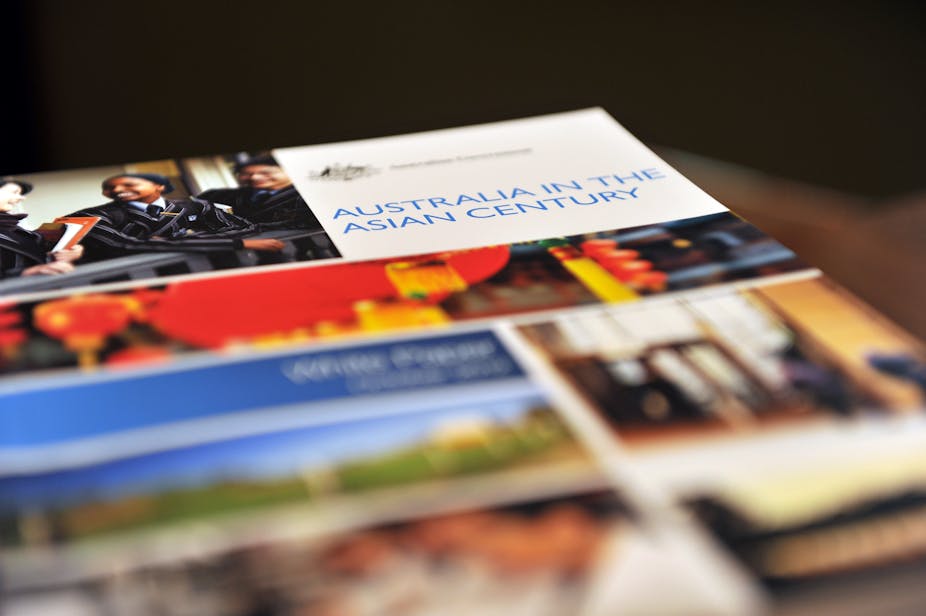
The white paper sets high standards for Australian universities in the Asian Century. AAP/Paul Miller

In the slip-stream of the Australia in the Asian Century White Paper, released by Julia Gillard yesterday, there is a one-off opportunity to evolve new programs, open up and engage in Asia at scale. Many of the new programs are likely to evolve in education and research.

The report is short on specific ideas because it wants them to bubble up from below. For a year or two, government will support program initiatives with unusual generosity. Asian Century Taskforce leader Ken Henry has created a window for Asianists with ideas.

Asia for the mainstream

The paper works as a strategy because it is utterly mainstream in tone. It does not rail at middle Anglo-Australia’s lack of Asian awareness from outside, though it could have. It does not dwell on the highly varied specifics of the sub-regions and nations under the heading “Asia”. Nor is it drenched in the rich excitement of 3000 years of Sinic, Indian and Southeast Asian cultures.

Instead it positions itself squarely in the Anglo-Australian mind. It wants to be Tony Abbott as much as it wants to be Julia Gillard. A laconic local drawl lurks behind the spare factual prose and in places you can almost hear it.

The white paper sets out to capture the mainstream, to change its thinking, naturalising regional engagement. Time will tell whether this works but the shift is essential. We must embed ourselves autonomously in the region. Or Australia, that odd nation at the end of Southeast Asia with a union jack on its flag, will be trapped in its history, in denial of its geography. It will become obsolete.

Sending students to Asia

The white paper sets few targets for higher education and science, again fostering an atmosphere where government and non-government initiatives and benchmarks will evolve. It emphasises people-to-people links, local demography and alumni. And it makes all the right noises. Asian languages in schools, compulsory Asia-related curricula (there will be rearguard resistance to this), more language learning in higher education, stronger research links in the region, and many more Australian students going to Asia during their degrees.

The last area on the above list — Australian study abroad — looks the most promising. Only about 4% of first-degree students study in Asia during their degrees. Even growth in two or three week stays will make a difference, starting the social and linguistic immersion which encourages longer stays and provides incentives for more protracted language learning at home.

The number of American students in China is trending sharply upwards, encouraging a behavioural change in Australia. The report goes in hard here. “We will provide more financial support and information for students who study in Asia,” it states. We have yet to see what this means but study abroad is receiving more attention in many universities. They should be talking to government as soon as possible.

Climbing the rankings

The white paper sets one new target: “By 2025, 10 of Australia’s universities will be in the world’s top 100”. The global ranking it cites, rightly, is the Shanghai Academic Ranking of World Universities (ARWU). This is an objective ranking that excludes reputation surveys and cannot be easily tricked up by universities.

It is also a research-only ranking. The target commits the federal government to a large increase in government research budgets over time. There is a close correlation between the position of universities in the ARWU and the level of public research funding.

Australia currently has five universities in the 2012 top 100: Melbourne (57), ANU (64), Queensland (90), Sydney (93) and Western Australia (98). The UK, which has the second strongest research system after the US, has nine. Canada, Australia’s closest comparator as a nation, has Toronto at 27. So the new target is a stretch. While Monash and UNSW are close to the top 100, the next in line, Adelaide and Macquarie, are in the 200-300 bracket.

It would be better to aim for six or eight in the top 100 and some in the top 40. Very strong research universities build local strength and draw global attention, especially in East Asia.

The National University of Singapore (NUS) has yet to crack the ARWU 100 — it lacks Nobels — but it is ahead of Australia on most research measures. In the Leiden ranking, which measures the scientific performance of universities, 13.9% of NUS research papers were in the top 10% of their field on citation rate between 2005-2009. The highest Australian university was ANU at 12.9%. Hong Kong University, Nankai, the University of Science and Technology in China and Postech in Korea were also ahead of ANU.

These rankings are encouraging, but we will need to build top-flight research capacity if we are to hold our own in Asia as the Asian Century White Paper suggests.

Join the conversation

8 Comments sorted by

  1. Stephen Manallack

    logged in via LinkedIn

    India is my area - not sure that we advance a lot via Hindi. Language might matter more in other countries but does not hold us back in India. Our biggest challenge is cross-cultural understanding and training/education in this can be readily available online. Hopefully this paper will make Aussies more interested. Student exchanges is a great idea and maybe workplaces could do something similar? For example, young and emerging corporate leaders exchanges. Presume this paper will all tie in with the good work of Asialink and Australia India Institute?

    report
  2. Tim Pitman

    Tim Pitman is a Friend of The Conversation.

    Researcher in higher education policy at University of Western Australia

    Nice article, thanks Simon. Two things interest me about the top 100 target. First, (as far as I am aware) this is the first time outside the higher education sector that the ARWU has been cited as an authoritative (read: objective) metric. Interesting how something that began as an internal institutional benchmarking tool (i.e. Chinese universities comparing their research performance against elite Western universities to work out strategies) is inexorably becoming the definitive device for all…

    Read more
  3. Greg Acciaioli

    University of Western Australia

    I find it flabbergasting that a publication that is seeking to increase Asia literacy would seek to orient Australian universities even more closely to the ARWU ranking and that the use of that ranking instrument should be endorsed ('rightly') By Professor Marginson in this column. If I may quote from the methodology page of the ARWU website, 'Arts and humanities are not ranked because of the technical difficulties in finding internationally comparable indicators with reliable data'. Orientation…

    Read more
    1. Tim Pitman

      Tim Pitman is a Friend of The Conversation.

      Researcher in higher education policy at University of Western Australia

      In reply to Greg Acciaioli

      When the Government's says it wants Australia to become more 'Asia literate', I believe it ultimately views issues of language, culture and sociology as utilitarian i.e. they are tools to allow us to engage with Asian economies. This is where 'literacy' and metrics such as the ARWU converge. My own analysis of the maiden speeches of all 150 members of the current Parliament show that when a politician says 'education' he/she invariably conflates it with economic growth, employment etc. For governments…

      Read more
  4. David Lamond

    Pro Vice Chancellor (Offshore Development) at Victoria University

    Hi Simon - thanks for your article; it raises important issues.

    The Australia in the Asian Century White Paper is a welcome addition to the national conversation about Australia and its place in Asia, geographically and economically, but does it really come to terms with our cultural engagement with Asia?

    Now it’s a fine thing that we promote learning about Asia (language and Asian studies in schools and universities) and learning in Asia (student exchanges and so on) but I read the document…

    Read more
  5. Donna McDonald

    Senior Lecturer / Convenor Disability Studies at Griffith University

    Yes, it is a good article, As a former Australian and Asian history student (at UQ in the mid-seventies), I am particularly taken by Simon's pertinent observation that the report:
    does not dwell on the highly varied specifics of the sub-regions and nations under the heading “Asia”. Nor is it drenched in the rich excitement of 3000 years of Sinic, Indian and Southeast Asian cultures.

    Learning an Asian language is certainly a useful goal. However, learning about the complexity, antiquity and richness of Asian cultures, societies, and histories is essential to building an improved understanding of their contemporary economies and politics. Given the absence of history departments from so many universities, we need to find ways of incorporating these elements into our courses where possible. I am trying to do this in my Disability Studies courses at the School of Human Services and Social Work at Griffith: the response from the students is keen.

    report
  6. Gavin Moodie

    logged in via LinkedIn

    It is true that high ranks for universities attract attention, but it is not clear that they do anything else aside from inflate the egos of their staff. The trickle down effect for research posited here is no more effective than economic trickle down.

    report
  7. Nattavud Pimpa

    Senior Lecturer in International Business at RMIT University

    Thank you Simon for this wonderful article. In my opinion, we need liberal educational financing system to push our higher education to the world-class level. Research and teaching on Asia and Asians must be promoted from all stakeholders in all disciplines. Otherwise, this White paper is just another political strategy.

    report