
Australia has had a pioneering role in the discoveries that underpin our understanding that some cancers can be caused by infectious agents. But we still face many problems that could be solved if we only had the will.
A recent article in The Lancet reported the results of a systematic review of the global burden of cancers attributable to infectious diseases. The review looked at incidence rates for 27 cancers in 184 countries. Of the estimated 12.7 million new cases of cancer worldwide in 2008, around two million were attributable to infectious diseases.
The four main infections that caused these were Helicobactor pylori, human papillomavirus, hepatitis B and hepatitis C. Overall, the study found that 16% of all cancers were attributable to infections; the good news is that many of these infection-related cancers are preventable.
Helicobactor pylori
In 2005, the Nobel Prize in Physiology/Medicine was awarded jointly to two scientists from Western Australia – Barry J. Marshall and J. Robin Warren. The prize was for their discovery of the bacterium Helicobacter pylori and its role in gastritis and peptic ulcer disease.
Rates of helicobacter pylori are reducing in most developed countries, including Australia, as a result. But the prevalence of H. pylori in Indigenous communities is two to three times higher than that in the non-Indigenous Australian population, with particularly high rates in rural and remote communities.
As recently as December 2011, there was still concern that Aboriginal and Torres Strait Islanders were at far greater risk of a range of gastric problems, including related cancers than their non-Indigenous counterparts.
Hepatitis B
Hepatitis B infection can be prevented with a safe and effective vaccine and much of Australia’s success results from the implementation of a vaccination program. But there are still populations that remain at higher risk of this infection. These include people born in countries where the vaccination program hasn’t been as effectively implemented or where implementation is recent.
This, however, is changing. China, the country with the most number of people infected with chronic hepatitis B in the world, has reduced the number of children with the illness to less than 1% of those under the age of five through vaccination.
But many of our neighbours need help vaccinating against hepatitis B. A 1998 letter to the British Medical Journal (BMJ) argued that the global burden of hepatitis B could be reduced more cost effectively if vaccination was targeted at highly endemic areas. In practical terms, this means that there’s a cost benefit for Australia to support vaccinating people in our region.
Hepatitis C
Reducing the transmission of hepatitis C is more challenging. While Australia was quick to secure the blood supply and support the operation of needle and syringes programs to prevent further transmission, an unsatisfactorily large number of people are still being infected with hepatitis C.

The association between hepatitis C transmission and unsterile injecting drug use (together with hostile attitudes and beliefs within Australia and the region about drug use), result in a reluctance to take the steps to reduce further transmission.
Key challenges remain for Australia to reduce the cancers associated with both hepatitis B and hepatitis C infections. It’s been estimated that about one-third of people in Australia with chronic hepatitis B remain undiagnosed and unaware that they’re infected. Added to this figure is the fact that less than 2% of the people who know they have the infection actually access hepatitis B specialist services.
Similarly, while Australia has been relatively successful in diagnosing people infected with hepatitis C, access to clinical services remains unspectacular.
In 2010, the World Health Assembly adopted a resolution acknowledging the impact of chronic viral hepatitis and identifying a series of interventions to address it. But most governments in our region have made slow, if any progress, in developing a comprehensive and coordinated response.
Australia was the first country in the world to have a national strategic approach to hepatitis C, and in 2010 developed its first National Hepatitis B Strategy. But while these strategies provide the framework for implementing a range of programs, the lack of funding to support them fundamentally limits their effectiveness.
Human papillomavirus
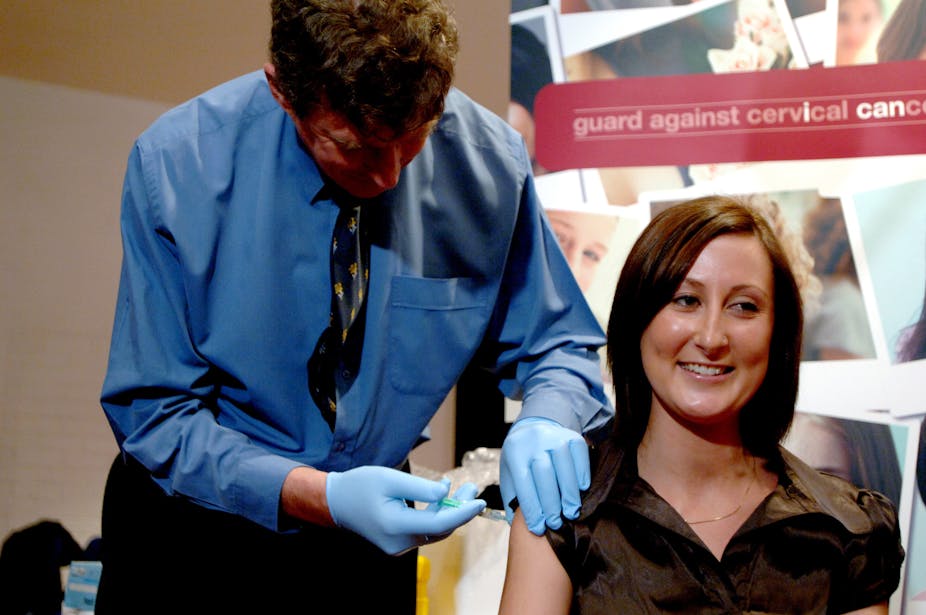
In 2007, Australia was the first country to introduce the Gardasil vaccine free to girls aged 12 and 13, via a school-based program. The success of this program is already apparent in reducing the incidence of cervical abnormalities in young women who have received the vaccination.
The current HPV vaccination program will ensure that cancers of the cervix related to some types of HPV will continue to fall. But there’s increasingly strong evidence (some of which was included in this review) that HPV is also associated with penile and anal cancers, as well as oropharangeal (mouth and throat) cancers.
These cancers affect men, and the Pharmaceutical Benefits Advisory Committee (PBAC) last year recommended the Gardasil vaccine be given to boys aged 12 to 13 in a school-based program.
The Federal Government is considering the recommendation, but to date, there still hasn’t been an official announcement about the measure. We don’t know how much longer we need to wait before the government rolls out the vaccine to young men.
So where does this leave with infection-related cancers? There’s a pattern here – excellent beginnings, but a lack of follow through. We know how to prevent these cancers and we have the tools, but do we yet have the will?
Sean Lamb
Science Denier
With regard to the papillomavirus vaccination of boys, I wonder if there is not a more effective strategy of achieving the public health outcome rather than the mass vaccination of children, the vast bulk of whom will not end up in the at-risk population.
When you tell parents that the potential risks are from anal and throat/mouth cancers, most of them are going to work out what that means - come to think of it these days most 12-13 year old boys are going to as well.
Since the gulf war syndrome…
Read moreSean Lamb
Science Denier
I can see the thumbs down brigade are already mobilising!
I am hoping I can beat my previous record of 33 "unconstructives"
Anne Coady
logged in via Twitter
"Excessive vaccination" and specifically the anthrax vaccination have been ruled out as causes of the "Gulf War Syndrome", perhaps since you "stopped following the literature". It is unwise of you to use this Conversation on cancer prevention as a forum for anti-vaccination rhetoric.
The HPV vaccination campaign for 12-13 year old girls has widespread community acceptance. There is no reason to suppose that parents would reject the HPV vaccination for their sons, not only as cancer prevention but to prevent the transmission of genital warts.
Your reliance on telling parents of teenagers, and teenagers themselves to change their sexual behaviour to avoid infection and transmission of HPV is highly unlikely to be "an effective strategy", particularly as you seem to have missed the reference to penile cancers when you were working out the "potential risks".
Sean Lamb
Science Denier
""Excessive vaccination" and specifically the anthrax vaccination have been ruled out as causes of the "Gulf War Syndrome", perhaps since you "stopped following the literature". It is unwise of you to use this Conversation on cancer prevention as a forum for anti-vaccination rhetoric. "
Source?
http://www.ncbi.nlm.nih.gov/pubmed/22235052
Since I quite specifically state that I readily accept vaccinations myself, I don't believe I can be accused of anti-vaccination rhetoric.
I simply take…
Read moreJoel Mayes
Bicycle Mechanic
Sean writes
"With regard to the papillomavirus vaccination of boys, I wonder if there is not a more effective strategy of achieving the public health outcome rather than the mass vaccination of children, the vast bulk of whom will not end up in the at-risk population."
The at risk population for HPV anyone sexually active, are you suggesting that most people remain celibate or that most people only have a single sexual partner for their entire lives?
HPV is also associated with penile cancers (and a many others, this is the one that breaks the gender divide), which though less frequent then cervical cancer is worth preventing.
Sean Lamb
Science Denier
I suggest you read the original article which clearly sets out the risks
https://theconversation.edu.au/the-case-for-vaccinating-boys-as-well-as-girls-against-hpv-6
If you are really concerned about penile cancer you will probably find circumcision provides a far greater (and wider) degree of protection.
I am just pointing out inevitable reactions. Parents and children will work out what the reason vaccination is being promoted for and the reaction is predictable.
What is equally predictable is that academics will charge up and down calling ordinary Australians bigots, homophobes, ignorant, anti-science and unenlightenee. Something I am sure they will highly enjoy.
And who am I to interfere with the fun?
Joel Mayes
Bicycle Mechanic
How does circumcision prevent penile cancers caused by HPV?
Joel Mayes
Bicycle Mechanic
Pardon the double reply!
Sean writes
"I suggest you read the original article which clearly sets out the risks"
"Group A most at risk" does not equal "Risk is exclusive to Group A"
You should read all the way to the end of the article where it states
"If 80% of boys were also vaccinated, the risk of unvaccinated women developing HPV-related disease would be greatly reduced through so-called “herd immunity”, because four out of five of their heterosexual partners would be vaccinated."
Sean Lamb
Science Denier
Yes, but the logic flaw is self-evident. I mean you could argue that because girls get vaccinated then boys should also, but that is not based on a health benefit to the individual - as such it is susceptible to be rejected, particularly if social pressures make taking the vaccine unpopular amongst boys.
I haven't seen figures that argue one way or another, but I suspect that penile cancer will have a higher incidence in gay men, simply because they are probably exposed to a greater HPV load - but I will accept correction on this. BTW if you want to read something jaw dropping (for me), try this
http://www.ncbi.nlm.nih.gov/pubmed/22023719
Regarding circumcision, it is associated with protection from a number of STDs including HIV. I don't think it is known for certain why.
Joel Mayes
Bicycle Mechanic
Yes it is, You appear to be arguing that boys shouldn't receive this vaccination because homosexuals and Zoophilia.
These links might help you umderstand the errors in your argument
http://en.wikipedia.org/wiki/Non_sequitur_(logic)
http://en.wikipedia.org/wiki/Cherry_picking_(fallacy)
Sean Lamb
Science Denier
"Yes it is, You appear to be arguing that boys shouldn't receive this vaccination because homosexuals and Zoophilia."
No I didn't. Try the wikipedia on strawman.
Although I do admit to being astounded that 30% of control sample in Brazil said they had sex with animals! However, that was clearly an aside - I simply came on that article while trying to find if any papers said if HPV and penile cancers were more common in gay men or not.
Your dishonesty in debate is noted.
Sue Ieraci
Public hospital clinician
"Since the gulf war syndrome which, at least up to the point I stopped following the literature, the most likely culprit identified was excessive vaccination load,"
Sean Lamb - if you had kept following the literature, you would know that "Gulf War Syndrome" turned out not to be a syndrome at all. So, if that was your premise for avoiding vaccination, you can now go back to vaccinating.
Sean Lamb
Science Denier
Great, if you could link to the definitive pubmed entry that says Gulf War Syndrome doesn't exist. Because someone forgot to tell these guys
http://www.ncbi.nlm.nih.gov/pubmed/21795757
http://www.ncbi.nlm.nih.gov/pubmed/20708902
http://www.ncbi.nlm.nih.gov/pubmed/20955779
http://www.ncbi.nlm.nih.gov/pubmed/14997036
For a Syndrome that doesn't exist there seems to be an awful lot of publications on it.
As I said, and I note this as yet another piece of dishonesty in debate so common by…
Read moreSue Ieraci
Public hospital clinician
Sean Lamb - the reason there are so many publications is that people noticed that soldiers returning from war suffered a variety of health problems. This is hardly surprising. The outcome of resarch, however, is that there was no single "syndrome".
If you really want to understand the issue better, here is a good reference:"Review
War Syndromes and Their Evaluation: From the U.S. Civil War to the Persian Gulf War" (at http://www.annals.org/content/125/5/398.short: )
Here is an extract:
Read more"Poorly…
Sean Lamb
Science Denier
1. Dr Ieraci, yet again you show an inability to comprehend the medical literature that is alarming in one of your profession. Is it normal for clinicians to be so deficient? Or you exceptionally poor in this regard.
Read moreThe article you choose is from 1996, it does not claim to demonstrate the Gulf War Syndrome does not exist, rather it says there are a great number of uncertainties around the issue. You, deceitfully I might add, edit out the conclusion: "Conclusion: Until we can better understand…
Jack Arnold
Director
Pitts & Wallace have identified the pathogenic agents that we as new postgrads suspected existed 40 years ago.
So the solution is quite easy. Papilloma virus & Hep B require immunisation for both sexes. Helicobacter has a pharmceutical control.
Only Hep C requires social change, notably the decriminalisation of presently proscribed 'social' drugs for users prepared to register & receive their 'hits' from the pharmacy of associated hospitals as a medical benefit cost.
This strategy was used in the UK until the mid-60s then discontinued to allow the illicit drug market to flourish.
But then, how far up the food chain do the profits from illicit drugs presently rise because this strategy will knock the profit out of the 'social' drug market.