Australia, India must look beyond lost decade

Many Indians still perceive Australia as a white, monocultural country, according to the authors of a major report that says relations between the two countries are on the mend but remain brittle. Despite a series of attacks on Indian students in 2009, Indians once again rank Australia as a top 10 country…

Pgjrh77f-1342519413
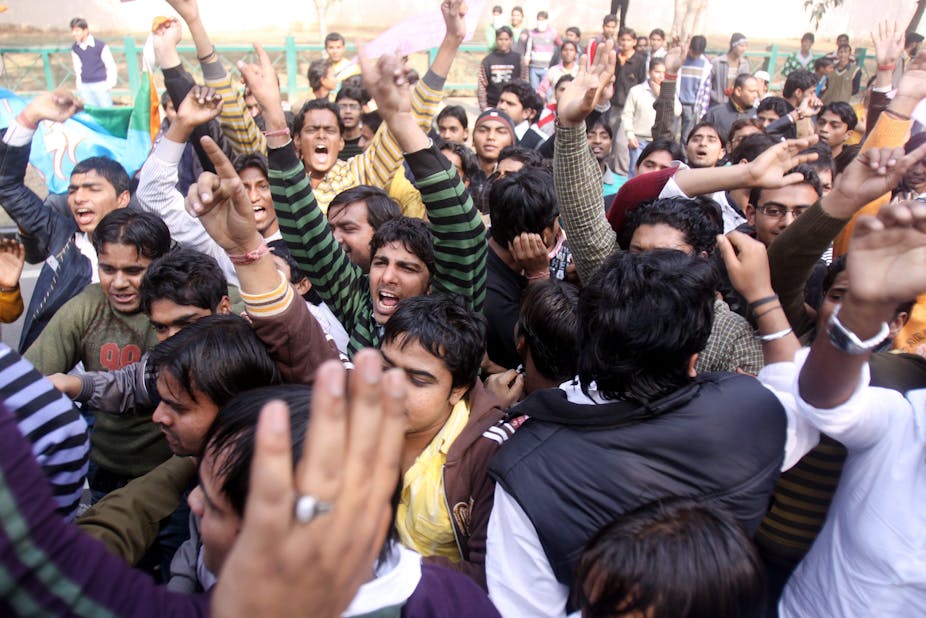
Indian students scuffle with Delhi police in a 2010 protest against attacks on Indian students in Australia. EPA/Anindito Mukherjee

Many Indians still perceive Australia as a white, monocultural country, according to the authors of a major report that says relations between the two countries are on the mend but remain brittle.

Despite a series of attacks on Indian students in 2009, Indians once again rank Australia as a top 10 country. But much more needs to be done to foster a relationship that years of neglect have left to wither, says Beyond The Lost Decade, a report by the Australia India Institute at the University of Melbourne.

The report calls for a rating system to downgrade states if they do not offer adequate security and education to international students, and says Australian school teachers should receive training in Hindi in anticipation of the addition of the language to the curriculum.

Additionally, it calls on Canberra to double the Department of Foreign Affairs and Trade’s public diplomacy budget to $10 million per year, and recommends – as a show of goodwill – extending the visas of Indian students caught up in changes to regulations following the crisis of 2009.

Enrolments by Indian students in Australian universities have fallen from a peak then of 120,000 to 37,453 in March this year.

One of the report authors, Ashok Malik, a prominent columnist for Indian newspapers and a Fellow of the Australia India Institute, said that “beyond the commonalities [of the two countries], frankly the relationship has lacked substance… it has been sub-optimal and has not achieved even a quarter of its potential.” For many Indians, exposure to Australian culture has come largely through contests on the cricket field, where the Australian team has long presented a monocultural face to the world, he said.

Amitabh Mattoo, appointed the first Director of the Australia India Institute last year, said that when he arrived in Melbourne he shared the impression that “Australia is not as multicultural as I found it. But it has been a most pleasant experience.

“Australia is not naturally multicultural. It’s about policy. It’s not organic. I think it’s great that in every aspect of public life there is a commitment to multiculturalism.”

Eventually, Professor Mattoo said, it would be “good to actually try and actually find out what happened in Melbourne [during the attacks on Indian students], and what was responsible for what was really an aberration, something which was a departure from the past and completely different from the way I see Melbourne today.

“If you drive from Melbourne University to Kew, you are traversing the geography of Asia, from little Saigon in Richmond, to Chinese in the CBD, to an Indian quarter. It’s fantastic.”

Report co-author Christopher Kremmer, a former foreign correspondent to India for the ABC and Fairfax newspapers, said: “In retrospect I think we could have called them the lost decades. The problem in the Australia-India relationship obviously has deep historical roots in the Cold War.

“It’d be fair to say that neither country was ready for a deeper relationship until 1991, when India started to open its economy, and the collapse of the Soviet Union and the whole game changed. What’s interesting about the relationship is that in the 20 years since India did start to open its economy, there has been a sense of spinning our wheels, not because diplomats haven’t been working hard, not because there hasn’t been political goodwill, but just because our attention has been elsewhere and some of the issues that have been important to the relationship have been very difficult issues – the uranium issue, the nuclear tests have challenged us.

“Ultimately it did come to a head in 2009, which was the big test, when the student crisis unfolded. And what surprised me about the student crisis was that it didn’t lead to a worse breach. In fact, it became a kind of opportunity to bury decades of benign neglect – cricket, democracy, the Commonwealth, an assumption that we knew each other.”

The authors of the report were unanimous in their criticism of Australian businesses for lacking the staying power needed to establish themselves in India. ANZ previously owned the Indian bank network Grindlays, but sold this to Standard Chartered in 2000. In the 1990s Telstra was among the first telecom companies to win mobile service licences in India in collaboration with a local business conglomerate. A few years later it chose to sell out and leave – today there are about 800 million mobile phone subscribers across the country.

John McCarthy, national president of the Australian Institute of International Affairs, said that “in all Asian countries, and particularly India, perseverance is the key … I see this as a fault generally with Australian business in Asia. It is a factor in the way we look at Asia that needs to be remedied.”

Sign in to Favourite

Want to follow The Conversation?

Sign up to our free newsletter to get the day's top stories in your inbox each morning, with a special wrap on Saturday.

Become a friend of The Conversation and donate

Join the conversation

27 Comments sorted by

  1. Peter Ormonde

    Peter Ormonde is a Friend of The Conversation.

    Farmer

    OH my goodness ... "lacking the staying power to establish a business in India" .... That could only be written by someone who has never tried to do real business in India. Corrupt, lazy, inefficient and deeply dishonest would pretty much sum up my understanding of the men I dealt with over several years. At every EVERY level. Not so the women, or at least significantly less so.

    India - a wonderful, vibrant, nasty, hard and unequal place.

    The emergence - eruption - of the Indian middle class…

    Read more
  2. Chris Carmody

    logged in via Facebook

    After being two India twice I could comment that it is a black monoculture - how profound. I am amazed how accommodating Australian are and the diversity of cultures we accommodate compared to many of the Asian countries I have visited. And I did not like the way the women are treated in India. But in my comments I am mindful that India is 16 states and my two visits have only been to one state.

    report
  3. Peter Gerard

    Retired medical practitioner

    I agree with most of the above comments. The attacks on Indian students, in 2009, has resulted in an orchestrated overreaction, that I feel is intended to produce a response from our politicians that results in the softening of entry criteria for courses in this country. These courses are an entree to full citizenship and there is no doubt that this is a prime motivator. The system was being abused by students and the training institutions and the government was quite right in tightening eligibility.

    report
  4. Sukhmani Khorana

    Lecturer in Digital and International Media at University of Wollongong

    As someone who first arrived in this country as an international student (notably with no interest in, or hope of gaining permanent residency), and at a time when overseas students weren't treated like cash cows to the extent they were in subsequent years, I feel compelled to shed light on a few matters:
    1. International student security and welfare, both on and off campus, are huge concerns regardless of whether they eventually apply to work or live here. There is a growing number of cases of female…

    Read more
  5. John Holmes

    Agronomist - semi retired consultant

    Having visited India several times, I have been struck by the incredibly wide gap between the privileged few and the rest. Culture shock occurs to most of those who are not closeted away in 5 star hotels and walk the streets with local guides.

    Listening to a mother who watched her 18 month old boy stolen from in front of her, yes she lives on the street and is lame, reply to the question "Did you go to the Police?" she said "No, I did not have sufficient for a bribe, I would get beaten…

    Read more
  6. Michael Leonard Furtado

    Doctor at University of Queensland

    Great article! Concerned about some of the responses missing the point that elites in one country expect to talk only with elites in another in a kind of 'policy officialese' that's often missing in Australia, but which John McCarthy has been wise to remind us about.

    Its at this level that Indians are often appalled by Australian educational and other discourse, which makes no pretence to recognise and respect an archetype of the aspiring educated Indian, in the manner of those Indians, who despite…

    Read more
    1. Peter Ormonde

      Peter Ormonde is a Friend of The Conversation.

      Farmer

      In reply to Michael Leonard Furtado

      Ah yes Michael it's a shocking business all this Australian stuff isn't it ... all that democracy with at least its appearance of classlessness and certainly castelessness? Why even the offer of a decent bribe gets one nowhere examwise. We just have no respect for money and social status. Barely civilised at all. Not a place for tall poppies at all.

      Give me some rough crude "bogans" anytime - not racists of course but people who will take new arrivals on face value and the content of their hearts rather than the contents of dad's wallet and their notions of social superiority.

      Let's talk about changing the nature of the students we select - people who want, need and really appreciate a chance - rather than changing our own character to meet these appalling expectations of the emerging middle class.

      But there's not much of a quid in that sort of business for our Universities is there?

      report
    2. Michael Leonard Furtado

      Doctor at University of Queensland

      In reply to Peter Ormonde

      Peter, I conceed every point you make about the contradictions and conceits that Indian life offers. My concern relates to the gaps in our own discourse, which help explain why we're at the bottom of the English-speaking table in terms of India's current assessment of our desirability as a destination for study and business.

      While we are certainly all too easily recognised for the wealth and other material opportunities that we offer to potential migrants, there is a disdain in the Indian psyche…

      Read more
    3. Peter Ormonde

      Peter Ormonde is a Friend of The Conversation.

      Farmer

      In reply to Michael Leonard Furtado

      No argument from me regarding the historical greatness of India and the respect the various cultures of India deserve. Curiously the metropolitan middle class monoculture that is emerging in India has little respect or regard for these cultures or traditions. And we are helping to do that.

      It's a commercial transaction this lure of overseas fee paying students. Let's not dress it up as some sort of aid program. We're doing this for a quid and the consequences for India are far from benign…

      Read more
  7. Michael Leonard Furtado

    Doctor at University of Queensland

    No difficulty with your prescriptions, either, Peter; but your proscriptions about social justice, limiting it simply to a discourse of human rights and equity, are ironically unworkable, I'm afraid, because they appear to preclude all other considerations of consumption, economics, competition, science and technology, innovation and sustainability, property ownership and work.

    Any review of the rise of capitalism and liberty in the West over the past half-millennium and its current takeover by…

    Read more
    1. Peter Ormonde

      Peter Ormonde is a Friend of The Conversation.

      Farmer

      In reply to Michael Leonard Furtado

      A yes social development ... always so much sweeter when we can make a quid out of it isn't it Michael?

      The mixed blessing always seems to be distributed the same way doesn't it? Some folks just get to wear the price of progress ... in India's case a lot of folks actually.

      Now don't go trying to paint me as some "gated community" absurdist Michael. I'm all for opening up this place that people who need to come, who have nowhere else to go, who want a future for their kids. But that is…

      Read more
    2. Michael Leonard Furtado

      Doctor at University of Queensland

      In reply to Peter Ormonde

      So how will we set up a Gandhian solution to the problem, Peter? Most of Gandhi's solutions (low technology, a protectionist government, non-aligned foreign policy) were implemented within the forty year phase after Indian independence. The poor actually got poorer over that period of time. Are you linking this with middle-class corruption, graft and the like, or was Gandhi's philosophy, some of it quite esoteric, also wrong?

      In the several phases of global development that might explain why Australia…

      Read more
    3. Peter Ormonde

      Peter Ormonde is a Friend of The Conversation.

      Farmer

      In reply to Michael Leonard Furtado

      No Michael, our wealth at least has been founded on what we found here ... stealing by finding according to Common Law. But our "social capital" - not a notion I accept incidentally comes from the people who came and yes from the notion of a fair go, and from the (ongoing) political struggles to establish it in practice.

      We delude ourselves if we believe we have a reputation for fairness. Our neighbours well remember the White Australia Policy and the selectivity of our fairness; they find our…

      Read more
    4. Michael Leonard Furtado

      Doctor at University of Queensland

      In reply to Peter Ormonde

      I understand the prognosis, Peter, but I dont agree with the diagnosis. Its rather more replete with punitive and, in my view, unrealistic correctives than with any of the altruism that used to be part and parcel of AIDAB and British Council development assistance policy frame.

      In fact, Gandhi himself (not a Marxist and disinterested in using the class theory that you insist upon) would observe that there's not much that's Gandhian in your analysis, given that you're more interested in stopping…

      Read more
    5. Peter Ormonde

      Peter Ormonde is a Friend of The Conversation.

      Farmer

      In reply to Michael Leonard Furtado

      Michael,

      I'm glad you have some on the ground contacts in the field in India. Especially with the scheduled castes. Your cousin will be able to tell you how things have been going for the Dalits during the great economic boom. The point is that they are not just being left out of India's economic miracle - they are being ground down even further. The new wealth comes from a very old source Michael.

      Now as for Gandhi - fully aware that he was no simplistic marxist. I don't think a simple…

      Read more
    6. Michael Leonard Furtado

      Doctor at University of Queensland

      In reply to Peter Ormonde

      Thanks, Peter. I admire your passion and commitment to justice.

      A minor detail: the Indian class constituency that you object to is not 'Old India' or in any other way an exact replica of an intransigent and unchanging plutocracy, but indeed a 'New India' with a strong mercantile profile.

      There are few 'Brahmins', and especially Bengalis here, but lots of 'Kshatriyas' or warriors, quite a few of them Punjabis, who a generation ago would have been hereditary farmers, and quite a few Gujeratis…

      Read more
    7. Peter Ormonde

      Peter Ormonde is a Friend of The Conversation.

      Farmer

      In reply to Michael Leonard Furtado

      Not feeding them - they were out - a mass breakout - a feathery riot - and were into the strawberries! Not a retreat by any means - a crisis of most dire consequences.

      As I implied above the old India is changing - from its traditional castes to an economic domination ... but it is substantially built on the grinding down of the poor and the dispossessed. It is not about making money - it's about taking it from others... the usual system. It's a pity that Australian Universities want to be joining in to make a quid out of it

      I reckon your cousin would be able to fill you in on the "microtheoretical flaws" far better than I could from here and I suspect that he is most ambivalent if not hostile to the modern miracle and its consequences for the poor. The fate of India's poor is not microtheoretical. Not theoretical and certainly not micro.

      report
  8. Michael Leonard Furtado

    Doctor at University of Queensland

    Peter, sorry you were faced with a massed feathery uprising. Not being able to control your chooks (are they Indian?) suggests that all may not be too well in the Ormonde household. Perchance we need Dianna's help, lurching from crisis to crisis with finely honed skills in policy analysis but not much chance of a solution, and instead a marked persistence in singling India out for demonisation over all other contenders.

    I checked, as you suggested, with my cousin, whose parish is not far from…

    Read more
    1. Peter Ormonde

      Peter Ormonde is a Friend of The Conversation.

      Farmer

      In reply to Michael Leonard Furtado

      No no no Mr F, my chooks are an American breed, silver and gold laced wyandottes... cute but rebellious to the core.

      Now I reckon you're just having an argument rather than a discussion. I am not - definitely not - singling out Indians as uniquely corrupt. But this article is about India and "the lost decade". Ghana and Pakistan probably beat it hands down. Poverty and despair rarely bring out the best in people.

      I am not saying that Indians are uniquely pathologically inclined to bend…

      Read more
    2. John Holmes

      Agronomist - semi retired consultant

      In reply to Peter Ormonde

      Good to see that well looked after chooks do manipulate their carers, something about the domestication of humans by their animals there.

      I showed your comment "the modern miracle sees the children of the poor being devoured as if they did not exist." to my wife who with congratulates you on succinctly summarizing the issues She sees in the community development project that she is assisting in the India. I mentioned some of the problems seen in my comment above above.

      Working in a small firm…

      Read more
  9. Michael Leonard Furtado

    Doctor at University of Queensland

    I've never said that Peter was a racist, nor indeed have I criticised him for his forthright and unequivocal defense of the Dalits. Indeed, I share these concerns with him and have established my credentials, as an educator committed to social inclusion, as committed to the struggle to protect and improve their rights.

    What I have taken issue with is the more than a detectable whiff of sinking the slipper into victims of Australia's neoliberal Indian student-enrolment policy frame that has sought…

    Read more
  10. Oliver D'Souza

    logged in via Facebook

    I think there could not be a bigger misrepresentation than saying that the economic boom in India has benefited the <a href="http://www.truthaboutdalits.com">Dalits Of India</a>. Sir, the real fact is that the boom has happened for those who had something - money or liquidate-able assets to garner money that they could invest or put in self-emancipation efforts through the opportunities provided by the boom. But the fact fact is that most dalits have very little money to even eat two square meals a day. The boom has passed them by as has everything else. Let's not be fooled, the upper castes get keeping richer the Dalits keep getting poorer. That's the reality.

    report
    1. Oliver D'Souza

      logged in via Facebook

      In reply to Oliver D'Souza

      Correction to previous post:

      I think there could not be a bigger misrepresentation than saying that the economic boom in India has benefited the ("http://www.truthaboutdalits.com";) Dalits Of India . Sir, the real fact is that the boom has happened for those who had something - money or liquidate-able assets to garner money that they could invest or put in self-emancipation efforts through the opportunities provided by the boom. But the fact fact is that most dalits have very little money to even eat two square meals a day. The boom has passed them by as has everything else. Let's not be fooled, the upper castes get keeping richer the Dalits keep getting poorer. That's the reality.

      report
    2. Michael Leonard Furtado

      Doctor at University of Queensland

      In reply to Oliver D'Souza

      Thanks for your post, Oliver. I agree entirely with you and speak as an Australian Indian whose entire professional and personal life in one form or another has been committed to drawing attention to and promoting human rights while redressing social injustice on several fronts. My concern about this blog, if you'd care to follow the thread, is the extent to which some of its contributors have used the undoubted corruption and inability of India's social, political and economic systems to deliver…

      Read more
  11. Stuart Clark

    Student (UQ)

    I would like to see the Indian establishment and educated classes spend more talking about the enormous differences in wealth between themselves, and the poorer people in their society, rather than blaming other cultures (particularly "whites" as they do), and whinging about not having someone to hold their hand once they disembark at Tullamarine airport (I've moved abroad a couple of times before, and yes, settling in is tough)... this typically comes from individuals within the Indian community…

    Read more