
Australia, Israel and the politics of diaspora

Australia is home to a many diasporas: communities of migrants and their descendants who maintain a spiritual or material connection to their mythical or physical homelands, be it their place of birth or a location with deep spiritual and cultural significance. With nearly one in four Australians born…

879zwhr9-1328074060
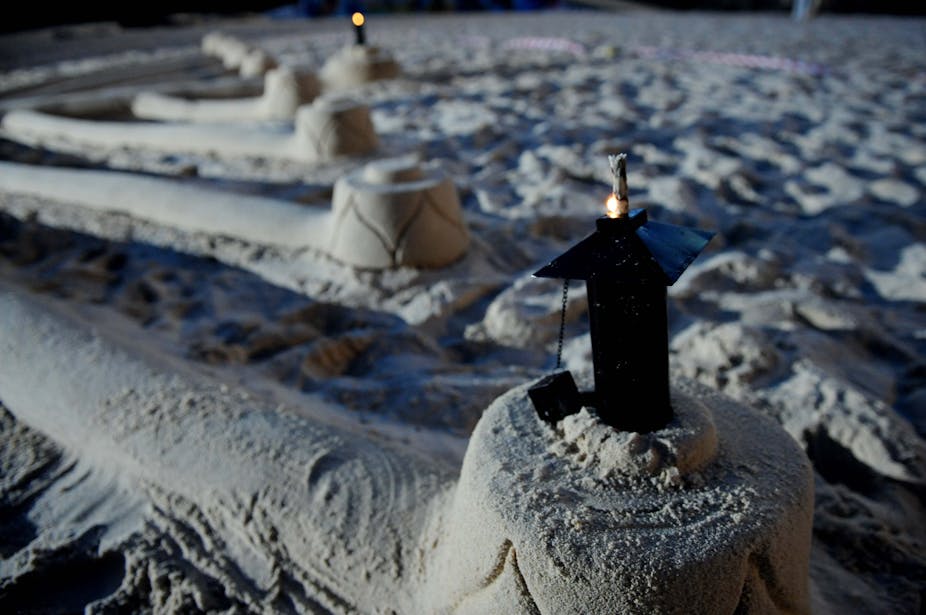
Chanukah lights on Bondi Beach. AAP/Tracy Neary

Australia is home to a many diasporas: communities of migrants and their descendants who maintain a spiritual or material connection to their mythical or physical homelands, be it their place of birth or a location with deep spiritual and cultural significance.

With nearly one in four Australians born overseas, not to mention all those descended from migrants, many communities are shaped by their multiple, overlapping, and sometimes clashing attachments.

Whether those attachments are to Greece, Italy, China, India, Sri Lanka, Ireland or any of the dozens of countries from which Australians have migrated, they are complex, as new identities are carved out, accommodating new and old homes.

The fluidity of diaspora identity

In many cases, migrants and their children have arrived in Australia from a third country where their families may have lived for generations. Go to any international cricket match at the MCG, for example, and you will see groups of Indians supporting South Africa and New Zealand.

The ways in which migrants connect with their homelands are through communication with friends and relatives, participation in mutual aid and cultural societies, or by sending money back to family or local charities.

How far does their support for the homeland extend? Do they act as de facto defenders of the homeland in the countries in which they live, a kind of embassy whose institutions and individuals monitor public representations and debates relating to their identified homeland?

What responsibility does a society have when it is the home to two diasporas on opposite sides of a conflict overseas? What about when communities provide material support for groups in their homeland that are not allied to the country of residence, or that are hostile to that country? How does a government balance its foreign policy responsibilities with the needs and demands of its constituents?

Australian Jewry and Israel

One of the oldest of these diasporas in Australia is the local Jewish community. Sociologists and historians have long considered Jews to be one of the three “classical diasporas” (along with Greeks and Armenians), with their historic connections to the mythical Zion (and since 1948 to the state of Israel) and their dispersion around the world.

Australian Jews have long supported Israel. Described by filmmaker and academic Danny Ben-Moshe as “the most Zionist Diaspora Jewish community”, the level of attachment most Jews in this country feel towards Israel is significant.

Of course, not all Jews feel the connection. Many Jews feel ambivalent towards Israel, whereas others are hostile. The majority, however, can be said to have a special affection towards Israel, a sense that it is a homeland.

First cousins to Israel?

According to a recent survey carried out by Professor Andrew Markus of Monash University, nearly 80% of the 5100 respondents in Melbourne and Sydney identified as Zionist, which the survey defined as feeling “connected to the Jewish people, to Jewish history, culture and beliefs, the Hebrew language and the Jewish homeland, Israel.”

Or as Israeli scholar Professor Fania Oz-Salzberger put it in a 2009 op-ed in the Australian Jewish News, Australian Jews are “first cousins to us Israelis, while many other communities are second cousins at best.”

This relationship manifests itself through visits to Israel, the maintenance of family relations, and both moral and material support (although it’s difficult to assess the actual financial contribution that Australian Jewry makes to the state of Israel).

Connection to homeland

It’s a different relationship to that of other local diaspora communities. Without doubt, other diasporas share a spiritual connection to their homeland; there are often family connections, and it is normal to offer moral and material support.

But there is a crucial aspect that separates the Jewish community: although a vast majority have visited Israel, and many have lived there for at least one year, most Jews in Australia were not born there, nor were there parents or grandparents.

Most have their roots in Europe: Jewish communities in Poland, Germany, and Hungary long since destroyed by Nazism. Yet, for a variety of reasons, Jewish links to the small nation-state in the Middle East remain strong. There is the historic/religious/spiritual significance, the annual Passover invocation of a return to Jerusalem.

There is the security aspect: the notion that Israel protects Jews around the world from antisemitism, or another Holocaust. Finally, there is the continuity aspect: the idea that Israel acts as a safeguard against Jewish assimilation, and ensures the continuity of Jewish life and culture (although this last aspect is contentious with the growing power and militancy of Ultra-Orthodox sectors within Israeli society).

Israel as spiritual and emotional hinterland

All of these are part of a redemptive narrative in Jewish history connected to the Holocaust: Israel as the answer to the tragedy that European Jews inevitably met, powerless to defend themselves against the Nazi onslaught without the security offered by state mechanisms.

Israeli troops on exercises in the West Bank. Many Jewish Australians profess a deep connection to Israel. EPA/Jim Hollander

Indeed, in his recent speech on the International Holocaust Remembrance Day (published in the print edition of the Australian Jewish News, 27/1/12; an abridged version can be found on The Australian), federal Liberal MP for Kooyong Joshua Frydenberg argued the establishment of Israel “represents the hope, renewal, and revival of the Jewish people… It is Israel’s very existence as strong, vibrant, democratic nation that is the real proof that Hitler did not win.”

He continued, arguing: “Israel and its armed forces stand ready to give force to the prophetic words ‘never again'.”

Outside of Australia, this situation is similar, as reflected in a recent survey of British Jewry, although the United States is an exception, with lower levels of identification with and travel to Israel (see for example, Peter Beinart’s much-discussed essay claiming American Zionism is in a state of crisis).

In Australia, many in the Jewish community vividly remember the experience of war, trauma, expulsion, and resettlement. Although Australia is a secure home for Jews, relatively free of antisemitism, and certainly with no existential threat, an anxiety remains for many, giving Israel’s predominance in the Middle East added meaning.

Homelands in conflict

Questions arise when the homeland — be it Israel/Palestine, Northern Ireland, or Sri Lanka — becomes mired in ongoing conflict. What part do their diasporas play? How do they align themselves? And how do they continue to operate in democratic third countries, to which they may or may not also feel an attachment? What happens when those third countries back the other side?

And what happens when the homeland is not only caught in a cycle of violence externally, but is also being torn apart by internal conflict, such as the religious/secular divide in Israel?

One example of how these questions find no simple solution was during Israel’s 2009 incursion into Gaza, when then-Acting Prime Minister Julia Gillard backed Israel’s actions.

The Australian government’s response was certainly heartening for the majority within the Jewish community that supported Israel, but an affront to the Palestinian community.

Galvanising the diaspora

There are, of course, no easy answers. Australia’s population is diverse: there are many layers of attachment and allegiance, and as transnational communication is made easier, cosmopolitan identities proliferate even further, and well-established attachments to place and space are maintained more readily.

The old adage that one person’s terrorist is another’s freedom fighter is also relevant here. This pertains to almost all conflicts around the world, and is certainly reflected in the way diasporas conceive of, and relate to, conflict in their homeland.

What Australian Jewry’s response to the Palestinian-Israel crisis shows is that the further a homeland sinks into a cycle of violence, the more diasporas are galvanised in defence of their homeland, usually with little discernible impact on the conflict.

Articles also by This Author

Sign in to Favourite

Want to follow The Conversation?

Sign up to our free newsletter to get the day's top stories in your inbox each morning, with a special wrap on Saturday.

Spinner
Help evidence based journalism become the norm and donate

Join the conversation

13 Comments sorted by

  1. Ron Hoenig

    logged in via Facebook

    Very interesting piece. Are you as confused as I about the definition of Zionist which inlcudes feeling “connected to the Jewish people, to Jewish history, culture and beliefs, the Hebrew language and the Jewish homeland, Israel.”" It is quite possible to be connected to being Jewish and have a variety of complex feelings about a Jewish homeland or the political state that bears that title. One may just feel or identify as jewish without being specifically Zionist. Why wasn;t there more questioning or this weird definition? Would it have made a difference to the numbers?

    report
  2. David Slucki

    Early Career Development Fellow at Monash University

    Hi Ron,

    Thanks for your comment. Of course, you're entirely correct to say that Zionism is much more complex than the definition offered by the survey, and that there are many different relationships Jews have with Israel (including ambivalence or hostility, or simply none at all). And Zionism is a difficult category to define today: does it include the old "negation of the diaspora" ideology? Is it simply moral or material support for Israel? How do we account for the political and religious…

    Read more
    1. Ron Hoenig

      logged in via Facebook

      In reply to David Slucki

      Hi David and Mat, the issue I was getting at is the conflation of Jewish feeling and zionism in the question. Yes, we jews do have a variety of approaches to Israel and to Zionism, but its important to sort out those feeling that are about the religious/cultural ethos of Judiasm and the ethnic/political connection with Israel or, perhaps more importantly the Palestinain and the Jewish claims to Israel. Zioinsm is a political claim that has religious/mythic/historical roots. Historically it was determinedly secular.

      report
  3. Mat Hardy

    Lecturer in Middle East Studies at Deakin University

    I think that a problem for many outside the Jewish community (here or elsewhere) is that the term "Zionism" has actually become pejorative. In the same way "Muslim fundamentalist" has. When much of the world thinks of Zionism, they picture the sort of frothing at the mouth, Nile to the Euphrates, Palestinian killing, pro-settlement Mossad ninjas that are associated with a certain Israeli political stance.

    So when they hear of Australian Jews espousing themselves as Zionists it causes a lot of conflicting feelings.

    Teaching people what Zionism means historically, practically and theoretically is a major challenge for me in class. One of the interesting discussions that always comes up is whether Zionism is exclsuively a religious ideology, or whether it can be secular.

    report
    1. Liam M. Getreu

      logged in via Facebook

      In reply to Mat Hardy

      Mat,

      I think you hit the nail on the head. The way the word Zionism has been twisted by people for their own benefit -- whether to disparage Jews and Israel almost arbitrarily, or on the flip side, to perpetuate endless settlement expansion and the occupation -- is a huge problem for those of us who do identify with the term.

      I find myself having to add caveats each time I use the word in public. I have come to hate using the term because I feel it has to be accompanied with a long explanation…

      Read more
  4. Marilyn Shepherd

    pensioner

    Judaism is a religion, it is nothing more and nothing less. Like all religions it was invented by men for reasons of power and control and nothing much else.

    Why would that religion have any special connection to any country - Shlomo Sand in "Who Invented the Jews" debunked almost all the myths surrounding it so why on earth do people continue to insist that Jews are special with special places.

    As for Israel, the zionists in Europe just wanted the land without the arabs and that was decided…

    Read more
  5. Gideon Polya

    Sessional Lecturer in Biochemistry for Agricultural Science at La Trobe University

    Well said, Marilyn Shepherd.

    For anti-racist Jews and indeed all anti-racist humanitarians the core moral messages from the Jewish Holocaust (5-6 million dead, 1 in 6 dying from deprivation) and from the more general WW2 European Holocaust (30 million Slav, Jewish and Gypsy dead) are “zero tolerance for racism”, “never again to anyone”, “bear witness” and “zero tolerance for lying”.

    However these sacred injunctions are grossly violated by the anti-Arab anti-Semitic racist Zionists running…

    Read more
  6. George Fink

    Professorial Research Fellow

    The proposition that the Jewish diaspora is somehow different from other diasporas is not supported by robust facts or arguments. On the contrary, the proposition seems to be based entirely on subjective beliefs. There is no significant difference in principle or in practice between the Jewish, English, Scottish, Irish, Greek, Italian, German etc diasporas, other than of course the Jewish diaspora is comprised of beastly, perfidious Jews, is it not? Consider the following:
    Hath not a Scot/Greek/Italian eyes? Hath not a Scot/Greek/Italian hands,organs, dimensions, senses, affections, passions; fed with the same food, hurt with the same weapons, subject to the same diseases,heal'd by the same means, warm'd and cool'd by the same winter and summer, as a Jew is? If you prick us, do we not bleed? If you tickle us, do we not laugh? If you poison us, do we not die? And if you wrong us, do we not revenge? If we are like you in the rest, we will resemble you in that.

    report
  7. Gideon Polya

    Sessional Lecturer in Biochemistry for Agricultural Science at La Trobe University

    There is a huge difference between the Jewish Diaspora in Australia and other Diasporas. The Zionist Lobby, which has substantial Jewish support in Australia, has secured the near-total support of the Coalition and Labor (there are a few decent, anti-racist Labor MPs who, like the Greens, are opposed to the ongoing Palestinian Genocide and gross human rights abuses by US-, UK- and EU-supported Apartheid Israel). Diasporas from Muslim countries face a regular dose of US- and Zionist-inspired anti…

    Read more
    1. George Fink

      Professorial Research Fellow

      In reply to Gideon Polya

      Polya...your rant about the "ongoing Zionist Palestinian Genocide" consigns your post to the trash can of anti-Semitic garbage! There has never been a Palestinian genocide save possibly that perpetrated by King Hussein on Palestinians living in Jordan. And the rest of your post is also full of deception...You choose, for example, to ignore the fact that there are infinitely more politicians and senior civil servants of Greek, Italian and Lebanese than of Jewish origin.You also highlight the racism that Chinese have suffered in Australia (correct)...but fail to acknowledge that anti-Semitism is endemic in Australia. Anti-Semitism in Australia has reached new heights of political correctness...best illustrated by your post which is redolent of Der Stuermer and the Protocols of the Elders of Zion. You are a disgrace

      report
  8. Gideon Polya

    Sessional Lecturer in Biochemistry for Agricultural Science at La Trobe University

    Readers of this thread - the above utterly false, grossly defamatory, ad hominem abuse by an intemperate Antipodean Zionist professor is a gross departure from sensible interlocution but is the sine qua non of Zionists attempting to defend the indefensible - the ongoing Palestinian Genocide, an appalling genocide as defined by Article 2 of the UN Genocide Convention (see: http://www.hrweb.org/legal/genocide.html ).

    The Palestine Genocide involves 0.1 million violent Palestinian deaths since…

    Read more
  9. Gideon Polya

    Sessional Lecturer in Biochemistry for Agricultural Science at La Trobe University

    Outstanding Australian writer Thomas Keneally was one of 18 famous writers including 3 Nobel Laureates who in an Open Letter published worldwide in 2006 slammed Apartheid Israel’s Palestinian Genocide as “[Israel’s] long-term military, economic and geographic practice whose political aim is nothing less than the liquidation of the Palestinian nation” (see: https://sites.google.com/site/palestiniangenocide/18-famous-writers ).

    Thomas Keneally, AO (born 7 October 1935) is an outstanding Australian…

    Read more
  10. Philip Mendes

    logged in via Facebook

    Hi Matt: found your comments interesting. Like a lot of people, I prefer to use the term pro-Israel rather than Zionist for a whole lot of reasons, but principally that many people associate Zionism with conservative or right politics which is the opposite of my own secular Left view of the world. Also, to answer your question, Zionism has been mainly a secular rather than religious ideology, and most Israeli Jews today are non-religious and secular.
    Philip Mendes

    report