


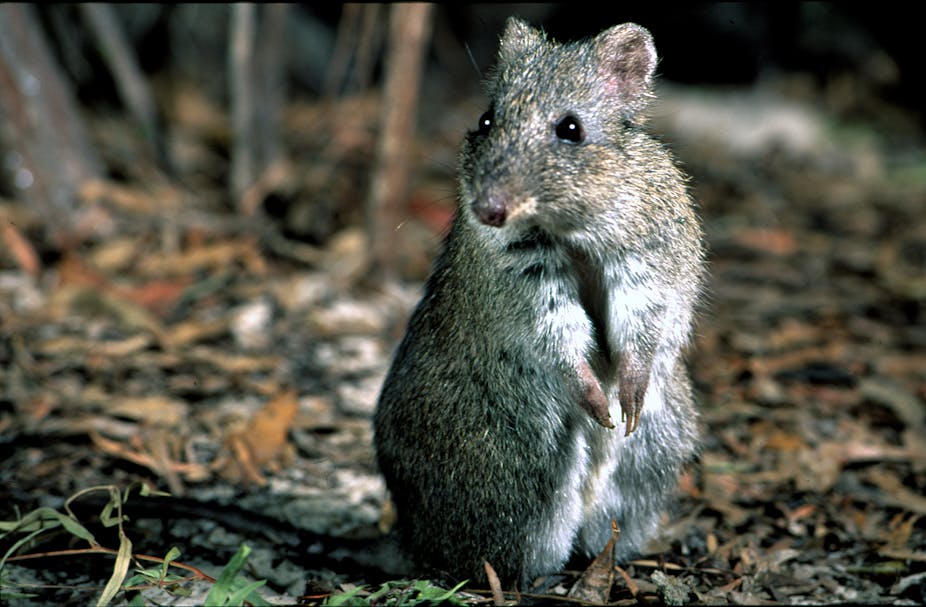
Gilbert’s Potoroo (Potorous gilbertii) is one of four species of potoroo. It has dense grey-brown fur, paler on the underside, with furry jowls, large eyes and an almost hairless tail. It is the smallest extant member of the genus, weighing in at around a kilogram. With a diet of over 90% underground fungi (truffles), it is one of the most fungi-dependent mammals in the world.
Like other potoroos, these animals are mainly solitary, with little overlap in home range between individuals of the same sex, although a male and a female may be found nesting together under the dense sedges in their heathland habitat, sometimes with a young-at-heel. Gilbert’s Potoroos may live ten years and reach sexual maturity at around one year of age. A female potoroo rears one young at a time, but up to three a year, so she could produce well over 20 progeny in her lifetime.
Status
Discovered near Albany in 1840 by John Gilbert, the renowned collector for British taxonomist John Gould, Gilbert’s Potoroos were never widespread. Sub-fossil remains in caves near the southwest corner show, at most, a narrow zone along the moist south coast where the marsupials lived. Rain in most months of the year supports year-round truffles in the soil.
The species was so rare by the early 1900s that it was thought to be extinct – appearing to meet the same fate as its desert-dwelling relative, the Broad-faced Potoroo (P. platyops). Remarkably it was rediscovered on the Mount Gardner headland at Two Peoples Bay Nature Reserve in 1994. However extensive surveys in likely sites along the south coast failed to find any more colonies. The tiny surviving population is now 30-40 animals strong and has been the focus of intensive recovery efforts.
Threats
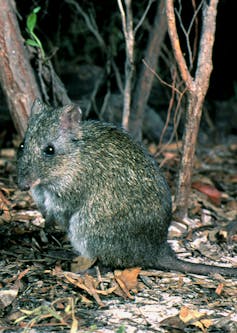
As these potoroos prefer to live in dense heaths, the greatest threat to the Two Peoples Bay population and any recovery colonies is catastrophic wildfire. Lightning strikes are common in this area during summer, often without rain to extinguish the fires. The popularity of the area with locals and tourists alike also increases the risk of fire. The rugged terrain and highly flammable vegetation would severely hamper fire-fighting efforts, although ironically the largely inaccessible habitat may have contributed to its survival. Potoroos rarely venture into open habitat, but those leaving cover risk predation by foxes and feral cats as well as native predators.
Strategy
Gilbert’s Potoroo could be lost in a single wildfire. The recovery strategy focusses on managing this risk by increasing numbers and establishing more populations. Initially, considerable effort went into attempts to breed Gilbert’s Potoroos in captivity. However, this proved unreliable, and efforts turned to assisted reproduction techniques including artificial insemination and cross-fostering using Long-nosed Potoroos (Potorous tridactylus).
Unfortunately, neither of these methods were successful. Meanwhile, regular monitoring of the wild population showed that it remained stable, and new young were born. Failure to find many of these individuals again as adults suggested that most available home ranges were taken and they were unable to establish home ranges.
So the focus of the recovery plan, which continues to protect the existing wild colony (through fox baiting and fire exclusion), shifted to establishing new colonies. With this in mind, a few wild potoroos from Mount Gardner were moved 25 km east to 800 ha Bald Island. Ten potoroos were taken from Two Peoples Bay to Bald Island between 2005 and 2007, with on-going monitoring of the tiny founding population. In 2009, the new Bald Island population had grown to over 25 animals, and six individuals were moved back to the mainland for introduction into a purpose-built 380 ha enclosure from which foxes and cats had been removed. Despite more removals back to the new mainland enclosure, by 2012, the Bald Island population surpassed 60 and there were over 20 within the new enclosure.
Conclusion
While Gilbert’s Potoroo remains arguably the worlds’ rarest marsupial, its survival and recovery so far is due to the remarkable haven provided by Two Peoples Bay, where it continues to breed naturally. Ongoing allocation of funding, particularly by the Western Australian State Government, has allowed long-term recovery goals to be realised.
This piece was co-authored by Tony Friend who heads the Gilbert’s Potoroo recovery project through the Western Australia Department of Environment and Conservation
The Conversation is running a series on Australian endangered species. See it here