


The last couple of weeks of our Australian Twitter News Index have been somewhat underwhelming: overall levels of news sharing on Twitter have been comparatively low, even in spite of a small blip at the tail end of week 37 which was caused by the reporting and commentary which covered the Sydney riots around the Innocence of Muslims film. In terms of total activity, week 38 picks up a little, but still fails to move past the long-term average – and that’s in spite of some notable spikes in the sharing of opinion articles from leading news sites.
ATNIX Week 38: 17-23 Sep. 2012
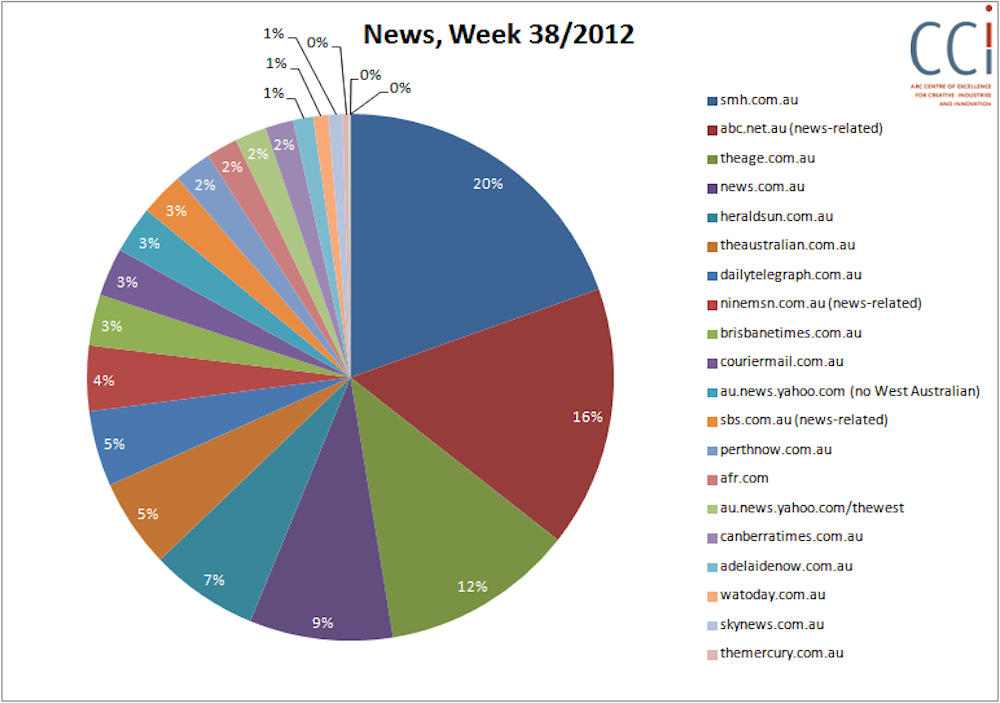
Overall numbers for this week provide a poor point of comparison, as – due to scheduled server maintenance – most of Friday 21 Sep. is missing from this week’s dataset. Given that this incomplete dataset contains some 108,000 tweets linking to Australian news Websites, and that we would usually expect to see at least another 15,000 such tweets on a Friday, though, we can assume that the total volume for this week would be somewhere upwards of 120,000 tweets – which would be at least a small improvement on the preceding week’s 115,000 tweets linking to news sites. Here’s how they are distributed across the sites we track: the main mover in the leading group is The Age, which surpasses news.com.au by some margin this week, after a virtually dead heat last time around.
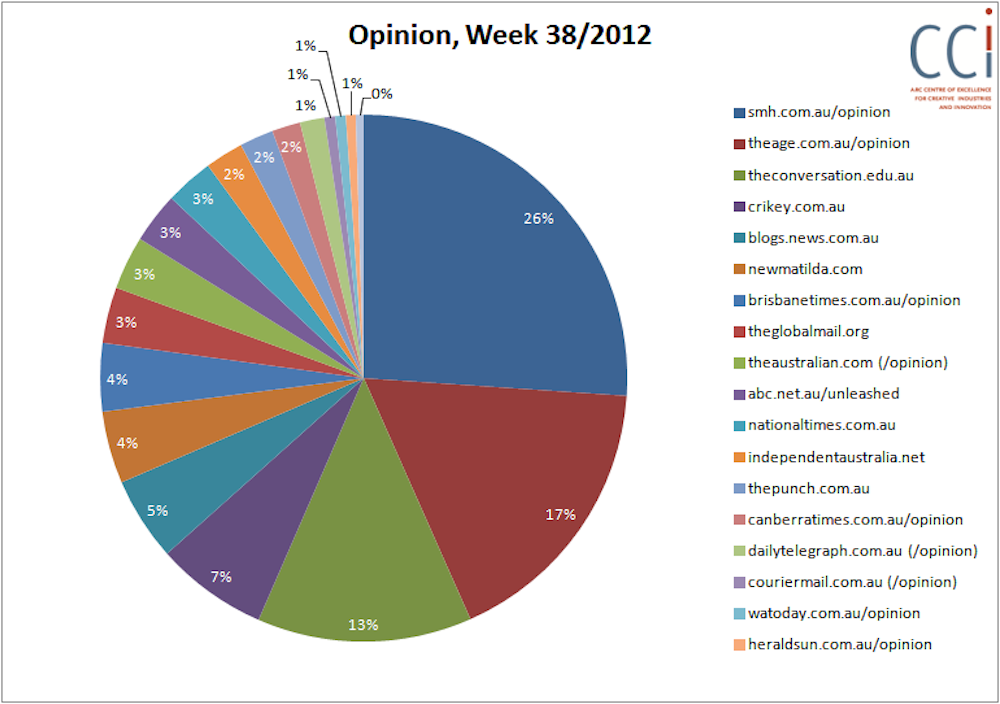
The situation for the opinion and commentary sites and sections is particularly interesting this week, as the day-to-day patterns below will also demonstrate. First, the total number of tweets linking to such sites has actually declined a little (from around 17,600 to 16,700), while the Fairfax sites have substantially increased their dominance: the Sydney Morning Herald maintains a remarkable 26% share of all Australian opinion links shared this week (unchanged from the similarly unusual result last week), but The Age now joins it by adding another 17%. This once again pushes it past the long-term runner-up The Conversation, which received roughly the same amount of links as last week, but was clearly outperformed by the substantial spike in The Age shares. There is further shuffling of positions on the minor places (the ABC’s The Drum loses another place, continuing its decline of the past few weeks), but these represent fairly small numbers in the first place.
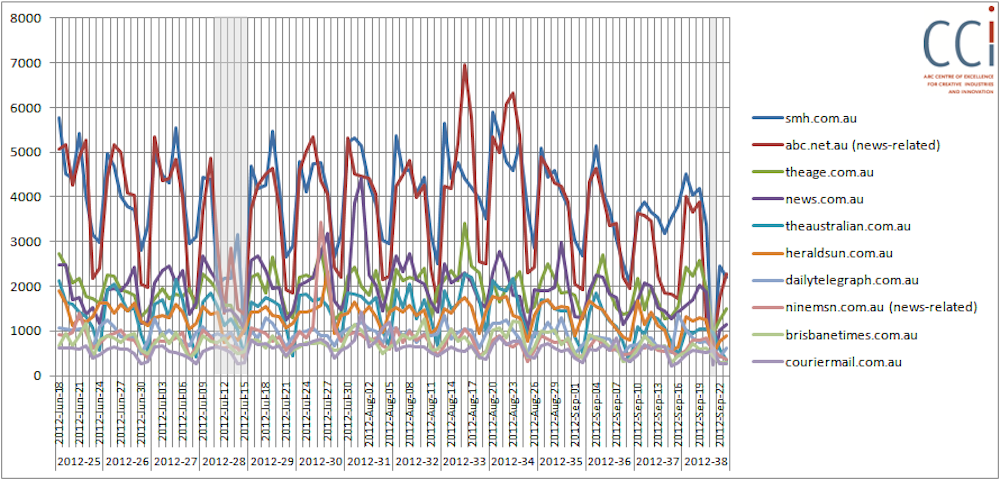
These patterns are further illustrated by the day-to-day comparisons (ignore the drop in numbers on 21 Sep. due to server maintenance, obviously). Links to the news sites remain below the long-term average, but are generally improved from the previous week; this is especially notable for The Age (in green), which is now well above news.com.au’s purple line. At the same time, there are no obvious spikes in activity – as weeks go, this is a sedate one.
That’s not the case for the opinion and commentary sites and sections, on the other hand: here, Sydney Morning Herald and The Age and both spiking on 17 and 19 September, and even Fairfax’s online-only Brisbane newspaper site Brisbane Times gets a minor spike (by its admittedly modest standards) on 18 September:
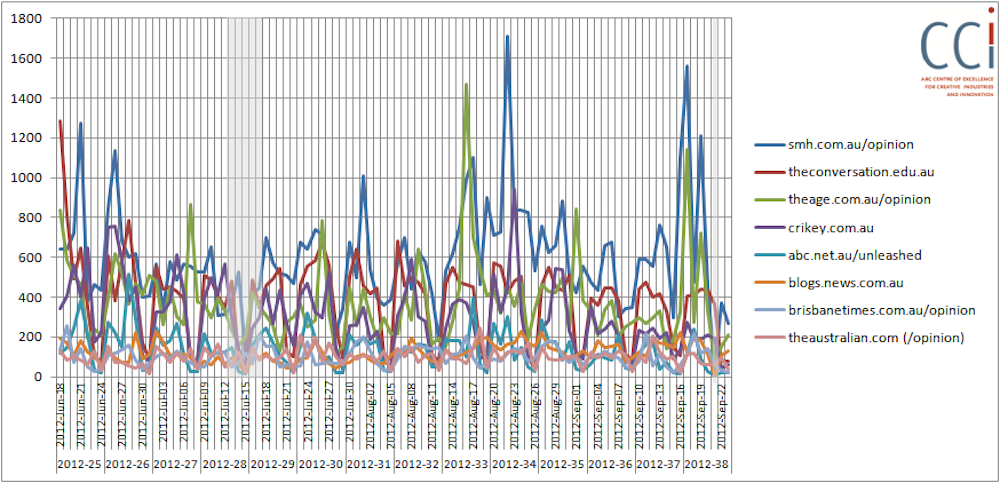
For the Sydney Morning Herald, the new week continues a trend which the preceding Sunday’s comparatively more minor spike around a piece by sports commentator Peter FitzSimons about the Sydney riots already foreshadowed: a substantial amount of tweets sharing links to commentary about the Innocence of Muslims film and its aftermath. On the Monday, it’s a more considered argument by Waleed Aly which is shared in more than 700 times.
By Wednesday, however, attention is split between this issue and a new political controversy: while another opinion piece on the Sydney protests, by Mohamad Tabbaa, gains some 140 additional shares, the majority of the 19 Sep. spike is driven by opinion articles which discuss the parliamentary debate about same-sex marriage. National Times-cobadged articles about Liberal Senator Cory Bernardi’s hysterical fear campaign and his subsequent resignation as Opposition Leader Tony Abbott’s personal parliamentary secretary are shared in some 260 tweets, while pieces about NSW Premier Barry O’Farrell’s intention to allow a conscience vote on same-sex marriage in state parliament and Finance Minister Penny Wong’s fight for the recognition of same-sex relationships each added another 100 tweets.
Similar patterns apply at The Age. Waleed Aly’s piece was published here as well, and receives some 375 tweets on Monday, and a (pre-bestiality) Cory Bernardi also enters this debate, if only as a sideline. At the same time, a piece about the erosion of Australian Internet users’ privacy rights through the government’s proposed data retention laws also receives some 150 tweets. Wednesday, on the other hand, is all about Cory Bernardi: articles discussing his contributions to the same-sex marriage debate account for more than half of all Age links shared on Twitter that day.
By contrast, the smaller spike in Brisbane Time_s links on the Tuesday is purely about state matters, incidentally: some 165 tweets linked to a piece by author John Birmingham on what’s wrong with Queensland Premier Campbell Newman. This makes sense in the overall context of the Fairfax setup, with _SMH and Age as the national flagships, and the Brisbane Times as a secondary, local platform which syndicates much of its national coverage from those newspapers – so Fairfax readers who are interested in following the national coverage should be expected to be more likely to link to those sites in their tweets than to the Brisbane Times.
Standard background information: this analysis is based on tracking all tweets which contain links pointing to the URLs of a large selection of leading Australian news and opinion sites. For technical reasons, it does not contain ‘button’ retweets, but manual retweets (“RT @user …”) are included. Datasets for those sites which cover more than just news and opinion (abc.net.au, sbs.com.au, ninemsn.com.au) are filtered to exclude irrelevant sections of those sites (e.g. abc.net.au/tv, catchup.ninemsn.com.au). For our analysis of ‘opinion’ link sharing, we include only those sub-sections of mainstream sites which contain opinion and commentary (e.g. abc.net.au/unleashed, articles on theaustralian.com.au which include ‘/opinion’ in the URL), and compare them with dedicated opinion and commentary sites.
See the posts tagged ‘ATNIX’ at Mapping Online Publics for a full collection of previous results.