


Do you believe in climate change? It’s seemingly a simple question.
But there are many reasons why it is not. Who is asking, why, and who is being asked?
This is why we read such widely varying reports of how many Australians accept that human-induced climate change exists.
Frame the questions in the right way, though, and you can get more informative and reliable answers. And they might surprise you.
More than just a Q&A
“Climate change” can encompass many things, including:
the system dynamics and make-up of atmospheric gases,
changes in planetary weather systems,
extreme weather events closer to home,
the global and local environmental and human consequences of this threat.
Is this a matter of belief or concern, or of reporting the underlying science? The current debate and mixed messages about climate change science and the response of the Australian public throws these issues into sharp relief.
For social scientists and survey researchers this matter of “question framing” and “response format” is a classic and well-researched issue. The wording of questions and adjacent context can strongly sway responses, and very limited response options may not allow a respondent to convey their actual view.
But the way in which surveys are often conducted and reported would not alert the average reader that things are not always what they seem to be.
One could be forgiven for thinking that the average Australian was relatively unconcerned and/or cynical about the threat of climate change, and if pressed, might well express doubt about the reality of this phenomenon.
Yet this would appear to be very far from the reality, as evidenced by a number of recent surveys in Australia and overseas.
Who wants to believe?
What of this matter of “belief in climate change”? This is a problematic question as stated, but researchers must use and address existing and important survey questions, for comparison as well as challenge.
It’s also often necessary to establish that a person accepts a contested phenomenon is real or genuine, before asking further questions relating to seriousness, causes and consequences, as well as concerns and possible psychological impacts.
Importantly, our primary purpose must be to better appreciate and document public understandings.
These include more specific considerations of people’s objective knowledge of scientific explanations of climate change, culture and experience-informed understandings, and possible changes in how respondents are thinking and feeling about threats to their family, community, and larger world.
So we ask about belief in a number of ways, allowing us to consider other research ostensibly addressing opinions, attitudes, values, and other psychological responses and impacts.
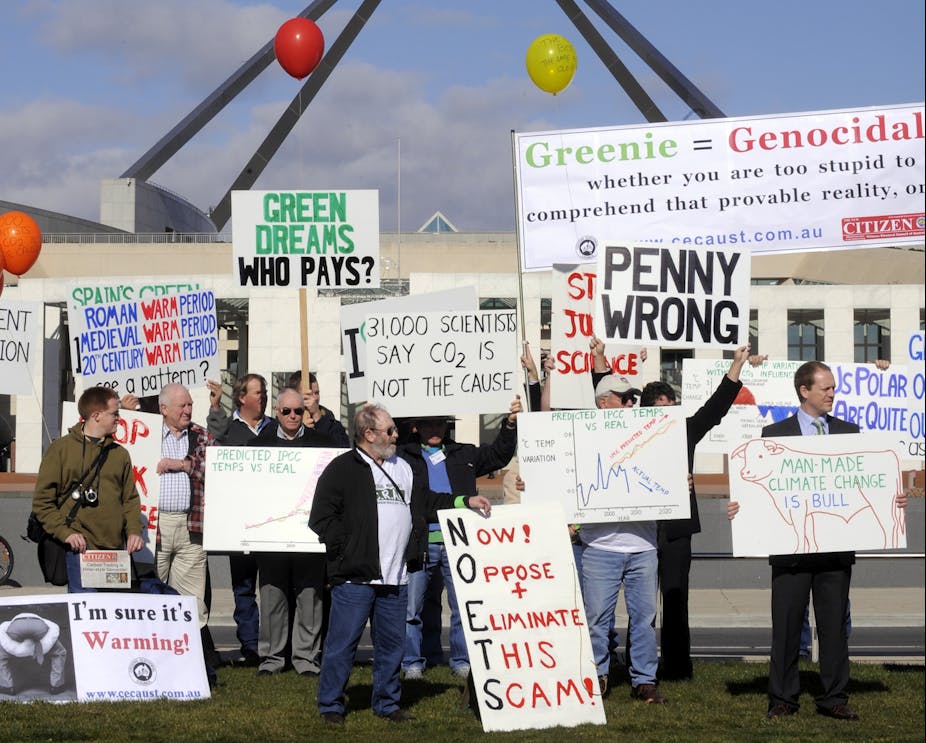
And, of course, there is no end of discussion and speculation about climate change disbelief and scepticism.
These two different but conflated notions deal with those who allegedly do not accept that current climate change is “real” and/or who do not accept that current climate change reflects some level of human causality.
Questions relating to belief and scepticism are often much more about political party identification and support and self presentation.
In the context of a very contested social, political, and environmental issue such as climate change, these responses often tell us little about respondents’ understanding of and response to the phenomenon itself.
So disbelief, like belief, is an odd but probably necessary terminology, particularly given the repeated claim that a very substantial proportion of Australians do not accept that contemporary “climate change” is happening or that it reflects an important component of human agency or responsibility.
Getting it right
By embedding a series of established questions in a larger survey (in this instance a very large cross-national survey about energy futures, climate change, and natural disasters), it is possible to determine and characterise the proportion of respondents who consistently indicate that they do not accept that a significant change in world climate patterns is taking place, and that such a change reflects some level of human causality.
In our research, a carefully considered and convergent calculation using a precise definition finds that 1.2%, or 38 individuals out of 3096 respondents, can be confidently categorised as disbelievers or strong sceptics.
A less stringent criterion allowing for less consistent “sceptical” responses but overall suggesting reasonable disbelief and/or scepticism results in a figure of 5.8%, or 180 individuals.
As responsible social scientists and researchers we have compared and contrasted our findings with those of other comparable and credible Australian and international survey findings.
Such comparisons, across a spectrum of similar questions relating to belief, concern, and acceptance of some level of human causality, along with our own careful sampling and survey design, allow us to be very confident of our research findings.
We’re also very sceptical of claims and interpretations of reported survey findings suggesting that a substantial proportion of Australian respondents do not accept that current climate change is very credible, a matter of considerable concern, and caused in part by human activities and lifestyles.
As research scientists we have provided full information in our report of our methodology, our survey questions, and our full aggregate findings. We feel there is no better way to clear the air about public response to climate change.
Tipping the balance
Given our findings, should mainstream media give equal time to the small minority of Australians who do not accept that climate change is a clear and present danger requiring urgent action by individuals, communities and governments?
Unfortunately, equal time suggests equal credibility and equivalent scientific support, and we are attuned to a powerful information environment in which careful research findings and widespread but incorrect beliefs can have equal currency.
Politicians, policy makers, and a nondiscerning public might take it at face value when a news commentator suggests that a substantial proportion of Australians do not accept that climate change is happening.
And political and policy decisions might be made on the basis of very incorrect assumptions and presumed knowledge.
In our view, there has been a substantial misreading of where the Australian public is at with respect to “climate change”.
A nation of believers
Our results, which are consistent with those of other studies in Australia, Europe and North America, indicate that respondents are very concerned by the nature and implications of climate change.
More than half of our survey sample believe the impacts of climate change are already being felt in Australia, and 90% accept that contemporary climate change is either partly or almost wholly caused by human activities and lifestyles.
It’s time the media accepted that.