
Australia’s Kyoto 2 target: shaking up our thinking

At the Doha climate conference, Australia has submitted a 99.5% emissions target for a second commitment period of the Kyoto Protocol. Why is Australia doing it, and what does it mean? Setting a good example The big picture is that by taking part in a new Kyoto round, Australia can help build trust…

J6xc3vmj-1354061285
What’s behind Australia’s Kyoto target, and could we shift it? ##Erika**/Flickr

At the Doha climate conference, Australia has submitted a 99.5% emissions target for a second commitment period of the Kyoto Protocol. Why is Australia doing it, and what does it mean?

Setting a good example

The big picture is that by taking part in a new Kyoto round, Australia can help build trust with developing countries. It is not a big part of the puzzle, but it still matters. Developing countries insist on the continuation of Kyoto beyond its first commitment period.

Even if only the European Union and Australia are sure to be on board, it still sends the right signal. China in particular has been adamant on the need for a second Kyoto period, even though its effect is likely to be dwarfed by the impact of China’s own domestic climate change policies that are underway and in preparation.

Of course, moderate emissions reduction commitments from a few developed countries are a far cry from effective global climate mitigation action. But without them, it is all the more difficult to argue that developing countries should act, and support those that do.

What does that number mean?

The 99.5% “Kyoto 2” target refers to the average annual amount of emissions that Australia commits to during the eight years from 2013 to 2020, relative to the level in 1990. The 99.5 target was derived by drawing a straight line from Australia’s 108% target under the first Kyoto period at 2010, to the emissions level at 2020 implied by the 5% reduction target at 2020 (which is framed relative to year 2000).

This is illustrated here:
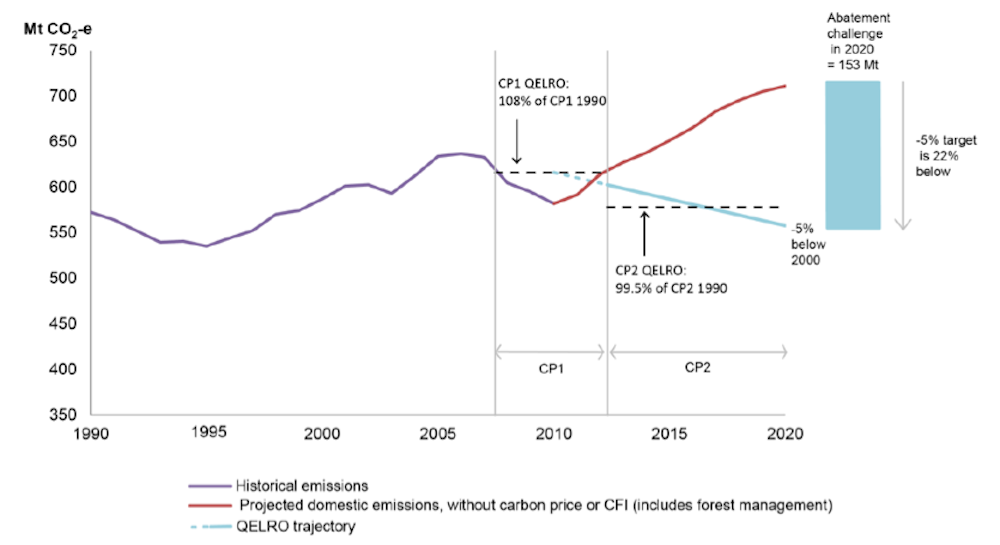
Notes on Figure: CP1 and CP2: First and second commitment period to the Kyoto Protocol. QELRO: Quantified Emissions Limitations or Reduction Objective (the average annual Kyoto target). Australia’s QELRO submission to the UNFCCC, November 2012 - http://unfccc.int/files/meetings/ad_hoc_working_groups/kp/application/pdf/awgkp_australia_qelro_26112012.pdf

So the proposed Kyoto 2 target is consistent with Australia’s 5% unconditional reduction target at 2020. This is supported by both the government and the opposition. It therefore comes as no surprise.

The question was how exactly it was going to be derived. Some other methods might have yielded a number above 100% of 1990 emissions. That would not have made a material difference, but it might have been a “bad look” because of the framing as a small increase rather than as a small reduction, relative to the 1990 base year.

At first glance, the 99.5% Kyoto 2 target does not look like much of a reduction. But it is a significant cut relative to today’s emissions levels, because emissions have grown since 1990. This is in contrast to Europe, where emissions fell between 1990 and now, in part thanks to industrial restructuring in Eastern Europe in the early 1990s.

And the target implies a significant cut from business-as-usual emissions, which would likely keep growing substantially if it was not for the carbon price and other policies to cut emissions. Government projections imply that Australia would import a substantial amount of emissions reductions units from developing countries and potentially Europe to achieve it.

On the other hand, achieving the national target might be easy due to a substantial surplus of emissions units from undershooting Australia’s Kyoto 1 target, and from accounting for forest management activities – see Andrew Macintosh’s analysis.

Importantly, in its submission the government explicitly mentions the possibility of moving to a more ambitious Kyoto 2 target, in line with its previous target range of up to 15% or even 25% reduction at 2020 relative to 2000. The 15% reduction target would translate into approximately a 93% Kyoto 2 target.

Among the conditions for shifting our target are commensurate commitments and actions by other countries and an international agreement. Australia’s Climate Change Authority is to make a recommendation to government in 2014 about whether the national target should be strengthened.

Australia could make some savings on savannah burning. Stray Croc/Flickr

Taking a different track

An alternative to wrapping everything into a single national target number would be a two-track target: in addition to the “headline” national target for emissions, Australia could make a separate pledge to reduce emissions from any land-based activities that may not be included under the headline national target. Many types of land-based emissions are difficult to estimate, and it can be highly uncertain whether efforts to reduce them will be successful.

For example, the national headline target could be a percentage reduction in emissions (say 5 or 15%), achieved through domestic reductions in the relevant sectors including energy, coupled with international purchases of eligible emissions units to make up the balance. In addition, a pledge (not a legally binding commitment) would be made to reduce land-based emissions by a given amount, say equal to 10 or 20% of Australia’s total emissions.

The additional pledge could also include efforts to reduce emissions from deforestation in Indonesia and other developing countries (REDD+), to the extent that Australia might pay for achieving them. Government purchases were already foreshadowed in the original announcement of Australia’s conditional 25% reduction target, but as part of achieving the headline target, not separately.

With a two-track target, Australia would not run the risk of missing the headline target if the land-based emissions reductions did not work out as planned. But it would get international recognition if successful under the pledge. That could allow for much greater ambition on land-based emissions than if wrapping them in under the headline target.

A two-track target is currently not even in the discussion. One reason may be that government would like to see any emissions reductions accounted for under the single national emissions target, and is hoping that land-based emissions reductions will make it easy to achieve Australia’s Kyoto 2 commitment – just like under Kyoto 1. Another reason may be that it would be a new and unusual form of pledge, which does not fit the template for developed countries in the UN negotiations.

Neither of these are good reasons for dismissing the idea of a two-track target. The thinking around international climate commitments could do with a bit shaking up.

Join the conversation

29 Comments sorted by

Comments on this article are now closed.

  1. Sean Lamb

    Science Denier

    "Many types of land-based emissions are difficult to estimate, and it can be highly uncertain whether efforts to reduce them will be successful."
    It is not entirely clear to me everything that might fall under "land-based emissions", but it sounds likely to consist in large part of strategies to reduce fire risk.
    In which case we are doing with our carbon budget what the Govt is doing with the national budget, creating an artificial surplus by moving expenditure forward or back a year to hide a…

    Read more
  2. John Newlands

    tree changer

    I don't buy the line that we were entitled to grow our emissions. Just artificially inflate any business-as-usual target for something bad (eg weight gain) and doing nothing appears flattering. Given Australia's posturing at climate conferences a 30% reduction from either 1990 or 2000 emissions by 2020 would have been more worthy.

    Thus a 2020 target of say 490 Mt CO2e or less would be praiseworthy. I suspect we'll end up around 530 Mt in 2020 compared to 546 Mt in 2011 and 558 Mt in 2000. Excuse the vernacular but that's bugger-all. I also think Australia is a teeny bit responsible for the 700+ Mt of CO2 from our coal exports.

    I'd like some scientists to comment on frequent firing of savannah. You're asking us to believe more burning = less CO2. Why can't we burn tens of millions of tonnes less coal?

    report
  3. David Arthur

    n/a

    Thanks for this article, Prof Jotzo.

    I think the notion of a two-track target could be further developed.

    For most of its geological history, earth has been somewhat warmer than at present. That it has cooled over the last 40 million years or so is largely due to the drawing down and geosequestration of a large proportion of the carbon which had previously been circulating in the earth's atmosphere.

    It had cooled to the extent of widespread glaciation for much of the last two million years…

    Read more
    1. David Arthur

      n/a

      In reply to David Arthur

      To shift the planet to this safe operating "space", we must achieve two goals:

      1) stop adding to the problem; we must cease using fossil fuels as quickly as possible.

      2) Develop carbon farming to draw atmospheric CO2 down from its present ~400 ppm to 350 ppm.

      Perhaps these separate goals can be a basis for a two-track Kyoto commitment.

      It is well established that to maintain the climate in which human civilisation has emerged, and to which human civilisation and all the ecosystems on which it is dependent, atmospheric CO2 should not exceed 350 ppm (Rockstrom et al, Nature 461 (2009), "A safe operating space for humanity").

      [By the same token, to avoid reversion to a new "Ice Age", atmospheric should be maintained above ~300 ppm.]

      report
    2. David Arthur

      n/a

      In reply to David Arthur

      To shift the planet to this safe operating "space", we must achieve two goals:

      1) stop adding to the problem; we must cease using (consuming) fossil fuels as quickly as possible.

      To optimally guide and inform the timing and choice of investing in non-fossil fuel-using equipment and technology, the effective price of using fossil fuels relative to non-fossil fuel alternatives should be increased by imposition of a fossil fuel consumption tax (FFCT).

      Among the advantages of a revenue-neutral…

      Read more
  4. Tim Scanlon

    Debunker

    Interesting to see this broken down. Pity that our goals, while still a sizeable reduction, are still way outside the ballpark for what is needed. Also, as far as I could tell from the various white papers and the like, it appears the government plans of action will battle to curb current emission growth, let alone reduce it to pre-1990 levels.

    report
  5. Ian L. McQueen

    Retired

    aN EXCELLENT EXAMPLE OF ASSUMERISM- ASSUMING THAT IT HAS ALREADY BEEN PROVED THAT THERE IS A SCIENTIFICALLY VALID RELATIONSHIP BETWEEN co2 EMISSIONS

    report
  6. Ian L. McQueen

    Retired

    An excellent example of assumerism- assuming that there is scientific validity to a belief that our emissions of carbon dioxide are affecting our climate, and that all the economists, psychologists, sociologists and others with negligible scientific knowledge have to do is propose ways to reduce emissons of CO2. The uncomfortable fact remains that Australia - the world, in fact - could reduce its emissions of CO2 to zero and the effect would hardly be noticeable because there is no solid evidence that CO2 governs our climate.
    The most important "greenhouse gas" (a misnomer because a greenhouse prevents convection, which is not the case with the world's climate) is NOT carbon dioxide. It is WATER, and the sooner we recognize this fact the better. We (the world) have already wasted hundreds of billions of dollars fighting a problem that does not exist. Let us put our energies into genuinely worthwhile projects like providing potable water to the world.

    IanM

    report
    1. Mike Hansen

      Mr

      In reply to Ian L. McQueen

      So the world's scientists and scientific organisations are wrong and you are right even though you do not appear to have any scientific credentials, offer no links to any scientific paper supporting your proposition nor any links to any evidence.

      Basically Ian, your claims are from the bottom of the climate denier barrel.

      It is true that water vapour is the major greenhouse gas but it is a feedback not a forcing.

      As temperature rises, evaporation increases and more water vapour accumulates in the atmosphere.

      So as the atmosphere warms in response to the added CO2, more water vapour is added to the atmosphere which then amplifies the warming caused by CO2.

      http://www.skepticalscience.com/water-vapor-greenhouse-gas-intermediate.htm

      report
    2. Chris O'Neill

      Telecommunications Engineer

      In reply to Ian L. McQueen

      Ian L. McQueen: "The most important "greenhouse gas".. is WATER, and the sooner we recognize this fact the better."

      This standard denialist strawman has a great irony that denialists like McQueen never understand. If water is a strong greenhouse gas then its greenhouse effect is a feedback. Denialists like to pretend that there is no feedback but at the same time say that a feedback gas, water, is a greenhouse gas. You can't have one without the other.

      report
    3. David Arthur

      n/a

      In reply to Ian L. McQueen

      Comparison of trends for average minimum temperature across Australian States or regions shows that over the last century, average minimum (night-time) temperature has increased at rates around 0.12 deg C per decade.

      Not only are these trends relatively consistent with each other, they are also larger and less variable than the same trends for average maximum (daytime) temperature.

      This leads to concluding that warming is attributable to a single cause, which is greater retardation of night time heat loss. In turn, this is exactly what we expect if the cause of warming is increased atmospheric greenhouse gas content.

      I suggest you go to the section of the Bureau of Meteorology's website entitled "Australian climate variability & change - Time series graphs". It's at http://www.bom.gov.au/cgi-bin/climate/change/timeseries.cgi?graph

      Let us put our energies into genuinely worthwhile projects like providing non-fossil fuel using power to the world.

      report
    4. Gary Murphy

      Independent Thinker

      In reply to Ian L. McQueen

      "... a greenhouse prevents convection, which is not the case with the world's climate".

      Actually - it is the case with the world's climate. Convection of heat into space cannot occur because space is a vaccum.

      report
  7. Ian L. McQueen

    Retired

    Moderator-

    Can you remove my recent "posting" in all caps. I hit a wrong key and what I was only beginning to type (and later to correct) got sent.

    Thanks.

    IanM

    report
  8. Jenny Goldie

    editor

    Where is the sense of urgency? News this week of permafrost melting and adding considerably to emissions should demand that Australia's target be much more rigorous than this damp squib of one. Is no-one listening to the warnings made by the IEA, World Bank, UN Environment Program, International Monetary Fund, PricewaterhouseCoopers, KPMG and the World
    Economic Forum? 2011 was our warmest year and 2012 may be even warmer. If we are to keep within 2 degrees (and even that may be too much) we have to keep two-thirds of all fossil fuels in the ground. What's the difference between two and four degrees? Human civilisation.

    report
    1. David Arthur

      n/a

      In reply to Jenny Goldie

      Gday Jenny, you're quite right about the urgency of this. Sadly, the same cannot be said of the various Brains Trusts that are purportedly guiding our progress.

      For example, one of these highly paid groups tell us that two thirds of fossil fuel reserves must remain in the ground. What these folk seem to not understand is that thawing permafrost means that much. much more than two thirds of fossil fuel reserves must remain in the ground.

      Now, while they might bleat that they weren't told about thawing permafrost (reminiscent of Abu Ghraib, AWB, even the Iraqi WMD disposal programme of the 1990's), awareness of the potential for permafrost thawing has been around for at least a decade.

      report
    2. Sean Lamb

      Science Denier

      In reply to Jenny Goldie

      Actually melting permafrosts - assuming the situation is not simply another polar-bears on ice-flows scare du jour - has, like all things, complicated interactions.

      Will frozen organic gases be released? Presumably so, equally the thawed land areas will be able to support a far greater biomass, locking up carbon.
      Of course, the gold standard is to sequester carbon permanently, this is a relatively slow process. Primarily it probably occurs in the oceans in the formation of limestone and the sinking of organic or calcium-carbonate matter to the ocean floor. On land, it presumably mostly occurs in highly anaerobic environments like swamps or water-logged soils (where we find peats, for example), so yes your melting frozen broccoli may release some gases, but it will also free up large areas for the permanent sequestration of carbon to take place

      report
    3. Tim Scanlon

      Debunker

      In reply to Jenny Goldie

      All I can say, Jenny, is make your voice heard and make your own changes as much as possible.

      There is no urgency from policy people and government. No-one wants to be the government or minister or whatever, who has to make the tough choices. Just look at the white papers, just look at the planned change over time periods, all so gradual and too late to be of any consequence. But the governments get to have their cake and eat it too, because they get to claim green cred (we have a plan!) and not cause any harm (the plan won't do anything!).

      And, as you can see from Sean's reply, denialists have mounted a successful anti-science campaign to help maintain the status quo. I hope that some of the deniers actually live long enough to realise just how wrong they are.

      report
    4. David Arthur

      n/a

      In reply to Jenny Goldie

      @sean lamb, who points out that as permafrost thaws, forest growth will resorb much of that carbon.

      While that's certainly true, the issue for us is that greenhouse gas emission from permafrost thaw will occur well in advance of carbon biosequestration through growth of tree cover on that landscape; I understand that terrestrial biogeosequestration of carbon through peat formation has made a substantial contribution to the planet's cooling over the last 50 million years that produced the conditions to which present ecosystems are adapted and on which human civilisation depends.

      That is, there may be a major peak in atmospheric greenhouse gas content as a result of permafrost thaw (comparable to the Paleocene-Eocene Thermal Maximum) before forest growth takes that carbon back from the atmosphere.

      report
  9. Neil Gibson

    Retired Electronics Design Engineer

    @David Arthur ."Comparison of trends for average minimum temperature across Australian States or regions shows that over the last century, average minimum (night-time) temperature has increased at rates around 0.12 deg C per decade."
    This is a nonsense! The greatest effect of Urban Heat Islanding is a rise in minimum night temperatures caused by the heat capacity of asphalt etc. David is quoting an error as an example of Global Warming.
    It is interesting to look at Australian temperature records comparing rural to urban records which shows that UHI creates most of the global warming signal.
    http://www.warwickhughes.com/climate/gissbom.htm
    Ken Stewart has also done a lot of work on Australian temperature records which have been adjusted to give a pronounced warming signal.
    http://kenskingdom.wordpress.com/2010/09/14/the-australian-temperature-record-part-9-an-urban-myth/

    report
    1. David Arthur

      n/a

      In reply to Neil Gibson

      @Neil Gibson:

      I said nothing about urban heat island effects, because the temperature increases I'm reporting have occurred ACROSS THE ENTIRE STATE, not just the capital city.

      With all due respect, you seem to be suffering from what I call Sydney Syndrome: I used to live there, and I noticed that most Sydney-siders could not tell the differenced between Sydney and New South Wales.

      Nor could they discern between Sydney and Australia.

      For your education and edification, here are the average…

      Read more
  10. Ian L. McQueen

    Retired

    I'm glad to see an active discussion, even if some people think that attacking the person with an opposing view is as good as attacking the idea. It isn't, and has been given the name "ad hominem attack" (Felix MacNeil).
    Someone closer to the situation wrote that the layer of organic material in the Canadian north is very thin and does not contain a lot of organic material. It is unlikely to release a lot of carbon dioxide, and in any case there is no scientifically valid proof that adding CO2 to…

    Read more
    1. Chris O'Neill

      Telecommunications Engineer

      In reply to Ian L. McQueen

      Ian L. McQueen: "the global temperature has not shown any statistically valid increase for 16 years."

      This is just not true. The probability that the warming trend from 1996 to 2011 inclusive did not arise simply from random variation was 99.6%, easily higher than the probability required for statistical significance of 97.5%. This lie originated from a tabloid newspaper journalist, David Rose.

      By the way, I see you're still citing pathological liar Anthony Watts' blog. In case you missed it…

      Read more
    2. David Arthur

      n/a

      In reply to Ian L. McQueen

      Thanks Mr McQueen.

      I'm not sure that your sources are up-to-date with research. Science Daily is Reuters' news site where new research is publicised and explained in terms explicable to 'the intelligent layman'. Reports also identify and have links to the original research. Here are a few recent highlights.

      Not-so-permanent permafrost: 850 billion tons of carbon stored ...
      http://www.sciencedaily.com/releases/2012/10/121025145436.htm 25 Oct 2012 ... As much as 44 billion tons of nitrogen…

      Read more
  11. David Arthur

    n/a

    @Prof Jotzo,

    you point out that our thinking needs to be shaken up. Trends in fossil fuel use (and hence CO2 emissions), suggest that this is well warranted.

    Regarding shaking up out thinking, how about we abandon the Kyoto process altogether, and just drive fossil fuel use out of our economies over a decade or so by imposing and then increasing consumption taxes on fossil fuel use (FFCT)?

    Professor of Economics at Oxford University Dieter Helm is of this view; please comment on his "The Carbon Crunch: How We're Getting Climate Change Wrong--and How to Fix It", in which he makes the point that the Kyoto process is structurally incapable of limiting CO2 emissions.

    report
    1. Frank Jotzo

      Director, Centre for Climate Economics and Policy at Australian National University

      In reply to David Arthur

      Dear David Arthur,

      indeed, my article looks only at some relatively narrow issues within the Kyoto Protocol. The key to emissions reductions are policies that individual countries implement. The Kyoto Protocol makes only a marginal contribution to reducing emissions, because of very limited participation and moderate targets; but it may help to encourage mitigation in countries that are outside of the Kyoto Protocol.

      Thanks to everyone who is making constructive comments.

      report
  12. Neil Gibson

    Retired Electronics Design Engineer

    @David Arthur. David - thanks for the facetious geography lesson as being a simple engineer I did not know all that. The simple fact is that asphalt , concrete etc act as heat sinks which will elevate night time minimums. If you don't believe that measure the evening temperature of a local concrete path and compare it to garden soil .
    Given that UHI is often multiples of the temperature anomaly it should be obvious to even a geography student
    that heat remanence would affect night minimums. The siting of temperature stations at airports above concrete or asphalt also will give elevated night-time minimums.
    You did not comment on Ken's analysis showing that global warming in Australia is mainly caused by adjustments to raw data so I guess it should be called "man-made" global warming.
    http://kenskingdom.wordpress.com/2010/09/14/the-australian-temperature-record-part-9-an-urban-myth/

    report
    1. David Arthur

      n/a

      In reply to Neil Gibson

      @Neil Gibson: Facetious? Moi?

      Mr Gibson, BoM realised that prior measurements bias were biased due to inappropriately sited measuring points for some decades; prior to that realisation, much meteorological data was affected by exactly the errors that Ken Kingdom discusses.

      What this means is, BoM data has been corrected for flaws in early measurement proceedures. It isn't a (Commie/Greenie/Druggie: insert your preferred conspiracy) plot, it's simply BoM correcting for biased data.

      Yes…

      Read more