
Australia’s newspaper crisis is a failure of the market, not journalism

“Perhaps the single most dishonest aspect of the New Right’s campaign has been its attempt to rubbish and discredit the public sector.” That’s Keith Windschuttle in his excellent 1983 book, The Media, a volume that while obviously dated, offers important context for understanding the current crisis…

7mv89mw7-1340691867
Most reporting still comes from a newspaper: Australia’s media troubles come from a failing commercial model, not a journalistic one.

“Perhaps the single most dishonest aspect of the New Right’s campaign has been its attempt to rubbish and discredit the public sector.”

That’s Keith Windschuttle in his excellent 1983 book, The Media, a volume that while obviously dated, offers important context for understanding the current crisis in Australian newspapers.

Democratic rule depends on an informed citizenry. The complexities of the modern world cannot be conveyed adequately through TV or radio soundbites, and so without the longer, more in-depth reports currently provided by broadsheet papers, we’ll lack information necessary to participate in political life. The internet might be awash with commentary and analysis but few websites can fund an old-style newsroom. Most online journalism still rests on reporting done elsewhere – and, very often, that elsewhere is a newspaper.

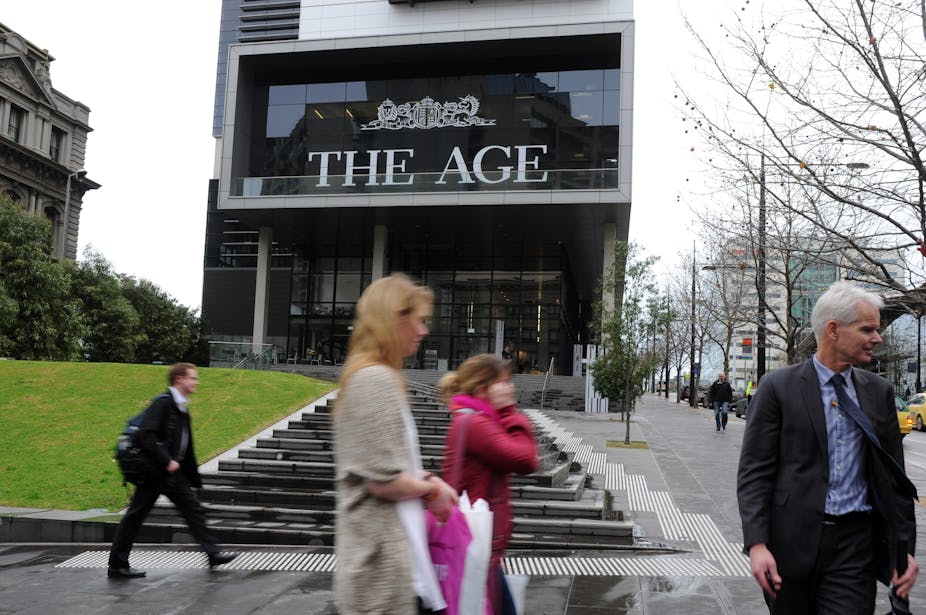
All of that is why the turmoil at Fairfax matters.

But most discussions of the current imbroglio fail to distinguish adequately between the social and the commercial function of newspapers, two quite different points. The business of broadsheets might be in crisis but there’s absolutely no crisis in the service they provide. It’s the owners of newspapers who are tied to print, not the journalists themselves. On the contrary, the digital revolution makes gathering and transmitting information easier than ever before in human history. There’s no necessary relationship between quality journalism and print – only an economic and historical one.

We’re faced, in other words, with a failure of the market, not a failure of journalism.

Business Spectator’s Alan Kohler puts it like this:

The fact is that the size of newsrooms is shrinking and in my view this is the issue that should be addressed. How many journalists are needed in Australia to properly report on national and local affairs? Unlike the production of aluminium ingots, everyone is agreed that this is a truly important function and that if it were not done, or were done less well, the nation would suffer. Yet it is being left entirely to the market to sort out how many people will perform this function.

Kohler, who announced last week that Business Spectator had been bought by News Ltd for an undisclosed sum (variously reported at between $22 million and $30 million) suggests – semi-facetiously – a bailout for journalists akin to that offered to Alcoa.

But, actually, that’s not a silly idea. The real problem is that it doesn’t go far enough.

After all, we’ve been here before.

Back in the early days of radio, it became apparent that commercial broadcasters would not use the medium to its full advantage. You could make money providing light entertainment to the cities but there was no profit in offering quality news to rural Australia. That’s how we ended up with the Australian Broadcasting Corporation: to ensure all Australians could enjoy radio to its full potential.

Likewise with television. Everyone knows that, left to its own devices, the market would never deliver the broadcasting the ABC offers. Precisely because we think TV matters, we don’t simply trust the benevolence of commercial operators. Instead, we fund a public option, because we know we can’t rely on the market.

And, by and large, it works. Despite the efforts of hysterical ideological critics, nine out of ten Australians think the ABC provides a valuable service – about as close to a consensus as you’re ever going to get.

Why, then, are we so willing to leave journalism to the market’s tender mercies? Surely the obvious response to the current crisis is to expand the ABC, extending its operations to fund the quality journalism the newspapers can no longer provide. With extra staff and extra resources, the ABC could quickly and easily provide the kind of journalism for which we once relied exclusively on the press.

The advantages are manifold. The technology that so threatens the commercial logic of Fairfax and News Ltd poses no problem for publicly funded journalism. Where the commercial media companies see the internet as a problem, an expanded ABC could devote resources to devising new ways to spread information, rather than hamstringing the web via paywalls and the like.

A properly resourced ABC could provide material from regional Australia, embark on investigative reports and pursue stories that were important but not necessarily sexy. It could, in other words, do all the things the broadsheets are increasingly failing at, even as it offered some much-needed jobs for reporters.

This is neither a new idea, nor a particularly radical one.

For years, Federal Labor advocated an ABC-style newspaper – as Gough Whitlam put it, the party sought “national newspapers and journals which would share the news and cultural services of the Australian Broadcasting Commission and which would give Australians the same choice of news and views in their newspapers as they expect in their radio and television”.

Technological change makes Whitlam’s proposal much more viable than ever before. The infrastructure’s already there: the ABC website is one of the most popular in the nation. With no need for paper, the costs would largely lie in hiring new journalists – and, god knows, there’s enough unemployed reporters available.

The problems, of course, are not technical but entirely political. As Windschuttle was already arguing back in 1983, a sustained attack on public ownership has meant alternatives to private businesses seem politically toxic. Nowhere is this more apparent than in the world of media. In the UK, for instance, James Murdoch has publicly denounced the BBC on the basis that state-funded news provided freely to consumers posed a threat to online journalism because it undermined “commercial viability”, and thus let “independence and plurality wither”. Here, News Ltd CEO Kim Williams says he’s “troubled” by the ABC’s expansion online.

Their chutzpah is extraordinary.

As Windschuttle argues: “The Australian media are among the staunchest of this country’s defenders of private enterprise and the “free market”. Yet the great virtues that are claimed for this system – the sovereignty of the consumer, the efficiencies of competition, the market open to talented new entrants – are nowhere more lacking than in the structure of the media business itself.”

You and I cannot launch our own newspaper empires to compete independently with the Murdoch press. Media ownership in Australia is so concentrated to be almost feudal – all of the main players (the Murdochs, the Fairfaxes, Gina Rinehart) owe their status to a dynastic succession. Amidst these huge monopolies, an expanded state sector would offer more choice, not less.

Isn’t there something innately sinister about state-owned media? Well, we’ve had ABC TV and radio for decades, and we’re not living under totalitarianism just yet. Indeed, surveys show most people trust the ABC more than its commercial rivals, and for good reason. Whatever might be wrong with Auntie, no-one’s implicated ABC employees in a widespread campaign of phone taps and corruption.

Naturally, in a democracy, all media should always be closely scrutinised. But, actually, it’s far easier to hold the public sector to account than a newspaper published by a multinational corporation. Could you imagine News Ltd scrutinising itself with the intensity that Media Watch has sometimes gone after, say, the 7.30 Report?

In today’s world, information is a public good. It’s a service we need, just as much as we need roads and hospitals. If the private sector won’t provide it, the public sector must, however much that makes the self-interested media barons squeal.

Sign in to Favourite

Want to follow The Conversation?

Sign up to our free newsletter to get the day's top stories in your inbox each morning, with a special wrap on Saturday.

Spinner
Help evidence based journalism become the norm and donate

Join the conversation

44 Comments sorted by

  1. Michael Shand

    Michael Shand is a Friend of The Conversation.

    Software Tester

    Great Article, and point well made that you cannot blame the news corporations for producing crap...becuase the public buy it and believe it.

    Its the people who are at fault for believing the bullshit they read and not seeking out better sources of information....and a state owned news operation may help but me thinks that these people will still choose to believe bullshit rather than change their opinions - how do we deal with that type of willful ignorance in society?

    report
  2. Allie Dawe

    Community activist

    find nothing innately wrong with public broadcasting or a public newspaper in fact. The notion that anything done by the private sector will be done better or more efficiently than in the public sector is merely an assertion, and one which needs scrutiny wherever it is thrown to disparage a public sector initiative.

    Information and free speech are fundamental to a democracy so who sells it or gives it away and why needs scrutiny for accuracy and always asking “who gains” in assessing claimed…

    Read more
  3. Chris Gibson

    Director, UOW Global Challenges Program & Professor of Human Geography at University of Wollongong

    Spot on. Information is a public good. We elect governments to fund and support the infrastructures we need as a people. Information infrastructures are as basic as roads and schools. We already have legislative frameworks for ensuring editorial independence of publicly-funded broadcasters.

    Diversity is an issue. But in my view, indie media and quasi-public sector outlets like The Conversation are more important accompaniments to publicly-funded news than commercial outfits. The latter sell advertising and the news is just the lure. Their very existence is based on this deceit.

    report
  4. Marc Hendrickx

    Geologist

    The notion that there is not a market for "abc" style reporting is a furphy. The fact that ABC garners about 20% of the combined tv/radio/online market a clear indication that if removed from the government teat there would be sufficient interest in a private organization taking up the reins. As noted one of the reasons abc was created was to provide for poorly provided rural audiences. The advent of the internet has made that redundant.
    The main difference if the ABC were privatized would be that those interested in ABC style reporting, with its mix of brilliant quality journalism and utter groupthink drivel, would have to pay for it, rather than being subsidized by those more interested in other media. In certain areas the ABC is distorting the market and is arguably responsibe for reducing media diversity.
    Time for a re-think on how the government funds public bradcasting

    report
    1. Dirk Baltzly

      A/Prof. in Philosophy

      In reply to Marc Hendrickx

      What the ABC provides (to a greater or lesser extent) is information that citizens need to have in order to fulfill their obligations as citizens. It does not matter whether there is a "market" for this or not. Many citizens may be negligent and not care about what they should care about. But this does not negate the community's obligation to provide the information that is necessary for citizens to discharge their duties as citizens.

      The political function of journalism is too important to be left to markets. Commercial media corporations fulfill this function only as a by-product of selling eyes to advertisers.

      report
    2. Peter Ormonde

      Peter Ormonde is a Friend of The Conversation.

      Farmer

      In reply to Marc Hendrickx

      Marc ... where do you geologists get off talking about economics as if you knew all about the stuff? You don't hear me wandering off delivering sermons about shales and strike and dip do you?

      See part of the thing done by the ABC is difficult to quantify (or even to detect) ... the ABC newsroom permeates public discussion in Australia ... it's where everyone - including other journos - get their news, or at least get their issues and story ideas. See it's worse than you think.

      I know you…

      Read more
    3. Marc Hendrickx

      Geologist

      In reply to Peter Ormonde

      Peter,
      Sorry but you'd be a lot more interesting if you stopped making things up and erecting and tearing down strawmen.

      In regard to who is setting the agenda over the last 24 months I'd say the mantle has firmly passed onto the Oz. Their excellent coverage and in depth investigations into the Brisbane flood inquiry just one example of where others in particularly the ABC completely dropped the ball.

      report
    4. Peter Ormonde

      Peter Ormonde is a Friend of The Conversation.

      Farmer

      In reply to Marc Hendrickx

      No ... I watched the ABC and some of the commercial coverage and couldn't see much difference to be honest. I've seen the coverage of the Inquiry and think the ABC's coverage has been significantly superior.

      I also listened to ABC Radio National's coverage throughout the floods and in the aftermath - and they were excellent.

      So you're right - I haven't been reading. I've been listening and watching - which is after all what the ABC actually does.

      What denunciations have been made of ABC coverage of the floods? By whom? and Why? Genuine questions.

      report
    5. Marc Hendrickx

      Geologist

      In reply to Dirk Baltzly

      Yes, indeed. GOd only knows how our democracy would survive without bananas in pyjamas and the Shaun Micallef show. One imagines rioting in the streets and a breakdown in civil society should silent witness be allowed to be screened on a commercial station.

      And yet somehow the nation managed to write a working constitution and form a federation with citizens discharging their civil duties, going to war, making peace, having a role in creating the league of nations. A country born and raised with a thriving diverse array of newspapers and no ABC in sight.

      report
    6. Roger Crook

      Retired agribusiness manager & farmer

      In reply to Marc Hendrickx

      And others too:
      The BBC was formed in 1922.
      The first public radios opened in Australia, starting with Sydney in1923 (so we weren’t so backward) to be quickly followed by stations in all capital cities.

      report
    7. Brian Boss

      Architect

      In reply to Marc Hendrickx

      yeah! i'd rather watch quality TV like Today Tonight! Lara Bingle! ACA! Top 20 Boob Moments! and you wonder why MSM (TV & papers) are going broke. The free market has spoken. But the monopolists aren't listening, see, you can do that when you are a billionaire. You don't need to operate under the free-market you preach to us. You can subsidise loss-making propaganda...kind of like China...

      report
    8. Brian Boss

      Architect

      In reply to Marc Hendrickx

      lol, setting the agenda for their small bitter old white men audience...no
      wonder they make a $25m loss every year...

      report
    9. Peter Ormonde

      Peter Ormonde is a Friend of The Conversation.

      Farmer

      In reply to Brian Boss

      The nice thing about propaganda - it doesn't last well... very short shelf-life. That's the main reason I'm not too concerned by Gina Hancock turning Fairfax into a megaphone for the Blots and Archcardinal Monckton... people have more sense ... Australians in particular.

      I hope she gives Lara Bingle a column - maybe "Canberra Underbelly Renovation" ...

      report
    10. Richard Ure

      logged in via Facebook

      In reply to Marc Hendrickx

      "going to war"? A better informed populace might have been more reluctant to throw itself into the meat grinder that was the Western Front.

      report
  5. Roger Crook

    Retired agribusiness manager & farmer

    Not a bad idea, never work though.

    On the advisability more power to the ABC, Putin would be able to advise. So probably would the Chinese.

    The ABC has an enormous opportunity to become the reference point and the standard for news and information in this country by simply being the best. To achieve that position they too will need to change.

    Whether management and the board have the knowledge and capacity and are able to find the people to meet this challenge/opportunity must be in doubt…

    Read more
  6. Peter Hobbins

    PhD Scholar at University of Sydney

    I agree that your suggestion of building on an extant skill base is logical, and could indeed capitalise (pardon the pun) on the ABC's digital inroads, rather than creating a retrogressive print alternative.

    Without seeming a neoliberal, however, my concern lies with the basic premise of your argument. If 'the market' has failed to support the maintenance of media organisations based the provision of 'quality' or 'independent' journalism, what does that tell us about the market value of this commodity…

    Read more
  7. Michael Brown

    Professional, academic, company director

    The Global Mail shows the market has not failed - your fundamental premise is incorrect.
    Furthermore, there is little evidence that people want long detailed stories - suggest you survey 20 to 30 year olds, and see what they say. I think the ABC already provides more than adequate coverage of important issues. At an annual cost of $1.2 billion for the ABC and SBS, there is no strong argument for even more taxpayers' money to be spend on news. In fact, given the very low ratings of some of their services such as ABCTV2 and Radio National, the ABC could do with some pruning.

    report
  8. chris matthews

    mediator

    Interesting article and insightful comments. A colleague of mine, Steve Rix, many years ago, did an economic analysis of public sector investment in infrastructure and the so called crowding out effect of private investment. He found that rather than crowding out, public investment acted as a stimulus to further investment.

    I rather think that the same model would apply with govenment investment in national print and digital media. Information from varied sources leads to more debate and more demand for information.

    I would also be interested to read views about Margo Kingston's proposal for a media conglomerate of Crikey, Global Mail etc.

    report
  9. Gavin Moodie

    Principal Policy Adviser

    Am I missing something? The ABC already provides journalism - lots of it, and much of it in text. So what is Sparrow proposing except more money for the ABC (which I support on other grounds)?

    report
    1. Peter Ormonde

      Peter Ormonde is a Friend of The Conversation.

      Farmer

      In reply to Gavin Moodie

      Morning Gavin,

      I reckon if the ABC is half smart - and the government half courageous - they would be buying up the best of Fairfax's discards by the container load... there will be a sensible reason for this ... a massive increase in unmet demand for analysis and reportage.

      I want to see Ross Gittins doing a weekly slot on The Business. I'd start watching that. I even want to see Michelle Grattan taking us through the week in the bunker. I want Four Corners two or three times a week…

      Read more
    2. Gavin Moodie

      Principal Policy Adviser

      In reply to Peter Ormonde

      'morning Peter

      I agree. It will be interesting to see how jealous Fairfax gets. Apparently News Corp is ok with Kohler continuing on the ABC, but will this change as the pay walls get higher?

      report
    3. Roger Crook

      Retired agribusiness manager & farmer

      In reply to Peter Ormonde

      I think it would be wrong to consider the ABC as just a news provider. ABC radio, particularly in the regions, has trouble putting relevant news bulletins together. I think I wrote on these pages the other Sunday morning 6am news on ABC radio was a crash in NSW (I live in WA) and the rest was news for OS. Conclusion nothing was happening in OZ.
      A reinvigorated and properly funded ABC could revitalise Australian drama, docos, education, expand childrens TV and in so doing encourage Australian creative talent in writing and production.
      The alternative is to continue to be fed, some may say force fed, American productions.
      The ABC already have news 24 on both TV and radio.

      report
    4. Peter Ormonde

      Peter Ormonde is a Friend of The Conversation.

      Farmer

      In reply to Roger Crook

      Oooh no Roger ... the "revitalisation" of drama, kiddie's TV and the like is occurring with tripe like Underbelly and the eagerly awaited Channel 9 warts and all bio/drama/doc on Kerry Packer. Even ABC3 runs pretty much the same tripe as is available on the Macca channels from the little I've seen.

      But News 24 is really News 4 X 6 ... four hours of news etc repeated 6 times.

      I'd like to actually see News 12 X 2 myself... as long as it was of the calibre of Four Corners, Media Watch and the like three of four - or in the case of Media Watch - 7 times a week.

      But you're right about ABC regional and rural reporting... that too needs a serious fix after years of narrow economic rationalism ... not easy that ...but I wouldn't be in a rush to make Ross Gittins the Oodnadatta roundsman. Maybe Michell Grattan.

      report
    5. Roger Crook

      Retired agribusiness manager & farmer

      In reply to Peter Ormonde

      Peter,
      With respect, you miss my point. The ABC have the channels (if that's the right word?) what they put on them is a different matter, that's a management decision and I presume that is governed by cost.
      I am not suggesting the ABC follow the 'standard' of the commercial channels. We are better than that as a nation. We have better writers, actors and entertainers than what we are subjected to on both commercial TV and radio.
      If we are not better than that, then we need to ask why. There are many creative Australians who live and work overseas and they don't do that for the climate in London.
      An ABC shop is an interesting place. Their reliance on the BBC is evident.

      report
    6. Peter Ormonde

      Peter Ormonde is a Friend of The Conversation.

      Farmer

      In reply to Roger Crook

      Sorry didn't mean to miss your point - I remember the brilliance of some of the earlier ABC drama series and the actors, writers and directors who cut their teeth there. Trouble is many were in black and white.

      Every now and again they crack one - but often they seem designed for some other market completely.... in the same way that the trivialised post card images of commercial soaps like Neighbours or Home and Away are pitched at the cliched perceptions of the Poms and, if they're really…

      Read more
  10. John B. Ellis

    Retired activist

    Surely it's time to stop giving the title to our problem as being the 'market.' Why not spell it our and call it what it is -- 'global capitalism.' And isn't it about time to start talking about an alternative to this clapped out system?

    report
  11. Gil Hardwick

    Anthropologist

    "Media ownership in Australia is so concentrated to be almost feudal – all of the main players (the Murdochs, the Fairfaxes, Gina Rinehart) owe their status to a dynastic succession."

    There are many who argue for this very return to feudalism, a 'new feudalism' they call it, harking back to the days of the old baronies and beyond to the Normans. Instead of misleading with these latter-day notions of 'right' and 'left' - imported French terms derived from the more recent and certainly far more…

    Read more
    1. Roger Crook

      Retired agribusiness manager & farmer

      In reply to Gil Hardwick

      No disrespect, but that's a long way of saying nothing has changed over time.

      I wrote on another thread, in my youth in the UK one could buy The Daily Mirror, which was left of Mao.The Daily Worker, editor, Mao. The Mirror enjoyed huge post-war socialist support, to a lesser extent 'The Worker', from memory, maintained the small c communist line and sold well for a while.

      The Daily Express (Beverbrook) was to the Right of maybe Genghis Khan or thereabouts. Then there were all shades (of newspapers…

      Read more
  12. Ross McPherson

    Editor-in-Chief, Goulburn valley-based McPherson Media Group

    With respect, Jeff, you're assuming the problems faced by three of the country's 40-odd daily newspapers apply to them all, which is not the case: most of the others remain profitable, and will for a long time if they meet the needs of their audiences.
    While immediately expanding the ABC's activities to compensate for troubled broadsheets may seem attractive, it has a downside; the fact remains that newspapers continue to do the heavy lifting, setting agenda for ABC radio, TV and websites and doing…

    Read more
  13. Doug Pollard

    logged in via Facebook

    If, as some have asserted, the ABC fails in some areas, it is because it is underfunded - it only gets about half, per capita, what the BBC receives, and the BBC is the benchmark for excellence in public broadcasting. As to the dangers in beefing up a public broadcaster - first, I think they're exaggerated, and second, this is easily fixed. We have TWO public broadcasters, so let's beef up SBS too while we're about it. Thirdly, if Gina Rinehart does dump her Fairfax shares to force down the price, Stephen Conroy should immediately buy them, and anyone else who wants to sell. They can be put back on the market later once the situation has been resolved and the market stabilised. If Rinehart wants to buy a paper, let her buy out Rupert Murdoch - his papers would be much more to her taste and are happy to run oligarchic propaganda rather than news.

    report
  14. Warwick Brown

    Retired

    It seems a lot of people want the taxpayer to fund “their’ or ‘my’ version of what is worthwhile and ‘right’ for us to receive by way of news and opinion. The writer cannot see that by using his fears of the short-term scenario (evil Murdoch and evil Rinehart, weakening Fairfax about to disappear ‘tomorrow’) to advocate a taxpayer funded/government –run media empire merely opens us to government media, pure and simple.
    Putting about this very stupid and very dangerous idea has already resulted…

    Read more
    1. Peter Ormonde

      Peter Ormonde is a Friend of The Conversation.

      Farmer

      In reply to Warwick Brown

      Nice try Warwick.

      This implicit assumption that the ABC is the slavish tool of government - or ever has been ... any evidence at all?

      What the ABC does (though not as extensively as it once did) is provide a national news service - which reflects us to ourselves. It is the only ONLY media outlet that links the bush and the city, that in itself makes it a national treasure.

      Free speech? Where does one not get free speech in this country? Examples please.

      Just because something is owned…

      Read more
    2. Warwick Brown

      Retired

      In reply to Peter Ormonde

      Please don’t give me any of this ‘nice try’ rot, As if I could care less about the current ABC! I am talking about what can happen not what is the ABC at the moment (although I see signs of groupthink there, as it probably is at Fairfax and News Ltd too - they think alike and write alike, the out-groupers go elsewhere. Lenore Taylor and Miranda Devine as good examples.). The only complaint is that people rightly say that the ABC is taxpayer-funded and has to have some balance as they see it (and…

      Read more
    3. Peter Ormonde

      Peter Ormonde is a Friend of The Conversation.

      Farmer

      In reply to Warwick Brown

      Oh what MIGHT happen.... I didn't understand. I thought you believed that "Being owned IS the thing when that means taking over the speech space ...".

      So while the ABC has been owned by government since its inception, I'm wanting some examples of where this dead hand of a government propaganda arm has been evident over the last 80 years or so.

      That is, do you have any evidence to actually support this fear you have of what MIGHT happen if the ABC gets bigger and increases its news and analysis…

      Read more
    4. Warwick Brown

      Retired

      In reply to Peter Ormonde

      If you don’t believe in free speech, but only speech acceptable to the sitting government, then you are welcome to that view. Like being able to second guess the “tone” of someone’s speech do you? Able to “read between the lines” in safety? I will oppose it though and actively work and speak against it. If you believe that government appointed minders to gauge what is acceptable speech/ print/ broadcast, then that’s you and not me. If you believe that, as per Finkelstein, that a government appointed…

      Read more
    5. Peter Ormonde

      Peter Ormonde is a Friend of The Conversation.

      Farmer

      In reply to Warwick Brown

      "....but only speech acceptable to the sitting government ..." again with the try- on Warwick...

      Do you have any evidence whatsoever that the ABC's worldview is made "acceptable" to a sitting government? That there is censorship or intervention? Any at all?

      You can advocate for free speech as much as you like ... Gina would agree with you - with any luck she'll be free to speak as much as she wants ... others won't. As they say, freedom of the press is owning one Warwick.

      The interweb is changing things regarding freedom of the press and freedom of expression - making publishing smaller, with a smaller more fragmented following - more narrowcasting than broadcasting - not necessarily a bad thing. And meanwhile the old horse and buggy media looks cheap and makes an excellent soapbox for cranks.

      report
    6. Warwick Brown

      Retired

      In reply to Peter Ormonde

      I should mention that groupthink, even in the ABC has nothing to do with it. I don’t have to watch the ABC or read News Ltd or Fairfax papers. I am paying for the ABC, of course, so neutrality should be a must there, not necessarily a subsidised resting place for the out-of-work journalists whose work sold fewer and fewer papers.

      And don’t try to sell this vilification abomination unless truth is an absolute defence.

      You answer, should truth be a defence to such hate laws?

      report
    7. Peter Ormonde

      Peter Ormonde is a Friend of The Conversation.

      Farmer

      In reply to Warwick Brown

      Of course not ... truth is never a defence for hating people or spreading hatred ... who decides what's true? You? The Blot? Gina? David Irving? Some judge? Dr Goebbels?

      Stuff that is published in malice, with the intention of smearing an entire class of people, is not by definition truthful in my view, or in the eyes of the government or the law. Thank heavens.

      report
  15. Doug Pollard

    logged in via Facebook

    It's very clear that although the ABC has been somewhat cowed since it was savaged by John Howard and his mates in the commercial media, it has a long history of being unpopular with whoever is in power, because it is free to follow an independent line without commercial pressures. It and the SBS are the nearest thing we have to impartial media in Australia. That does not mean that individual programs all lean one way, but that it is broadly neutral across most of its output. Given the trivial infotainment that makes up the bulk of commercial TV and radio output, and the general Fox News/Tea Partyish leanings of much of the print media, any slight centre-leftish lean is not just forgiveable but essential.

    report
  16. Peter Boyce

    logged in via LinkedIn

    Looking to the future, as distinct from admiring the problem, I suspect that 3 things will happen;
    1
    The civic minded desire in the private sector to disseminate critical analysis and insight will find a way to monetize itself - just as newspapers developed beyond philanthropy to finding via classifieds (albeit with some fumbles and 'creative descruction' in the Schumpeter sense over the next few years. The equyivalent of newspapers will be reborn in a new form. It will probably be stronger financially…

    Read more
  17. Michael Ekin Smyth

    Investor

    A market failure? Not at all. It is a success: the newer, more efficient and productive digital technologies are driving out the old print based ones. Fairfax failed to adapt - and it is now suffering the Schumpertarian consequences.
    If Jeff Sparrow had his way we'd still be protectionist, poor - and driving around in horse buggies. Learn, adapt and grow.
    Of course all this angst is coming from a bunch of academics who will soon be displaced by fast growing digital universities. The current fate of newspapers is the future for all but the very best universities - and many academics. No wonder they are worried.

    report