
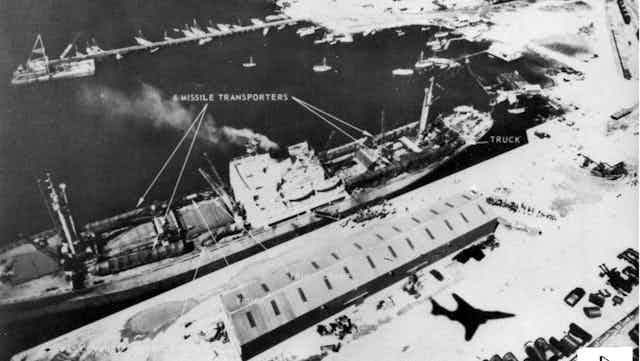


Fifty years ago, the United States and the Soviet Union stood on the brink of nuclear war over Soviet missiles in Cuba. Since then, the Cuban Missile Crisis has been recognised as one of the most definitive moments of the 20th Century.
In the past twenty years, declassified government records have revealed indeed how close the parties came to nuclear conflict. More records continue to be declassified. The Woodrow Wilson Center’s Cold War International History Project in Washington D.C., for example, recently announced the release of 500 previously classified documents, offering further insight on the crisis and responses to it from across the globe.
What has not been greatly explored to this point, however, is Australia’s reaction to this crisis.
On 23 October 1962, Prime Minister Robert Menzies addressed parliament and declared Australia’s support for the United States. He welcomed the US decision to bring the matter before the United Nations and pledged his Government’s support for its UN resolution. The US State Department acknowledged that Menzies’ statement was “the first one received”. While this did not pre-date the privately expressed support of the British, it was clearly a swift and therefore significant response.
Australia’s pledge of support for its American ally is not surprising. Australia was positioned on the west of the Cold War’s ideological divide and our great and powerful friend faced, as Menzies put it, “a very grave threat, at close quarters”. In a letter to Menzies in the days following his address, Kennedy said Australian support was “no surprise”.
However, a close examination of declassified government records illustrates that the Menzies Government’s response was more calculated than this statement suggested, and the Kennedy Administration perceived. Behind closed doors, the government, particularly officials in the Department of External Affairs — now the Department of Foreign Affairs and Trade — were concerned about the implications of the crisis for Australia.
On the same day that Menzies declared Australia’s policy, the Minister for External Affairs, Garfield Barwick, and his Department Secretary, Arthur Tange, discussed the potential effect of the crisis on future Australian-American cooperation over missile bases.
In their view, Australia had “a distinct interest in preserving the right of powerful allies to put bases and offensive weapons in Australia if we want them”. That is, in October 1962, there was a desire to host American nuclear weapons and bases on Australian soil. The likely reasoning would have been to secure American interest in Australia’s region and enhance Australia’s defence capabilities.
But Barwick and Tange were acutely aware of the complexity and difficulties of this position. In effect, but not intent, Australian desires aligned with Cuban objectives. Just as Cuba wanted their ally’s weapons on their soil, so did Australia. Barwick and Tange agreed that this could not interfere with the government’s policy on the Cuban crisis at the expense of the American alliance on which Australia so heavily relied for its defence.
The perceived threat of communism in South East Asia amplified Australian anxieties over regional security. In January 1962, the all-important Defence Committee stated in its paper, Strategic Basis of Australian Defence Policy, that “Australia cannot defend herself unaided against the military power of the communist nations”.
Australia depended on US assistance for its defence. As the Cuban crisis reached almost two weeks’ duration and tensions over Berlin simultaneously increased, External Affairs officials asserted Australia’s “need to prevent a situation arising which would concentrate US attention on the Caribbean and Europe, and thus reduce her capability to take effective action, if necessary in South East Asia”. The Menzies government was mindful of the consequences the crisis could have had in our region; a region which Britain and America advised was vulnerable.

Uncertainty over implications for Australian defence ambitions, the legality of US actions, Australia’s obligations to its ally, and potential regional repercussions were all factors given serious consideration by the Menzies government during the crisis. Such concerns and anxieties explain the deliberate nature of its policy. Support for America’s UN resolution, for example, would have given American actions legitimacy where it was otherwise absent.
Even then, however, the government’s support was conditional: Australia was not, and still isn’t, a member of the Security Council. So formal support for the American resolution depended on it being put before the General Assembly.
Nonetheless, Australia’s Permanent Representative to the UN, James Plimsoll, worked feverishly to garner support for the US position from the non-committed states. He was well-respected within the UN and had a close working relationship with the American delegation.
While publicly Australia was perceived as a faithful American ally, declassified government records reveal that the Menzies Government developed a calculated policy, carefully managed the American alliance given Australia’s defence needs, and kept Australia’s national interests in sharp focus.