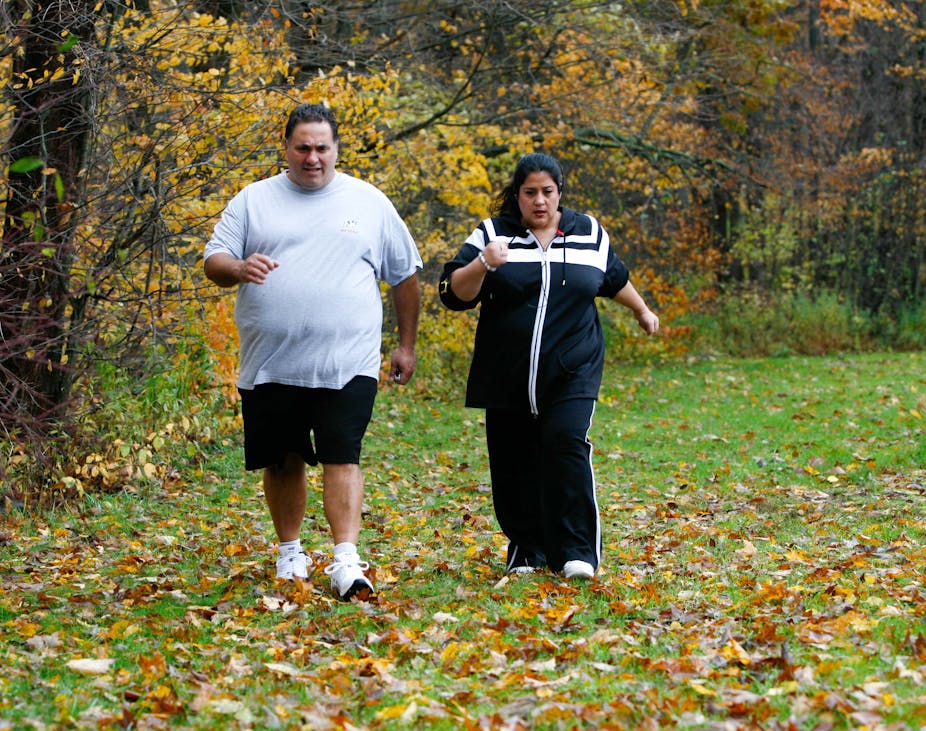
Back off, fatists – obesity blame games don’t help anyone

For anyone having doubts about overweight or obese people feeling blamed and shamed, the comments on a recent article about a positive image library should settle the matter. They clearly illustrate the assumption that obesity and associated conditions are the fault of the individual, the result of a…

Xqtzyjhv-1328681124
Focussing on individual behaviour for preventing and managing obesity is simplistic and misleading. Rudd Center for Food Policy & Obesity

For anyone having doubts about overweight or obese people feeling blamed and shamed, the comments on a recent article about a positive image library should settle the matter. They clearly illustrate the assumption that obesity and associated conditions are the fault of the individual, the result of a personal failure to be fit and healthy – they are not.

Eating healthy food and being physically active are important habits, but emphasising only the causal role of individual behaviour for preventing and managing obesity is overly simplistic and misleading. The underlying assumption here is that prevention of lifestyle diseases is completely within the control of the individual.

Contrary to what many people think, there’s a significant body of evidence showing that obesity is much more complex than the equation of calories in and calories out. This was highlighted by a recent series in journal The Lancet. It’s now apparent, for instance, that there’s a strong genetic basis to obesity, a factor that is obviously outside individual control.

What’s more, environmental features make maintaining a healthy diet and being physically active very difficult. An abundance of cheap fast-food options and unrelenting junk food advertising conspire against intentions to only eat healthy food.

Many people have sedentary jobs and rely on cars for transport due to a lack of active transportation options, such as safe and well-lit walking or bicycle paths. And busy lifestyles make it difficult to plan and prepare balanced meals.

Neglecting to acknowledge and address these risk factors, which are outside individual control, leads to a number of unintended, negative consequences. One particularly worrying consequence is the social stigma that now surrounds obesity and associated conditions, such as type 2 diabetes. Indeed, the creators of the positive image library of obese and overweight people were responding to these very prejudices.

Health-related social stigma

Physical and medical conditions, including leprosy, HIV/AIDS, and mental illnesses, have a history of being stigmatised. Some of these persist, and more recently, obesity has joined this list.

Overweight and obese people are thought to be at fault and are blamed for their health challenges, resulting in negative stereotypes and labels, such as lazy, greedy, and undisciplined, which are at once de-motivating and stigmatising.

A systematic literature review indicates the consequences of this social stigma are far-reaching. Weight-related bias is evident in employment, health-care, and familial and romantic relationship contexts. Negative emotional and psychological consequences include loneliness, embarrassment, and depression and anxiety.

Add type 2 diabetes to the mix and the associated stigma becomes even more complex. Type 2 diabetes treatments often induce further weight gain. The condition also requires daily self-management, including dietary adjustments, taking tablets, or injecting insulin. Many of these activities need to take place in public during the course of the day to optimise blood glucose levels.

But the fear of being judged, blamed or misunderstood, sometimes leads people with type 2 diabetes to conceal their condition. The result: omissions of crucial self-management activities, and sub-optimal biomedical outcomes; high or low blood glucose levels in the short term and; complications (such as micro- and macro-vascular disease leading to stroke, impaired vision, or foot problems) in the long term.

In actual fact, type 2 diabetes can be prevented in only around ⅔ of cases. So, blame-driven explanations of the condition reflect the gross misconceptions in society.

Reducing stigma

The widespread, negative social judgements of obesity and related conditions will be difficult to change but here are some ways to start:

1. More comprehensive health promotion messages

Health promotion messages focussing solely on individual behavioural change contribute to and reinforce assumptions that individuals are to blame. We need more comprehensive messages to educate society about how our physical environment and other social, economic, cultural, and genetic factors contribute to obesity and type 2 diabetes.

2. Stigma-sensitive health care

Health professionals have an ethical responsibility to minimise health-related stigma. They should demonstrate an awareness of negative stereotypes and actively work against them. One way of doing this is by not (unintentionally) casting blame on patients for not trying hard enough if their weight-loss efforts are not immediately successful.

People who are actively trying to manage their health can be empowered by becoming involved in organisations aiming to have a positive impact on our food and activity environments. Health professionals might consider referring patients to such organisations as Parents’ Jury and Victoria Walks.

3. Speaking out

Open discussion of the social stigma surrounding overweight, obesity and type 2 diabetes in a forum such as this one is important. Opinion leaders, health professionals, and people who are overweight, obese, or living with type 2 diabetes should be encouraged to engage in conversations in the public arena. They should seek to dispel myths that lead to blame and negative stereotyping.

Researchers also have a role to play. Work exploring the perceptions, experiences, and consequences of health-related stigma from the perspective of the targeted group is one way to have their voices heard. We need systematic exploration of the stigma experienced by people who are overweight or obese.

Improving our understanding

Obesity and type 2 diabetes are both increasing at epidemic proportions. The impact on the healthcare system (in terms of cost, and capacity for service delivery, for instance) is often discussed, but the impact on the individual lives is not.

In Australia alone, there are more than seven million overweight or obese people, and 1.7 million diabetics (around 85% to 90% of whom have type 2 diabetes). So a substantial proportion of our society will experience reduced quantity and quality of life, and is at increased risk of psychological and emotional distress.

It’s crucial to consider the psychological, social, and behavioural predictors of chronic health conditions. But it’s equally important to consider the psychological, social, and behavioural consequences of these conditions.

Better understanding of these issues will lead to better policy and practice. And, ultimately, this means better care and better lives for people who are overweight, obese, or living with associated chronic conditions.

Articles also by These Authors

Sign in to Favourite

Want to follow The Conversation?

Sign up to our free newsletter to get the day's top stories in your inbox each morning, with a special wrap on Saturday.

Spinner
Help us have better conversations — donate

Join the conversation

99 Comments sorted by

  1. Diane Fruchtman

    Student

    This article, while supplying an important corrective, still misses the point, and dangerously so. The point is that size is no indicator of health, and treating obesity and fatness as a health problem in and of itself is why fat is stigmatized.

    Furthermore, there are individual lifestyle choices that lead to illness and being unhealthy. Smoking, doing cocaine, staying indoors too much, not moving enough, eating animal products, eating processed foods rather than whole, and not drinking enough water all have negative health consequences, and if you want to be healthy and can afford to/are able, you should change those habits. But! (and here's the important bit) those behaviors do not correlate to size. In fact, smoking and cocaine tend to decrease your size. And exercise tends to increase it.

    The answer to fat-shaming isn't to say "They can't help being fat," but to say "There's nothing wrong with or unhealthy about being fat."

    report
    1. David Poynter

      Medical Scientist

      In reply to Diane Fruchtman

      Eating animal products is not obesogenic.
      In fact, I would contend that in order to address obesity the food pyramid needs to be turned on its head. Carbohydrates should not dominate, should not be at the base of the pyramid. If protein and fat, predominately in the form of unprocessed meats fish and poultry are increased and carbohydates greatly reduced along the lines of the paleodiet then people will lose wieght (may even have trouble holding weight). I would argue that we are in an evolutionary sense not programmed to eat a diet so dominated by grains.

      However, I agree with an earlier comment that obesity ha a large psychological component and is often intimately associated with depression.

      report
    2. Halla O

      writer

      In reply to Tony Linde

      Being fat is not necessarily unhealthy and more than being thin is automatically healthy. Being sedentary is more unhealthy, regardless of body size.

      report
    3. John Bourke

      Student, LLB, BSc

      In reply to Halla O

      It may be valid to say that being fat is not unhealthy, how obesity is clearly a marker of an unhealthy lifestyle at some point in time. This much cannot be denied. People who exercise regularly and eat quality food do not BECOME obese. Thus, you may say that fat people can engage in the most healthy life-style imaginable, however, often by the time they reach the stage in their lives where they decide to start living a healthy life, the damage has already been done. I.e. syndrome X (pre-diabetes), diabetes, cardiovascular illness. Obesity is not the cause of these problems, but is correlative with them. In one sense you could argue that someone who begins to show extra weight is being given a clear message by their body; it's telling them to change. Someone who remains skinny while engaging in an unhealthy lifestyle is not getting that clear message.

      report
  2. Meagan Kae

    Film maker

    Unlike smoking or drinking you can't just quit being overweight.
    My BMI is 27 so not only am I defined to be overweight, I personally feel overweight. I don't blame anyone else but myself for the condition that I am in, and I don't have the luxury of any genetic predisposition to it that I know of.
    I did hike the Kokoda Track last year (after undergoing a fitness assessment and months of personal training), which was extremely challenging so it's not like I'm lazy.
    In many ways these extreme…

    Read more
    1. Tony Linde

      Tony Linde is a Friend of The Conversation.

      retired

      In reply to Meagan Kae

      I've no idea what my BMI is but I am definitely overweight, feel crap being overweight (not due to media representation or anything else, just because of the fat), and am useless at getting rid of it. I did drop a stone and have kept it off but could still do with losing another two. I'm very impressed at your doing the Kokoda Track - well done.

      Personally, I feel that obesity, like alcoholism and depression (another one I can tick), is a mental disorder and does not have a simple solution. There ought to be more research into the mental correlates of obesity and overeating because just banging on about eating less and getting more exercise clearly isn't working.

      report
    2. Meagan Kae

      Film maker

      In reply to Tony Linde

      I totally hear where you care coming from. There are a bunch of new studies and research papers showing sugar to be a way more addictive substance than alcohol and drugs.
      The mental component to eating wasn't covered in this article but I am sure as part of the discussion/series it will be covered also.

      report
    3. Halla O

      writer

      In reply to Meagan Kae

      Meagan, if you have undertaken a fairly arduous physical challenge after months of training and you haven't lost weight, do you think that is an illustration of what the article says about it not being as simple as calories in/calories out?

      In any case, studies show that fat people following healthy habits are about as healthy as thin people following healthy habits and that being sedentary is more risky than being fat.

      report
    4. Meagan Kae

      Film maker

      In reply to Halla O

      Halla O,
      Unfortunately, in my case it is quite simple I am a COKE (a cola)/energy drink addict. I hate the taste of diet and I would put down easily 2 liters a day. I'm a sugar addict and it's totally all my own fault.

      But you make a very valid point, that while I am "fleshy" I'm also quite fit and flexible and know how to pace myself, so while some of the really fit, 6 pack guys had difficulties on Kokoda, I pulled up really well.

      What needs to change is our instinct to mock fat people at the gym, walking the dog, jogging with all curves bouncing... we need to be supportive of as you say any non sedentary activity.

      report
    5. Iain Wicking

      Director

      In reply to Meagan Kae

      Not just any sugar. I think the artificial stuff made from High-fructose corn syrup is an issue, which is present in near all processed foods.

      report
    6. Iain Wicking

      Director

      In reply to Meagan Kae

      I am always intrigued by pictures of groups of people in the 20's, 30's, 40's and so on, right through to the 60's. We were all much leaner I guess through lower calorie diets, more manual work and lifestyle and not tormented by high calorie processed foods.

      report
    7. Geoff Russell

      Computer Programmer, Author

      In reply to Meagan Kae

      Please look at the data ... Australia isn't the US. We don't produce much corn here and our intake of sugar and sweetners in general has been declining for about 50 years.

      There is also an obesity crisis in Italy. How much sugar do they eat? very little.

      And what about Cuba? They've generally eaten 2 to 3 times more than the Italians, but with far lower levels of obesity. Please look at the chart at the bottom of the following article ... based on FAO food supply data:

      http://animalliberation.org.au/blog/123-who-owns-diet-guidelines.html

      report
    8. Petrina Reichman

      Natural Health Practitioner

      In reply to Tony Linde

      Yes Iain, fructose (found in sugar, honey, fruit, corn syrup, etc) is a massive contributor as it is metabolised mainly in liver and converted to lipids (fat molecules) that are then stored in adipose tissue. Fructose is found in most refined food which makes up the biggest portion of weekly groceries in a lot of households here and in the states. This is the difference, we have moved away from whole diets and everything is refined and calories are empty. This in itself causes other inflammatory…

      Read more
    9. Halla O

      writer

      In reply to Meagan Kae

      Yes, that's a really good point, Meagan - there can't be articles about how crappy the lifestyles of fat people are (whether or not they are) and then mocking of fat people exercising. Can't have it both ways, so can we all live and let live instead?

      You must be as fit as the 'six pack guys' if you did as well or better than them. You're a different shape is all. It's a shame that you downgrade your own achievement like that, based on appearance rather than health. I mean, that doesn't look like it's an easy stroll! I'm in awe here. :-)

      report
    10. Andrew Jones

      logged in via Facebook

      In reply to Geoff Russell

      Uh, Geoff, do you have any idea what pasta or flour is? Pure carbohydrates, aka sugars.

      report
    11. Frances Lockie

      Policy officer

      In reply to Tony Linde

      "Personally, I feel that obesity, like alcoholism and depression (another one I can tick), is a mental disorder and does not have a simple solution."

      WHOA. My body is not a mental illness. Binge eating disorder? Sure, that's a disease, but obesity it's not synonymous with obesity.

      report
  3. Peter Fox

    Peter Fox is a Friend of The Conversation.

    Medical doctor

    Jessica & Jane, I acknowledge some of your points, but I don't think it's a helpful framework to allow overweight/obese people to take a passive role in this. If you tell them they can't change the way they are, this decreases the motivation to change.

    Your comment that "only 2/3 of diabetes is preventable" is highly misleading. Clearly that statement applies to insulin resistance, by which time I think we can agree the horse has already bolted.

    I think we need to address the "social contagion…

    Read more
    1. Meagan Kae

      Film maker

      In reply to Peter Fox

      Peter, ok but who gets to single them out and on what criteria?
      I know you don't mean walk up to a fat person in the street and say "hey what a fattie you are" anymore than you would walk up to a smoker and say "you are so going to die of lung cancer man".
      and I do agree with you that if you tell people that they can't change you remove the motivation to do so.

      If everyone had individual control then we wouldn't need to worry about drink drivers, or gun laws, speed cameras. The fact that Roxon…

      Read more
    2. Halla O

      writer

      In reply to Peter Fox

      Peter, do you not think that singling people out to criticise renders them passive? You are reducing them to a body rather than a complete person. Fat people already get a lot of stick for being fat, trying to counter it is why things like this stock picture library have been started.

      What "social contagion" is there?

      By the way, I find your last sentence offensive - why do you imply that fat people are stupid and do nothing but overeat? It's like saying all people would be murderers without religion and law to check their baser impulses. Why should you be in charge of what people eat or even deciding what ways are 'ruinous'? Are you a moral paragon in all matters? Even if you are, when did food become immoral?

      report
    3. Peter Fox

      Peter Fox is a Friend of The Conversation.

      Medical doctor

      In reply to Peter Fox

      Actually, I do approach smokers in the street and ask them to stop smoking.

      I don't really get your point. Are you trying to say we should wrap fat people in cotton wool to protect their feelings? The cold hard facts are they are overweight and it's a massive burden to themselves and society. It is not a normal body habitus.

      Their weight is mostly caused by poor nutritional education, poor exercise choices and lack of motivation. Attributing this to genetics is unhelpful and removes the motivation for people who already lack motivation.

      I can't imagine why people should need to be provided with free fruit and veg. They already are very cheap, tasty and nutritious. Poor education is a issue, and this needs to be corrected.

      If genetics was such a strong factor, why did it take until post WW2 before the obesity epidemic exploded?

      report
    4. Peter Fox

      Peter Fox is a Friend of The Conversation.

      Medical doctor

      In reply to Peter Fox

      Halla O, the socially contagious nature of obesity is well documented. Many articles are published on this, including: http://www.nejm.org/doi/full/10.1056/NEJMsa066082
      It refers to the fact that the more you associate with obese people, the more likely ou are to 'catch' obesity. Many theories for why this is the case, but in my opinion, is to do with normalising overweight body habitus.

      report
    5. Meagan Kae

      Film maker

      In reply to Peter Fox

      I'd love to see some video evidence of you approaching smokers and fat people telling them so. I await your youtube links... until then I don't believe you. I trust after you tell people they are fat you offer some support? no... yeah... that's what I thought... all talk and empty words.

      You have clearly never been overweight or understand what it is like to be so.

      report
    6. Halla O

      writer

      In reply to Peter Fox

      What do you mean by 'overweight body habits' (I am assuming you meant 'habits', my apologies if that's not the case)?

      I see they considered three causes in that study. They don't draw any firm conclusions though. It is interesting reading.

      The problem is that fat people - people who are already fat, to be clear - are being treated like disease vectors because of thinking like that. Or are being treated as if we're stupid, as you do in your last sentence of the first comment I responded to…

      Read more
    7. Peter Fox

      Peter Fox is a Friend of The Conversation.

      Medical doctor

      In reply to Halla O

      habitus |ˈhabitəs|
      noun chiefly Medicine & Psychology
      general constitution, esp. bodily build.

      Overweight people are not intellectually 'stupid'. However, as is evident by the clustering in lower socioeconomic groups, there is clearly an association with poor health education.

      There is a difference between treating people like lepers and letting people do whatever they want. As a society we have to discourage 'undesireable' health behaviours, sincere they are costly.

      report
    8. Frances Lockie

      Policy officer

      In reply to Peter Fox

      $20 says that you approaching smokers in the street doesn't make them quit smoking. Your unsolicited comments make you a jerk, not a saviour.

      report
  4. Geoff Russell

    Computer Programmer, Author

    The various comments on the previous article conflated two very different issues. First, positive images of fat people exercising and eating well in order to encourage them to lose weight and get healthier. Excellent. Obviously a great idea. But the second was a line that said being obese is fine and that obese people should be encouraged to feel good about it and give up trying to "be something that was impossible". The second line is questionable at best and damaging if it translates into a message…

    Read more
  5. Anne Wall

    nurse

    The writers of this article make a lot of sense. Sigmatizing obesity is does not help anyone loose weight. Appreciating that this is a complex topic that deserves thoughtful conversation is a first step. I think the goal should be to improve health rather than to loose weight. Loosing weight does not neccesarily mean becoming healthy. Improving health by healthy eating and joyful movement is a positive message rather than loosing weight which is a negative message.

    report
  6. Joseph Bernard

    Director

    I believe this article is counter productive because it just promotes a blame game rather than try treat the cause.
    Yes, i agree you can be happy and fat, but as a society should we be happy to see our children Fat and suffering from all sorts of fat related diseases? Should we be happy about the medical costs? Should we just sit by and deny the health issues?
    The first step to recovery is to acknowledge we have a problem. Once you have accepted this you can then focus on the difficult task at hand.. This issue has more to do with attitude than anything else and accepting responsibly for our own health is a good start..
    If society is not happy with Fatness, is that a bad thing when it encourages people to be thinner and healthier?

    report
    1. Halla O

      writer

      In reply to Joseph Bernard

      The key there is thinner *and* healthier - they don't necessarily go together. And yes, attempting to shame people about their bodies is bad.

      report
    2. Joseph Bernard

      Director

      In reply to Halla O

      Shaming people? or Loving them to death?

      Why use the word Shame? I was using the word question and that maybe challlenging!

      But i would rather challenge someone and atleast get them to think about their weight than say nothing and see them die early..

      I wish that I had challenged my late brother in law who die at the age of 45.. He had all the usually polically correct responses, which I respected at the time but when He faced death He was really sad and I miss Him dearly.

      report
    3. Kath Read

      IT Librarian

      In reply to Joseph Bernard

      You seem to think Joseph that fat people don't know they're fat. Trust me, we know. We don't need you to tell us. We don't need you to point out that our bodies are culturally "unacceptable". Minding ones own business is not being "politically correct" it's behaving a decent human being. The only people in denial about fat bodies are those of you who seem to think we need to be intervened in or "educated" in some way.

      We know. We're told every minute of our lives, every time we turn on the…

      Read more
    4. Joseph Bernard

      Director

      In reply to Kath Read

      Hi Kath,

      Surely, being overweight that is bad for your health and cause people to have a shorter life that is a "shame" or "Tragedy"!

      Talking about it and making it a conscious thought that will help many to heal and even avoid this situation.

      Is it a good thing to bring to people’s attention this issue so that they can avoid this life issue for themselves and/ or their children?

      In order to start to address a problem you first have to be aware and accept there is a problem!

      report
    5. Petrina Reichman

      Natural Health Practitioner

      In reply to Kath Read

      Yay Kath, say it how it is! And this is exactly what the authors of this article were trying to illuminate - a fatist culture driven my media, imagine if we still said similar comments etc if the word fatist was replaced with racist as it once was.

      Joseph, that is a very limited view. You are suggesting that overweight people do nothing about it and need to be shamed into taking action, because they are oblivious?? I see many clients in clinic coming for weight management. They are taking positive…

      Read more
    6. Kath Read

      IT Librarian

      In reply to Joseph Bernard

      Another person who didn't even read what I said.

      1) We know we are fat.
      2) We can't avoid messages about how obesity is "bad".
      3) Every fat person I know has spent most of their life trying to be "not fat".

      The problem isn't that we're fat. The problem we need to address is that people like you think you have a right to judge us and intervene in our lives.

      If it's not your body, it's not your business. Butt out.

      report
  7. Damien Gildea

    Author

    This article implies that because something is 'difficult' then rather overcoming that difficulty to achieve some success we shift the goalposts.

    The statement:
    "environmental features make maintaining a healthy diet and being physically active very difficult" is a highly subjective value judgement stated here as fact, that a large number of people not only disagree with, but disprove every day of their lives. It is simply far too inaccurate a statement for a supposedly evidence-based piece…

    Read more
    1. Thomas Marshall

      Postgraduate Student

      In reply to Damien Gildea

      I agree with your argument entirely.

      I'm a bit concerned by all the comments, and their endorsement by this site, that point to any suggestion that obesity is unhealthy as demonisation that needs to be silenced. Obesity is unhealthy; and the majority of people saying so here agreed with the original article's proposal to promote the use of images that are neutral or positive, so that media coverage may not be demoralising (reducing motivation to lose weight).

      The "Healthy At Every Size" league are abdicating any individual responsibility for health, and further, seem to be implying that obesity is not unhealthy at all!

      report
    2. Frances Lockie

      Policy officer

      In reply to Thomas Marshall

      Shame and stigma are NOT motivation. If it were, we'd all be thin right now. Every fat person has had a gutful (GEDDIT?!) of shame. It hasn't worked.

      HAES means health at every size for the population, not the individual. That means health can exist along of spectrum of sizes, not that every obese individual is automatically healthy.

      I find it amazing that you think that HAES - with its tenets of mindful eating and enjoyable exercise - has nothing to do with an individual taking responsibility for their health. Like, that's so ridiculous I don't know where to start.

      report
    3. Thomas Marshall

      Postgraduate Student

      In reply to Frances Lockie

      Health may exist for people of various weights but obesity is not helping re: health. Obviously a fat person is healthier if they don't smoke than if they do, or if they eat whole foods than if they don't, but HAES is being used as a tool to ignore the fact that a healthy weight range is a healthy place to be.

      My point about abdication of personal responsibility relates to people who have convinced themselves they live in a world not conducive to being slim so there is nothing they can do about it, or that their genes are responsible.

      I've been told a lot that I'm lucky to have a good metabolism. It doesn't have anything to do with the 4 times a week I go to the gym, or that I cycle everywhere.

      report
    4. Petrina Reichman

      Natural Health Practitioner

      In reply to Damien Gildea

      On the contrary to what Damien has stated, this concise and eloquent article shows a total lack of bias (well done!) and has demonstrated the complexities not only with obesity, but also the general public's perception of obesity and related illnesses. I agree, there are many factors involved with obesity and environmental factors cannot, and have not, been ruled out.

      Times have changed and unfortunately it is very difficult to have the opportunities to use and move our bodies as have previous…

      Read more
    5. Damien Gildea

      Author

      In reply to Petrina Reichman

      Petrina, you may disagree with what I have written, but your post would be strengthened by addressing particular sections that you can show to be incorrect or untenable. I elucidated what I felt were points of bias or inaccuracy. You are free to do likewise.

      Your comment that thyroid disorders are 'endemic' in the developed world is not backed up by evidence. As others have hinted at, such conditions leading to obesity are no more than 5% of cases. eg. http://www.ncbi.nlm.nih.gov/pubmedhealth/PMH0001409/ and have been reported to be as low as 1%. Anecdotes from a homeopathy business may or may not enhance understanding of a matter, but do not constitute medical evidence.

      report
    6. Petrina Reichman

      Natural Health Practitioner

      In reply to Damien Gildea

      Damien, please check the meaning of endemic, maybe you are confused with epidemic? It is a very common disease especially in women, and there are reams of research on this topic, so yes my comment is backed up by evidence...and lots of it. By the way, clinical anecdotal evidence should never be dismissed as "not medical evidence", never lose sight in the fact that science means knowledge.

      Thyroid hormone regulates our metabolism so it is not a big ask to link it with obesity. However, this is…

      Read more
    7. Damien Gildea

      Author

      In reply to Petrina Reichman

      It's you that need to check your definitions.
      "characteristic of or prevalent in a particular field" from http://www.merriam-webster.com/dictionary/endemic

      "natural to or characteristic of a specific people or place;" from http://dictionary.reference.com/browse/endemic

      Something showing in just 5% of a population can in no way be considered to be characteristic of that population, nor prevalent in it.
      Prevalent = "widespread; of wide extent or occurrence" from http://dictionary.reference

      Read more
    8. Petrina Reichman

      Natural Health Practitioner

      In reply to Damien Gildea

      Oh my, Damien you do get hot under the collar!!

      I absolutely disagree with everything you have said and am sticking to my guns. There is really no need for abusive language, as this is a forum for open and intelligent discussion. Independent thinkers seldom carry on in the language you have just demonstrated.

      5% IS prevalent (1 in 20 adults) and characteristic to western society, and this is just Hashimoto's disease, there is also sub-clinical hypothyroidism which is far more wide spread and can also have damaging effects on the metabolic processess. If you want links to research, don't be lazy, there are stacks of studies. I use a university database for access to journals which is far more tantalizing than pubmed - but not free to non-alumni...so good luck with that.

      report
    9. Frances Lockie

      Policy officer

      In reply to Thomas Marshall

      I dance four times a week and walk everywhere. I'm still obese. My obesity may not help my health, but it certainly is no hinderance. If you acknowledge that health may exist for people of varying weights, what's the problem? Why does health not count unless it comes in a thin body?

      report
  8. Stephen Bant

    Freelancer

    Nowhere has this article demonstrated obesity as anything other than the responisbility of the individual.

    So there's a strong genetic basis to obesity? Then are we to presume that people genetically predisposed to obestity have been breeding at a much faster rate than at any other time in history, resulting in the current obestity epidemic? Nonsense.

    Then you want to blame "environmental features" like convenient fast foods and adversiting, as if fat people are up against an unrelenting barrage…

    Read more
    1. Halla O

      writer

      In reply to Stephen Bant

      Stephen, when faced with healthy, fit, fat people who don't indulge in any of the stereotypical behaviours you scoff at in your comment, what do you think? Being fat is not the issue, telling people they are worthless because they are fat is.

      I'd prefer if everyone adopted healthy behaviours (and had access to nutritious food) but do you know what? It isn't my business to tell others how to live with their bodies and it's not theirs to tell me what's best for mine.

      report
    2. Meagan Kae

      Film maker

      In reply to Stephen Bant

      Stephen while your views may be entirely justified, the problem is just by having them doesn't fix the problem.

      If you were Health Minister would just say, fat people, you are fat it's your fault, get over it and no health benefits until you have an acceptable BMI (and that may well work). As Health Minister already your biggest (pun ;) problem is Australia now has an obesity rate higher than the United States. That's a lot of fat people in this country, regardless of what the reason is.

      Even…

      Read more
    3. Thomas Marshall

      Postgraduate Student

      In reply to Meagan Kae

      Because you took the decision out of the dog's (hands?) to eat less. It's a lot harder to take decisions out of your own hands.

      report
    4. John Bourke

      Student, LLB, BSc

      In reply to Halla O

      However, if someone has become obese, they must have engaged in an unhealthy lifestyle at some point in time. It seems there is a sense of cultural amnesia whereby fat people are somehow, one-day, fat. The work that needs to be done is to stop people becoming fat in the first place. Government policies can assist with this, however, at the end of the day, the ultimate responsibility lies with the individual. When you notice at 23 that you're a little heavier than you used to be, you should take…

      Read more
    5. Petrina Reichman

      Natural Health Practitioner

      In reply to John Bourke

      John, there have been a few comments similar to your comment that "people go on about it being 'out of their hands'". This may be the case for a very small number of people but there are a lot of people very concerned with their weight and unsure of how to make changes and do seek professional help and advice. This is part of the stigmatisation this article is getting at! Misconceptions and far too many generalisations.
      You are correct that obesity does not occur overnight, however, you have outlined a very simplistic view of the process. I see a lot of women in clinic reaching their 40's, after raising children (which is an extrememly busy and time-devoted undertaking) find themselves in a hormonally and metabolically compromised state leading to weight gain which can escalate into obesity very quickly. This is just one example of why eliminating stigma and generalisations is important for the health and wellbeing of our society.

      report
  9. Kath Read

    IT Librarian

    And yet again, a whole swathe of people don't actually read what the article is saying, and totally miss the point.

    There is no amount of evidence that can be presented that will sway these people who need to feel superior to someone, anyone that:

    a) fat does not equal lazy/greedy/stupid
    b) that fat people actually DO lead active, healthful lives yet still remain fat
    c) health is not some hierarchy of social value
    d) shame cures nothing
    e) human bodies are not lawnmowers, the law of thermodynamics…

    Read more
    1. Peter Fox

      Peter Fox is a Friend of The Conversation.

      Medical doctor

      In reply to Kath Read

      I don't think anyone is suggesting that fat people are worthless. However at a public health level, the authors' stance amounts to ignoring the problem. Every overweight person (and the more accurate measure of healthy weight is waist circumference, ideally <80cm in women and <94cm in men) is exposing themselves to the substantial morbidity and mortality of metabolic health problems. Furthermore, our society is bearing the substantial cost of this (Diabetes Australia has estimated this to be $58 billion per annum, and on the steep rise).

      Overweight people are important contributors to our society, but we can't stop meaningful public health interventions because we are worried about offending them.

      report
    2. Peter Fox

      Peter Fox is a Friend of The Conversation.

      Medical doctor

      In reply to Peter Fox

      Sorry, ipad cut off my reply:

      I don't think anyone is suggesting that fat people are worthless. However at a public health level, the authors' stance amounts to ignoring the problem. Every overweight person (and the more accurate measure of healthy weight is waist circumference, ideally <80cm in women and <94cm in men) is exposing themselves to greater burden of morbidity and mortality of metabolic-related diseases. And the cost to society is substantial (Diabetes Australia in 2008 estimated the per annum cost of obesity to be $58 billion, and is rising sharply).

      Overweight people are clearly valuable contributors to our society. However, I don't think we can stop meaningful public health interventions because we are worried about offending them.

      report
    3. Peter Fox

      Peter Fox is a Friend of The Conversation.

      Medical doctor

      In reply to Peter Fox

      I think the system cuts off any after 'less than' symbols.

      I don't think anyone is suggesting that fat people are worthless. However at a public health level, the authors' stance amounts to ignoring the problem. Every overweight person (and the more accurate measure of healthy weight is waist circumference, ideally less than 80cm in women and 94 cm in men) is exposing themselves to a significant burden or metabolic-disease related morbidity and mortality. Furthermore, the cost to society is substantial, with Diabetes Australia estimating obesity is costing us $58 billion per annum (and rising).

      Overweight people are clearly valuable members of our society. However, it makes no sense to stop meaningful public health interventions because we are worried about offending them.

      report
    4. Meagan Kae

      Film maker

      In reply to Peter Fox

      Well put and this statement I completely support.
      But now take it one step further, what should that intervention look like?

      report
    5. Joseph Bernard

      Director

      In reply to Meagan Kae

      Open Discussion is a good start.
      People in general have to "want" to change in order for them to start to then take the necessary steps. All too often this 'want" to change only happens when there is a “significant” event in their lives ie Illness. The “emotional content” from this event then drives the person do actually do something about the "thought" of change..
      Everyone is different and so there is no “single” way of addressing this Issue. For one group, those that wish to live a full life, well sell them the benefits and the facts. When we step around the issue Trying to “Back off, fatists” , well are we then denying people the emotional content that they need tol drive them to change?

      report
    6. Meagan Kae

      Film maker

      In reply to Joseph Bernard

      well put.
      I don't know how else you motivate people to make the change other than being sincere and telling them they are overweight and need help. and if you do that with support in hand, financial, medical then hopefully you can make a difference.

      report
    7. Frances Lockie

      Policy officer

      In reply to Joseph Bernard

      Shame doesn't make people thin. If it did, there wouldn't be a single fat person around.

      "Everyone is different and so there is no “single” way of addressing this Issue."

      Agreed. And yet the only way that we seem capable of addressing obesity is with stigma. I'd like to see a positive health campaign that espouses the benefits of exercise and healthy eating for all, without stigmatising fat people, if only for balance.

      report
  10. Tim Scanlon

    Author and Scientist

    Strange, my wife and I have managed to stay thin and healthy. According to this article and the comments here I should be battling an ongoing war with genetics and evil food.

    Nothing encourages me more than the comments we receive weekly: "You have a lucky metabolism", "You're eating a carrot as a snack!?" and my favourite "How do you find the time to exercise?"

    Yes, us thin people are lucky, so lucky to eat properly and exercise regularly. It definitely is lucky that we take the dog for a…

    Read more
    1. Russell Hamilton

      Librarian

      In reply to Tim Scanlon

      "According to this article and the comments here I should be battling an ongoing war with genetics and evil food"

      Not necessarily, Tim. Don't you know any slim people (who eat whatever they want) and come from a long line of slim people? Genetics can make you slim, and so, I suppose, genetics can make you more easily, fat. Maybe you're happily at the ideal point.

      Do we need to be more precise here? Being a bit chubby all over doesn't seem to matter much if you are healthy/have a healthy lifestyle…

      Read more
    2. Kissindra

      logged in via Twitter

      In reply to Tim Scanlon

      did you read the other article and comments? Plenty of us fatties are out there talking our dogs for walks, using gym equipment or taking other forms of exercise, eating healthy and not reaching a dress size that society deems acceptable! Do you not realise that your body is not a carbon copy of every body and that what is easy for you to achieve may be unachievable for others and that that can have absolutely nothing to do with any "poor choices"?

      report
    3. Tim Scanlon

      Author and Scientist

      In reply to Kissindra

      Incorrect.

      I've seen plenty of overweight and obese people in gyms "working out". What seperates them from the people who are in shape is dedication and intensity.

      I've seen the lunches and dinners that overweight and obese people eating at the same places as I do. The difference is I'm making a better choice and not eating poorly as regularly.

      If you really want to discuss body physiology and chemistry, feel free. The actual differences are minor in comparison to the gross discrepincies in caloric intake and lifestyle. This has been studied time and time again and proven to be the case. WHO showed 1500 calories more for the average heavier person, that isn't accidental or genetics.

      report
    4. Tim Scanlon

      Author and Scientist

      In reply to Russell Hamilton

      Sorry Russell, but you are only half right.

      There are metabolic differences between individuals, some gain weight (muscle and/or fat) more easily than others. But this is still controlled by satiety and dietry habits. The studies on the proportions of overweight people who have an actual problem with registering satiety or "genetic" problems (e.g. thyroid conditions) are actually less than 5% of the obesity problem.

      On the chubby thing, you're on the right track. BMI and waist measurements…

      Read more
    5. Thomas Marshall

      Postgraduate Student

      In reply to Tim Scanlon

      I don't agree with everything you said - I think you're being a bit harsh. But it does bring to mind the regular comments from my housemate about me being lucky to have a good metabolism, something which he "lost". It doesn't have anything to do with the 4 times a week I go to the gym.

      However, I'm sure if I didn't have the time to go to the gym, (I have almost no commute), I'd be fatter. I'm looking forward to going back to uni so I can have a healthier lifestyle of intermittent exercise between classes and work. As for the rest of my life, I hope work is flexible enough to allow some exercise into my life.

      report
    6. Russell Hamilton

      Librarian

      In reply to Tim Scanlon

      "fat people have to stop pretending that it is someone elses fault "

      Yes, the same could be said for depressed people - give them a good slap and tell them to buck up.

      Maybe I just haven't got the terminology right, but to me if a person is a bit fat, it's probably not a problem. If they are too fat - obese - they need to change that for their own good.

      I'm only going on my own experience re genetics - I come from a skinny family, and until I was in my 40s I ate a vast amount of rubbish - 3 or 4 chocolate bars a day, thickshakes, chips - nothing could put an ounce of fat on me. So I imagine there are people with the other tendency - they only need a little too many calories to get fat. I don't think the difference between fat and thin people is only strength of will power.

      report
    7. Tim Scanlon

      Author and Scientist

      In reply to Thomas Marshall

      I'm rather sick of the time argument. We all have ~24hrs in a day. If someone choses to put their health last then that is still a choice. I have my weights, stationary bike and rowing machine at home. I often catch up on The Daily Show on the bike.

      I've met competitive bodybuilders who have intensive day jobs, yet still manage to prepare for competitions with huge demands on their diet and training. All of them pack their food to take with them and all of them make time to train before or after work.

      report
    8. Tim Scanlon

      Author and Scientist

      In reply to Russell Hamilton

      Russell I understand what you are saying, but I disagree.

      Depression is not "something you just get over". It isn't a choice that suddenly occurs. It is something you can combat though, something you have to be proactively dealing with to not let it control your life.

      The idea that someone can just eat whatever they want and not get fat is rubbish. High basal metabolisms are related to a number of things, but they are still dependant on caloric intake. There is plenty of research that covers…

      Read more
    9. Russell Hamilton

      Librarian

      In reply to Tim Scanlon

      "The idea that someone can just eat whatever they want and not get fat is rubbish"

      Tim, I was the living proof - until I got into my fifties. When I was younger, at the same time as eating vast amounts of rubbish (who else do you know whose mother drove to the ice-cream factory to buy small drums of it, we ate so much of it!) I also used to swill down those 'protein' shakes and lift weights, but, no, didn't put on an ounce, just like my father, grandfather ......

      I mentioned depression because…

      Read more
    10. Tim Scanlon

      Author and Scientist

      In reply to Russell Hamilton

      I agree with your point on the underlying aspects to why people don't make the right decisions. I've read a few papers on it, the scariest one is the normative conditioning and genetic linkages from perinatal influences.

      I won't go into the science but instead quote an example. My wife and I went on a boat cruise, which is pretty much an eat and drink bonanza. While we queued up for lunch one day a obese woman was guiding her daughter through the lunch options. The girl was a normal size and was picking all the right foods to eat. Her mother told her off and told her to have some of the chocolate covered pastries.

      Oh, and I know several people who struggle with their weight. My opinion still stands.

      report
    11. Russell Hamilton

      Librarian

      In reply to Tim Scanlon

      "genetic linkages from perinatal influences"

      Is that a fancy way of blaming mothers? Because they'll just blame Dr Spock.

      report
    12. Jay R

      Mining Engineer

      In reply to Tim Scanlon

      I agree with most of what you say Tim. Particularly about peoples priorities. I didn't own a car for a few years (until a few months ago unfortunately), and cycled everywhere I needed. Did this impact on my convenience? you bet! Rolling up to a date on a bicycle looks daggy? sure does! But I love the exercise and that was more important.

      But..

      So if someone normal is truly motivated to not be fat (my motivation comes from have an entire family of fatties), then they can. You could say the same for smoking. Although smoking is still a personal choice, as a society we support things that make less people choose it. I think that obesity discussions should be based along the same lines. I support higher taxing of cigarettes and why not the same for unhealthy food etc..

      report
    13. Frances Lockie

      Policy officer

      In reply to Tim Scanlon

      "People can justify their choices anyway they want to, just quit complaining about the negative consequences."

      Regardless of how fat people came to be that way, we deserve to be treated with respect. Stigma and prejudice is not a negative consequence we should be expected to put up with, and I'm pretty distrubed by the implication that we should.

      report
  11. Hans Larssón

    logged in via Facebook

    So much rage going on in the comments below. Why not the just eat around the recommended daily intake of 2000 cals with moderate exercise and stick to it..... and the money you save from what you would have eaten in excess of that you send in aid to third world countries like Ethiopia who need the money for food.

    report
  12. Mario Bono

    Mario Bono is a Friend of The Conversation.

    Health/Nutrition Coach

    Best diet I've come across is ...

    1. Eat food.
    2. Not too much.
    3. Mostly plants.

    Seven words - easy to remember and suitable for all.

    So ...
    If it doesn't look like real food, best to avoid it.
    When you've finished your meal, there should be room for more!
    Plant-based diet is best, with occasional meat/fish.

    I'd also throw in regular exercise - mix of aerobic and resistance training.

    report
  13. Sharon Clews

    Director

    There may well be a strong genetic basis for obesity, but let's not use it as an excuse for people to not lose weight and become healthier. This article has probably made a whole bunch of overweight people sigh with relief, and find another excuse to not make changes to their lives. I've been overweight and had a "weight problem" (read mental issues regarding food and body image) and lost a great deal of weight. My problem was denial. I didn't realise I had put on weight. I thought the clothes sizes…

    Read more
  14. Alex Avery

    logged in via Twitter

    From Facebook comments on reference to article by The Conversation:

    ‎The Conversation, the first thing we all need to agree on, and I think the article supports, is that obesity is largely behavioural. Society already has frameworks for dealing with non-preferred behavioural issues. One such system is the criminal system. There are others.

    Common frameworks, in both sciences and law, would consider concepts such as causation and appropriate allocation of blame and responsibility as important…

    Read more
    1. Yoshua Wakeham

      Graduate

      In reply to Alex Avery

      Well, one distinction that immediately springs to mind between crime and obesity is that crime has both a direct cost (the impact on the victim of the crime) and indirect cost (the cost of maintaining a criminal justice system). Obesity doesn't have a direct victim. Our health and lifestyle choices would be completely personal if it weren't for the costs of the public health system – whereas the choice to commit a crime that hurts another person could never be considered simply a personal choice. (Admittedly I'm generalising here—not all crimes are the same. But you get the idea.)

      Obviously we can't ignore the public health costs associated with obesity. But I think the efficacy of shame and guilt as corrective mechanisms might be different in the two cases.

      report
    2. John Bourke

      Student, LLB, BSc

      In reply to Yoshua Wakeham

      Insider trading is a crime. Point to the victim.

      Parking infringements are met with retributive punishments. Point to the victim. Same goes for speeding offenses.

      Sadomasochistic acts are illegal, but the person being harmed actively consents. If I was to kill someone who consented to that act, I would still be charged with murder.

      The point that Alex above is making is clear. The criminal justice system deals with activities that are considered non-preferential by society. While becoming obese (and smoking/alcholism) is not a crime per-se, it does share a common element with the examples listed above: the activities are not considered to be good for society.

      report
    3. Yoshua Wakeham

      Graduate

      In reply to John Bourke

      That's a fair point. My distinction was sloppy. I agree that Alex's point is clear, and that it's true that obesity/smoking/alcoholism are considered by society to be non-preferential behaviours.

      What isn't clear to me is that assigning blame and attempting to elicit shame are going to be equally effective in criminal and health cases. I presume there's fairly solid evidence to support the effectiveness of blame/shame in deterring would-be criminals and preventing recidivism. Is there data that shows that blaming/shaming overeaters/smokers/drinkers actually makes them change their behaviour? I'm all for "Go for your life" and similar campaigns, which gently rebuke overeaters and remind them that their health is their responsibility. But I find it difficult to believe that abusive anti-overweight discourse in media and society helps the problem.

      report
    4. John Bourke

      Student, LLB, BSc

      In reply to Yoshua Wakeham

      I would certainly agree that shaming on an individual basis is not going to be effective. Even if it were effective at curbing the incidence of obesity, it would, in my opinion, still be the wrong thing to do. However, as with the criminal justice system, fear of shame/incarceration/punishment is not the only factor that mitigates criminal activity. Another important factor is the moral rightness of the law. I.e. I do not refrain from murdering and raping because I am worried I will be caught…

      Read more
  15. James Jenkin

    EFL Teacher Trainer

    If government employs people to 'help' and 'advise' us on our lifestyles, then naturally they're going to spend 40 hours a week telling us that we'we don't know what we're doing and that they have to intervene - or they wouldn't be doing their job.

    report
  16. Petrina Reichman

    logged in via Facebook

    The revised Australian Dietary Guidelines are available for public consultation. This is exciting for anyone interested in nutrition as it represents a new era of understanding human nutrient requirements that are evidence-based. Fingers crossed.

    http://www.eatforhealth.gov.au/

    report
    1. John Wright

      Director

      In reply to Petrina Reichman

      Hi Petrina They could be a force for good - but are unlikely to be. The data set is taken from 1995, and the evidenced based recommendation system, rates that the proposed guidelines will have neither a positive or negative effect on Australian Nutrition - not the most ringing endorsement is it? The best chance to have made a real change to nutrition could have come from the 2010 DGAC report - but the authors backed off making significant changes under pressure from the food lobby.

      The food industry is so dominant in Aus can't really see the Authors rocking the boat, after all who else will provide their research funding?

      report
    2. Petrina Reichman

      Natural Health Practitioner

      In reply to John Wright

      Hi John, I am not sure what sure what you mean by "the data set is taken from 1995", I understood the process guidelines were undertaking systematic reviews from 2002 to 2009. The guidelines for modelling do address inadequate micronutrient intake as well as the overall dietary patterns and the importance of lactation and pregnancy on weight outcomes (which is all fabulous) - and long overdue!

      I am quite familiar with the 2010 DGAC report as it is a wealth of information and very thorough and in depth. As far as I can see, it looks like the revised Oz guidelines will be following in the same fashion, once report has been released. But I am really interested on further discussion. Real change in the population will come about as more health professionals understand and acknowledge the impact nutrition plays on public health and chronic disease. Are the guidelines really there to rock the boat? Maybe that is more the job for people like you and me.

      report
    3. John Wright

      Director

      In reply to Petrina Reichman

      Yes but the what Australians Eat Data is 1995 - unless I am much mistaken, hardly current!

      report
  17. John Wright

    Director

    Hi Sorry for joining this a little late. It is really good to see discussion about the limitations of Energy Balance as a hypothesis - although disappointing there are no nutritionists in the discussion. This is a response to a NYT article from Taubes and Attia http://www.nytimes.com/2012/01/22/magazine/reply-all-fat-trap.html?_r=1 which you may find of interest.

    We have spent 4 years developing new metabolic monitoring technology for primary care , based on some established research technology…

    Read more
    1. Petrina Reichman

      Natural Health Practitioner

      In reply to John Wright

      I agree John, we are all unique with differing metabolic and biochemical situations that require a more holistic approach to treament. The problem I find in clinic is that people don't knnow where to start, how to maintain compliance, and often come with emotional issues. However, prevention is easier than cure and education, awareness etc are slowly coming into public view, and it is really important we lose the stigmatisation and lack of understanding that seems to be a common thread in posts of…

      Read more
  18. Francesca Cathie

    Policy and Planning

    Come on every fat person knows exactly why they are fat - they eat too much! It is my personal responsibility to understand what is good for me and to choose to maximise my health - if I choose to prioritise long hours, no exercise, commuting etc that's my choice. Each and everyone of us who has access to resources and education has the choice to make their lives different - however access to resources is limited for some in Australia (we like to cry poor but most of us are pretty damn well off…

    Read more
    1. John Wright

      Director

      In reply to Francesca Cathie

      Francesca wouldn't it be wonderful if it were only that simple. The obese store more fat than the rest of us, that is true and relatively simple to understand. Why they store fat is substantially more complicated. It may be eating too much, it may be the composition of the food is wrong, maybe there is poor hormone regulation (particularly insulin) 1 in 4 Australians are insulin resistant (1 in 2 in the obese), or anyone of 8 - 10 factors that impact on mitochondrial function. Then there are the…

      Read more
    2. Petrina Reichman

      Natural Health Practitioner

      In reply to John Wright

      Well said John.

      With your last statement though, there is never going to be a universal theory to obesity due to all the other factors you highlighted already (:

      report
    3. Damien Gildea

      Author

      In reply to John Wright

      John,

      I agree with a number of your points above, and with some of the issues ascribed to Taubes' book, but without any indication in that link of the runners' consumption of calories the study is not particularly useful as it stands - it's only half the story. In fact, in the very next paragraph the author admits this in relation to the second, Danish, study when she says:

      "Granted, this study doesn’t take into account what the subjects were consuming but what it does do is prove that diet…

      Read more
    4. John Wright

      Director

      In reply to Damien Gildea

      Hi Damien
      I agree with you and your answer is more complete. I simply wanted to illustrate the point - that simple energy balance theory is not appropriate for all if any. Runners as with any other conditioned 'athlete' that I have worked with generally are more motivated to eat well, have a clearer understanding of their energy demands and because of their chosen exercise are probably more motivated to stay lean that the rest of us. Despite this and perhaps because of the reasons you outline - they still gained weight. The irony of this study is in the conclusion that the only plausible answer to this issue was to increase the output side.

      report
  19. Tyler Reed

    logged in via Facebook

    I feel like a lot of this article is just trying to saying fat people aren't at fault for being overweight. Well despite a genetic predisposition if someone is fat it is generally due to lack of exercise and a poor diet, so in reality overweight people are to blame. I wouldn't say that a junkie isn't to blame for their addiction because of a predisposition, not would I say a criminal isn't to blame regardless if they were raised by criminals. To say overweight people are not to blame is just laughable.

    report
  20. Alison Moore

    Senior Lecturer in Modern European History, University of Western Sydney

    It is important to remember that there are multiple genetic, situational and life-style factors involved in the markers of health commonly recognised by modern medicine. We can never assume we know to what extent someone is responsible for being fat, thin or anything else. Many thin people also take little care with their health and end up burdening the health system with preventible diseases. There is, for instance, a greatly increased documented incidence of slim people developing Type II diabetes…

    Read more
    1. Alison Moore

      Senior Lecturer in Modern European History, University of Western Sydney

      In reply to Alison Moore

      that plagues contemporary societies. It is difficult to know what kind of images might help to play that subversive role.
      The issue of "normalisation" perhaps needs to be considered more carefully. What is at stake in the "normal"? Must this necessarily imply encouraging people to ignore health concerns about obesity? Are you sure that if you invoke that concern, you are not simply reinforcing a system of shame, guilt and denial? I certainly don't see anything to be gained from fat people feeling that they are ugly or wrong. It seems like that kind of self-perception can quite easily cohabit with avoidance and denial of questions of health and wellbeing.
      So although I am not sure I can see anything especially "positive" about the images in this archive, I have to support the attempt to reconfigure public imagination of different kinds of bodies.

      report