
Barclays' rate-rigging scandal exposes the rot in UK banking system

The sense of frustration and despair within the British government and regulatory agencies over the behaviour of Barclays in submitting patently false returns to the London Interbank Offered Rate (LIBOR) panel that sets global interest rate benchmarks is palpable. The avuncular Business Secretary…

4mxkbjzk-1341203439
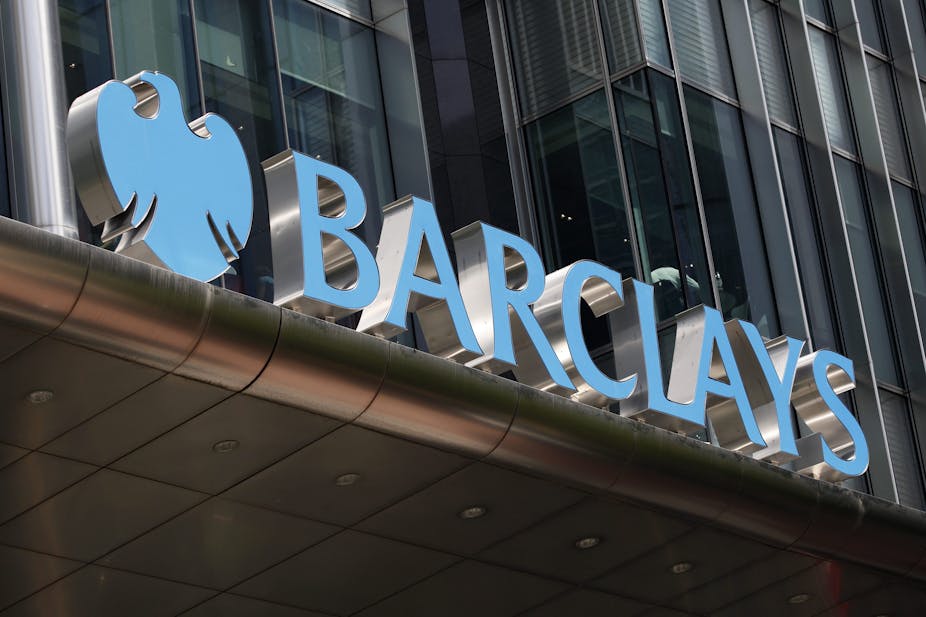
Barclays – Britain’s largest investment bank – has been fined after it was revealed that the bank had manipulated the London Interbank Offered Rate to boost its trade of credit derivatives and bolster its financial reputation. AAP

The sense of frustration and despair within the British government and regulatory agencies over the behaviour of Barclays in submitting patently false returns to the London Interbank Offered Rate (LIBOR) panel that sets global interest rate benchmarks is palpable.

The avuncular Business Secretary, Vince Cable, spoke of the need to clean up what he termed the “cesspit of British banking”. The Governor of the Bank of England, Mervyn King, accused the bank of “deceitful manipulation”. The scandal, he said, provides evidence that “something went very wrong with the UK banking industry and we need to put it right”. Perhaps the most telling reflection, however, came from Lord Adair Turner, the outgoing chairman of the Financial Services Authority, which is itself to be disbanded as a consequence of prior failure to police the market. For Lord Turner, quoted in the Financial Times, the manipulation revealed a “degree of cynicism and greed which is really quite shocking…and that does suggest that there are some very wide cultural issues that need to be strongly addressed”.

The disclosure and settlement derives from a joint transatlantic investigation into how the LIBOR rate is calculated and whether conflicts of interest meant that it was prone to manipulation. The investigation is being conducted by the United Kingdom’s FSA in conjunction with the United States Department of Justice and the Commodities and Futures Trading Commission (CFTC) with the assistance of the Securities and Exchange Commission.

Barclays has agreed to pay $US200m to the CFTC, $160m to settle related charges brought by the Department of Justice and $93.2m to the Financial Services Authority. The cumulative fines – the largest imposed on a bank since the financial crisis began – reflect the fact that the manipulation did not simply predate the crisis but continued throughout it. As noted by Tracey McDermott, the head of enforcement at the FSA, this was not the result of a single mistake. Rather, “Barclays’ misconduct was serious, widespread and extended over a number of years…This was possible because Barclays failed to ensure it had proper controls in place. Barclays’ behaviour threatened the integrity of the rates with the risk of serious harm to other market participants.”

It would appear, however, that Barclays was not acting alone. In an exceptionally revealing statement, the Department of Justice notes that “to the bank’s credit, Barclays also took a significant step towards accepting responsibility for its conduct by being the first institution to provide extensive and meaningful cooperation to the government. Its efforts have substantially assisted the Criminal Division in our ongoing investigation of individuals and other financial institutions in this matter.”

This sends an ominous signal that the scandal is far from over.

The Department of Justice has used similar tactics in a range of high profile cases, including the infamous price-fixing scandal involving the auction houses Christies and Sothebys in 2001. In that case, however, Christies availed of the leniency program and evaded financial penalty. The fact that Barclays had to pay what the Department of Justice refers to as a “substantial price” suggests the cooperation – although in itself substantial – was both late and insufficient to compensate for the egregiousness of the offence, as laid out in the Principles of Federal Prosecution of Business Organizations. These principles include the pervasiveness of wrongdoing within the corporation, the corporation’s history of similar misconduct, including prior enforcement action.

Although the Department of Justice has agreed not to prosecute Barclays, the non-prosecution agreement does allow for the future prosecution of individuals, including employees of the bank. Furthermore, it is conditional on the bank continuing to cooperate not only with the Department but with any other US enforcement agency. Should the bank fail to comply with the terms of the agreement, the adjudication of which is at the “sole discretion” of the Department of Justice, it is subject to immediate prosecution for a range of offences, including perjury and obstruction of justice. This suggests the evidence of misconduct is exceptionally strong.

By cooperating, Barclays has made a rational calculation. The reputational damage will, however, extend far beyond the 15% share fall since the disclosure last Wednesday. The chief executive, Bob Diamond, has determined to try to ride the crisis out rather than following the lead of the bank’s chairman, Marcus Agius, who resigned on Monday, citing his responsibility to uphold the reputation of the bank. The phrasing is rendered even more curious given the fact that at the time of the manipulation of the dollar and euro interest rates Diamond was in charge of the unit involved.

Changing or charging individual executives will not, however, change the culture – either within Barclays or the wider banking sector. The fact that the misconduct was reported to the bank’s compliance department and was ignored suggests an amoral culture within the bank. It demonstrates, yet again, that unless compliance is linked to warranted commitment to high ethical standards, it is meaningless.

Restoring integrity to the banking system necessitates building integrated accountability systems that are subject to ongoing external evaluation. The non-prosecution agreement is a start; but it is only a start.

Effective reform requires a cleaning of the “cesspit”, which can only occur if there is acceptance within the industry of systemic ethical failings. That in turn requires a far-reaching inquiry on what should constitute the moral foundations of market integrity.

Just as the phone hacking scandals in the United Kingdom prompted judicial inquiries in both Australia and the United Kingdom into media ethics, there is a similar need to establish the parameters of acceptable practice in banking. The prosecutorial leverage provided by the Barclays admission of wrong-doing suggests and future revelations will increase the possibility of it occurring – if only to protect the industry from itself.

Justin O'Brien writes a column for The Conversation, The ethical deal, and is director of the UNSW Centre for Law, Markets and Regulation portal, where this story also appears.

Join the conversation

11 Comments sorted by

  1. Tim Keegan

    Community Worker

    Are there large personal fines and jail for these types of offences?

    report
    1. Shane Kidd

      logged in via LinkedIn

      In reply to Tim Keegan

      Quote from article: Although the Department of Justice has agreed not to prosecute Barclays : end quote

      That answers your question Tim. And if a person, besides the person referred to as Barclays Bank, is ever prosecuted, it'll be a scapegoat.

      Same happened here with Telstra recently. Exposing millions of customers personal data for 8 months on the internet, only to be slapped on the wrist, no conviction.

      Just make sure you don't park too long in a parking place, or exceed the speed limit by more than 10km/hr, as you'll cop a bigger fine than any of these corporations. And a conviction.

      report
    2. David Healy

      Retired

      In reply to Shane Kidd

      "The fact that the misconduct was reported to the bank’s compliance department and was ignored suggests an amoral culture within the bank. It demonstrates, yet again, that unless compliance is linked to warranted commitment to high ethical standards, it is meaningless."

      Amoral? Ethical? Good grief!

      Many years ago, when I was a young man and my father was manager of a large firm in Manhattan, he warned me about making assumptions based on the moral and ethical standards my brothers and I had been taught from Day One. Not everyone plays by the same rules.

      At the risk of sounding cynical, I believe it's ridiculous to assume ANYONE, let alone large financial institutions, is going to behave in a way consonant with my moral and ethical standards, such as they are. There is no substitute for vigilance.

      report
    3. Dennis Alexander

      logged in via LinkedIn

      In reply to Shane Kidd

      Shane, the full quote is: "Although the Department of Justice has agreed not to prosecute Barclays, the non-prosecution agreement does allow for the future prosecution of individuals, including employees of the bank." Fining the corporation is one thing, but it is individuals in the corporation who commission or commit the crimes. David is right, there is no warrant that anyone shares community values, but people can be deterred from breaching them and vigilance can lend teeth to that deterrent…

      Read more
    4. R. Ambrose Raven

      none

      In reply to Tim Keegan

      In the USSR, Khrushchev reintroduced the death penalty for 'large-scale embezzlement of state property' in May 1961. The former Soviet Union and some non-aligned nations had the death penalty for the economic crimes of counterfeiting, speculation in currency, stealing state property, and official corruption.

      Here, of course not! A cynic would say "silly question"!

      report
  2. Colin MacGillivray

    Retired architect

    The business of banking appears to have changed enormously in the last 30 years from a fairly simple model. Banks used to take deposits, lend to home mortgages and business ventures and profit from the difference in interest rates. Retail banking still does this.
    Now banking "casino" operations have evolved and these should be separated, by law, from Retail operations. Money trading could largely disappear by setting exchange rates every eight hours, round the globe, in a way similar to Libor, but with more inputs to exclude fraud. Or set them for a week or a month- better for those who need them for their business not speculation.

    report
    1. R. Ambrose Raven

      none

      In reply to Colin MacGillivray

      So you'd suggest a return to the division between trading banks and savings banks of the pre-deregulation/flog-off period? Sounds a pretty good idea - think what it would do to executives' and directors' remuneration, though.

      report
  3. Daryl Deal

    retired

    Ah, the double lies and a completely incompetent "peter principle board audit committee"

    There is another irony, given who Barclays current major stockholder is, since the UK property bubble burst

    report
  4. Christopher White

    PhD candidate

    It has been my opinion for some time that the study of ethics should be mandatory across all year levels for all those enrolled in any kind of tertiary study related to the financial industry. It may not actually improve the situation, but it will at least ensure that there is no possibility for those involved in such wrongdoing to claim they are ignorant of their ethical responsibilities.

    Perhaps the reintroduction of regulation and forced transparency in financial institutions would also be of benefit.

    report
  5. R. Ambrose Raven

    none

    You call that double standards? THIS is double standards!

    For the British media, Murdoch included, the five nights of rioting in August 2011 were a great success. Not only did it sell papers, the tabloid press in particular delighted in blaming criminal hooligans, poor parenting and out of control teenagers and calling on “David Cameron's coalition government and the forces of law and order” for brutal and ruthless suppression.

    As the Metropolitan Police grades reporters according to the…

    Read more
  6. Joseph Bernard

    Director

    Is it Banks or Some Banks?

    have you watched "inside job" documentary.., which identifies a number of institutions and especially Goldman sachs which have behaved in a very questionable manner..
    do you recall a claim by an ex Goldman sachs executive that their clients are referred to as "Mupperts"?.

    And now Barclays!

    What a breach of trust! How can our goverment expect us to put 12% of our earning is a flawed system.

    report