
Benevolent neglect: how Indonesia handles its asylum seeker problem

Despite arrivals of asylum seekers by boat being a major political issue for Australia over the last decade, the Indonesian government has not regarded the presence of asylum seekers and refugees with nearly the same urgency. In fact, for almost a decade the Indonesian government has reacted towards…

Mc9nzntg-1345172601
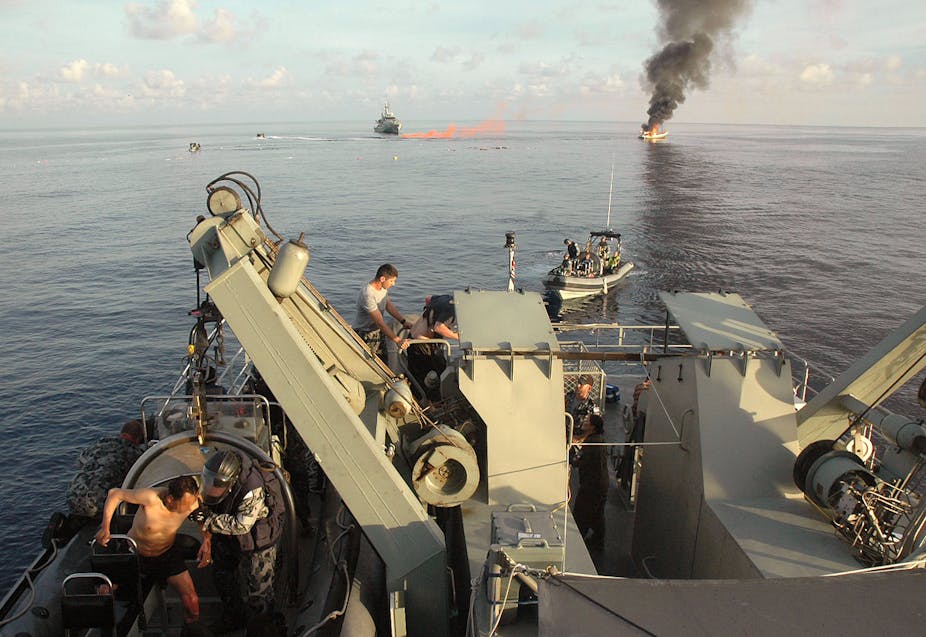
For many asylum seekers the route to Australia is via Ashmore Reef, and fraught with danger. AAP/Department of Defence

Despite arrivals of asylum seekers by boat being a major political issue for Australia over the last decade, the Indonesian government has not regarded the presence of asylum seekers and refugees with nearly the same urgency. In fact, for almost a decade the Indonesian government has reacted towards them with what could be described as a “benevolent neglect”.

By and large, asylum seekers and refugees do not attract sympathy in Indonesia, with the exception of the tragic disasters at sea. More interest is reserved for the hundreds of imprisoned Indonesian fishermen, some of whom are underage, who are serving sentences in Australia for having shipped asylum seekers to the “Lucky Island”. However, it is also the case in Indonesia that local fishermen and other transporters face minimum five year prison terms when caught and put on trial. Since the enactment of the new Law on Immigration in May 2011, there have been a number of trials for local and foreign people smugglers.

Journey to ‘Lucky Island’

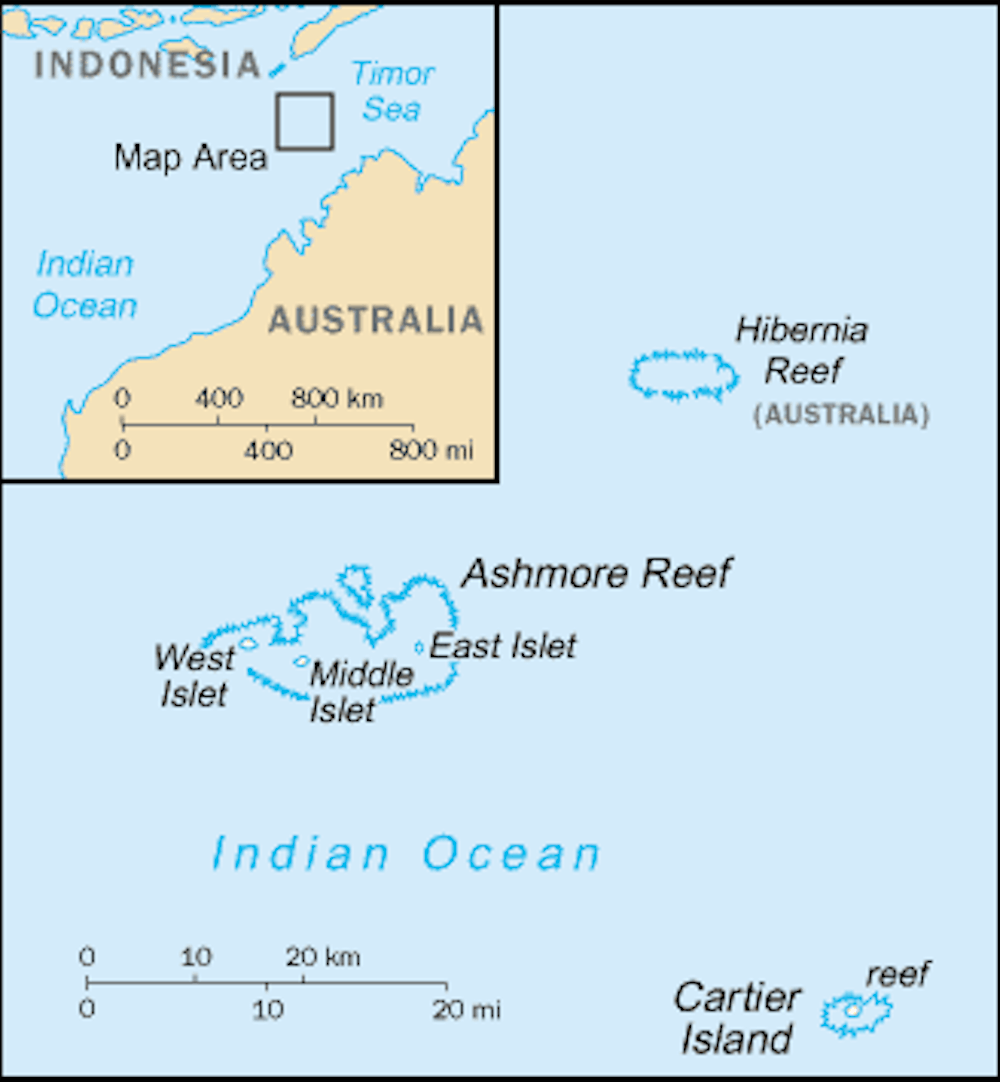
The two most common routes to Australia from Indonesia are from Lombok, Sumba, Sumbawa or Timor via Sabu or Rote to the 170km-distant Ashmore Reef and from the South Java Coast to Christmas Island, a 400km long journey though open sea.
United States Central Intelligence Agency

Previously, most transit people were transported to Eastern Indonesia for departure. At the moment it is the boat crews that are transported to take the boat people from Java.

Intensified border surveillance and more frequent arrests, and to some extent, persecution, create higher risks for people smugglers. These risks force networks to adapt by choosing new routes or paying higher bribes. The inflated prices have to be paid in turn by the transit migrants. Whereas in the late 1990s a passage from Indonesia to Australia cost around US$2000, nowadays prices range between US$5-8000.

Surveillance and awareness raising

In order to sensitise police and immigration officers to irregular migration, the International Organisation for Migration (IOM) in cooperation with the Indonesia Police and the Department of Immigration has held hundreds of seminars all over Indonesia during the last three years.

Officers on the ground were trained on how to recognise, arrest and deal with irregular migrants. Besides the local police, special awareness campaigns also targeted staff in areas known to be frequent transit points, such as bus, taxi, aviation and ferry companies. And over the past few years, anti-people smuggling propaganda has been deployed widely to prevent local fishermen becoming involved in people smuggling.

Strategies included the distribution of compilations of Christian and Muslim sermons among Christian and Muslim preachers with the core message that assisting people to go to Australia will result in severe punishments. The increase in the number of locals reporting foreigners to the authorities has been attributed to the anti-people smuggling campaigns. But knowing about the possible legal consequences does not mean that poor fishermen will resist being involved in transporting asylum seekers to Australia. Recruiters of ship crews intentionally focus on unmarried and underaged boys, knowing they face less severe punishments when sentenced.

Interceptions

Indonesia’s borders remain porous despite increased awareness-campaigns and border surveillance to counter people smuggling. The three brand new patrol boats provided by the Australian government in late 2011 to enable the Indonesian Maritime Police to patrol more than 40,000 kilometres of coast-line seem rather inadequate.

Although the Indonesian Maritime Police have their own boats, these are often not ocean-going. Maritime patrols are costly in terms of fuel and maintenance, to the point that interceptions rarely happen in the open sea. Asylum seeker arrests mostly take place at the beach before boarding a boat or on the road or in hotels further inland. Hardly a single day passes without interceptions somewhere around the archipelago.

Once intercepted, police and the immigration officers examine the arrested migrants and then send them to one of the 13 detention centres in Indonesia. The conditions in these centres are often substandard compared to Western standards, but generally slightly better than in Indonesian prisons.

Law enforcement

During interceptions, the police occasionally arrest transporters.

The real brains that set up these smuggling ventures, however, are rarely in the field. The Indonesian special unit for people smuggling claims to have cracked down on people-smugglers, but far more Indonesians than foreigners have been detained.

In 2011, for example, three foreigners and 24 Indonesians were arrested for people smuggling. Whereas asylum seekers can avoid legal consequences for breaking the immigration laws when they apply for asylum, their transporters face the law.
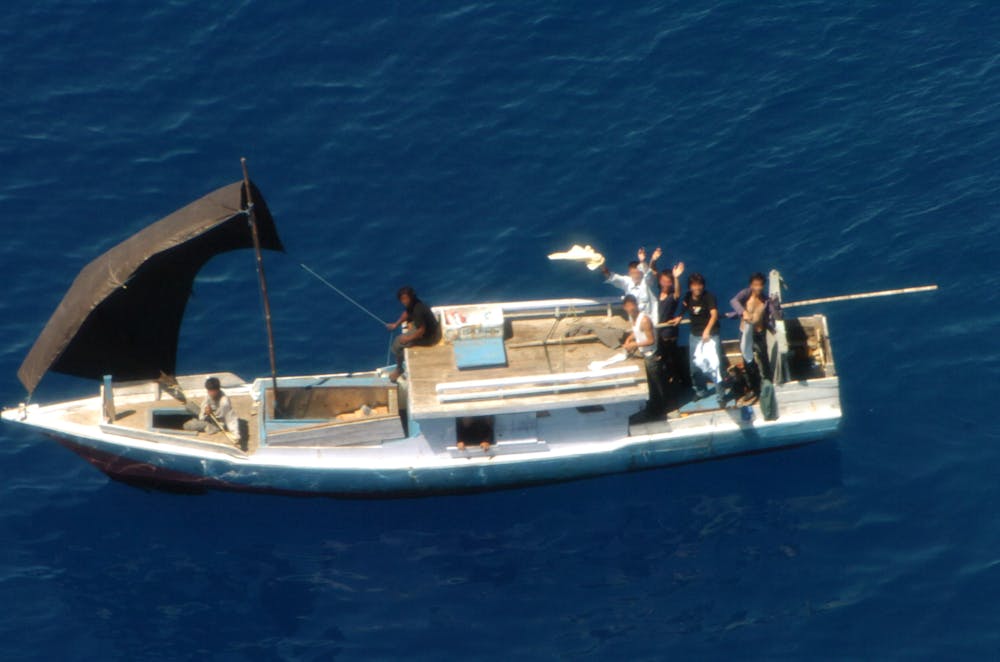
Some people smugglers are charged in Indonesia, but smalltime fishermen suffer more than kingpins. AAP/Office of the Prime Minister

Evidently, not all cases of arrest go to court. Lack of evidence or, more specifically, lack of will to find evidence, saves some suspects from penalty. Nevertheless, there are an increasing number of cases going to court, resulting in harsher sentences than those imposed in the past.

Taking a closer look at some of the trials, it becomes obvious that it is most often the chauffeurs and the boat crew who stand trial. According to Ferdinand Lolo, a former prosecutor with the Attorney-General Office, smuggling bosses tend to have good links with the authorities and it’s often the lowest-ranking members in the hierarchy who are deliberately sacrificed in order to protect the ones further up the chain.

The eagerness of impoverished fishermen to be recruited enables smuggling bosses to easily exchange lower positions, such as drivers, with new staff. So far, only few organisers of people smuggling have been arrested and incarcerated. Recent reports have shown that the criminal elements of the Indonesian police and navy involved in the people smuggling business have hindered sentencing.

Despite Indonesia responding to Australia‘s pressure and funding in the past two years by intensifying its anti-people smuggling activities and carrying out more interceptions, arrests and trials with harsher sentences, asylum seekers are still getting on the unseaworthy boats en route to Australia.

The fundamental problem – what to do with the increasing numbers of transit migrants coming to Indonesia for whom fast resettlement is unavailable – remains unsolved.

Sign in to Favourite

Want to follow The Conversation?

Sign up to our free newsletter to get the day's top stories in your inbox each morning, with a special wrap on Saturday.

Spinner
Donate and become a friend of The Conversation

Join the conversation

14 Comments sorted by

  1. John Newton

    Author Journalist

    The word 'benevolent' hardly applies to the way Indonesia handles the asylum seekers themselves. I urge you to look for and see the very moving film The Devil and The Deep Blue Sea for a full understanding of the way in which these people are treated and the reasons why the cruel offshore solution will never work.

    report
    1. Greg Boyles

      Lanscaper and former medical scientist

      In reply to John Newton

      Regardless of how they are treated in Indonesia they can't all come to Australia.

      And there are far more needy people in oifficial UN refugee camps around the world.

      report
    2. Marilyn Shepherd

      pensioner

      In reply to Greg Boyles

      So what if there are. Last year we accepted 190 Somalis,900 Afghans and we can see we don't care of they die over there.

      Refugees who have UN protection simply are not entitled to come to Australia, we have only an obligation to those who can arrive here.

      report
    3. Greg Boyles

      Lanscaper and former medical scientist

      In reply to Marilyn Shepherd

      To be perfectly blunt, no I don't care - I am well and truly into compassion fatigue. And even if I did care it would make little or no difference to the out come.

      Thousands more of them will continue to die until imbeciles like you recognize the cause of the problem - over population and uncontrolled human fertility. And address it directly and corageously.

      Until human fertility is brought under control across the globe human suffering like this will get a great deal worse.

      report
    4. Greg Boyles

      Lanscaper and former medical scientist

      In reply to Greg Boyles

      All I ever hear from you people is "let them into Australia".

      Perhaps one day the fact that this is not a credible solution to this enormous problem will filter through those thick skulls of yours.

      report
    5. Greg Boyles

      Lanscaper and former medical scientist

      In reply to Greg Boyles

      P.S. Any compassion I feel is reserved entirely for my two children, future generations of Australians and for Australia's unique flora and fauna.

      report
    6. Greg Boyles

      Lanscaper and former medical scientist

      In reply to Greg Boyles

      So basically Marlyn sooner or later you will have to face a very difficult dilemma.

      Concede to some loss of reproductive freedom across the globe or allow human misery (starvation, war, genocide, persecution,.....) across the globe to become a great deal worse than it needs to be.

      Immigration of refugees into Australia will make no signficant difference to either of these scenarios.

      report
    7. Chris Watson

      logged in via Facebook

      In reply to John Newton

      Indonesia had the sense to refrain from signing away control of its borders by ratifying the UN Convention. Australia is causing problems to countries that are already heavily populated, by offering to people in war torn countries, the prospect of a western standard of living. It is not reasonable for Australia to ask Indonesia to protect our borders from asylum seekers.

      Since 1954, the world's population has more than doubled, and it is no accident that the asylum seekers are coming from places with high birth rates. It is not reasonable for parents in undeveloped countries to try to provide for their own security by having large families, and then demand that countries that have shown reproductive restraint provide their children with a better, safer life.

      report
  2. John Coochey

    Mr

    What this article ignores is that corruption is endemic in Indonesia so if there isn o money in it they are not interested. What Australia should do is follow the suggestion of the Sri LankanGovernment and pay these countries to improve their intercept rates. No point in scuttling your boat if you are only going to be picked up and taken back after the swim.

    report
    1. Marilyn Shepherd

      pensioner

      In reply to John Coochey

      Sri Lanka is arresting, jailing and torturing tamils escaping from them you frigging moron.

      Indonesia is jailing refugees from other countries and does not want them so why would they stop them leaving.

      If you cannot yet rise above cretin status John why not just be silent.

      report
    2. Greg Boyles

      Lanscaper and former medical scientist

      In reply to Marilyn Shepherd

      I think like the climate deniers Marlyn, you will pick and choose the data that suits your argument.

      There may well be some discrimation of Tamils but, based on the Foreign Correspondant report, I do not accept your contention that Sri Lanka is systematically jailing and torturing Tamils.

      I place greater trust in ABC journalists than an over emotional and hysterical refugee advocate!

      report
  3. Marilyn Shepherd

    pensioner

    It is not people smuggling and never has been. Why Australia has turned a further protection treaty into a criminal thing is beyond me but Australia and Indonesia operate under two different systems.

    1. both have signed the smuggling of migrants treaty that makes it illegal to punish asylum seekers and those who help them but as Indonesia treats asylum seekers as migrants instead of asylum seekers they misread and misuse the protocol the same as we do because we have convinced them to do so…

    Read more
  4. Diana Sabidi

    logged in via Twitter

    you're dealing with people who think that they have nothing to lose, they will keep coming!

    report
    1. Greg Boyles

      Lanscaper and former medical scientist

      In reply to Diana Sabidi

      That would indicate we need to get even tougher then doesn't it.

      Send a message loud and clear they are not welcome coming to Australia in this manor.

      If you arrive by boat then you will be subject to mandatory expulsion.

      UN refuge convention be damned!

      report