
Better jaw jaw than war war: Australia should seek peace first

Our Chief of Army, Lieutenant General David Morrison, has told Australia, “The idea that we can will away war because we are about to withdraw from one that went longer and ended less conclusively than we liked is wishful thinking.” I believe this is simply wrong. And I believe a lot of Australians…

89njzz3g-1351643230
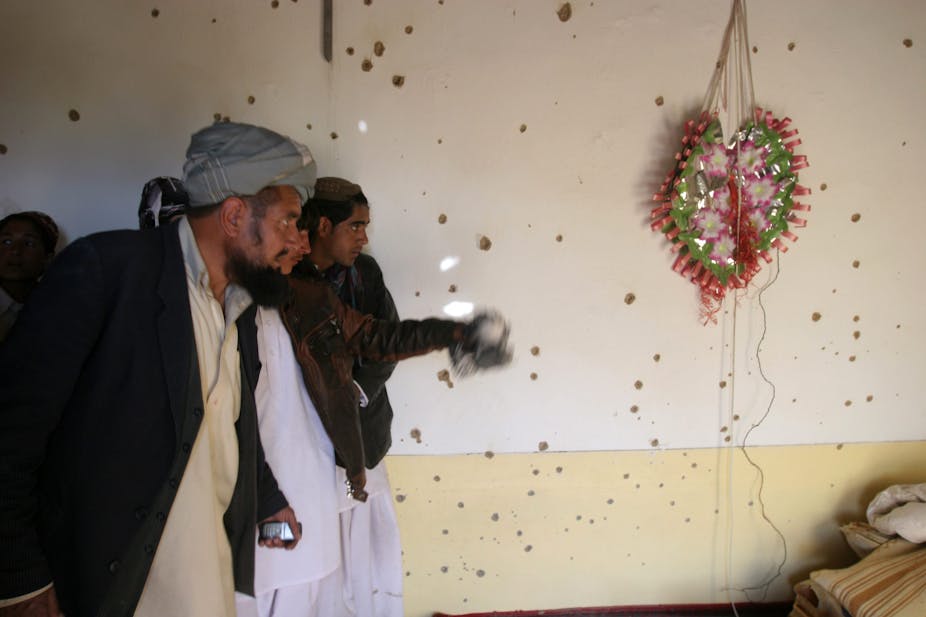
Afghan civilians point to bullet holes in a wall after a raid by Allied special forces. EPA/Naweed Haqjoo

Our Chief of Army, Lieutenant General David Morrison, has told Australia, “The idea that we can will away war because we are about to withdraw from one that went longer and ended less conclusively than we liked is wishful thinking.”

I believe this is simply wrong. And I believe a lot of Australians feel the same way.

General Morrison’s made this statement at Canberra University’s National Security Institute last week, when he warned that further financial cuts to military spending ”could pose a real risk to the effectiveness of the armed forces and lead to a repeat of ‘mistakes’ made after the Vietnam War".

In reality, it is those who believe war will succeed who are, Disney-like, wishing upon a star; the star bright with bigger, more expensive, more destructive weapons of war.

Doomed to repeat the mistakes of history

According to General Morrison, after the Vietnam War Australians experienced, and risk repeating today, a kind of “historical amnesia that is breathtaking in its complacency”.

PIC Cpt Scott Smith Sergeant William Guthrie st Joint Public Affairs Unit AAP/Sergeant William Guthrie Joint Public Affairs Unit ADF

Canberra reduced the nation’s military capability in the name of an anticipated “peace dividend” — a dividend based on myopic strategic policy making and a poor understanding of Australia’s geography and alliance arrangements that never eventuated. However, it is not those who oppose high levels of military expenditure who have historical amnesia, it is those who advocate war as a solution to disputes between nations.

Nobody believes war is something that you can wish or will away, but, equally, war is not something that just sneaks up on you, or magically falls out of the sky. Nor is it, as many claim, just a reflection or expression of human nature. It is precisely this way of thinking that lead to the view that nations make “mistakes’ after wars by not maintaining high levels of military preparedness.

War is unnatural

I regard war as the result of deliberate decisions, made by leaders or their small group of advisers – small groups who see specific gains to be made, sometimes personal, sometimes communal or national, by the use of armed force regardless of the costs to others.

This is not a natural state of affairs; it is a deliberate decision to use force to gain political ends. The language used to justify the use of the military encourages us to think that war is an acceptable or “normal” response to dispute resolution.

Thus we are told we have to have military formations capable of fighting against a “credible peer competitor". A “credible peer competitor” used to be called the enemy; and the aim of our army is to kill members of the enemy’s army and destroy enemy property and infrastructure.

Why we fight

It would be tragic enough if the only — or even a majority of — casualties in modern warfare were military personnel, but, of course, the vast majority (upward of 90%) of casualties in the wars fought in recent times have been, and continue to be, civilians — mainly women and children.

Astonishingly, we look with horror and rightly condemn the sickening brutality of dictators such as Bashar al-Assad of Syria in his war against his own people, but we look with equanimity upon the reign of terror we wreaked upon the population of Iraq, and believe we have learned the right lessons from that war.

US Civil War Union General William Tecumseh Sherman, one of the most successful soldiers in modern history, said it bluntly but accurately; “war is cruelty. There is no use trying to reform it”.

An Afghan civilian killed by Allied troops. EPA/Naweed Haqjoo

War is something that can and should be avoided, primarily because it does not work. Wars rarely achieve their stated aims even for the victorious parties, and the original aims of going war are soon subverted into something quite different by the course of the war itself.

Even in victory, the history of warfare demonstrates that the benefits gained prove to be short-term and illusory. Today’s wars rarely end with surrender ceremonies and tickertape parades. They end is a fog of ambiguity, and it is easier to discern what has been sacrificed than what has been gained.

Wars don’t win peace

It is the proponents of the use of military force who have drawn the wrong conclusions at the end of wars. You would think by now we would have worked out that killing people and destroying their lives, homes, towns, and cities does not create peace.

Military victory does not guarantee compliance by the defeated belligerent, or act as a deterrent against future outbreaks of war. International stability, domestic prosperity, and peace come through the strategy of offering attractive alternatives to war: inducements to trade, commerce and investment, access to resources on favourable terms, the free movements of people with equal political and economic opportunities, for example.

These strategies have been employed by members of the European Union and have proven remarkably successful in lessening the likelihood of war in Europe over the past 60 years.

Surely in dealing with our neighours and our region Australia be better off showing consideration, patience and respect rather than reaching for our gun.

Join the conversation

42 Comments sorted by

  1. alfred venison

    records manager (public sector)

    if the general & his masters would only keep the country out of neo-colonial adventures like, vietnam, iraq and afghanistan, instead of entering gung-ho into them, then the citizens mightn't be so inclined to develop the "vietnam syndrome" in response.

    i appreciate your taking the time to write this - i enjoyed reading it. for what its worth, i agree with what you say. -a.v.

    report
    1. Seamus Gardiner

      Citizen

      In reply to alfred venison

      Mr venison,
      that's a good point, a reflexive drawdown of our defence forces might be a natural response to unpopular and unjustifiable conflict. It doesn't make it sensible however - we should always have a defence force with a size adequate to meet our forseeable security problems. Whilst that doesn't mean carte blanche for our military, we should resist shrinking our military if it means removing this capacity.
      The unspoken subtext from the general, I believe, is not about inadequate support…

      Read more
  2. Seamus Gardiner

    Citizen

    This seems like an exercise in naïveté. I'm not sure what the author is advocating... An end to war? Reducing our armed forces will not end wars, just our capacity to contribute to them;or, at worst, defend ourselves from aggression. Reducing our propensity to engage in colonial wars seems a sensible option but is this all the author wishes?
    The unfortunate truth is that their are security problems both within our borders and in our region. Whilst engaging in aggression against sovereign countries is rightly debated how would the author suggest we respond to a coup in Fiji, border aggression between west Papua and PNG or blockade of sea lanes in the Melaka strait without an ADF with expeditionary capacity?

    report
  3. Gerard Dean

    Managing Director

    So Professor Bickerton, you claim war, '...does not work.'

    You might try telling that to American blacks whose forebears were freed by your General Grant. Grant's victory over the Confederate army liberated black slaves who faced another generation in chains.

    And, why not eyeball an old Russian soldier who, along with millions of his Soviet comrades, fought and died to liberate Europe from the most loathsome, despicable and horrendous war machine in the history of humankind.

    You might suggest…

    Read more
  4. Ian Bickerton

    Associate Professor at University of New South Wales

    The time to talk, Gerard Dean, is long before Grant or your Russian soldier or men like Hitler and his ilk have created 100 divisions. Wars don't just suddenly appear or fall from the sky--they take years in the making. That is the time to sort our international issues and disputes; before they reach a critical point of violence. Surely there are better ways to sort out problems that 60 million dead. IJB

    report
    1. Gerard Dean

      Managing Director

      In reply to Ian Bickerton

      Professor Bickerton

      I agree there are better ways to sort our problems than war. But when the 'problem' was a maniacal madman like Hitler bent on leading his country to total domination of the world or total self destruction- talk did nothing but allow time for him build his war machine.

      Hitler ignored the Versailles Treaty and rearmed- The appeasers and pacifists looked the other way and talked.
      Hitler re-occupied Rhineland - France and Britain huffed and puffed and talked and looked the…

      Read more
    2. Seamus Gardiner

      Citizen

      In reply to Ian Bickerton

      'Why can't we all just get along' is no way to run foreign policy or as a philosophical underpinning for our defence force funding.

      report
    3. Tim Niven

      Tim Niven is a Friend of The Conversation.

      IT Manager at KJ Risk Group Pty Ltd

      In reply to Seamus Gardiner

      That's not even close to what's being suggested - have another read of the article and see if you can put some meat on that straw man.

      Another danger from the pro-military view (ideology, you might say, Seamus) is that when you have a hammer all you see is nails, as they say ;)

      You mention Rwanda below. I'm guessing you've read Shake Hands WIth The Devil, by the UN force commander, Romeo Dallaire? Quote from the Western diplomats at the UN at the time: "Rwanda is a place of no economic or…

      Read more
    4. Seamus Gardiner

      Citizen

      In reply to Tim Niven

      Must one be pro-military or anti-military? Whilst the conflict in iraq and afghanistan this century is lamentable it is quite different to rwanda.
      The problem in rwanda in the sufficiency of armed response, not the presence of armed response. Diplomacy was never going to help once the machetes were unsheathed. What would you suggest as an anodyne to problems like rwanda? send in a debating team?
      You are conflating the philosophical with the actual here, just because the conflict in the middle east is unethical does not mean that all conflicts are unethical. Just because the Iraq war was avoidable by diplomacy does not mean that all wars are avoidable by diplomacy.
      naivete is an insufficient philosophical response to a complex issue. I suggest that 'jaw-jaw' is dangerous as a sole ideology to apply to all complex international disputes.

      report
    5. Philip Dowling

      IT teacher

      In reply to Seamus Gardiner

      Both in Rwanda and at Srebenica external trained military forces were impotent spectators of the massacre of many, including large numbers of children.

      report
    6. Tim Niven

      Tim Niven is a Friend of The Conversation.

      IT Manager at KJ Risk Group Pty Ltd

      In reply to Seamus Gardiner

      There's no need to wield false dichotomies - to be "pro-military" need only mean to have a propensity to try and solve problems through force. Like the bully who rushes to punch on when "dissed", or the mafia boss who cannot tolerate any threat to his authority (the US). One CAN be anti-military, or one can be neither - one can favour an appropriate use of force when necessary, as I would in the Rwanda case if the West didn't block an effective force.

      You are right, though - there is the danger…

      Read more
    7. Seamus Gardiner

      Citizen

      In reply to Tim Niven

      I agree with what you have said and I never expressed a pro-war sentiment. The need for diplomacy before the application of military force was so obvious I'm surprised the Author of the article made the point at all.
      Unfortunately just because something can be solved by dialogue it doesn't mean that it will, or more to the point, that both sides of a conflict will engage in dialogue at all. As a general principle the author is, of course, correct. I'm interested to see how the author suggests such a broad change in human behaviour could ever be accomplished, given that the futility of war has beeen discussed since the earliest written record.

      report
    8. Seamus Gardiner

      Citizen

      In reply to Philip Dowling

      Philip,
      Absolutely. An insufficient military force becomes a mere recorder of atrocity instead of a deterrent to it.

      report
    9. Tim Niven

      Tim Niven is a Friend of The Conversation.

      IT Manager at KJ Risk Group Pty Ltd

      In reply to Seamus Gardiner

      In the "War is Unnatural" section of the article, Ian points out (correctly, I believe) that it's not inevitable human nature that led, e.g., the US to invade Vietnam and Iraq. In fact there is a great book by a US military guy (pretty serious military type, Green Beret, officer), name is David Grossman, book called "On Killing". Now, I'm no expert and can't evaluate the evidence in fine detail, but the argument is that killing is unnatural, that (apart from those few percent psychopaths, who funnily…

      Read more
    10. Seamus Gardiner

      Citizen

      In reply to Tim Niven

      Tim,
      I have to agree, I just think it's an ideal and a goal, not in any way a realistic proposition.
      Peace is the aberration of human history, not war I'm afraid. Of course we should always act as if war is to be avoided.

      report
  5. Peter Bysouth

    Semi-Retired

    To write against war is laudable but the author appears to miss the point of General Morrison's speech. Creating a strawman argument "...war is bad and causes death, harm and destruction to civilians..." has nothing to do with the General’s point, which was that after Vietnam the Australian Army was reduced to the point where it was incapable of conducting the kind of regional tasks that the Government could reasonably require it to do at short notice. The example he gave was the one of assisting one of our nearest neighbours (East Timor) in the comparatively simple military operation of peace enforcement which the Army (and Navy and Air Force) were incapable of doing without significant assistance from the US.
    Then again, it could be me missing the author's point, which is in East Timor we should not have asked the US to assist us and/or we should have left the East Timorese people to be over run.

    report
    1. Philip Dowling

      IT teacher

      In reply to Peter Bysouth

      Both the East Timor intervention and Cyclone Yasi showed that the Royal Australian navy has suffered from inadequate finance and management.
      The habit of the ADF buying secondhand equipment raises issues of a sufficient defence budget.
      While I am not convinced of the wisdom of buying the biggest and best toys, the ADF does need to have both current capability and the industrial and management capability to reallocate or produce greatly increased quantities of materiel.

      report
  6. Philip Dowling

    IT teacher

    The selective choice of examples is quite puzzling. Apparently the author has yet to acquaint himself with the names of Pol Pot, and Robert mugabe. Rwanda and DRC don't count. Apparently black people don't have wars. Somalia does not rate a mention. Central governments are not necessary obviously, and piracy is acceptable if the the pirates are black. The Sudan also does not rate a mention. Hacked off hands were just an occupational hazard in Sierra Leone. Nigeria of course is at peace as is Mali…

    Read more
  7. Gerard Dean

    Managing Director

    Professor Bickerton,

    One other point which I have raised on The Conversation before. The choice of photographs to support your article is heavily biased.

    There are no photographs of the bestial and disgusting behaviour of the Taliban's treatment and murder of women.

    Do you condone the Taliban's treatment of women?

    When next you write an article, do try and convince the editorial staff at the Conversation to provide a small semblance of balance.

    Gerard Dean

    report
    1. alfred venison

      records manager (public sector)

      In reply to Gerard Dean

      you should write a letter to the editor. the essay is his point of view - his polemic. so why shouldn't the graphics support the argument of his essay? a.v.

      report
    2. Gerard Dean

      Managing Director

      In reply to alfred venison

      I accept your point on this matter, and I may write to Mr Jaspan to again complain about the inappropriate images used on The Conversation articles.

      On a couple of previous occasions, the authors of the articles have responded and claimed that they did not provide the images or see them until their article appeared on The Conversation. Evidently, the editors choose the photos they consider best support the article.

      Unfortunately, the editors often miss the point of an article or place misleading images. It appears this might be the case in this instance. The editor could have quite easily found a photo of a person killed or wounded by the Taliban to provide balance, but they chose not to.

      It is quite sad really, because The Conversation's charter says it will, 'Provide a fact-based and editorially-independent forum, free of commercial or political bias.'

      Mr Jaspan has so far ignored all of my polite emails about this matter.

      Gerard Dean

      report
  8. Bruce Moon

    Bystander!

    Ian

    I am 'SOOOO' with you on this one.

    I am a veteran of the Vietnam conflict. I say that only because I consider it gives me a little bit of 'experience' about the topic.

    Unless threatened with direct conflict, I see no benefit whatsoever in the Australian military entering others' conflicts.

    That said, I also hold the view that Australia is a very warring nation. Our political leaders have long embraced the military chiefs' preference for real combat experience over training exercises…

    Read more
    1. Frank Moore

      Consultant

      In reply to Bruce Moon

      Bruce, you were sent to Vietnam to suck up to the US.
      This aided our defence, because the US is our primary means of defence.
      So, good job.

      On your other issues, what sort of kit would Indonesia need to put together to challenge us?
      Simply blockading 'our' sea lanes through Indonesia would be enough?

      What about India?
      Rapidly nuke arming. We are selling them Uranium out of fear. Nothing else.

      Then you have the PRC.
      I agree with your identification of it, as our most immediate threat…

      Read more
  9. John Zigar

    Researcher

    Professor Bickerton, I wholly agree with your article. I believe we are on the same wavelength here. I knew before reading the posts that the majority of comments would belittle you in regards to war and that ignorant people would highlight the usual suspects: Hitler et al. War is gruesome, there are no winners and the final cost (human and economically) far outweighs the supposed gains of military action. When Germany was occupied by the allied forces after World War II, images of young German women…

    Read more
  10. Greg Boyles

    Lanscaper and former medical scientist

    Free movement of people in europe maf have avoided out right war between nations in the short term

    But instead there has been a clash of cultures, particualry between islam and christianity, leading to low level simmering domestic tensions that will inevitably lead to out break of civil wars at some point in the future.

    The only real solution to these problems is population control so that tens of millions of people in non-western countries do not feel the need to immigrate to the west and such that the west does not need to all but take resources from non-western countries to sustain the lving standards of an incresing number of consumers.

    Hell even involuntary fertility control via some sort of biological agent would be better than the alternative means of population control we are increasingly seeing around the world - war and genoicde.

    report
  11. Laurence Castle

    PhD Candidate, University of Adelaide

    " The language used to justify the use of the military encourages us to think that war is an acceptable or “normal” response to dispute resolution." This is very true, the public is not informed about the human cost of the wars.

    It is worthwhile viewing Brown University's findings to find out the actual costs of the current conflicts: http://costsofwar.org/

    For example:
    There are 1.7 million internally displaced Iraqis and 1.8 million Iraqi refugees - As of 2011, there remained 1.8 million Afghan refugees in Pakistan - one million Pakistanis are currently conflict-displaced in the Afghan border region.

    Little wonder we have a refugee "problem". This will affect Australia and the rest of the world for years to come. Surely we can learn from history - there must be a better way to resolve differences.

    report
    1. Philip Dowling

      IT teacher

      In reply to Laurence Castle

      The Brown University's findings are completely US-centric. While understandable at one level, it certainly doesn't give the complete picture.
      As for learning from history, one has only to consider the individual history of various countries to realise that very few have managed to have periods of over a century without being subject to invasion, civil war, or participation in external wars.
      Perhaps more knoweldgeable people may be able to provide instances where this was not the case.
      http://en.wikipedia.org/wiki/List_of_ongoing_military_conflicts

      report
  12. Ian Bickerton

    Associate Professor at University of New South Wales

    In response to some of the comments made on my brief piece, can I make the following observations for consideration.
    My argument is that wars do not achieve their goals of resolving international problems. What they do is create new problems which in turn, following the logic that military force is the best way to teach someone a lesson, result in yet further wars. Defeated powers/parties feel humiliated, resentful, full of hatred for those who vanquished them, and determined to right what they…

    Read more
  13. Steve Brown

    logged in via email @yahoo.com.au

    So our military wants another war and thinks that the government should shower it in more money and new toys.

    Well, what a suprise.

    Obviously our security isn't being compromised by a lack of spending, quite the opposite. Iraq and Afghanistan achieved nothing positive and created a generation of muslims who hate us for killing their people (intentionally or not it doesn't matter, the effect is all the same) and want to get their pound of flesh. It was so obvious that Mick Keelty or Dennis Richardson…

    Read more
    1. Seamus Gardiner

      Citizen

      In reply to Steve Brown

      A very simplistic view with recognition of the reality of SEAsia and Australia's strategy therein. Whilst there is no little doubt of the egregiousness of recent conflicts, to lambast the entire ADF as welfare dependants is myopic.
      Whilst General Morrison's op-ed may make you splutter latte froth into your beard (and i agree it is execrable) it should be seen in light of the distaste of the ADF to have to restrict their spending, not a cry of havoc for more wars.

      report
    2. Steve Brown

      logged in via email @yahoo.com.au

      In reply to Seamus Gardiner

      What justifies the existence of the ADF let alone the huge amount of tax money they leach from us on an annual basis?

      What is the 'reality' of our region? The only nation in our vicinity which is adopting a threatening stance is the one which doesn't actually belong in it.

      report
    3. Philip Dowling

      IT teacher

      In reply to Steve Brown

      China's idea that the South China Sea is a Chinese "lake" is not exactly welcomed by its neighbours.
      China's relationship with a number of the smaller Pacific island nations is puzzling.
      The expenditure on military hardware by Indonesia would be a worry if there was a change in government attitude as in Turkey.

      report
    4. alfred venison

      records manager (public sector)

      In reply to Philip Dowling

      you mean the west philippine sea.

      china's relations with south pacific nations makes perfect sense. you or i may not like it but it makes sense. china wants their friendship & their votes at the u.n.

      as it stands presently, the south pacific nations are an anglo voting block at the un. these are 22 supposedly independent nation states, that know perfectly well where their aid money is coming from, and steadfastly vote with "the west" at the u.n.

      like the caribbean, excluding cuba, where…

      Read more
    5. Philip Dowling

      IT teacher

      In reply to alfred venison

      Another explanation is that China seeks to firstly neutralise these countries as potential Western Allies, exploit their resources and establish naval bases and/or possibly air bases in these countries. It is on its way in this in Sri Lanka and Pakistan.
      It is inevitable that Chinese hegemony of one kind or another will expand and develop as it has in previous times for all major powers.
      The issue to consider is what role a military force may have when it comes down to negotiating agreements in the future, or currently on the ocean around Antartica.

      report
    6. Seamus Gardiner

      Citizen

      In reply to Steve Brown

      West Papua/PNG, Fiji, Solomon Islands, Bougainville, Indonesia, sea trading routes to Australia. They are the current issues in the region.
      Internal security is always a problem, even if you won't/can't see it.
      Future threats:as above+trade routes to Australia, India/china/Indonesian nexus, climate change affecting pacific region, growth of militant Islam...

      The problem being you cannot turn on/turn off a defence force at will. You need a standing force for foreseeable current threats and future threats.

      report
    7. Philip Dowling

      IT teacher

      In reply to Steve Brown

      Well, at least a couple of the putative terrorists have been dealt with by the Syrian army.
      Has it ever occurred to the Australian government to be proactive rather than reactive on this matter?
      From Hurstville to Merrylands a war zone has developed which small armies consider a free-fire zone.
      How soon can we expect the level of violence that Venezuela or Mexico experiences?
      After all, even the Holsworthy Army Base has not been secured following an earlier plot.

      report
    8. Frank Moore

      Consultant

      In reply to Philip Dowling

      Clueless intervention Alfred.
      Any peasant knows when he is in a buyers market.
      Competing with the PRC for 'friends' via a bidding war is extraordinarily dumb.

      The PRC's power and influence can be turned off in an instant.
      Withdrawing it from the benefits of the WTO, is the first step.

      Shoring up Western manufacturing via any means possible is the second.

      We need a serious trade war now.

      The west could still win such a war.

      The longer the power of the PRC dictatorship and…

      Read more
  14. Frank Moore

    Consultant

    Nothing changes.

    Through history, appeasers espousing the 'yawn', tired old ideas of the good professor have created the circumstances loved by the trigger happy dictators who justifiably perceive "talkers" as weak.

    Only through a thorough military preparedness do we - ironically - avoid the circumstances for war.

    Our choices post WW2 included creating a viable nuclear deterrent.
    Had Menzies taken up the offer, no soldier would have had to go to Vietnam.

    Because of the Left's appease…

    Read more
  15. Greg Boyles

    Lanscaper and former medical scientist

    I believe that a defence strategy that might be worth exploring is as follows.

    First of all let us note that the US has embraced computer gaming as a recuitment tool for their army. If you are not aware of it google "americas army" which is a first person shooter game that is very realistic with gun re-coil etc. They are enticing gamers into their army to play the game for real and having some degree of success I believe.

    We already have a generation that is adept at various flight simulators…

    Read more
  16. Joe Gartner

    Tilter

    War is the highest concern of man.

    Before man existed, warfare waited for the ultimate practitioner.

    report
    1. Greg Boyles

      Lanscaper and former medical scientist

      In reply to Joe Gartner

      War, and all that goes with it including genocide etc, is mankind's subconscious method for managing over population and always has been.

      report
    2. Greg Boyles

      Lanscaper and former medical scientist

      In reply to Greg Boyles

      This is probably true for most higher life forms.

      When food resources become scarce due to over breeding the level of conflict increases and alleviates some of the over population pressure.

      Of course disease and starvation also play their part in correcting the over population.

      report