
Beyond bodies: there’s more to robots than a humanoid shape

If someone tells you to think of a robot, what springs to mind? Is it a humanoid shape made of metal, with glowing eyes, that speaks in a jerky voice? Or is it a robotic factory arm, or a car that can park for you, or maybe a system that heats or cools your house? For some time now pop culture has…

Rvhc5dcq-1355806242
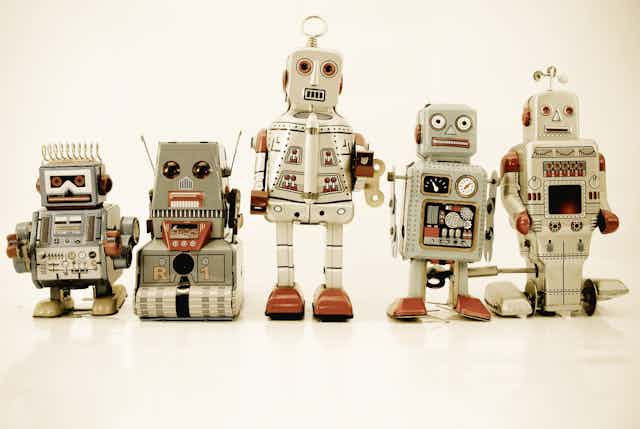
Caution: robots in real life may differ from those that appear here. Robot image from www.shutterstock.com

If someone tells you to think of a robot, what springs to mind? Is it a humanoid shape made of metal, with glowing eyes, that speaks in a jerky voice?

Or is it a robotic factory arm, or a car that can park for you, or maybe a system that heats or cools your house?

For some time now pop culture has painted a particular picture of robots. From Asimov’s ‘bots, to the Terminator – even the Transformers – the very concept of a robot has grown up next to these hugely popular sci-fi characters.

So why aren’t we seeing robots like these by now?

Hollywood bots

On one hand we have the glamourised depictions of sci-fi robots. On the other we have the roboticist’s more pragmatic view of robots as machines that perform functions in an autonomous way.

For these roboticists (myself included), robots are all around us – in our cars, our homes, on public transport and in buildings.

Part of the problem is that there are a number of research projects around the globe that seem to fit the “Hollywood” robot image – Hiroshi Ishiguro’s Intelligent Robotics Laboratories with their Geminoid and Robovie enabled research and our own RobotAssist to name just a couple.

This is one major source of the confusion surrounding the state of the art in robotics. In an attempt to make our research accessible to the wider world we, the roboticists, have leaned on pop culture’s sci-fi robot and subsequently reinforced the stereotype.

Sure, the fundamental research questions we are probing are embedded in the project, so there’s no harm done, right? Well, yes actually, there is.

Great expectations

We’ve shaped the presentation of our research around this stereotype and the actual science questions are less visible to the casual spectator of our work.

With robotics research and development presented in this manner, the tendency for the casual onlooker is to measure the gaps between the research on show and the benchmark of the sci-fi robot. This is not always a true indication of the state of the art.

I myself have been guilty of unintentionally obscuring my own research intentions by putting them in a sci-fi friendly wrapper with RobotAssist. While RobotAssist appears on the surface to be another somewhat human-like robot that can do some cool things (but is no T1000), this isn’t its intended role.

RobotAssist is a research and development platform for core robotics technologies. It has provided a valuable platform for a number of important developments that have found their way into real-world realisations. These include robust people-detection and tracking techniques that are currently deployed in mining, construction and transport environments.

From a particular robotics perspective there is little difference between the RobotAssist incarnation of the technology and how it is used in a transport environment. What changes is the way the technology is embodied.

Your local train station, say, doesn’t look anything like a robot. But in a sense, the entire building is a robot. Maybe the security cameras and embedded sensors are its eyes, maybe turning on and off exit signs and dynamically restricting and redirecting some passageways are the actuators. This kind of robot is invisible.

Put your body into it

Roboticists have been guided by the “sense-act-think” operational definition of a robot for more than 30 years now.

This definition states that a robot is a machine that can actively “sense” the state of the world, “think” intelligently about its task in light of sensed information to form an action plan, and “act” that plan upon the world.

Notice there is no mention of embodiment?

This, I believe, drives another major source of the confusion surrounding the state of the art in robotics.

Society is conditioned by pop culture to recognise robots through the way they’re embodied. Roboticists, however, often consider the embodiment superfluous, or at least tangential, to the robot.

This brings us back to the two viewpoints that I mentioned earlier. The reality is that disembodied robots are already prevalent throughout society.

Just think about our cars with their automatic parking (see video above) and braking. We don’t tend to acknowledge these machines as robots, partly due to the sci-fi stereotype and partly due to roboticists further encouraging this stereotype – but they do fit the operational definition of a robot.

Don’t get me wrong, the sci-fi style robot entering society is inevitable. Too many people want it for it to not happen.

My point is that this is just one of the many forms a robot can take, and perhaps it will be one of the later ones to be realised.

If we want a true gauge of where we are at with robotics we may need to re-calibrate our expectations of what a robot is. We are “getting there” with our research. It just turns out that “there” isn’t exactly where pop-culture told us where we should be.

Sign in to Favourite

Want to follow The Conversation?

Sign up to our free newsletter to get the day's top stories in your inbox each morning, with a special wrap on Saturday.

Spinner
Help us have better conversations — donate

Join the conversation

14 Comments sorted by

  1. Baron Pike

    logged in via Facebook

    Here's what gets me: We're smart enough to realize that it's the robots strategic program that's used to develop and design its body, but we still teach our students that in evolution, it's our bodies that nature "accidentally" refashions to change and improve our behavioral strategies.

    report
    1. Paul Miller

      logged in via LinkedIn

      In reply to Baron Pike

      I think you'll find that while nature might 'accidentally' refashion aspects of our bodies it is natural selection that has determined the extent to which such changes are beneficial or otherwise given the environment in which those bodies need to exist and thrive.

      There is no sense in which nature "refashions to change and improve our behavioural strategies" other than to winnow out those models least well equipped to propagate.

      report
    2. Baron Pike

      logged in via Facebook

      In reply to Paul Miller

      In reply to Paul Miller, the adaptive mutation theorist will say you're wrong. Although you seem to also be arguing that our bodies do get behaviors from somewhere and that all natural selection does is winnow out the things that don't work, no matter how we seem to have miraculously acquired them.
      The adaptive mutation people believe that we intelligently self engineer ourselves, whereas you seem to have left intelligence out of the selection mix entirely.
      Hey, if that works for you, stay with it.

      report
    3. Paul Miller

      logged in via LinkedIn

      In reply to Baron Pike

      "the adaptive mutation theorist will say you're wrong"

      I daresay there will be a few creationists that might say something similar.

      "Although you seem to also be arguing that our bodies do get behaviors from somewhere and that all natural selection does is winnow out the things that don't work, no matter how we seem to have miraculously acquired them."

      I didn't bring behaviours into this and see no reason to muddy the waters with discussing behaviours now. On the issue of 'design', however…

      Read more
    4. Baron Pike

      logged in via Facebook

      In reply to Paul Miller

      "Because mutation is not always beneficial, those threads with a higher rate of mutation will die out in some proportion to those threads with lower rate of mutation"
      What you've failed to account for is how mutation ever accidentally creates intelligent behaviors that in turn require intelligent designs to accommodate behavior. And creationists are just as wrong as you are when they give no credit to the organism for making its own choices as opposed to God's - or to your mother nature's.
      And here you are, acquainted with experiments with bacteria that support the adaptive mutation theories, but yet can't see that higher life forms are then more likely to follow on the same path as bacteria than not - otherwise they'd not have become more intelligent in the evolutionary process, would they? Or was it a waste to evolve intelligence here at all?
      But that's large;ly a rhetorical question as intelligent evolution clearly doesn't work for you.

      report
    5. Paul Miller

      logged in via LinkedIn

      In reply to Baron Pike

      While proponents of adaptive mutation (and I'm sure there are probably still some around) may attempt to support their theories by reference to certain experiments involving bacteria I don't believe they have yet been able to establish a compelling case (ie, one that cites experimental outcomes that cannot be adequately explained by other, better supported, theories).

      I'm still bemused by your use of terms such as 'intelligent behaviours' or 'intelligent designs' in this context let alone your…

      Read more
    6. Baron Pike

      logged in via Facebook

      In reply to Paul Miller

      It's clear to the increasing number of adaptive mutation followers that bacteria do make choices and that nature in and of itself does not (so try not to twist my words too much in that respect). Which is why your nature's allegedly random infusion of intelligence in some of our later life forms, but not our earlier, makes no sense. And who declared authoritatively that evolution of life forms has or serves no purpose, when the very purpose of those forms has to be and must be to survive. So it…

      Read more
  2. Craig Minns

    Self-employed

    There are lots of automated, semi-autonomous systems but I'm not sure I'd call them robotic. For the word to have meaning separate from the concept of being part of an "automation spectrum" there has to be some non-arbitrary defining feature. Gee it's difficult to work out what that might be though.

    The humanoid robot beloved of Asimov isn't by any means an exclusive or even the most common type in SF, though. The most compelling example would be Iain Banks' "Culture" series, with its sentient spacecraft, or in a different vein Douglas Adams "Heart of Gold" (http://en.wikipedia.org/wiki/Technology_in_The_Hitchhiker%27s_Guide_to_the_Galaxy#Heart_of_Gold), but all sorts of things have been given robotic existence by imaginative authors.

    report
  3. Geoffrey Edwards

    logged in via email @gmail.com

    "...so there’s no harm done, right? Well, yes actually, there is."

    Yet the only "harm" you have identified is that the "casual onlooker" doesn't have a realistic conception of what your research field involves.

    But this can be stated of pretty much any field, from Astrosphysic to zoology.

    This seems to be a harm only to your subjective sense of worth.

    Given that the very term "Robot" enters the english lexicon via science fiction, approximately 60 years prior to your "operational definition," and was linked to humanoid automata from the out-set, the idea that there is a popular misconception about "robotics" seems a little precious.

    Your field is named from a term that has it's origins in sci-fi and popular culture, pop-culture did not borrow it from you.

    report
  4. Ben Brooker

    Technical Analyst

    Hi Nathan,

    How far away do you think true AI is?

    report
  5. Pamela H.

    logged in via email @hotmail.com

    It just shows how anthropocentric we are that we think robots have to be built in the clumsy shape of a humanoid.

    report