
Big Tobacco on the warpath against plain packaging in New Zealand

The tobacco industry has launched an advertising campaign against the New Zealand government’s proposal to introduce plain packaging of tobacco products. According to the media campaign, plain packaging will simultaneously decrease government revenue and increase youth smoking uptake. The industry’s…

H8cwqwbc-1345703950
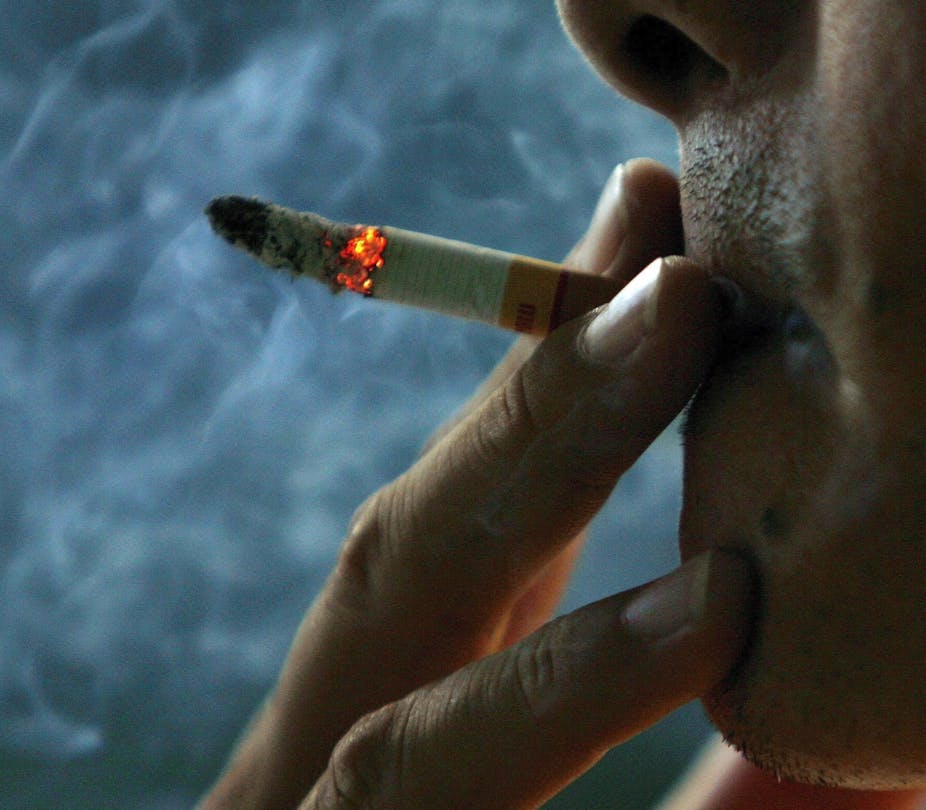
There’s a broad base of public support for government action against smoking in New Zealand. Barbara Walton/AAP

The tobacco industry has launched an advertising campaign against the New Zealand government’s proposal to introduce plain packaging of tobacco products. According to the media campaign, plain packaging will simultaneously decrease government revenue and increase youth smoking uptake.

The industry’s arguments are the same as those broadcast in Australia: plain packaging will infringe its intellectual property rights, expand the black market in tobacco, jeopardise foreign trade and drive down prices. But it seems the the government isn’t persuaded by these arguments.

Minister of Health Tony Ryall was blunt. “British American Tobacco is wasting its money”, he said. According to Ryall, tobacco companies have little credibility these days, and anyway there is a broad base of public support for government action to cut smoking rates.

Still, the legislation to implement plain packaging is not certain. The government has agreed in principle, and has published documents that describe in detail the rationale for introducing plain packaging of tobacco products. But senior members of the government signal caution.

Softly, softly

Prime Minister John Key says “There is a lot of things we need to consider – I wouldn’t say it’s a slam dunk by any chance that plain packaging would take place.”

It’s not pubic opinion that’s holding them back. Ryall is right – on the whole, New Zealanders distrust the tobacco industry and support strong action against smoking. Instead, it’s the international reaction to plain packaging that worries Key, Ryall and colleagues. Specifically, what challenges the country might face under existing trade laws, and how a move to plain packaging might complicate agreements now under negotiation.

There is reason to be cautious, according to Jane Kelsey, professor of law at the University of Auckland. Kelsey warns that the industry is likely to use a number of devices to obstruct radical restrictions on the supply of tobacco.

There are several routes by which cases could be brought to the World Trade Organization, along the lines of those lodged by the Ukraine and Honduras in objection to Australia’s proposal for plain packaging. (Note that New Zealand’s moral authority in health and trade matters has been somewhat compromised by the objections it raised last year against Thailand’s declared intention to introduce graphic warning labels on alcohol. But then, so has Australia’s.)

Dangers in the TPPA

In some respects, New Zealand may be less vulnerable than Australia – the country has signed few investor agreements that permit enforcement against domestic policy. But this would change if New Zealand agreed to investor-state enforcement powers under a Trans Pacific Partnership Agreement (TPPA).

Key and his colleagues have high hopes for the TPPA, but the arrival of the United States relatively late in the process has raised the risks considerably. The United States is pushing for stronger intellectual property and other investor protection conditions as part of the TPPA, and if these are included, the tobacco industry will be in a much stronger position to challenge policies such as plain packaging.

As Kelsey and others have pointed out, the threat of action may be sufficient to discourage governments, given the high costs of defending a national position, and how difficult it is to predict the outcomes from investment tribunals.

The high road

But let’s not forget the bigger picture on tobacco. In New Zealand, we have a conservative government – not enamoured of regulation – that has raised tobacco taxes substantially (smokers are likely to be paying at least $1 a cigarette by 2016) and banned point of sale displays. With a strong nudge from its Maori Party coalition partners, the government has signed up to making the country smoke-free by 2025.

Will we get there? Smoking statistics are pointing in the right direction – unpublished data for the second half of 2011 show that the proportion of the population smoking every day is down to 16%, a fall of two percentage points in five years. But the trends are not strong enough, even if “smoke-free” is loosely interpreted as a smoking prevalence of under 5%.

This is the importance of plain packaging: it is a test of government commitment to tighten the screws on supply, to continue the shift from viewing tobacco as a consumer commodity to treating it as a hazardous substance, and to balance the virtues of global trade against what is needed for health protection at home.

Sign in to Favourite

Want to follow The Conversation?

Sign up to our free newsletter to get the day's top stories in your inbox each morning, with a special wrap on Saturday.

Spinner
Help us have better conversations — donate

Join the conversation

12 Comments sorted by

  1. Chris Booker

    Research scientist

    I just hope that the whole process of the TPPA takes so long that there's another election before it's signed.

    report
    1. Michael Hay

      retired

      In reply to Chris Booker

      I do not like the idea of the USA having the power to influence an internal Kiwi matter. There are enough problems with various trade arrangements already, without the Yanks protecting their cigarette industries.
      I smoked for 50 years and stopped when I wanted to. This talk of addiction is a load of bull. A little strength of character, something to chew (even the stem of an empty pipe) and an ability to shut out the false compassion of the anti-smoking lobby is all that is needed. Until then, anything that helps smokers to quit is a good thing, be it Olive, Brown or over-the-top photos.

      report
  2. John Bloomfield

    Retired Engineer

    Just get on with it Kiwis!.
    Do it for your children.

    Don't cave in to "Big Baccy' bluff and bluster.

    report
    1. Anne Jones

      CEO

      In reply to John Bloomfield

      Its long overdue for governments to stand up to the tobacco industry bullies and not only end all forms of tobacco advertising but to end their long standing exemption for regulation of highly engineered and lethal cigarettes that are sold from every street corner. Its 100 years since the first report linked tobacco use with disease and 5 million people are dyinig each year from tobacco use.

      report
  3. Clifford Chapman

    Retired English Teacher

    There is no way any company or industry can be allowed to over-ride democratically elected governments' decisions and legislation.

    This totally morally bankrupt industry should be closed down.

    report
  4. Ron Chinchen

    Retired (ex Probation and Parole Officer)

    I'd consider smoking the peace pipe with the Tobacco Industry, if it wasn't for the fact that it would probably kill me.

    report
  5. Clifford Chapman

    Retired English Teacher

    To continue this discussion. I don't believe this is a 'test of government commitment', as you put it in your final paragraph.

    With all due respect to you, Mr. Woodward - and I do hope you respond as so often the authors of many of these articles, despite being academically well qualified, do not seem to have the integrity to do so, though I'd put money on them reading many replies - the question really is one of human rights.

    When push comes to shove, does democracy or big business run this world?

    report
  6. Shona Walter

    Master in Environment and Energy law

    If you look at the GATT agreement (one of the main agreements made by WTO member states), Article 10 allows states (like NZ and Aust) to impose barriers to trade, such as a certain kind of cigarette packet, to meet certain social, environmental or health ends.

    In past WTO rulings on Article 10 (for example the Turtle case), the job of the WTO is to figure out which regulations (or barriers to trade) are there for genuine reasons and those that aren't. The WTO suggests states should enter into talks with those being affected before doing imposing anything..

    If states like NZ of Aust go ahead and do it anyway, they have to be prepared to show before the WTO that the imposition of plain packaging will eventually produce health benefits and are introducing these measures in a transparent way.

    Proving that health benefits can come directly from cigarette packaging is not an easy task and the WTO tends to take a hard line in Article 10 cases.

    report
    1. Clifford Chapman

      Retired English Teacher

      In reply to Shona Walter

      I understand basically what you are saying here, but can you clarify your third paragraph in that if independent countries like New Zealand and Australia - what you have termed 'states' - 'have to be prepared to show before the WTO' etc., wouldn't that depend anyway upon the tobacco companies initiating action?

      And since plain packaging does not ban the import, purchase and smoking of cigarettes, on what grounds would those companies' arguments rest, if their trade is not being directly restrained?

      You seem to be puting the onus on the governnments. Surely it should be on the tobacco manufacturers?

      report
    2. Shona Walter

      Master in Environment and Energy law

      In reply to Clifford Chapman

      Sorry I tried not to put too much legal banter in there. Countries are sometimes referred to as a 'State' in international law.

      Your right, for NZ or Australia to have to justify their anti-smoking policies before the WTO, the Tobacco companies would first have to bring a complaint. I was merely speculating on how governments might respond to an action brought by tobacco companies.

      One of the main reasons why the WTO was created was to progressively liberate international markets in goods and services. This is usually done through negotiation, such as the DOHA rounds -rather than through the GATT agreement.

      Article 10 is there as a kind of balancing provision. Because governments realised that it is all well and good to have free trade, but not at the cost of certain social, political or environmental ends.

      report
    3. Clifford Chapman

      Retired English Teacher

      In reply to Shona Walter

      Thank you for having the courtesy to reply, and I've only just got this message, otherwise I'd have responded earleir.

      I think they are referred to as being 'Member States', rather than just 'States'.

      Thank you also for confirming that point - it would be interesting indeed to see if a tobacco company would lodge a complaint.

      Givne the moral integrity they have shown up to now, I'd not be putting any money on it happening.

      report
  7. Gabriel Macy

    logged in via Facebook

    Having plain packaging on cigarette packs or not, smoking is still bad for our health. We need to reinforce this that smoke when inhaled by second-hand smokers is even more dangerous compared to the smokers themselves. Education is key and by relaxing packaging cigarettes packs, these tobacco companies are making it easier for people to become addicted to smoking without having to see the ill effects of smoking right in front of their faces.

    report