Big Tobacco’s box fetish: plain packaging at the high court

Tobacco, says the World Health Organisation (WHO), is “the only legal consumer product that kills when used exactly as intended by the manufacturer.” Supporting the WHO Framework Convention on Tobacco Control, the Australian Parliament has passed The Tobacco Plain Packaging Act 2011 (Cth). The legislation…

Qm8p8dcb-1334885903
The government argues that plain packaging is “directed to informing, redressing and reducing harm to the public health." AAPIMAGE/Tracey Nearmy

Tobacco, says the World Health Organisation (WHO), is “the only legal consumer product that kills when used exactly as intended by the manufacturer.”

Supporting the WHO Framework Convention on Tobacco Control, the Australian Parliament has passed The Tobacco Plain Packaging Act 2011 (Cth). The legislation was supported by all the major parties.

Labor Attorney-General, Nicola Roxon, argued, “Plain packaging means that the glamour is gone from smoking and cigarettes are now exposed for what they are: killer products that destroy thousands of Australian families.”

The leader of the Coalition Opposition, Tony Abbott, acknowledged: “This is an important health measure. It’s important to get smoking rates down further.” The Greens also supported the measure – and called for the Future Fund to end its tobacco investments.

In response, Japan Tobacco International and British American Tobacco brought legal action against the government in the High Court of Australia, claiming that the Act amounts to an acquisition of property on less than just terms under the Australian Constitution. Phillip Morris Ltd and Imperial Tobacco joined the case, and supported their fellow tobacco companies.

In its defence, the Commonwealth was supported by the governments of the Australian Capital Territory, the Northern Territory, and Queensland. The Cancer Council Australia made written submissions, but was not given leave to intervene.

The High Court of Australia heard arguments over three days from the April 17 to 19, 2012. The various parties enlisted battalions of lawyers, the proceedings received intense media attention, and the public galleries were packed. Here’s how it went.

Big Tobacco’s arguments

Tobacco companies struggled with their argument that the introduction of the plain packaging of tobacco products amounted to an acquisition of property on less than just terms.

There was much discussion as to whether the Commonwealth had indeed effected an “acquisition” of the tobacco trade marks. Japan Tobacco International’s barrister argued, “The Commonwealth law by its terms abrogates the power to substitute any message the Commonwealth chooses on what we say is our billboard.”

The tobacco companies argued for a broad view of property under the Australian Constitution, and claimed to hold various forms of intellectual property in relation to tobacco packaging, including trade marks, patents, designs, copyright and passing-off.
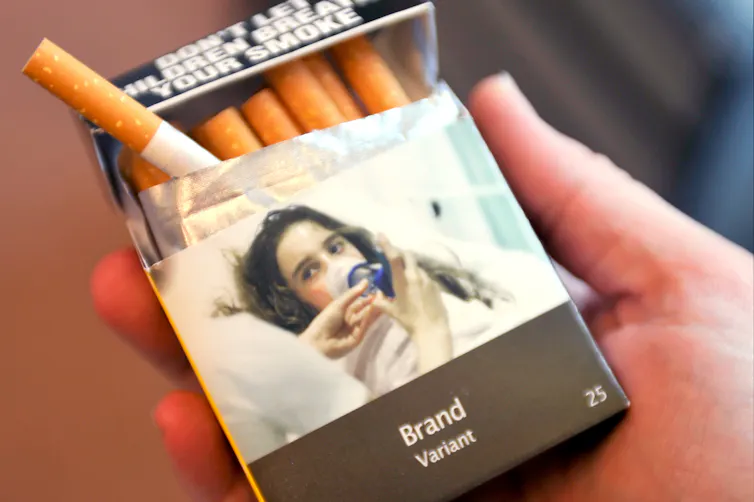
Has plain packaging extinguished tobacco companies' intellectual property? AAPIMAGE/Alan Porrit

Their barristers said the intellectual property rights of tobacco companies had been extinguished, or at least severely impaired. One said, “On our analysis, everything has been taken.”

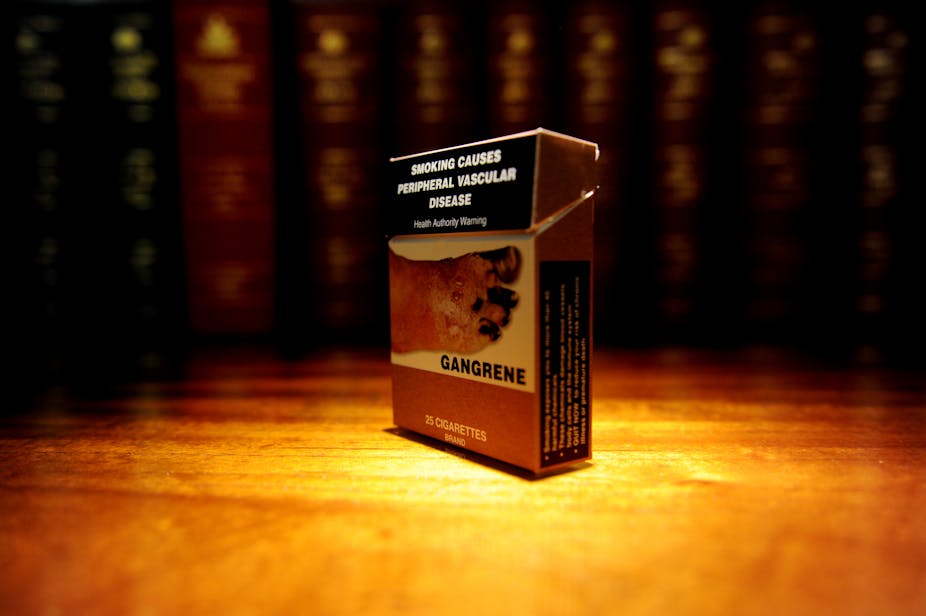
There was much debate about the semiotics of tobacco packaging and clear festishization of the tobacco pack. The judges were invited to closely inspect the packaging of tobacco products. And there was a discussion of the use of words, colours, emblems, badges, and logos – with references to examples such as Camel cigarettes.

But the judges questioned the analogies drawn between property cases, dealing with land, and intellectual property cases on the acquisition of property. Justice Gummow asked, “Are any of these cases about intangibles? A lot of the American cases are about land, are they not?” It was surprising that there was relatively little discussion about past Australian precedents on intellectual property and constitutional law, such as the Grain Pool case, the Blank Tapes case, the Nintendo case, and the recent Phonographic ruling.

Tobacco companies wanted to draw a distinction between graphic health warnings and “excessive regulation” (plain packaging). Justice Kiefel responded, “The degree of regulation may be extremely restrictive and yet there be no acquisition.”

British American Tobacco argued tobacco companies should receive compensation for public health advertisements. “The fact that it is an improving message or a good message may be socially desirable and if it is then the Commonwealth should pay for it,” they argued.

As a witness to the proceedings and an expert in intellectual property, the arguments of the tobacco companies about acquisition of property often seemed synthetic and unreal to me.

The Commonwealth

The Commonwealth government mounted a strong defence of the legality and constitutionality of the plain packaging of tobacco products. Their submissions explained the measures were “directed to informing, redressing and reducing harm to the public health that is caused by use of the tobacco products.”

The solicitor-general for the Commonwealth, Stephen Gageler, argued the law was “no different in principle from any other specification of a product standard or an information standard for products or, indeed, services that are to become the subject of trade in the future.”

He observed, “The product information required to be placed on these products differs only in intensity from product information that is routinely mandated to accompany therapeutic goods, industrial chemicals, poisons and other products injurious to the public health”. He commented, “The mandatory graphic health warnings are the skull and crossbones for a digital age, nothing more.”

AAPIMAGE/James Lane

The Solicitor-General said that “to suggest that the tobacco packages become little billboards for government advertising is wrong.” He denied the government was engaged in advertising, or derived any such benefit, and contended that a regulatory norm of conduct was not an acquisition of property.

The government stressed the sale and packaging of cigarettes had long been regulated in Australia, and that plain packaging was but the latest step in this process.

The solicitor-general argued the statutory rights of intellectual property are often varied and modified, adding a trademark “must at least be subject to a subsequent prohibition on use to prevent harm to the public or to public health”. Indeed, Article 8 of the TRIPS Agreement 1994 recognises that “members may, in formulating or amending their laws and regulations, adopt measures necessary to protect public health and nutrition”.

Solicitor-general also argued that the concept of just terms raised larger questions of fairness and justice under the constitution.

The Commonwealth maintained that it would be incongruous to compensate Big Tobacco, “For the Australian nation representing the Australian community to be required to compensate tobacco companies for the loss resulting from no longer being able to continue in the harmful use of their property goes beyond the requirements of any reasonable notion of fairness.”

Sideshows: margarine, boxes and Ratsak

Notwithstanding its serious subject matter, the case also had its colourful moments.

An amusing esoteric sideshow in the case was the fierce battle between junior lawyers over legal history relevant to the case. There was discussion of the Margarine Act of 1887 (United Kingdom), which required the plain packaging of margarine and margarine-cheese. But there were no reports of 19th century margarine and margarine-cheese makers ever ran litigation over plain packaging.

There has been much debate about absurd patent applications of late. And in this case, British American Tobacco revealed that it has filed patent applications for packages for tobacco products. Here’s the WIPO version of British American Tobacco’s suspect patent application for a “soft cup package for tobacco products”.

What is novel, inventive or useful about a soft cup package for tobacco products? Patent law should be encouraging the progress of science and the useful arts – treatments and therapies for cancer, for instance – rather than cigarette boxes.

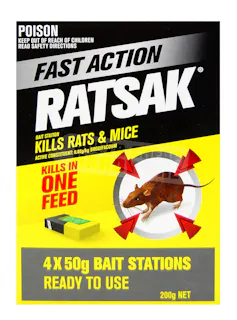
Tobacco company lawyers compared warning on Ratsak (rat poison) with warnings on tobacco products. http://www.ratsak.com.au/

Another oddity was the frequent comparisons between warnings on Ratsak poison, and health warnings on tobacco products, which gave the case a peculiar ending. The barrister for Japan Tobacco International invited the seven judges of the High Court of Australia to inspect the labelling on Ratsak, which he had bought at local shops.

A brilliant Australian idea

The High Court of Australia has reserved its decision. A ruling can be expected later in the year.

French CJ signalled that he thought that the matter of tobacco was exceptional. “None of these cases… involve somebody putting into the marketplace a substance which places at risk of serious and fatal disease. We are talking about something in quite a different category, are we not?” he asked.

The case provides the court with an opportunity to contemplate the constitutional role of the Commonwealth in regulating and protection health.

In terms of larger principles, the High Court of Australia can provide guidance on:

  • the difference between acquisition of property and regulation;

  • the relationship between property and intellectual property; and

  • the standard of justice underlying just terms.

It remains to be seen whether the ruling will have larger implications for the labelling of therapeutic goods, food, alcohol, and beverages, such as soft drinks.

What we know for certain is that, far from heralding the end of the fight about plain packaging, this case is merely one battle in an ongoing war for better public health.

But it will certainly have wider international implications. Geoffrey Robertson QChas predicted that, not only will the Commonwealth win the case, but other countries will follow the “brilliant Australian idea”. Both New Zealand and England have initiated public consultation processes, with a view to establishing schemes for the plain packaging of tobacco products.

Meanwhile, other attempts by tobacco companies to thwart this measure will continue. Big Tobacco will no doubt seek to challenge plain packaging in a wide array of arenas. The Ukraine, for instance, is leading a misconceived challenge to Australia’s plain packaging of tobacco products under the TRIPS Agreement 1994. And, there’s a contrived action against Australia’s scheme under an investment treaty between Hong Kong and Australia.

Health activists are also concerned about Big Tobacco’s involvement in the development of free trade agreements, such as the Anti-Counterfeiting Trade Agreement and the Trans-Pacific Partnership Agreement. There are fears that such treaties will include parts aimed at undermining tobacco control measures.

Coda

British American Tobacco Australasia Limited v. The Commonwealth of Australia Case S389/2411

JT International SA v. The Commonwealth of Australia Case S409/2011

Transcript of Day 1 of oral argument

Transcript of Day 2 of oral argument

Transcript of Day 3 of oral argument

Join the conversation

27 Comments sorted by

  1. Gavin Moodie

    Principal Policy Adviser

    Thanx for this. It is so nice to have a report of the actual case and the principles involved, rather than interest groups' reactions to it.

    It would be good to have an analysis of the High Court's recent iinet decision.

    report
    1. Matthew Rimmer

      ARC Future Fellow and Associate Professor in Intellectual Property at Australian National University

      In reply to Gavin Moodie

      It has been a busy week at the High Court of Australia. The ruling is here Roadshow Films Pty Ltd v iiNet Ltd [2012] HCA 16 (20 April 2012) http://www.austlii.edu.au/au/cases/cth/HCA/2012/16.html The High Court of Australia ruled 5-0 that iiNet had not authorised copyright infringement of films and television programs.An interesting case to watch as well.

      French CJ, Crennan and Kiefel JJ noted: 'The concept and the principles of the statutory tort of authorisation of copyright infringement are…

      Read more
    2. Gavin Moodie

      Principal Policy Adviser

      In reply to Matthew Rimmer

      Thanx. I don't know how I missed Suzor's piece.

      I am surprised that Gummow and Hayne JJ think that a test of whether the High Court should make the law reflect new circumstances is not the extent of change needed nor whether it involves mostly contentious policy issues, but whether Parliament has a practice of amending that law.

      On an analogous reasoning the Court should reinterpret the Australian Constitution strongly because the electorate has been so disinclined to amend it, and perhaps that is indeed what the Court has been doing.

      report
    3. Matthew Rimmer

      ARC Future Fellow and Associate Professor in Intellectual Property at Australian National University

      In reply to Gavin Moodie

      In their judgment in iinet, Gummow and Hayne JJ with concerned about a number of problems with the modern copyright regime - a lack of clarity and coherence; the sprawling, additive nature of the legislation; and a failure to keep up with modern technological developments:

      'As was emphasised in Stevens v Kabushiki Kaisha Sony Computer Entertainment, given the complexity of the characteristics of modern copyright law it perhaps is inevitable that the legislation will give rise to difficult questions…

      Read more
    4. Gavin Moodie

      Principal Policy Adviser

      In reply to Matthew Rimmer

      Thanx. One can indeed sympathise with the courts in trying to apply legislation which may include general principles but which also provides for specific technologies or circumstances but not those before the court.

      Priest's point was neat.

      report
  2. Roger Crook

    Retired agribusiness manager & farmer

    The question must be asked, if this law is passed, what next?
    Alcoholic drinks? Beer with plain labels. Jack Daniels and Johnny Walker, gone!
    Research years ago showed the more the horrific the depiction of vehicle crashes associated with drink had the least effect on the reduction of those crashes.
    Fast food? Smaller portions has been proposed. Will not people just buy more?
    The ingredients to commit self harm or to make bombs that are available in all hardware shops. But we don't use buy them…

    Read more
    1. Gavin Moodie

      Principal Policy Adviser

      In reply to Roger Crook

      The law is already passed; the issue is whether plain packaging amounts to the acquisition of property which paragraph 51(xxxi) of the Australian Constitution provides must be 'on just terms'.

      Tobacco is different from all the other examples in being the only legal substance which if consumed in accordance with the producers' guidelines increases morbidity and the risk of mortality.

      report
    2. Roger Crook

      Retired agribusiness manager & farmer

      In reply to Gavin Moodie

      Sorry, never read or heard of the tobacco industry telling anyone how much they should smoke.

      What they have done is made the product available with health warnings. That it is addictive is without question.

      By the same token I have witnessed people 'drinking themselves to death'. That booze is addictive to some, is also without question.

      I would recommend you read the recent release of Animal Farm. Publisher Harville Secker. There is a wonderful Introduction by the late Christopher Hitchens. ISBN978-1-846-55354-7

      report
    3. Matthew Rimmer

      ARC Future Fellow and Associate Professor in Intellectual Property at Australian National University

      In reply to Roger Crook

      Roger Crook, you are quite right, there are parallel debates on the regulation of labelling, packaging, and advertising in other areas - such as the regulation of alcohol, and food.

      The tobacco industry tried to run a 'floodgates' argument at times. Griffith QC for Japan Tobacco International argued: 'Yes, your Honour, but we say there is nothing illegitimate here. It is not made illegitimate by the fact that the Act has its objects to promote public health. I mean, for example, one might say…

      Read more
    4. Matthew Rimmer

      ARC Future Fellow and Associate Professor in Intellectual Property at Australian National University

      In reply to Roger Crook

      It is interesting to note that advertising experts and pundits have observed that the plain packaging case is exceptional http://www.adnews.com.au/adnews/tobacco-trademark-stoush-won-t-hit-other-industries
      They have dismissed the tobacco industry's claims that other categories will soon be targeted. Julian Martin noted: 'I don't think other brands or sectors are worried about it happening to their own products, beyond perhaps stronger measures toward confectionery advertising to children.' He commented: 'Cigarettes stand on their own, they are such a bad product for public health.'

      report
  3. Sue Ieraci

    Public hospital clinician

    Perhaps there are times when overhwelming public benefit trumps other legal principles. This might be one of those.

    report
    1. Roger Crook

      Retired agribusiness manager & farmer

      In reply to Sue Ieraci

      It may well be, Sue.

      My concern is that it may become, or set, a precedent for others to make claims for legislating for change for what they perceive as being for the 'public's benefit'.

      report
    2. Gavin Moodie

      Principal Policy Adviser

      In reply to Roger Crook

      The tobacco plain packaging legislation is not a precedent for parliament legislating for the public benefit since that was set centuries ago by legislation restricting the sale of alcohol, banning marijuana, requiring the installation and wearing of seat belts, etc.

      report
    3. Roger Crook

      Retired agribusiness manager & farmer

      In reply to Gavin Moodie

      Accept your first point but restricted licensing hours are not common to all countries and there is no proof that we are right, try many counties in Europe where, if what I have read is correct the availability of alcohol is not restricted to the same extent as here, yet they do not endure the problems we have with the binge. I lived in Germany in the sixties and, if my seven score years and ten and then some memory, serves me correctly, cafes/pubs shut 1 hour in 24. I saw less drunkenness in Germany…

      Read more
    4. David Arthur

      n/a

      In reply to Roger Crook

      At a guess, there may be reasons other than availability to account for exceptional rates of alcohol abuse in the British Isles and Eastern Europe relative to Western Europe.

      report
    5. Matthew Rimmer

      ARC Future Fellow and Associate Professor in Intellectual Property at Australian National University

      In reply to Sue Ieraci

      Sue and Roger, the debate about public benefit took place on a number of levels.

      In terms of constitution law, there was certainly much argument as to the difference between regulation and acquisition of property. The Commonwealth started off with a broad view of regulation [as stated in paragraph 83]
      http://www.hcourt.gov.au/assets/cases/s389-2012/BAT_Def.pdf

      Under criticism, the Commonwealth retreated to a somewhat narrower justification for restrictions 'where it was reasonably necessary to prevent or reduce harm caused by that trading activity to members of the public or public health' [as stated in paragraph 84]

      report
    6. Matthew Rimmer

      ARC Future Fellow and Associate Professor in Intellectual Property at Australian National University

      In reply to Sue Ieraci

      There has long been a debate about the private and public interests to be served by intellectual property law

      Article 7 of the TRIPS Agreement 1994 notes: 'The protection and enforcement of intellectual property rights should contribute to the promotion of technological innovation and to the transfer and dissemination of technology, to the mutual advantage of producers and users of technological knowledge and in a manner conducive to social and economic welfare, and to a balance of rights and…

      Read more
  4. Matthew Rimmer

    ARC Future Fellow and Associate Professor in Intellectual Property at Australian National University

    I did not have space to capture the arguments of some of the intervenors in the case. Worth mentioning the perspectives of the supporters of the Commonwealth.

    Katy Gallagher's ACT Government made a strong submission. It argued that Big Tobacco should not be compensated "for a loss of the opportunity to continue to engage in conduct of harm (and in this case, of extreme harm) to the community": http://www.hcourt.gov.au/assets/cases/s389-2012/BAT_AGACT.pdf

    The State of Queensland, in…

    Read more
  5. Matthew Rimmer

    ARC Future Fellow and Associate Professor in Intellectual Property at Australian National University

    It is also difficult to fully encapsulate the legal strategies of the four different tobacco companies in the case in a short overview. It was notable that the barristers for the tobacco companies went through an extraordinary range of variations of their arguments over three days. It would also be fair to say that the barristers tried different tacks on the question of acquisition of property on just terms, both in terms of substance and style.

    report
  6. Matthew Rimmer

    ARC Future Fellow and Associate Professor in Intellectual Property at Australian National University

    One important stakeholder was not represented in the High Court of Australia hearing on the plain packaging of tobacco products: the medical profession (comprising doctors, surgeons, clinicians, nurses, counsellors, palliative care specialists). The Australian Medical Association has been a strong supporter of the necessity for plain packaging of tobacco products http://ama.com.au/node/6943

    The contributions of doctors were notable during the parliamentary debate over the plain packaging of tobacco…

    Read more
  7. Matthew Rimmer

    ARC Future Fellow and Associate Professor in Intellectual Property at Australian National University

    Alison Rourke from the Guardian also has a concise overview of the legal conflict -
    'Tobacco giants fume at Australia's plans for unbranded cigarette packets': http://www.guardian.co.uk/business/2012/apr/20/tobacco-australia-unbranded-cigarette-packets Professor Mark Davison from Monash University, Melbourne, commented that he expected the government to win. "The tobacco companies were in trouble from the start. The government has no interest in acquiring the tobacco trademarks for its own use or anyone else's. Therefore, no acquisition of property under the constitution takes place with plain packaging."

    report
  8. Barry Calderbank

    Farmer

    I've no argument with the plain packaging idea. But surely there's an easier way.

    Why not impose a punitive tax - yes, even call it that officially - on cigarettes at, say $1 a pack rising by a further $1 every year until smoking rates (or possibly instead the cost of smoking to the public health system) has fallen to a pre-determined threshhold. In other words, we tax the smokers at an ever increasing rate and they know the financial pain will get worse and worse until they stop smoking. Or…

    Read more
    1. Roger Crook

      Retired agribusiness manager & farmer

      In reply to Barry Calderbank

      It's an interesting debate this one. There is an assumption running through the debate that governments, by legislation, can change behaviour. We all know that knowledge, values, attitudes and beliefs determine behaviour.
      So we know what the government and the legislators have in mind by doing what they are doing. The other factor, which can change behaviour is cost, keep on putting the cost up and one puts a theoretical limit on the size of the market.
      I say theoretical because place a virtual…

      Read more