
Can Greece learn from the story of Indonesia in the Asian financial crisis?

European financial woes are mounting daily is what some have called the biggest economic challenge of our generation. However, just over a decade ago an even larger financial crisis was unfolding in Australia’s own back yard with the Asian financial crisis. The economic calamity in Asia was blamed…

8rvhxbqs-1339652572
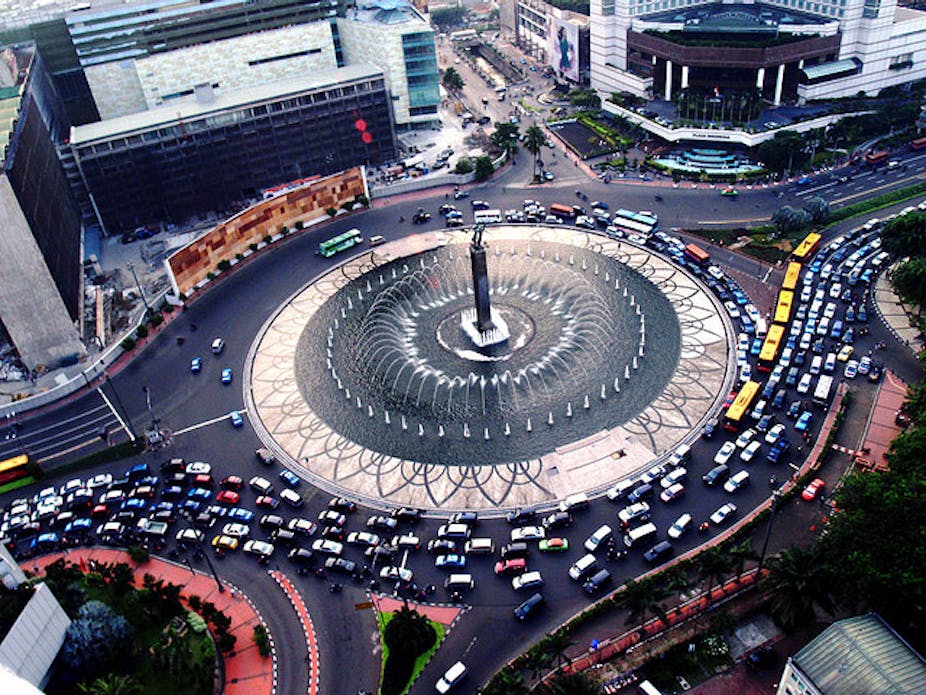
Worst hit by the Asian financial crisis in 1998, Indonesia’s economy has returned to pre-crisis growth rates. What lessons are there for Greece? Flickr/Cillian Storm

European financial woes are mounting daily is what some have called the biggest economic challenge of our generation.

However, just over a decade ago an even larger financial crisis was unfolding in Australia’s own back yard with the Asian financial crisis. The economic calamity in Asia was blamed on a build-up of short term foreign cash investments – mostly from Wall Street – into a number of Asian countries which promised significant growth opportunities and high returns from mostly extractive industries such as mining, forestry and low cost manufacturing.

Also strong long-term governments in the region provided the illusion of political stability. The Asian financial crisis started in Thailand on July 7, 1997, when the Thai government had no choice but to disconnect their currency from the US dollar.

That resulted in a precipitous decline in the value of the local currency. From there contagion took on a life of its own hammering a number of Asia’s “miracle” economies. But Indonesia was hardest hit of all. Like Greece in the current European calamity, the underbelly of a corrupt and crony political and financial system in Indonesia only made the crisis much worse.

Since the start of the GFC in 2008, the Greek economy has dropped by about 6% as the crisis spread from the US to Europe. The downturn in the Greek economy has resulted in tremendous decline in the standard of living for the population throwing many people into long-term unemployment and uncertain future.

But picture the situation Indonesia found itself in during the height of the AFC in 1997 and 1998. GDP dropped by 14% in less than one year, the currency was all but destroyed losing 80% against the USD within a few weeks, a massively greater decline than the Greeks have endured.

Like a startled herd the investors withdrew their money out of Asia so rapidly that it resulted in a fiscal vacuum and countries in the region had literally no cash to operate. Currencies collapsed, unemployment exploded and there were riots in the street.

Three thousand people were killed in Jakarta alone in protests against IMF-orchestrated austerity programs. Billions of dollars from the IMF was provided to rescue nations from bankruptcy on the proviso a long period of social/political and financial restructuring followed. Indonesia then was likely worse off than Greece is now.

The bright side is that much of Asia, and in particular Indonesia has now returned to pre-crisis growth rates with a much more structured and controlled economy in the region. Indonesia has greatly reduced its level of corruption, improving significantly each year since the end of the AFC. (See www.transparency.org for details.)

Greece is yet to see the light at the end of the tunnel. Perhaps if there is a lesson to learn from the AFC, it is that Greece and the EU might need a crisis in order to reset growth?

The world hangs on because in the end there is no guarantee that all will end well in the case of Greece. Perhaps it might be the end of the shared European currency and eurozone. That conclusion seems to be an extreme view, but events seem less positive as each day passes.

It seems that the world has learnt nothing from past events.

While in the final analysis the Asian crisis was the result of the lack of structure of the local political/financial system, like the Greek economic situation, it had its roots in the role of Wall Street investment banks.

Is it finally time to investigate tighter controls – or at least some monitoring – on Wall Street’s global activities?

Then there was the role of bodies such as the IMF in demanding a number of Asian nations open themselves up to international trade – arguably marking the beginning of significant international neo-liberalism in those economies.

According to many, the AFC was the perfect opportunity for the US to achieve its desires to remove as many trade barriers as possible in the region and open up much Asia to future pro-west economic development. Ironically that may have contributed to the weakening of the US economy due to the cash flows towards Asia.

So perhaps the current Greek crisis is not so far removed from the events which unfolded in Asia.

The Asian experience could show countries like Greece that out of the pain there can be a future after all. But some heavy lifting has to be done, and there are few certainties.

Join the conversation

5 Comments sorted by

  1. R. Ambrose Raven

    none

    It's a little more complicated than that, leaving aside this belief in endless growth. Consider a different summary of Greece's position and options.

    Both equality and recovery will benefit from much more active efforts made through government business enterprises (GBEs) to develop new industries and improve the present ones. It means ending middle- and upper-class welfare, suppressing corruption, creating a culture of efficiency, improving tax collection, and increasing investment in research…

    Read more
  2. Lincoln Fung

    Economist

    The article overlooked a number of issues and superficially attributed the problems in Indonesia had (and Greece faces) now to corruptions and crony political and financial system. Further, the viewpoint that post AFC Asian growth weakened the US economy does not appear to be sound and correct.
    It ignored the wrong approach by IMF in the AFC and the unnecessarily excessive damages to a number of Asian economies, especially the Indonesian one.
    More significantly, the current problems Greece faces is partly and perhaps more due to its inability to adjust to its lower international competitiveness by the single currency the euro, while on the other hand, the Indonesia currency dropped too much due to international forces.

    report
  3. Peter Ormonde

    Peter Ormonde is a Friend of The Conversation.

    Farmer

    Interesting and important issues.

    And central to it is the question of who pays ... who carries the burden for these routine crises?

    The IMF has always - ALWAYS - adopted a single cure for these crises - cut debt, cut spending and drive the economy to the floor. This invariably puts the weight of the crises fair and square on the poorest and most vulnerable. The end result is that the "economy" recovers - leaving a more unequal and unfair society with lower wages and less spending on education, health and welfare. Like surgery with a chainsaw.

    The IMF and the institutions of global finance have no particular affection for "wayward" states - their enthusiasms are for the system as a whole. We must all make sacrifices and we are sacrificing you lot.

    Using a crisis to eliminate cronyism, corruption and expand democratic rights is anathema apparently - that is after all the nature of business in these places isn't it?

    report
  4. Mardi Dungey

    Professor and Deputy Head, School of Economics and Finance at University of Tasmania

    Indonesia had some important differences - a developing economy with a flexible labour market, a powerhouse of growth in the Asian region (China) to stimulate its recovery and a set of international investors who didnt have immediate buy-in to the economic consequences of the withdrawal of their funding as well as a over-zealous IMF package. It is not clear where the engine of growth to rejuvenate Greece will come from - there is no clear external source amongst their trade partners - but on the plus side for the Greeks their plight poses a significant threat to the world's developed financial markets, which should provide sufficient incentive for renegotiation. The fear on the eve of the Greek elections was palpable, and may well flow into negotiationsof the terms of repayment.

    report
  5. Phillip Lawrence

    PhD Scholar at University of Sydney

    Thank all for the great comments. My intention was to highlight that while Greece is a major issue at the moment, many Australians have forgotten that not that long ago there was a massive financial disaster on our door step. At least 3,000 Indonesians killed was a terrible part of that period. My Indonesian friends are still hurt. Indonesia has made massive changes and are now definately in a period of recovery. The Greek crisis is different, as all financial crisies are obviously. The point is hard work and change is required. What work and change is of course the question.
    Important the IMF have learnt what not to do in Europe after how they handled the Asian Financial Crisis.

    report