
Can Indigenous education afford to wait for a real response to Gonski?

In all the discussion, media releases, press conferences and TV coverage of this week’s government response to the Gonski review, it was fascinating that the issue of Indigenous education rated such little mention. More than the divisions between private and government schooling, the division between…

Bbhygdm3-1346799517
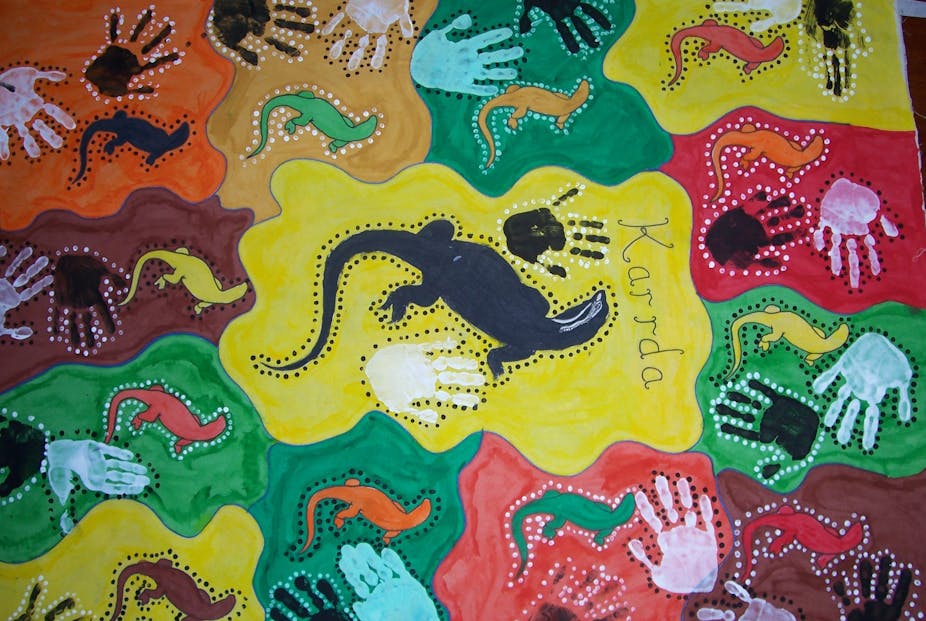
The government can’t wait any longer, it needs to make changes now to improve Indigenous education. Aboriginal Art image www.shutterstock.com

In all the discussion, media releases, press conferences and TV coverage of this week’s government response to the Gonski review, it was fascinating that the issue of Indigenous education rated such little mention.

More than the divisions between private and government schooling, the division between the access and experience of education by Indigenous families and non-Indigenous families is most telling about quality and equity in Australia’s schools.

We know there are strong links between low achievement and socio-economic positioning and a growing gap in achievement between those achieving highly and those at the bottom of the scale. But Indigenous students lose out on both counts: they are over-represented in the bottom quartile of achievement and there is a growing distance between their achievement and those at the top.

You would think this would be at the forefront of concerns but the government’s response provided little detail in this area. That is until fortunately The Australian newspaper reported that “the government told The Australian” they would change the Gonski recommendation funding for Indigenous schooling. Instead of the recommended loading for schools with 5% – 25% Indigenous student enrolment with a sliding scale to 100% Indigenous, the government now apparently will fund every Aboriginal and Torres Strait Islander child in a school.

The overall direction of the announcements Monday and this reassurance on Tuesday were a welcome reversal of a slide in overall education funding per student in which Australia was well below average of OECD countries’ funding. However, we still do not know any details of what is yet to be discussed with the states and territories.

At the moment, we know nothing about the standard base-funding formula per capita to be made available to all schools; the basis of deciding the loading for disadvantage; and the processes for accountability.

Until these core issues are negotiated and made public, it will be almost impossible to tell what differences the funding will make for Indigenous education – particularly whether there is any likelihood of decreasing the gap between Indigenous students and the higher socio-economic students currently privileged in school curriculum and access.

Improvements in Indigenous education will require significant injections of money. As the Gonski report noted, many Indigenous children experience multiple and deeper forms of disadvantage than other groups. Previous targeted programs from states, territories and the Commonwealth have not provided the necessary funding, nor the flexibility and stability of funding, which are required to reverse more than 200 years of colonial treatment.

However, money alone will not make the difference needed. As the National Congress of Australia’s First Peoples this week welcomed the government’s positive response to their criticism of the initial Gonski proposal, a spokesperson also underscored the relationship between funding, community-school connection and culturally relevant curriculum:

“Our children perform well at school when the connections between families, home and school are strong, when quality teachers are in front of classes, when curriculum is culturally relevant and inclusive, and when school infrastructure and resources are tailored to local circumstances.”

For remote and regional schools with large numbers of Indigenous students, high teacher turnover, an over-representation of inexperienced teachers, lack of familiarity with Indigenous languages and cultural protocols, and lack of Indigenous teachers all add to the problem of culturally irrelevant curriculum and teaching methods.

As importantly, there are few schools in provincial cities or metropolitan areas where Indigenous students receive the kind of curriculum or culturally appropriate learning and teaching that would raise the overall levels of achievement. Aboriginal and Torres Strait parents have often had a history of poor relations with schools, yet need to be involved in their children’s education, formally and informally.

As the National Congress itself noted in response to Gonski, ATSI peoples need to be represented on the stakeholder group which decides funding and accountability processes, as well as at the local school level. The Howard government’s removal of the Aboriginal Student Support and Parent Awareness scheme in the 2005-2008 funding cycle significantly undermined Indigenous parent engagement in schooling and will need to be replaced, with links from local groups to Australia-wide policy and program decisions.

So while everyone waits to find out the details yet to be negotiated – and the timeline for even beginning the process is lengthy – education for Indigenous students receives only sporadic attention.

Early learnings from the government’s National Partnership programs appear to have something to say but this will need expert advice which is currently in short supply in most states and territories, which have been reducing their education infrastructure.

Indigenous Education simply cannot afford to wait until 2025 for the level of improvement needed.

Sign in to Favourite

Want to follow The Conversation?

Sign up to our free newsletter to get the day's top stories in your inbox each morning, with a special wrap on Saturday.

Help evidence based journalism become the norm and donate

Join the conversation

16 Comments sorted by

  1. Michael Leonard Furtado

    Doctor at University of Queensland

    Thank you, Marie, for shedding light on this most needy and yet perversely hidden problem of educational injustice. I hope it results in less policy posturing and a much more attentive response to resource delivery, where it is needed most.

    report
    1. Tony Kruger

      Assoc Professor, School of Education, Victoria University

      In reply to Michael Leonard Furtado

      Thanks Marie. Might I suggest that the next question you consider is the kind of coordination across national, state and territory governments which will be needed to provide 'the flexibility and stability of funding, which are required to reverse more than 200 years of colonial treatment.' And then there will be the curriculum questions to answer.

      report
  2. John Zigar

    Researcher

    I don't believe that the indigenous population in particular need 'more' support or funding than 'white' Australians. The issue is that the two ethnic groups persist to be segregated intellectually in such a way that fosters an upper and lower class. As long as we persist to create two separate curriculums for the two ethnic groups, one will be 'stronger' and 'better' than the other. If you continue to make such comparisons and ask "...are you an Aboriginal Torres Strait Isalnder?" you are undermining…

    Read more
    1. Judith Olney

      Ms

      In reply to John Zigar

      Hi John, I agree with your post. I live in an town with a large Indigenous population, where most of the Indigenous kids do as well at school as every other kid. There are exceptions to this, but this is not down to the children's ethnicity, but down to the parents not sending the children to school, because of problems in the family, such as alcoholism, extreme poverty, lack of education of the parents, or family breakdown. These problems cross all cultural and ethnic boundaries.

      When the local…

      Read more
    2. Michael Leonard Furtado

      Doctor at University of Queensland

      In reply to Judith Olney

      Judith, thanks for your post. The concept of treating all equally is exceedingly important, especially for advancing a merit-based society like ours. The trouble is that we have to start on a equal footing for freedom, non-interference, choice and measurable achievement to follow. Much as your commitment to these values is commendable, the fact is that by living in a non-metropolitan part of Australia, none of the kids who school there, whether black or white, and notwithstanding your evident contentment…

      Read more
    3. Lorraine Muller

      PhD - eternal student

      In reply to John Zigar

      When curricula represents only one worldview, it can be used as a tool of oppression and colonisation.
      In Australia education is based on Western knowledge, values, and protocols, it is assimilationist.
      Mainstream culture is assumed to be the norm.
      Education - promoted as the key to addressing the social and health issues that create the gap between Indigenous Australians and mainstream Australians.
      Student’s success relies on them being adept in the cultural traditions and knowledge of non…

      Read more
    4. Lorraine Muller

      PhD - eternal student

      In reply to Lorraine Muller

      The last paragraph was aimed at Michael.

      However, the stats show that all universities are lacking in valuing the more than 200 Indigenous PhD achievers.

      report
    5. Michael Leonard Furtado

      Doctor at University of Queensland

      In reply to Lorraine Muller

      As a non-white (though indigenous to another country) PhD holder who has only ever been employed on a contract basis, I wholeheartedly agree that your analysis of the problem about the curricular and pedagogical impositions that Aborigines face is spot on and entirely in sympathy with my own position. Also if you were to check out Marie Brennan's credentials you might be overtaken by the kind of remorse that the oppressed shouldn't have to deal with because of its costly and inevitably wasteful divisiveness.

      Incidentally, Marie was responding to the by now well-known fears about Gonski and its implementation that several ATSI academics and others had already given voice to. How about a little solidarity on this front, for fear of our situation being exploited by those who dont really give a stuff other than to point to our fragmentation and shrug their responsibilities off their collective shoulders yet again.

      report
    6. Judith Olney

      Ms

      In reply to Michael Leonard Furtado

      The primary school, that my friend's Grandchildren, and indeed my own Grandchildren attend, is in the top 10 in the entire state, which includes schools in the city and larger towns. This comparison comes from the "My School" website, results of which have also been printed in our local newspaper. The school has extremely good outcomes because it has extremely good support from the local community.

      I am under no illusions at all about the need to improve education for rural and Indigenous students…

      Read more
    7. Michael Leonard Furtado

      Doctor at University of Queensland

      In reply to Judith Olney

      I can't disagree with your sentiments, Judith; though I don't follow their connection with John Zigar's 'out-of-left-field' salvo in favour of government non-interference and a supposed equal playing-field in regard to righting the wrongs against Indigenous persons (which I have contested with verifiable evidence).

      To refresh our memories, Marie Brennan wrote as follows:

      "We know there are strong links between low achievement and socio-economic positioning and a growing gap in achievement between…

      Read more
    8. Judith Olney

      Ms

      In reply to Michael Leonard Furtado

      As I use my real name on this website, I do not name names of others that I do not have their permission to do so, and think it unethical to do so. This goes the same for the school my Grandchildren attend, and the my friends Grandchildren attend. There are a lot of disturbed people in cyber space that could use this information to harass those that they do not agree with. However, this does not change the point I was making in my posts, if you choose to either believe or not believe my story, that…

      Read more
    9. John Zigar

      Researcher

      In reply to Judith Olney

      Hi Judith, I agree with your view.

      Michael shouldn't discredit people's posts. Michael's post was poorly written, dismissive of your experiences (and mine) and rude. If Michael wishes to dangle pseudo-scientific evidence to back up what he says that's fine - but he shouldn't dismiss hands-on experience gathered by people on the ground.

      report
  3. Michael Leonard Furtado

    Doctor at University of Queensland

    Good point, John. What you say properly assumes the prior existence of a level playing-field. Marie (as much 'hard head' as 'big heart') cites important statistics showing how miserably far from the truth this is. Maybe its time to reflect on this before unwittingly engaging in victim-bashing.

    report
    1. John Zigar

      Researcher

      In reply to Michael Leonard Furtado

      Michael, there was no victim bashing in my post. I never assumed prior existence of a level playing field because we need to look forward and make improvements to the current system of education and not continue to lament the past.

      report
  4. Reinhard Dekter

    logged in via Facebook

    The author of this article has completely ignored the fact that educational outcomes have a strong negative correlation with government spending on education. Hence the statistics would indicate that increasing spending on indigenous students will have the effect of making them even less educated over all than they are now. It should bring dread to every parent of a child in the Australian government education system that it intends to cast more of their hard-won money into an educational bottomless pit. The only genuine solution for education is to have it completely privatised with absolutely no government funding of any class of student.

    report
    1. Caroline Gopalkrishnan

      logged in via Facebook

      In reply to Reinhard Dekter

      I thought that historically the Australian government has not previously injected the money into Indigenous education to the extent that it supposedly will? So there really is no precedent for assuming that government spending on education has a negative correlation with educational outcomes. The attention to detail that Brennan is proposing will benefit all children but will hopefully in the longer term break down the deeper more insidious barriers facing Indigenous children. Perhaps education funding…

      Read more