Canadian ice shelves halve in six years

Half of Canada’s ancient ice shelves have disappeared in the last six years, researchers have said, with new data showing significant portions melted in the last year alone. The rate at which ice melts is seen by climate scientists as an indicator of the pace of global warming. Satellite images released…

Southernwardhunticeshelfaugust2008
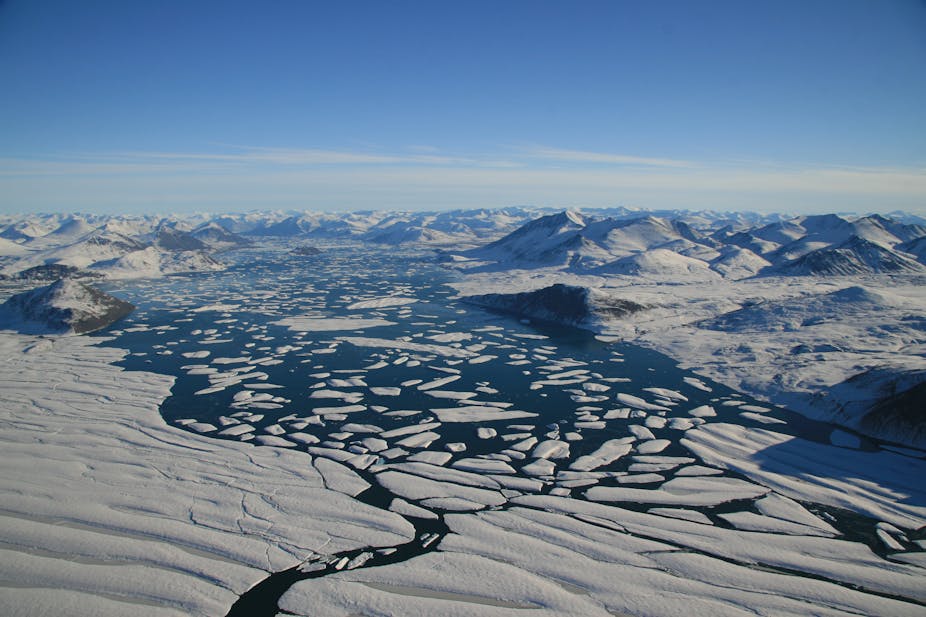
Around 50% of Canada’s ice shelf has disappeared in the last six years, researchers say. Denis Sarrazin, ArcticNet/Centre d'Etudes Nordiques

Half of Canada’s ancient ice shelves have disappeared in the last six years, researchers have said, with new data showing significant portions melted in the last year alone.

The rate at which ice melts is seen by climate scientists as an indicator of the pace of global warming.

Satellite images released by researchers from Carleton University in Ottawa show that most of the Serson Ice Shelf broke away during the Canadian summer this year.

Serson shelf before Canadian summer 2011

Serson Ice Shelf on March 19, 2011 (red) before Canadian summer 2011 break-up. Serson A is a floating glacier tongue (south) and Serson B is composed of thick, ancient sea ice (north). Blue denotes the coast of Ellesmere Island. Radarsat-2 fine beam imagery © MDA 2011, Distribution licensed by MDA-GSI for the SOAR program.

Serson shelf after Canadian summer 2011

Serson Ice Shelf on September 23, 2011 (red) following Canadian summer 2011 break-up. Serson A is a floating glacier tongue (south) and Serson B is composed of thick, ancient sea ice (north). Blue denotes the coast of Ellesmere Island Radarsat-2 fine beam imagery © MDA 2011

The Ward Hunt Ice Shelf split into two separate pieces during the Canadian summer this year, the images show.

Ward Hunt shelf before Canadian summer 2011

The Ward Hunt Ice Shelf on March 23, 2011 (red) before Canadian summer 2011 break-up. Blue denotes the coast of Ellesmere Island. Radarsat-2 fine beam imagery © MDA 2011, Distribution licensed by MDA-GSI for the SOAR program

Ward Hunt shelf after Canadian summer 2011

The Ward Hunt Ice Shelf on September 22, 2011 (red) following Canadian summer 2011 break-up. Blue denotes the coast of Ellesmere Island. Radarsat-2 fine beam imagery © MDA 2011

This ice lost during the Canadian summer this year equals up to three billion tonnes or about 500 times the mass of the Great Pyramid of Giza, a statement released by the university said.

“Since the end of July, pieces equaling one and a half times the size of Manhattan Island have broken off,” said Luke Copland, researcher in the Department of Geography at the University of Ottawa. Oil rigs in the Beaufort and Chukchi seas may be at risk from large icebergs that broke off the shelf and are now floating south, he said.

Assistant Professor Derek Mueller, a researcher in the Department of Geography and Environmental Studies, said that Canadian ice shelves had halved in size since 2005.

“The ice shelves were formed and sustained in a different climate than what we have now. As they disappear, it implies we are returning to conditions unseen in the Arctic for thousands of years,” he said.

Professor Steven Sherwood, Co-Director of the University of NSW’s Climate Change Research Centre, said the rapid pace of melting showed that recent global warming was unnatural.

“The real significance of this, in my view, is that this ice has reportedly been there for thousands of years. The same is true of glaciers that have recently disappeared in the Andes. These observations should dispel in one fell swoop any notion that recent global warming could be natural,” he said.

Sign in to Favourite

Want to follow The Conversation?

Sign up to our free newsletter to get the day's top stories in your inbox each morning, with a special wrap on Saturday.

Spinner
Help evidence based journalism become the norm and donate

Join the conversation

5 Comments sorted by

  1. Roxane Paczensky

    Registered Nurse

    "These observations should dispel in one fell swoop any notion that recent global warming could be natural”. I hope professor Sherwood is right, but as evidence has been ignored until now I fear the deniers will happily deny this evidence too. After all he planet's declining health has had no effect on the drive for increased shareholder profit until now and I fear the aquisition of money will remain the primary goal of the psycopaths that lead our corporations into the future.

    report
    1. Toby James

      retired physicist

      In reply to Roxane Paczensky

      Roxane, why is this melt evidence of unnatural warming? How do you differentiate between man-made and part of natural warming that is a consequence of the Earth coming out of the little ice age.

      This story is nothing more than Warmist hype, and is the kind of stuff that gets climate science the image it currently suffers from.

      report
  2. Roxane Paczensky

    Registered Nurse

    @Toby i have taken the word of this practicing scientist. Professor Steven Sherwood, Co-Director of the University of NSW’s Climate Change Research Centre, said the rapid pace of melting showed that recent global warming was unnatural. If you disagree with his research findings please show you have reviewed his research and provide peer reviewed research evidence that condradicts his. Until then your comment is nothing but white noise.

    report
    1. Toby James

      retired physicist

      In reply to Roxane Paczensky

      Roxane, Prof. Phil Jones in a BBC interview on Feb 2010 was asked the following question and gave the answer below.

      Q - Do you agree that according to the global temperature record used by the IPCC, the rates of global warming from 1860-1880, 1910-1940 and 1975-1998 were identical?

      A - So, in answer to the question, the warming rates for all 4 periods are similar and not statistically significantly different from each other.
      http://news.bbc.co.uk/2/hi/8511670.stm

      Given that the four periods of global warming during the last 150 years are not different from one another, and that there has been no global warming during the last decade, we can only conclude that the distinction between man-made and natural warming cannot be seen in the statistics - its invisible.

      It remains the case that this sort of hype gives warmists a bad name.

      report
  3. Marc Hendrickx

    Geologist

    On the issue of ice loss around the northern margin of Ellesmere Island. A search of the National Library’s newspaper archive (using the words Ellesmere Island ice shelf) finds a series of reports from the 1950s. I found this headline from the West Australian from the 8 November 1954 of interest:
    ARCTIC IS WARMING, SCIENTISTS THINK
    Two Canadian scientists, just back from the northern-most tip of Canada, said they found some evidence that the Arctic was becoming warmer.
    http://trove.nla.gov.au/ndp

    Read more