
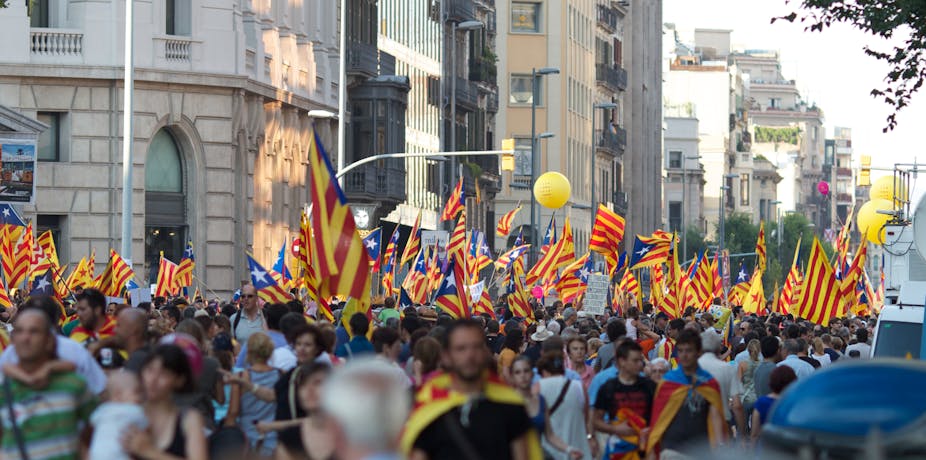
On 25 November Catalans will go to the polls in what will be their 11th regional elections since Spain’s return to democracy after Franco’s death in 1975. This time, however, Catalans will be voting much more than a Parliament: they will be in effect deciding whether they want Catalonia to secede from Spain.
When Artur Mas (leader of centre-right coalition Convergència i Unió) won the previous Catalan elections in 2010, he ran on a platform that blamed fiscal arrangements with Spain for Catalonia’s growing debt and requested an urgent renegotiation of Catalonia’s contribution to Spanish central Treasury. Unable to reach a “fiscal pact” with the also centre-right Partido Popular (in Government in Spain since 2011), Mas called a snap election last September 25th, only a few days after up to 1.5 million citizens took to the streets of Barcelona to celebrate La Diada (Catalan National Day) and call for independence for Catalonia under the slogan “Catalonia, new European Nation”. This time, Artur Mas has promised to call a referendum in a maximum of four years, with the slogan question already in circulation: “Do you want Catalonia to be a state within the European Union?”
Since polls show that Convergència i Unió will win the 25 November elections (although Mas will not be able to form the majority government that he would have wished for), the issue will soon become a legal one. Article 92 of the Spanish Constitution states that a referendum can only be called by the King, at the proposal of the Prime Minister, following prior authorization by the Spanish Parliament. Thus, if Artur Mas is re-elected and he calls a referendum, even if he does so as Head of the Catalan government and with the support of the Catalan Parliament, he will be breaking the law and taking the issue to a new, unpredictable level (and an ultra-right wing group has already announced that if Mas calls the referendum, they would sue him for “high treason to the state”, a crime typified in Spanish military legislation).
But how has all this arisen?
Catalan independentism, of course, is not a new phenomenon, and can be traced back for centuries. More recently, however, it had been replaced by autonomismo, a generalized backing of the devolution process initiated in Spain after Franco’s death: in 1984, the major independentist party (Esquerra Republicana de Catalunya, Catalan Republican Left) received only 4% of votes. In the past few years, the Spanish economic crisis, which seems to worsen by the day, has fuelled a new, somehow different wave of independentism. If previously Catalan independentist feeling was mainly based on the perception of Catalan national identity as intrinsically different to Spanish national identity, nowadays most of the arguments revolve around fiscal deficit, taxes and the amount of Catalan money that ends up elsewhere in Spain through the very controversial and outdated interterritorial funding arrangement currently in place.
While Spain is not a federal state like Australia, both countries operate on the basis of interterritorial solidarity and horizontal fiscal equalisation. The latter is defined by the Australian government as “the making of payments [by the Federal government] to State governments with the objective of equalising their fiscal capacities to provide public services”, with the aim “to reduce the inequalities in the fiscal capacities of sub-national governments arising from the differences in their geography, demography, natural endowments and economies.” Also in both countries, most taxes are collected centrally (by the ATO and its Spanish equivalent), with the Canberra and Madrid governments deciding, in consultation with State or regional governments, the amount each State or Autonomous Community receives every year.
For some years now, Catalan governments (regardless of political leanings) have claimed that Catalan fiscal deficit was too high compared to that of other regions outside Spain with a similar GSP, and an interterritorial national funding arrangement comparable to Spain’s. More recently, and given the current context, the Catalan government has been claiming that such a deficit is more than unfair; it is simply unsustainable for Catalonia, with independence the obvious solution.
While I remain unconvinced that independence will solve Catalonia’s problems and that it will almost certainly lead to new ones, the refusal by most major Spanish parties to support a referendum seems uncompromising and hardly democratic.
For further information and discussion on this topic, you can hear a seminar given recently by Dr Carlos Uxo and Gillian Darcy.
alfred venison
records manager (public sector)
thank you for another essay on the interesting on-going situation in spain and catalonia. this is indeed a boom time, as it were, for students of nationalism. one of the earlier authors on this subject wrote that (i paraphrase) the spanish gov't is constitutionally bound to preserve the unity of the state. it seems this oath is taken to preclude the gov't even contemplating a constitutional amendment, if necessary, to enable some kind of a constitutional process to address the aspirations of catalonia…
Read moreCarlos Uxo
Senior Lecturer, Spanish Program Coordinator at La Trobe University
Alfred, thanks for your comment. Yes, article 2 of the Spanish Constitution states that "the Constituion is based on the indissoluble unity of the Spanish Nation". No article in the Constitution leaves a door open for any part of Spain that may want to secede. (That said, I am not an expert in international law, and I don't know if any other country has an article to that effect.) However, the Constitution itself can be changed (and has been changed) - so it could at least hypothetically include…
Read morealfred venison
records manager (public sector)
thanks for the reply & the corrections. given catalonia knows about article 2, just what does catalonia expect from madrid? where does this go, given article 2 & catalonian's feelings? it doesn't seem able to go the way of quebec with a clearly worded referendum with a clear majority leading to negotiation. nor does it seem able to go the way of scotland, with referendum leading to negotiations between the two nations about a new relationship. where is the path for catlonia & spain out of this apparent standoff? a.v.
Carlos Uxo
Senior Lecturer, Spanish Program Coordinator at La Trobe University
Alfred, Catalan independentists, other non-independentists nationalists, and even Iniciativa per Catalunya-els Verds (eco-left) basically want a referendum, but all major parties in Spain refuse to even discuss the possibility (and here Spain includes Catalonia: we should not think that everybody in Catalonia wants the referendum and independence, while everybody outside Catalonia is against independence. Incidentally: after recently winning the elections in the Basque Country, the Nationalist Basque…
Read moreJason Bryce
logged in via Twitter
Very interesting article thank you.
But I have to raise some crucial issues you have totally ignored.
Will Catalonian independence lead to a break up of La Liga? Because songs language and cultural displays at El Classico at Camp Nou have helped drive Catalan pride and this whole campaign. But to the extent of not seeing Real Madrid 3 or 4 times per year - im sure many Catalans want this clarified.
And independent Catalonia would rob World Cup/Euro Cup winners Spain of most of their best men. But then there is the mouth watering prospect of Catalonia vs Spain - Thats like a Super El Classico. Im sure these issues are in the minds of many voters.
Carlos Uxo
Senior Lecturer, Spanish Program Coordinator at La Trobe University
Jason, some independentists have already said they would want Barcelona to continue playing in the Spanish La Liga (as, they say, Monaco does in the French equivalent).
Will Spanish clubs want that? Another question mark to add to this issue.
Carlos Uxo
Senior Lecturer, Spanish Program Coordinator at La Trobe University
Check this video on Barça and independentism
http://www.guardian.co.uk/football/video/2012/nov/22/fc-barcelona-catalonia-independence-video
Peter McPhee
Professorial Fellow in the Melbourne Graduate School of Education at University of Melbourne
Thanks for this interesting article. It's dismal that Catalonian separatism - for so long unsuccessful despite the strength of historical and linguistic arguments - should now be successful on the basis of fiscal self-interest. In that it reminds me of what has happened in Belgium, and makes one wonder about xenophobic attitudes to non-Catalans, such as the many North Africans and Castilians in Catalonia.
Carlos Uxo
Senior Lecturer, Spanish Program Coordinator at La Trobe University
Peter, yes, one of the main issues would be the attitudes toward non-Catalan Spaniards (not only Castillians). While some independentists have said they would welcome Spaniards (as they welcome French or English citizens, for example), I am convinced there would be many frictions.
In other parts of Spain like Valencia many people are very worried, since independentists believe in "Paisos Catalans" (which include Valencia and Baleares). Would and independent Catalonia want to expand its frontiers?
alfred venison
records manager (public sector)
dear author - i rely on en.wikipedia article about catalan separatism: http://en.wikipedia.org/wiki/Catalonian_separatism .
i'm intrigued by the table for the question about what form of political relationship with spain would be acceptable to respondents? clearly opinion favoring sovereignty is growing, with the the 29 september poll finding support for sovereignty at an all time high at 44.3%, with status quo at 19.1% & some form of confederal association at 25.5%.
if these results were…
Read moreCarlos Uxo
Senior Lecturer, Spanish Program Coordinator at La Trobe University
Alfred, the question of percentages is very interesting. How many Catalans would have to vote for independence for Catalonia to be independent: 51% of the electorate or 51% of those voting in the referendum? In either case, the question is extremely important.
About the non-binding referendum, Mas cannot call a referendum where voters would be exactly the same as in a "normal" election. It has been said (by some independentists) that a way around this could be to give 17-year- people the right…
Read morePeter McPhee
Professorial Fellow in the Melbourne Graduate School of Education at University of Melbourne
Carlos, you are quite right about the uncertainty in Valencia, for example. It's also the case across the frontier, in the Roussillon or Catalogne Nord, certainly part of Catalonia historically (to 1659) and linguistically. There is a small movement there for reunification in a new Catalan state, but most of its inhabitants are non-Catalan. Many Europeans hoped that the idea of the 'Europe of the Regions' had created a modus vivendi for nation-states and their regional minorities. Apparently not.
alfred venison
records manager (public sector)
certainly catalonia will have to take a share of the spanish national debt and the banks will dictate the terms. i do not think upon independence they will be granted any more money from the banks to invest in catalonian national needs than spain is granted today to spend on spanish national needs.
the centre right nationalist party went to the polls, two years early & during an economic crisis, and lost 12 seats to its major ideological competition, the centre left nationalist party. there…
Read more