Challenge 13: smart energy demand and renewable supply

In part 13 of our multi-disciplinary Millennium Project series, Mark Diesendorf argues that it is high time we got smart about power: how we generate it and how we deliver it. Global challenge 13: How can growing energy demands be met safely and efficiently? The stated purpose of the Millennium Project…

M3r8tpxw-1340261151
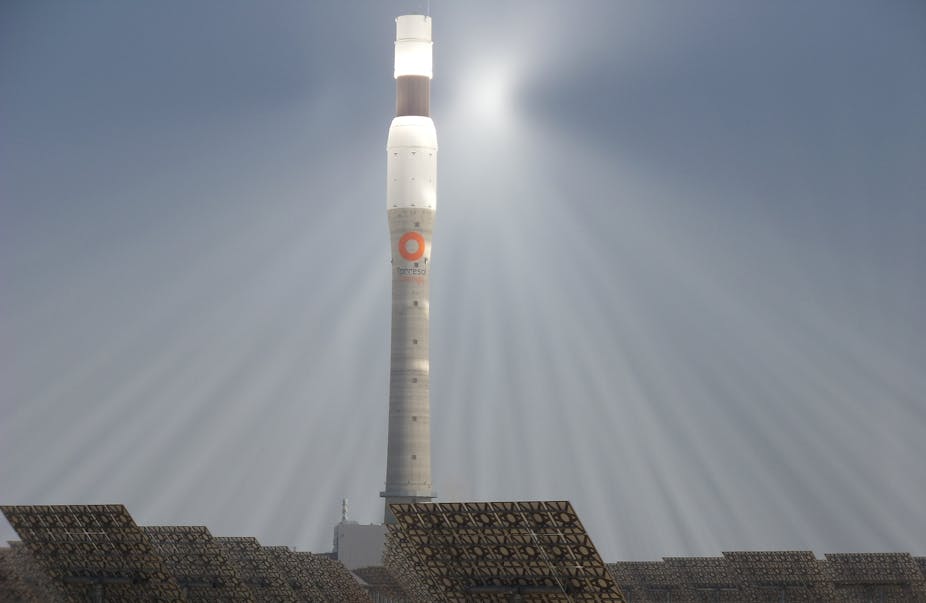
A cleaner, more efficient Australia will blend smart grids and meters with renewable power’s growing capacity. Pictured: Spain’s Gemasolar concentrated solar thermal power plant. Gemasolar

In part 13 of our multi-disciplinary Millennium Project series, Mark Diesendorf argues that it is high time we got smart about power: how we generate it and how we deliver it.

Global challenge 13: How can growing energy demands be met safely and efficiently?

The stated purpose of the Millennium Project, which has inspired State of the Future 2012, is “to improve humanity’s prospects for building a better future”. I interpret “better future” to mean an ecologically sustainable and socially just future. To achieve this, we must challenge the three drivers of unsustainable development on a finite planet – growth in population, growth in consumption per person, and inappropriate technology — and present a vision of a sustainable future.

Question 13 was posed by the Millennium Project in a global context. However, when applied to Australia and other rich countries, the assumption that energy demand should continue to grow must be challenged at the outset.

There is huge potential for increasing the efficiency of energy use through technological improvements (known as “energy efficiency”) and reducing the demand for energy services by fostering behavioural changes (known as “energy conservation”). These are the cheapest and fastest ways of cutting unnecessary energy demand. The key foci are buildings (including the appliances and equipment they contain) and industry.

Wising up electricity use: a smart meter. AAP/David Crosling

In the near future, a new tool will become widely available for monitoring and reducing electricity demand: the smart meter as a component of the “smart grid”. A smart meter can monitor a consumer’s electricity demand continuously and can display that demand in real time to both the consumer and the distant electricity utility. In a system where electricity price varies by time of day, a very smart meter could be programmed by the consumer to switch off certain circuits (e.g., air conditioning) temporarily when electricity prices reach a certain level. When there is a high peak in demand or a failure in part of the supply system, the utility could also remotely and temporarily turn off a customer or one or more of their appliances via the smart meter or other devices.

Energy supply may be classified into forms that are used as electricity, heating and transportation. At present about 80% of Australia’s electricity is generated by the combustion of coal, the majority of heat comes from burning gas and almost all transport is fuelled on oil (most of which imported at a huge cost). This combination, but especially the heavy coal use, has given Australia the unenviable record of the highest per capita greenhouse-gas emissions in the developed world.

Australia has huge renewable energy, especially solar, wind and hot rock geothermal. Even if we are limited initially to technologies that are currently commercially available, we could make the transition to a predominantly renewable energy system within two to three decades, if we could mobilise the political will. Scenarios for 80-100% renewable energy have been developed by government agencies, academics, and NGOs for the whole world, the European Union, Denmark, Germany, the Netherlands, United Kingdom, USA, Japan, New Zealand, Ireland and Australia. Some of these studies address the whole energy sector, while others focus on electricity. Denmark has a target of 100% renewable energy by 2050. This includes reaching 50% of electricity from wind by 2020, phasing out coal by 2030 and reaching 100% renewable electricity and heat by 2035.

In Australia, two groups have published computer simulations showing hour-by-hour how observed electricity demand in a given year could have been supplied entirely by renewable sources with the same reliability as the existing polluting system. The first study was a single scenario spanning 2008-2009 commissioned by the NGO Beyond Zero Emissions (BZE). A much more detailed examination – based on scores of hourly simulations of 2010 – was published in 2012 in the peer-reviewed journal Energy Policy (vol. 45, pp.606-613) by Ben Elliston, Mark Diesendorf and Iain MacGill from UNSW. In the UNSW scenarios, we removed several assumptions making the BZE simulation unnecessarily expensive while maintaining reliability at the current standard. In our model, electricity is generated predominantly from concentrated solar thermal (CST) power with thermal storage, solar photovoltaics (PV) and wind, with the flexible sources being biofuelled gas turbines, hydro, and smart demand management balancing supply and demand – in effect smoothing the fluctuations in wind and solar PV.

Both the BZE and UNSW studies refute the claims by vested interests and their unwitting proponents that renewable energy cannot replace base-load (24-hour) coal-fired power. BZE interprets its results by saying that CST with thermal storage is base-load. We interpret the simulation results differently, concluding that although CST can perform in a similar manner to base-load in summer, it cannot in winter. However, that doesn’t matter. In a predominantly renewable energy supply mix, the concept of “base-load power station” is redundant. The important result is that renewable energy mixes can give the same reliability of the whole generating system in meeting demand, as the existing polluting fossil-fuelled system. Similar results and conclusions were obtained for the USA by David Mills in a paper presented at the Solar 2011 conference.

It should be emphasised that neither the modelling of BZE nor UNSW establishes a timescale for the transition to 100% renewable electricity. However, the main body of the BZE report claims heroically that the transition could be made in a decade. That claim is actually an assumption based on the observations that Australia could supply the raw materials for manufacturing the systems and that solar and wind technologies are suitable for rapid manufacture. While these observations are valid, they don’t justify the notion of a very short timescale for the transition.

We must consider the time needed to undertake a huge training program for engineers (especially electric power engineers) and other essential professionals, the challenges of reversing the industry policies of many previous Australian governments that have decimated most of our manufacturing capacity, and the complex institutional reforms needed, such as changing the rules of the National Electricity Market. An entirely different kind of research project is needed to investigate possible transition timescales.

A renewable energy future will see internal combustion engines replaced by electric motors. AAP/Julian Smith

In most 100% renewable electricity scenarios, electricity is given a wider role than at present. It is envisaged that electric vehicles would replace most motor vehicles for urban use. Public transport, mostly electric, would be greatly expanded and improved, as would facilities for cycling and walking. A greater proportion of high temperature industrial heat would be supplied by renewable electricity and possibly from CST heat, which is not yet commercially available. Most low-temperature heating and cooling would be supplied by solar thermal energy and by geothermal heat pumps.

The principal barrier to the transition to a predominantly renewable energy system is the failure of governments of both major parties, both federal and state, to implement effective policies. The carbon price to take effect on 1 July will alert prospective investors in new dirty coal-fired power station that they would be taking a risk; however, its initial value of $23 per tonne of CO2 is too low to drive the necessary transition. It would be better to have a carbon tax that increases steadily up to at least $100 per tonne by 2030.

Until such a level is reached, a stronger Mandatory Renewable Energy Target is needed, at least 30% of demand in 2020 and at least 60% by 2030. Large-scale solar needs feed-in tariffs (FiTs), gradually decreasing to zero as the technologies mature. Small-scale solar, wind and hydro also need FiTs, initially equal to the retail prices of grid electricity and then decreasing steadily. Time-of-day pricing of electricity for all consumers would give a big boost to solar PV on residential and commercial buildings and would enable their FiTs to be phased out within a few years.

Other required policies include mandatory energy efficiency standards for all residential and commercial buildings and all energy-using appliances and equipment. Essential infrastructure is new transmission lines and railways. About $10 billion per year could be freed up to assist the transition by removing existing subsidies to the production and use of fossil fuels.

The job creation potential in energy auditing and in manufacturing and installing renewable energy and energy efficiency technologies is substantial. The current subsidies to the production of petrol-guzzling cars should be shifted to the sustainable energy technologies and to retraining auto-workers to build renewable energy hardware. Australia could manufacture components that are too large to import at low cost, such as wind turbine blades and mirrors for solar power stations.

We must finally discard the notion that Australia’s role in the global economy is restricted to that of a quarry for fossil fuels and minerals. Australia could be a manufacturer of sustainable energy systems and, in the long term, a major exporter of solar hydrogen to countries that are less blessed with renewable energy resources.

Comments welcome below.

Join the conversation

41 Comments sorted by

  1. David Poole

    logged in via Facebook

    Good article. Agree that we are more than a farm and a quarry. Perhaps the Roads Authoritiies in each State could be encouraged to look at solar power generation, as well as biomass fuel production on some of those very long roads in the outback. At least distribution costs to rural areas would be reduced. www.projectcoach.com.au , would be happy to help in re training, when it is required

    report
  2. William Bruce

    Artist

    "There is huge potential for increasing the efficiency of energy use through technological improvements (known as “energy efficiency”) and reducing the demand for energy services by fostering behavioural changes (known as “energy conservation”). These are the cheapest and fastest ways of cutting unnecessary energy demand."

    Well said.
    I think the Govt ought make a rule that any building Development Applications to upgrade the "Energy efficiency" of all buildings is FEE FREE.

    My smart meter makes it almost impossible to monitor electricity use in the various periods....one can see the total use but only in 30 min increments so it is hard to estimate power use.

    report
    1. Ken Fabian

      Mr

      In reply to William Bruce

      Smart meters need to go with connected smart appliances - without that they make planning efficient energy use more difficult instead of easier.

      report
    2. William Bruce

      Artist

      In reply to Ken Fabian

      Ken,

      Dont know what you mean by smart appliances....obviously one will aim to use min kilowatts in any period.

      It's just a matter of price per Kilowatt Hr in the 3 different price zones.

      Problem with my meter is I can only monitor TOTAL Kilowatt Hrs used in 30 Min increments....
      I can not see the usage in the 3 price bands until my quarterly bill ...Also very hard to see individual appliance usage and verify it is logging properly as it only logs in 30 min increments.

      I think ought be mandatory to show each price band use on meter.

      report
  3. Gerard Dean

    Managing Director

    Mr Diesendorf

    Your claim. "The principal barrier to the transition to a predominantly renewable energy system is the failure of governments of both major parties, both federal and state, to implement effective policies." appears reasonable on first reading, so why don't they just do it?

    Renewables supply about 5% of Australian energy with the bulk provided by hydro electricity which is maxed out - no more dams. Wind erratically supplies about 2%.

    So, what's coming onstream to replace the…

    Read more
    1. David Boxall

      logged in via Facebook

      In reply to Gerard Dean

      Gerard Dean: "... wind turbines only supply about 30% of their rated capacity ...".
      From http://b.qr.ae/LY8dQJ "Wind turbines are cost effective forms of generation achieving 35%-47% capacity factors today that take into account the variability of the wind in specific sites along with their efficiency. This is factored into the business cases for new generation. New turbines aimed at specific wind conditions are much more efficient at capturing the wind than older wind turbines.
      ...
      The wind…

      Read more
    2. Rob Crowther

      Architectural Draftsman

      In reply to Gerard Dean

      Well that confirms it. The author is an idiot and so are the people that reviewed his article that went into ‘Energy Policy’.

      May I suggest your considerable talents are clearly wasted. After sorting out the energy mess could you please go on an cure cancer.

      report
    3. Gerard Dean

      Managing Director

      In reply to David Boxall

      Mr Boxall

      I accept your demonstration that modern wind turbines may extract more power than the 30%, however this is the oft quoted % for existing wind farms in current operation. No doubt the efficiency of the latest wind turbines will be continuously improved which is a good thing.

      My contention about Mr Diesendorf's article is not that renewables won't or should not be used as power sources. Rather, that they are not ready to supply reliable base load power in the time frame he hopes for…

      Read more
    4. David Boxall

      logged in via Facebook

      In reply to Gerard Dean

      Gerard Dean: "I trust you agree ...".
      Gerard, you trust in vain. My attitude to the rest is the same. I just couldn't be bothered repeating myself.
      Judging by the counters, you're not convincing anyone else either.

      report
    5. Peter Lang

      Retired geologist and engineer

      In reply to Gerard Dean

      Good, succinct summary of the factual position.

      The voting on comments reveals the ideological persuasion of the comenters. And it shows how the commenters on this web site are not interested in facts; they just want comments that support their beliefs

      report
    6. Gerard Dean

      Managing Director

      In reply to David Boxall

      Mr Boxall

      I am somewhat saddened by your latest response. I acknowledged your point that efficiency improvements are being made by wind turbine manufacturers and thought we would have a robust discussion a factual basis. You have not in turn acknowledged the failures of both geothermal and wave energy thus far in Australia preferring to say "I just couldn't be bothered repeating myself" when you didn't say anything in the first place.

      Frustrations aside, I am not saying these technologies…

      Read more
    7. David Arthur

      n/a

      In reply to Peter Lang

      Ideological persuasion?

      No, it reveals where comment-markers sit on the spectrum of understanding of science.

      report
    8. William Bruce

      Artist

      In reply to Rob Crowther

      Re, Peter Lang & Gerard Dean's comments...
      Too right...And it is so obvious that it is astonishing that people whom one would presume are "educated" can be so dismissive... so many negative feedbacks? (Total of 40! Ha).....and Jeez, not much reason for them either.....It's actually so not funny it is funny...& so often they tend to like to play the man and not the ball too.....seems "Academic Vested Interests Meal Ticket syndrome" again?

      "Peter Lang
      Retired geologist and engineer (logged in via email @netspeed.com.au)
      Good, succinct summary of the factual position.

      The voting on comments reveals the ideological persuasion of the comenters. And it shows how the commenters on this web site are not interested in facts; they just want comments that support their beliefs"

      report
    9. David Boxall

      logged in via Facebook

      In reply to Gerard Dean

      Gerard, you'd be familiar with the term "signal to noise ratio". Showing how far from the mark your comments are in one aspect effectively established your credibility. The readers are bright enough to join the dots.
      Laboriously responding at length would achieve nothing but an increase in noise. I have too much respect for the readers to do that.
      If indeed you are a managing director, the revealed quality of your analyses bodes ill for your company's future

      report
    10. David Arthur

      n/a

      In reply to Gerard Dean

      Gerard, in dismissing solar panels as only having miniscule output, you are making a mistake characteristic of central planners.

      Central planners look at the aggregate requirement for the entire nation, and are staggered by the immensity of it all.

      Divide the issue by 22 million, however, and you start to see the human scale of the issue. Why would a home-owner bother to install solar panels, when it's the central planner who has to work out ways for the nation to meet its Kyoto targets…

      Read more
    11. Mark Harrigan

      Dr

      In reply to David Boxall

      Mr Boxhall - your comments do you no credit. They are playing the man not the ball.

      Whilst I may not agree with all of Gerard Dean's comments a close reading of them show them to be neither unreasonable or unsupportable. He raises real issues that have to be addressed if we are to solve the conundrum. That requires a willingness to address concerns with reasoned argument.

      Your dismissiveness does not progress the conversation, it impedes it.

      If we are serious about addressing the issue of CO2 emssions that requires us not to have wishful thinking about renewables bus a serious and engaged dialogue about both their positives and their shortcomings.

      Not simply dismissively deriding commebnts that reflect a different view from our own

      report
    12. David Boxall

      logged in via Facebook

      In reply to Mark Harrigan

      Mark Harrigan: "... playing the man not the ball ...".
      In this case, the man has shown a gross lack of care, which disrespects the readers. Were I an investor in his company, that lack of care would be a substantial concern. I've already provided some information demonstrating the magnitude of his folly. I feel that my contribution sufficiently progresses the conversation, as you put it. My hope is that Gerard will be motivated to put in a decent level of effort and further progress the conversation.
      I'm holding out to see what Gerard comes up with but, just to keep you amused, here's something on PV: http://www.pv-magazine.com/features/solar-superhero/

      report
    13. Mark Harrigan

      Dr

      In reply to David Boxall

      I would have to disagree.

      I invite any reader to read your first reply to Gerard - the facts speak for themelves.

      In your reply to Gerard you pointed to one area in which Gerard may mave undererpesented the capacity factor of Wind - a point to which he responded to fairly and acknowledged. The rest of your post was dismissive and slurs on his character and his company - none of which you know anything about. That part was totally unnecessary to your point and to the debate and is clearly…

      Read more
    14. David Boxall

      logged in via Facebook

      In reply to Mark Harrigan

      If anyone's still reading, it looks like I've been sucked in by a troll. Gerard Dean and Mark Harrigan are apparently two names for one person.
      Analysis of the first post shows that it was cobbled together from various sources, apparently in an effort to appear authoritative and more mature than its compiler actually is (eg. "... plant in Spain (pictured) ..."). The "Managing Director" and "Dr" serve similar purposes. The profile is of a male, probably less than 20 years old.
      Needless to say, I'll wast no more time here.

      report
    15. Mark Harrigan

      Dr

      In reply to David Boxall

      David - not content with sluring Mr Dean you now choose to slur me - and without any basis.

      I do not know Gerard - apart from his posts occasionally on TC. The fact that you feel able to make such unsubstantiated statements in defence of demonstrable personal attacks to which you cannot admit - merely because someone has a different view from your own says far about you as a person than any denigrating statements I might choose (but have not) made

      report
    16. Gerard Dean

      Managing Director

      In reply to Mark Harrigan

      Mr Boxall, I am not a troll nor am I Mr Harrigan. In fact I must thank Mr Harrigan for his spirited defence of me in the last few days over your name calling and refusal to stick to the facts during our discussions

      I do not know Mark, but he sounds like just the bloke to be next to in a trench on the Somme.

      Managing Director Issue. I am the founder and managing director of a high technology measurement company based in Melbourne. We design and manufacture measurement systems for can makers…

      Read more
  4. Bruce Waddell

    logged in via LinkedIn

    There is a whole lot of sense presented here. Isn't it weird that Denmark can be a leader in alternative energy when, as is pointed out, Australia has an abundance of natural resourses; sunshine, thermal hot rocks and tidal variation. To be investing in coal field gas extraction, or digging even bigger holes, is wasteful even with the limitations of current "new" generation. Why other that coal fired energy is considered new is also difficult to comprehend given these methods have been available…

    Read more
  5. Bruce Moon

    Bystander!

    Mark

    To understand the view you express above - and subject that view to critique - I suggest some of the basic assumptions you make warrant consideration.

    All too many years ago I earned myself an honours degree in environmental science. For several reasons, I did not join the 'green ideologues'. Since, I've learned that many seemingly intractable 'ecological' problems are often so because the viewer has a myopic approach to the subject.

    The topic today is "How can growing energy demands…

    Read more
    1. Bruce Moon

      Bystander!

      In reply to Bruce Moon

      Ahhhh...the ire of the ideologically converted...

      So many negative 'hits'.

      There can be no real move forward if there is not also reasoned debate. In the end, it is politics that moves the populace, not ideology (that merely flavours politics).

      Cheers

      report
  6. Bob Phelps

    ED

    I recommend a thought-provoking book, The Conundrum by David Owen, Scribe, 2012. It challenges us to consider how scientific innovation, increased efficiency and good intentions can make our energy and climate problems worse. Read particularly Chapter 17 about William Stanley Jevons' insight - that increasing efficiency and innovation cause overall consumption to rise, not fall. Chapter 34 struggles with resolving The Conundrum, that we are all responsible in all aspects of our lives for making the changes needed to turn around a global tragedy of the commons.

    report
    1. Stephen Prowse

      CEO at Wound CRC

      In reply to Bob Phelps

      I never though that I would see the day I agreed with Bob Phelps but what I think he is saying, and I agree, is that cheap renewable energy and greater energy efficiency may support increased consumption and will not necessarily lead to a more ecologically sustainable and socially just future. I do not think he is even implying that renewable energy is not desirable.

      report
    2. Bob Phelps

      ED

      In reply to Stephen Prowse

      Yes Stephen. Now the only effective signal to restrain rampant consumption is higher prices but a slower economy has social consequences that few people accept. Our challenge is to replace the social norms of consumerism with a universal ethic of genuine frugality, social justice and equity for everyone. If we all lived by these values, societies and the world would be transformed. How?

      report
    3. Bruce Waddell

      logged in via LinkedIn

      In reply to Bob Phelps

      Your last comment may have been your original intention. Whether or not it is, it is on the mark. One of the most innovative frugal societies is the example given by Cuba. We do need to reduce our consumption. Much of what is produced is simply excess to reasonable need. We do however need to move to renewable energy as well. There are handicaps to efficiency with renewables but industrial energy plants many have had their day. We would do better to produce and use energy locally. A national grid is an expensive luxury and since governments no longer seem to see supply as a government responsibility the "supply for profit model" suits best the supplier. I agree with the few last linked comments.

      report
    4. Byron Smith

      PhD candidate in Christian Ethics at University of Edinburgh

      In reply to Bob Phelps

      "There is huge potential for increasing the efficiency of energy use through technological improvements (known as “energy efficiency”) and reducing the demand for energy services by fostering behavioural changes (known as “energy conservation”). These are the cheapest and fastest ways of cutting unnecessary energy demand. The key foci are buildings (including the appliances and equipment they contain) and industry."

      While energy efficiency is subject to the Jevon's paradox, or rebound effect…

      Read more
    5. Gerard Dean

      Managing Director

      In reply to Bruce Waddell

      Mr Waddell.

      Are you talking about the same Cuba as the Cuba the rest of the world knows.

      Cuba is an economic basket case. It is corrupt, it is undemocratic, it is poverty stricken, there is no free press, there is no universal, uncensored internet access, there are secret police, the power system is hopeless and Cubans are desperate to escape to the big, bad USA.

      If you got your wish and the world economy collapsed to a Cuba like Nirvana, you are correct in that our energy usage would plummet…

      Read more
    6. Bruce Waddell

      logged in via LinkedIn

      In reply to Gerard Dean

      Yes. It is the same shameful Cuba. I wasn't promoting Cuba but in wonder at the Cuban people and speaking of their acceptance of their need of frugality in this mad world. Refer to Monty Don at http://www.youtube.com/watch?v=jRz34Dee7XY In support of Bob Phelps I repeat we do consume too much. Like all discussions this side track reminds me one shouldn't leave the reader to imply what is meant by a reference. In the same vein some of your comments might have been better said in response to Challenge 12 (justice) and 11 (women.

      report
    7. John Hartshorn

      retired - financial analyst

      In reply to Bob Phelps

      The increased consumption Jevons observed following technological improvements flows from reduced costs and/or increased utility, neither of which would apply in the 100% renewables scenario outlined here. To the contrary, as Peter explains above, costs will be substantially higher and flexibility of demand lessened to some extent due to necessary curtailment during periods of low output.

      None the less this, study is valuable as a lesson in the weaknesses of the 100% renewable option. In the…

      Read more
  7. Peter Lang

    Retired geologist and engineer

    What's the cost?

    Researchers at the Centre for Energy and Environmental Markets (CEEM), University of NSW, did a desk top study called “Simulations of Scenarios with 100% Renewable Electricity in the Australian National Electricity Market” (Elliston et al., 2011).

    The authors claim their study demonstrates that renewable energy could supply 100% of the Australian National Electricity Market’s electricity and meet the demand with acceptable reliability.

    However, they did not estimate the…

    Read more
    1. David Boxall

      logged in via Facebook

      In reply to Peter Lang

      Peter Lang: "... even with highly optimistic assumptions, renewable energy cannot realistically provide 100% of Australia’s electricity generation ..."
      I guess the only way to find out for sure is to do it.

      report
  8. Lincoln Fung

    Economist

    Why the author does not use and present simple numbers in terms of costs of each of the said renewable energies as compare to the current costs of electricity?
    Real figures should be powerful enough to convince the readers.

    report
  9. Tim Scanlon

    Author and Scientist

    Thankyou for the article Mark.

    I've looked at a number of reports in the last few years that have looked at renewables and how they could supply our power. Having seen several people go off the grid rather than pay the massive connection fees for new power poles, it is patently obvious that it can be done.

    I'd assume that with the price drops that have already come for renewables the move to them is an even better idea now?

    Also, I don't see any replacements for high torque combustion engines, especially for agricultural machinery, on the horizon. Are we going to need biodiesel or are there technologies that will replace the need?

    report
  10. Mark Harrigan

    Dr

    An interesting and useful article. But many shortcomings I felt.

    Bottom line - disappointed

    I suggest that while political will IS a barrier to progress, it is far from the only one. There are very real problems with ALL the options.

    Thus far renewables (exclusing hydro which cant expand much more) have not managed to supply significant quantities of reliable power for extended periods anywhere in the world - despite much government investment. They hold out much promise and are getting…

    Read more
    1. David Arthur

      n/a

      In reply to Mark Harrigan

      Mark's got a point: rather than push the arrow for any particular technology, would it not make more sense to simply impose a consumption tax on fossil fuel use, then steadily increase it until the requisite decrease in CO2 emissions is achieved?

      Assuming appropriate environmental safeguards (eg water demand), all other power technologies would then compete on the newly-formed level playing field.

      report
    2. William Bruce

      Artist

      In reply to David Arthur

      David says

      "...would it not make more sense to simply impose a consumption tax on fossil fuel use, then steadily increase it..."

      I think this is absolutely right....just start a very small tax on the bad things and very gradually increase it... also perhaps, create big tax incentives for good alternative things.
      Also, Govt could provide very cheap loans for good things (provided honesty!)

      Abbott more or less said "Why not a simple tax" at the onset. ...and so did I!

      report
    3. William Bruce

      Artist

      In reply to David Arthur

      Also, it ought be revenue neutral! Trouble is vested interests....Alcoa gets $53 Million today AND concurrently sacks everybody.....Jeez, this is mad!

      Both thums down to Julia I say!

      report
  11. Ian Lett

    Managing Director, Airskywind for business energy efficiency

    Thanks Mark for a clear and well researched picture of what 100% renewable energy would look like in Australia. As Mark has said, we must not accept that energy demand will inevitably rise in future. Reducing energy consumption through energy efficiency and conservation is the cheapest and quickest way to cut emissions and reduce costs. We know how to do it, can use current technology and the investment has payback periods of one to four years. It's no secret that power prices are going up, so the time to cut energy use is now. Or next Monday if you want an additional reason to act (the carbon tax).

    report