
Challenging stereotypes of Afghan women as the West withdraws

As the withdrawal of foreign troops nears, with a full withdrawal expected by the end of 2014, Afghanistan has re-emerged as a major issue in Australian politics. Those worried about Australian casualties will breathe a sigh of relief at the return of soldiers. Afghanistan, however, is facing an uncertain…

P52gqvvb-1360544340
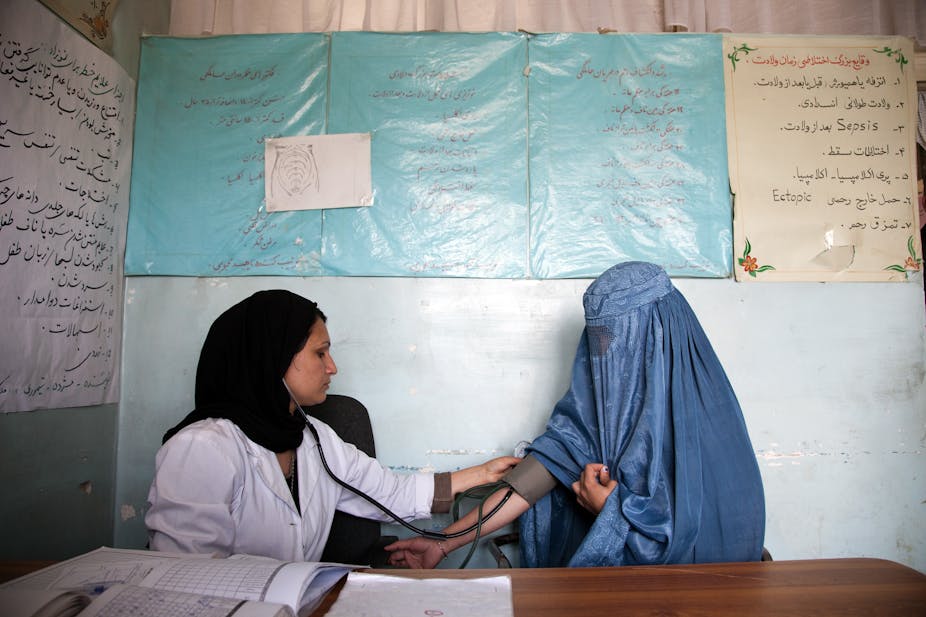
Under President Karzai women now can study, hold office and choose not to wear the burqua. Flickr/World Bank Photo Collection

As the withdrawal of foreign troops nears, with a full withdrawal expected by the end of 2014, Afghanistan has re-emerged as a major issue in Australian politics.

Those worried about Australian casualties will breathe a sigh of relief at the return of soldiers. Afghanistan, however, is facing an uncertain future post-withdrawal. President Karzai’s term is due to end in 2014 and a peace settlement with the Taliban looms.

This week, Australia will be hosting a delegation of ten Members of Parliament and Civil Society Leaders from Afghanistan, who are here to raise an issue that has so far lacked serious discussion in relation to post-withdrawal Afghanistan: women’s rights.

As much as President Karzai’s term has been shaky and subject to criticism, there have been some tentative gains made in women’s rights. Compared to the time of the Taliban regime, women in Afghanistan can now study, hold office and choose to go without the burqa. Preserving and building on these gains will be key to Afghanistan’s success in the short- and long-term, and it is vital that women’s rights are at the forefront of discussions about national security and development.

The status of women has had a consistent presence in discussions of Afghanistan since the 2001 US invasion, which was partially justified by citing the Taliban’s abuse of girls and women. More recently, cases of murder and serious abuse of women have made international headlines and constituted some of the most spectacular reporting on Afghanistan.

While the status of women is an issue worthy of significant deliberation, it is unfortunate that so many discussions lapse into cultural explanations. These are often Orientalist in orientation, and deeply connected to the notions of a “gender emancipated” West and a “misogynist, backward” East.

Kevin McCracken recently reported on the results of a survey taken of women in Afghanistan. He suggests an alarming 92% of women felt their husbands had the right to hit or beat them for various reasons. As he rightly points out, these results are particularly worrying, and suggest that the subordination of women has been naturalised into some people’s mindsets. Such results should serve as a word of caution for the long road to withdrawal ahead, which must not only take place in the public realm of politics but also the private realm of people’s minds.

We should be cautious about interpreting such results as a simply an outcome of “culture”. The ease with which such discussions have been taken up should serve as a warning for the way in which cultural explanations can obfuscate as much as they reveal.

A cultural argument risks eclipsing the efforts made by Afghans themselves to change societal mindsets and advocate for women’s rights. We know from other contexts and past experience that change must come from within.

In Afghanistan, there are a number of individuals and civil society organisations engaged in the important work of protecting and promoting women’s rights, perhaps most notably the Revolutionary Association of the Women of Afghanistan (RAWA).

The labelling of women’s subordination as cultural makes it sound inevitable – which it most certainly is not. Likewise, it ignores the serious efforts of Afghans, supported by countries like Australia, to combat these issues in their own society. The question is why the wife beater or child rapist should be seen as a representative of “culture”, and the pro-women’s rights activist as a “cultural anomaly”. To highlight and support the work of those seeking to make a change from within recognises that culture is always a site of struggle and contestation.

The delegation’s visit presents an opportunity for the Australian government to take seriously the issue of women’s rights and status in Afghanistan, during the transition and in post-conflict peace building. Globally, the role of women in peace building has been recognised through UN Security Council Resolution 1325.

With its temporary seat on the UN Security Council, Australia can play an even more important role in ensuring women’s rights are part of all discussions pertaining to Afghanistan’s future. Listening to those seeking to bring about change from within is an important interjection into the dominant framing that assumes violence against women is cultural.

Only then can we begin to take the question of women’s rights in Afghanistan as seriously as many Afghans.

Join the conversation

8 Comments sorted by

  1. Anthony Nolan

    Ruminant

    What a relief at last top read an article that cites RAWA as an exemplary civil organisation in Afghanistan. Readers unfamiliard with RAWA, its history and the ongoing courage of its members are urged to read the link. If Australia had put the same money into RAWA as has been wasted on its military policing operation then there would be a different outcome.

    report
    1. Mat Hardy

      Lecturer in Middle East Studies at Deakin University

      In reply to Anthony Nolan

      "If Australia had put the same money into RAWA as has been wasted on its military policing operation then there would be a different outcome"

      Or the money we have tipped into keeping a corrupt, nepotistic kleptocrat in power, with all his cronies and sham elections.

      report
  2. Karen Price

    GP, Chair of women in GP VIC, Juggler of domestic chaos

    Interesting thoughts Anthony and its great to see a womens rights civil organisation in this context. My concerns remain that Afghanistan is inextricably linked to "the War on Terror" and earth based resources.. Very political and $$ based.

    Womens rights linked very closely to the prosperity and stability of a country.

    Not mineral resources.

    Which "rights" will win? These are good questions to ask, raise and keep in the public domain.

    report
  3. Stephen John Ralph

    carer

    sometimes ladies, if it looks like a fish, and smells like a fish....voila

    perhaps not so much an emancipated west, but certainly a mysogynistic east in this case.

    are we so politically correct we ignore the elephant in the room..............so many islamic countries around the world treat women appallingly....not all obviously. and those that dont, often have a very paternalistic attitude that wants to protect women from this and that fro their own good.

    forget the scarves (altho these may be symptomatic), concentrate more on the mores and cultural attitudes.

    i am often struck by the complete lack of women in teev footage of markets and street scenes in some countries.

    report
  4. Dale Bloom

    Analyst

    There are men being heavily persecuted in Afghanistan and in other Middle East countries, and in fact more men are stoned to death than woman in Muslim countries.

    The problem is the religion, and while countries such as France have welcomed in such large numbers of Muslims that the population of France may become predominantly Muslim in a few decades, persecution of Christians has risen to such an extent, there may be few Christians left in the Middle East in the near future.

    Instead of Women’s Rights, how about a call for democracy, and the right to practice whatever religion someone wants, besides Islam.

    report
    1. Baz M

      Law graduate & politics/markets analyst

      In reply to Dale Bloom

      Woaw. What immense self righteousness. Ye sure there are radical elements in the Islamic world. More cults than anything Islamic really funded by Gulf oil money. You know the nations the West and specially US is in bed with. Oh as for the cliche simplistic argument of Christians vs Muslims, since that's the route you wish to pursue, perhaps ask what the f...k the US and other Western predominantly Christian nations are doing in the Middle East. Over a million civilians dead since the US "liberation of Iraq". Is this the democracy Muslims should want? Please. But all this is trivial and fed to the mainstream to justify Middle Eastern actions. Perhaps the real question of "enlightened Western democracy (specifically the US, and I hope to god never Australia, even if mining Gina is trying) is, who the hell wants a nation overdosed on capitalism extremism that comically still can't come down hard on the people who caused the last GFC.

      report
    2. Dale Bloom

      Analyst

      In reply to Baz M

      Make no mistake, there are quite a few Muslims who want every country to be Muslim, and if the country is Muslim, everyone in that country has to be Muslim. There is no choice.

      It is a difficult thing trying to achieve democracy at the point of a gun, but it was achieved in Germany and Japan.

      report
  5. Baz M

    Law graduate & politics/markets analyst

    Sensational article. Thank you for outlining that instead of sitting back with the cliche, "oh those backward Eastern world notions" notion. Thank you for highlighting the incredible organisations risking their lives every day for the most simplistic of woman's rights.

    In an ideal world the Taliban would be vaporised and so would their poisonous ideology but till than, I hope the wider strong Afghan people regardless of being Hazara Tajik etc can come together and move in a way that's forward while incorporating their incredible history. In which case would inevitably make the Taliban insignificant.

    report