
China’s economic miracle is close to fruition, but what now for workers?

China’s Communist Party has overseen an economic miracle over the past 20 years, but they are now facing the consequences of becoming the fastest growing economy on the planet. With China’s GDP now standing at US$7.3 trillion, which is five times more than 10 years ago, it is now hot on the heels of…

X7bcwwcb-1353629763
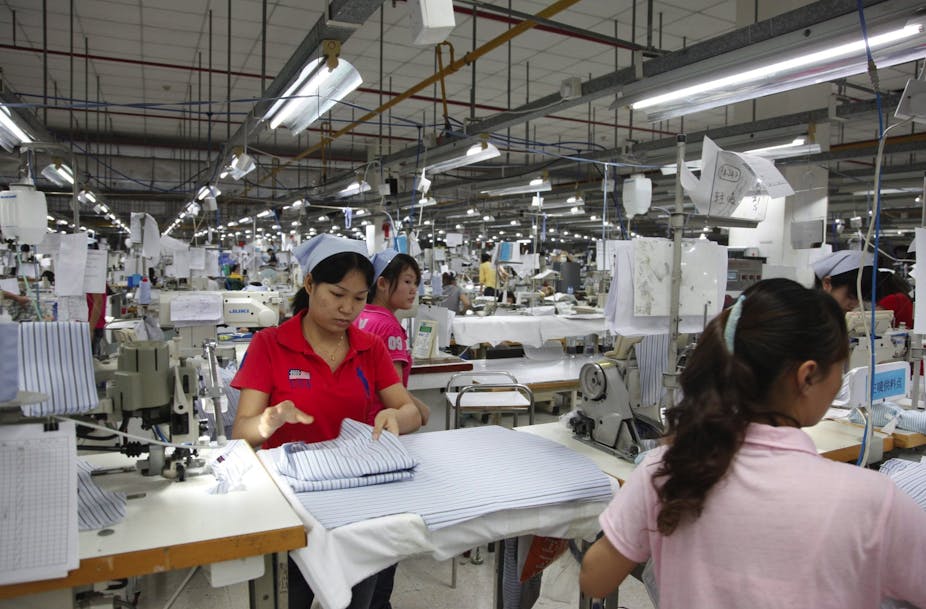
China’s economic miracle will see it become the world’s greatest financial power; but it critical for the country’s new leaders to ensure its workers aren’t left behind. AAP

China’s Communist Party has overseen an economic miracle over the past 20 years, but they are now facing the consequences of becoming the fastest growing economy on the planet.

With China’s GDP now standing at US$7.3 trillion, which is five times more than 10 years ago, it is now hot on the heels of the US. Just a decade ago it was sixth behind not only the US, but Japan, Germany, the UK and France. A recent McKinsey report predicted that China will overtake the US in the 2020s. But what happens then?

The drive to be the biggest economic power in the world has been a unifying power for the people of China, who have had to cope with the rapid urbanisation and a growing poverty gap, between the haves and the have-nots.

Only 20 years ago the majority of the country was on the same wage, but raising living standards and promoting competition between the State Enterprises has left some behind. If China is to continue its astonishing growth it needs to take care of these people, it needs a proper social welfare system, one that includes a proper pension and healthcare.

The new leadership urgently needs to eradicate corruption as well, or it will face social unrest, something may be exacerbated by the increasing poverty gap.

While the Chinese Communist Party created an economic miracle, they also destroyed old safety nets provided under the planned economy. When the economy was growing at double digit, the problem was not as acute as when the economy is slowing down as it is now. The new leaders now have to face up to these problems, which the old leaders managed to avoid.

The Government has to re-focus its workforce. It no longer has cheap labour and the new middle class are demanding high quality goods and if China is not careful that vacuum will be filled by foreign exports.

The Government needs to start a new round of policy reforms ranging from fiscal, monetary to industrial restructuring to stimulate domestic private consumption. It also needs to shift its focus to high value added and knowledge intensive industries.

For example, the government has recently raised the threshold of personal income tax to increase disposable income among China’s middle and lower income groups and has set an inflation rate of four per cent for this year.

China has always had to be innovative because they do not have many natural resources, unlike the USA where they are blessed with so many. China has to come up with creative answers to solve the social and economic problems the country is facing.

As long as living standards continue to rise for its people the Communist Party will continue to keep favour with the people. The western world is slightly naïve in thinking China’s political reforms have not been done properly and made only very small steps, but actually they have made a huge amount of policy reforms.

If the Government policy was rigid the economy would have run out of steam and the one-party system means they can be very responsive and introduce reforms quickly. Any policies that are not good they quickly change them.

China needs to show how quickly it can move to keep its economic boom going and keep its people on side by continuously improve their standard of living.

Sign in to Favourite

Want to follow The Conversation?

Sign up to our free newsletter to get the day's top stories in your inbox each morning, with a special wrap on Saturday.

Spinner
Become a friend of The Conversation and donate

Join the conversation

7 Comments sorted by

  1. Richard Koser

    Dude

    Uh, I'm not an economist but I can do simple maffs. If China's economy had expanded 400% in ten years, thats an average annual growth rate of nearly 19%. I know China's economic numbers are as rubbery as a Monty Python chicken, but surely this is a bit high? According to the World Bank, the best China managed (2007) was 14.2%, which is still staggering. I spent a minute with a calculator and the numbers from http://data.worldbank.org and came up with a 10-year growth rate (ten years being 2002-2011) of about 173% (ie the economy at 1 Jan 1012 was about 273% the size it was 10 years earlier). Can we square this circle?

    report
    1. Lincoln Fung

      Economist

      In reply to Richard Koser

      Richard, the 400% is nominal in $US dollars and consists three parts:
      1. the real growth, average at about 10%
      2. an Chinese domestic inflation: at X%
      3. a Chinese currency appreciation: at X%
      It isn't the rubbery of China's economic numbers, as opposed to a proper understanding of their menaing.

      report
    2. Richard Koser

      Dude

      In reply to Richard Koser

      Thanks Lincoln (see below), that does explain the anomaly. Confusing though. Is it fair to measure any country's economy based on any other single currency? If Australia's economic numbers were expresed in USD, we would have been in a major recession in 2008/9, when the AUD went from around 0.98USD to 0.62 in six months, and our GDP growth would have been above 10% in the three years following that, as the exchange bounced back to above parity. Anyway, as I said I'm not an economist, so I'm signing off.

      report
    3. Lincoln Fung

      Economist

      In reply to Richard Koser

      Richard, No, nominal growth generally should not be used to indicate growth and you are right on that. The issue Qing presents is the relative international comparison, so she used $US. It is confusing to readers, though she may want to show readers how big the Chinese economy is now.

      report
  2. Lincoln Fung

    Economist

    What now for workers?
    While the Chinese government must pay attention to increasing income inequality, the problem of inequality should not be exaggerated because the changes in the economic structure including the change in labour supply will generate an autonomous equaliser in terms of income distribution.
    Many people have argued that income inequality has increased in China. Few, however, has realised it was not the effect of deliberate Chinese government policy as opposed to market forces.
    As the labour market changes, wage will rise more rapidly and its share in the economy will rise accordingly. That will be the main means of reducing inequality and narrowing the gap of income distribution.
    Many economists, Chinese or otherwise, have called for more economic reforms to give ways to market. But they are superficial and have failed to understand the stages of economic developments and the changing economic stories along its path.
    It is irony, isn't it?

    report
  3. Dale Bloom

    Analyst

    There obviously needs to be a better way to measure the actual progress of a country (or its backward decline).

    China does not fare well on the Human Development Index (HDI), at 89. On the Happy Planet index (HPI) it ranks 60, which is actually ahead on Australia at 76.

    The Genuine Progress Index (GPI) seems an interesting index, but most attention in the past has been given to the US and worldwide figures, and those figures do not show much improvement since the 1960’s.

    In effect, countries such as the US have actually made no forward gains for nearly 50 years.

    http://www.wikiprogress.org/index.php/The_Genuine_Progress_Index

    It would be interesting to know if China has actually improved in the GPI.

    report