Today, an Australian parliamentary committee grilled the IT titans – Apple, Adobe, and Microsoft – on price discrimination against Australian consumers. The IT companies were evasive under questioning.
The House of Representatives Committee on Infrastructure and Communications issued a summons to Apple, Adobe, and Microsoft to appear before the Parliament.
The Committee is investigating the impacts of prices charged to Australian consumers for IT products. The Committee has been examining claims by consumer advocates CHOICE Australia and the Australian Communications Consumer Action Network that Australian consumers have been the victims of price gouging.
The inquiry into IT pricing has grown into a larger public debate about copyright law, consumer rights, and competition in the digital economy. Harrison Polites has observed that the Labor member for Chifley, Ed Husic, has transformed the inquiry into “a debate in microeconomics that has significant implications for Australia’s national economy”.
Apple’s cloak of invisibility
Husic has said that Apple has sought to hide under “a cloak of invisibility” in a number of Australian policy debates.
With some reluctance, Apple’s written submission was published. At the IT pricing inquiry, Apple Australia vice-president Tony King blamed copyright rights-holders for price discrimination in Australia. However, the relationship between Apple and copyright owners has been competitive — and sometimes collusive.
Apple has been under investigation for its collaboration with publishers on setting e-book prices both in the United States and the European Union. Tim Cook, the chief executive of Apple, has been ordered to testify in the United States case.
One has to wonder whether Apple has sought to collaborate with copyright owners in price-setting in Australia.
CHOICE Australia has observed disparities in pricing on iTunes between Australia and the United States. Rihanna’s latest album Unapologetic costs A$22.99 in the Australian iTunes store, but only $15.99 in the United States. Australian fans of the Boss, Bruce Springsteen– such as the Treasurer Wayne Swan – would pay $AU16.99 for his Greatest Hits on iTunes, whereas purchasers Born in the USA would only pay $US11.99. Matthew Levey from CHOICE Australia wondered: “Why is it costing Australians 70% more to rock out to AC/DC’s Back in Black on iTunes?” Parliamentarian Paul Neville was particularly aggrieved about the high cost of the works of Led Zeppelin on Australia’s iTunes.
Stephen Jones MP raised questions about whether Apple was a dominant market power in the IT field, much like Woolworths in agriculture. King denied that Apple was like Woolworths. He suggested that Apple was comparable to JB Hi-Fi, much to the scepticism of the committee.
Adobe’s acrobatics
In contrast to Apple, Adobe sought to deflect criticism of its pricing in the Australian policy debate.
Adobe’s managing director Paul Robson appeared before the committee, and failed to justify why Australian consumers paid higher prices for software. At one point, he suggested Australians could fly to the United States, if they wanted cheaper prices of boxed Adobe products.
Elsewhere, Adobe’s chief executive, Shantanu Narayen, has defended the software prices in Australia. He has maintained: “You always have to look at different pricing in different regions and we do the research just like other companies … We look at the appropriate pricing and the value associated with products everywhere.”
Under pressure, Adobe announced that it would cut its Australian prices in respect of cloud-based software services the Creative Cloud.
However, Adobe has come under attack for making token concessions in the IT Pricing debate. Such statements have been seen as a public relations smokescreen.
CHOICE Australia CEO Alan Kirkland said: “If Adobe was genuine about treating consumers fairly, it would have reduced prices across all of its products.”
Adobe has been reliant upon technological protection measures, digital locks, and geoblocking. Husic suggested that Adobe took a medieval approach to IT pricing, with “regional fiefdoms”. Stephen Jones MP commented that Adobe “digitally handcuffed” its consumers.
Adobe threatened that if geoblocking was prohibited in Australia, it would reconsider its willingness to invest in local IT.
The Microsoft monopoly
The United States multinational software company Microsoft – founded by Bill Gates and Paul Allen – made a written submission to the inquiry. Microsoft’s Pip Marlow appeared before the inquiry.
CHOICE Australia has been damning about prices charged by Microsoftin Australia compared to the United States: “Software is another product that is broadly the same regardless of where it is sold, yet still attracts price differentials.” Microsoft’s Office Professional 2013 software package costs A$599 to download in Australia, but merely $399.99 at the United States Web store.
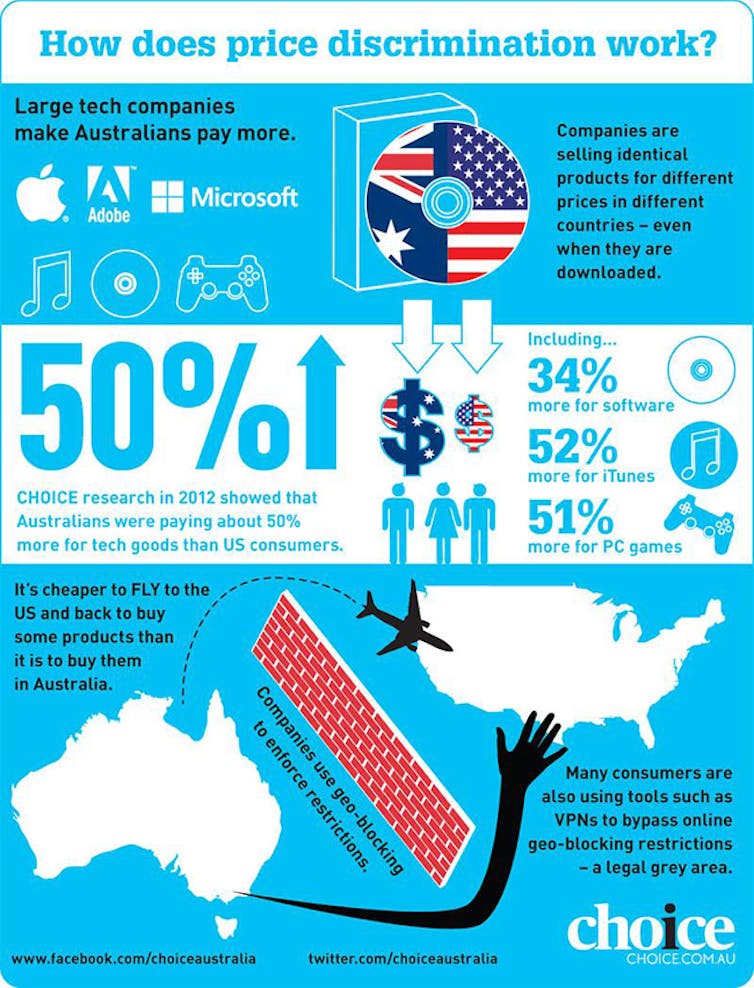
Microsoft has been unapologetic about its price discrimination in relation to its services. The company maintains that “the costs of providing the services – including establishing, maintaining, supporting and advertising the services – needs to be recovered and a profit from those operations derived, in order to contribute to the overall return on the company’s investment”.
Microsoft has long been an intellectual property maximalist, both in terms of litigation and policy debates. Along with Adobe, Microsoft is currently suing a Dubbo radio station for copyright infringement, with the accusatory rhetoric of “software piracy”.
Law reform
Given the great public interest in the inquiry into IT pricing, it will be striking to see whether the Committee will respond to proposed legislative action to address geo-pricing and geo-blocking.
The inquiry has highlighted the need for copyright law reform to protect the interests of consumers. In the wake of the March 2013 case of Kirtsaeng vs John Wiley & Sons, there is a need to reconsider Australia’s ancient parallel importation restrictions.
Similarly, there is a need to revise the copyright laws regarding digital locks – technological protection measures. Digital locks have had many unintended consequences– including jeopardizing consumer rights, chilling free expression and scientific research, and impeding innovation and competition. The author Cory Doctorow has been an eloquent critic of digital locks:
In a piece for Wired, Kyle Wiens wrote that there was a need for real copyright law reform to unlock content. “Copyright is impacting more people than ever before because the line between hardware and software, physical and digital has blurred … once we buy an object — any object — we should own it.”
The Australian Competition and Consumer Commission (ACCC) has been impressive during the debate over IT pricing in Australia.
The chairman of the ACCC, Rod Sims, has observed that his agency will take action if there is evidence of violations of Australian consumer law or competition law. He has observed: “If we can find one where we think the representation made looks to be significantly divorced from reality and we think it’s one of general use, then we’ll certainly take action".
However, some of the government departments and agencies seemed somewhat apathetic about the topic of IT pricing, and lacking initiative in formulating policy responses – which is disappointing, given the great public interest in the subject.
Ultimately, the inquiry into IT Pricing will be judged by the efficacy of its outcomes – whether they have an instrumental impact in lowering the prices of copyright works in Australia.
International trade
The inquiry into IT pricing, and the interrogation of Apple, Adobe, and Microsoft, has generated much domestic and international interest.
There has been much interest in New Zealand as to whether there should be a similar inquiry into IT pricing. Northwestern University law students from Chicago have flown from the United States to follow the inquiry. International press agencies – like Bloomberg and the BBC – have sought to cover the public grilling of the IT titans.
The inquiry has also raised questions as to the impact of the Trans-Pacific Partnership upon consumer rights. The United States Trade Representative’s controversial proposed ban on parallel importation in that agreement runs counter to both recent United States precedent, and the Australian inquiry into IT pricing.
George Michaelson
Person
I would have loved to see the same companies grilled over transfer pricing. I may be out on a limb here, but I can't help wondering if the complaint about localized cost of support and sales equates to where they declare the income they are earning.
As regards digitally downloaded IPR like s/w, its a complete phurphy. We didn't ask to be taken to http://mumble/au to buy, we would have quite happily bought direct from http://mumble/us even in $USD, and paid the horrendous visa card rate: we'd still be ahead.
The ironies of the AUD/USD rate being in our favour ...
Matthew Rimmer
ARC Future Fellow and Associate Professor in Intellectual Property at Australian National University
Thank you for your contribution, George. There was some discussion about transfer pricing in the committee hearing. Once the transcript is out, I will link to the parts where that was discussed.
Matthew Rimmer
ARC Future Fellow and Associate Professor in Intellectual Property at Australian National University
Some exchanges on the transfer price:
Mr HUSIC: What I am asking is: is it, in effect, a fluid negotiation where you work out with the US parent what the price will be, or does the US parent basically set the price and you import at, effectively, the transfer price?
Mr King : Certainly at a global level we are setting consistent product costs for internal use around the world. Those are a function of a number of different things, but I am not privy to the underlying details within the product…
Read moreGeorge Michaelson
Person
nothing about the tax implications of their transfer pricing model. so, one suspects that for tax minimization, the income is declared against a non-resident company, which leases the right to sell and buy domestically to the declared australian entity.
they can then claim ASTRONOMICAL costs of local operation against staff, GST and other costs, for low profit, because the local agency is passing the entire profit out to the external non-tax paying owner.
yet, they price higher in australia. Its like a double whammy.
Gavin Moodie
logged in via LinkedIn
I agree that it is outrageous to charge more in Australia than in the US.
The US Supreme Court has recently decided an interesting case of reverse price discrimination. US owners of copyright publish their works in developing countries at substantially lower prices than in the US. Supap Kirtsaeng bought cheap textbooks published by Wiley in a developing country and resold them in the US at lower prices than Wiley sells them in the US. The US Supreme Court overturned decisions of lower courts…
Read moreMatthew Rimmer
ARC Future Fellow and Associate Professor in Intellectual Property at Australian National University
To give the Committee credit, there was quite a significant amount of discussion about the case of Kirtsaeng v John Wiley & Sons. The Parliamentarians were interested in Breyer J's argument that the role of copyright law is to promote the larger public interest in the progress of science and the useful arts; it is not to allow copyright owners to engage market divisions and price discrimination:
"The Constitution describes the nature of American copyright law by providing Congress with the power…
Read moreMatthew Rimmer
ARC Future Fellow and Associate Professor in Intellectual Property at Australian National University
The authors of the Knockoff Economy, Kal Raustiala and Christopher Sprigman, have a thoughtful commentary on the case on Freakonomics http://www.freakonomics.com/2013/03/22/a-brave-new-world-for-copyright-and-the-first-sale-doctrine/ The pair note: "At one level this was a narrow case of statutory interpretation. Yet it also has big implications for ordinary people, as well as the future of media distribution in an increasingly globalized and wired world."
The pair have a particularly interesting…
Read moreMatthew Rimmer
ARC Future Fellow and Associate Professor in Intellectual Property at Australian National University
Mr NEVILLE: Are you familiar with the recent ruling by the US Supreme Court on 19 March regarding copyright... In that decision on Kirtsaeng v. John Wiley & Sons, Inc.the court found that, when you purchase a copyrighted product, that copyright does not prevent the resale of that product to someone else and that the copyright owner cannot exercise his copyright to the second and subsequent person. There is an interesting parallel there, isn't there, that, if I buy an Adobe product in Canada, the…
Read moreTrevor S
Jack of all Trades
Since when is it a right to be able to purchase cheap software ?
See that large brick wall in the Choice Facebook graphic ? That's there because Government allow it. If you're looking to apportion blame, Government are the most culpable. Ostensibly they serve "the people", a job they are not doing thus the Government sanctioned brick wall The Corporations serve the shareholders, a job they are doing. Everything else is rhetoric.
The other stone the Government is responsible for not turning…
Read moreMatthew Rimmer
ARC Future Fellow and Associate Professor in Intellectual Property at Australian National University
There was much discussion about whether Microsoft was a dominant player in the marketplace.
One of the politicians suggested that Microsoft's high prices were a tax on small businesses in Australia. He maintained that small businesses had little choice in terms of products.
Microsoft argued that it operated in a highly competitive marketplace. It pointed to free software and open source software as competition (much as it did in the United States, when it came under scrutiny under antitrust allegations).
There was also a lot of discussion as to whether Microsoft was moving to cloud computing, because of consumer resistance to its prices for software.
Matthew Rimmer
ARC Future Fellow and Associate Professor in Intellectual Property at Australian National University
When I appeared before the committee last year, I discussed parallel importation: http://works.bepress.com/matthew_rimmer/121/ It is a very longstanding debate in Australia. Reform has been slow, uneven, and piecemeal. I agree that there is a lack of consistency and uniformity in the treatment of parallel importation in Australian copyright law. I submitted that there is a need to repeal all the remaining parallel importation restrictions under Australian copyright law.
Henry Verberne
Former IT Professional
And then they complain about piracy! Vote with your IP address so that it does not appear to come from Australia as hell may freeze over before much changes.
They charge what they think they can get away with.
Matthew Rimmer
ARC Future Fellow and Associate Professor in Intellectual Property at Australian National University
Good point, Henry. Microsoft and Adobe have defended their high IT pricing in Australia in policy debates; but they have also been willing to take copyright action in respect of unauthorised use of their copyright works. In my piece, I note that Microsoft and Adobe have recently brought action in the Federal Court of Australia, complaining that a radio station has engaged in copyright infringement: http://m.smh.com.au/it-pro/business-it/tech-giants-sue-australian-radio-stations-over-alleged-software-piracy-20130313-2fzbf.html The name of the case is Adobe Systems Inc & Ors v Western Broadcasters Pty Ltd & Ors (2013) https://www.comcourts.gov.au/file/Federal/P/NSD404/2013/actions
Matthew Rimmer
ARC Future Fellow and Associate Professor in Intellectual Property at Australian National University
The chair of the committee Nick Champion MP posed some particularly thoughtful comments during the inquiry. He asked: In an age of the global consumer, are market divisions justified? He posed the question later on as: For global consumers, is market segmentation and geoblocking ethically and economically justified? This may indicate an important context for the inquiry's deliberations in respect of law reform options.
Matthew Rimmer
ARC Future Fellow and Associate Professor in Intellectual Property at Australian National University
Nick Champion MP provided a good preview of the Committee hearing on the Business on the 21 March 2013: http://www.abc.net.au/iview/#/program/31792
Lateline - with Karen Tan and Emma Alberici - provided an excellent round-up of the Committee hearing on the 22 March 2013: http://www.abc.net.au/lateline/content/2013/s3722152.htm
Matthew Rimmer
ARC Future Fellow and Associate Professor in Intellectual Property at Australian National University
A day after the inquiry, CHOICE Australia has emphasized the need for Australian consumers to be able to circumvent geoblocking in order to buy cheap software:
http://www.abc.net.au/news/2013-03-23/circumvent-geo-block-to-buy-cheap-software-choice/4590210
Matthew Rimmer
ARC Future Fellow and Associate Professor in Intellectual Property at Australian National University
News Exchange on the ABC News TV have provided some video coverage of the hearing into IT pricing, with some accompanying commentary: http://www.abc.net.au/news/2013-03-22/news-exchange-friday-march-22/4589848
Matthew Rimmer
ARC Future Fellow and Associate Professor in Intellectual Property at Australian National University
Worth mentioning some comparative competition law on Microsoft as well. In the European Union, this month, Microsoft was fined $A712 million for breaking a settlement under competition law to offer personal computer users a choice of internet browsers when they install the Windows operating system: http://www.theaustralian.com.au/australian-it/european-union-slaps-microsoft-with-a-712million-fine/story-e6frgakx-1226592096530
John C Smith
Auditor
Time to stand up to economic imperialism. What about car prices? The sea and air prices are very low and is no longer an excuse to say we are a small market and is far away from the source.
Adam Richards
Teacher
I have a couple of questions.
1) Apart from Australia and New Zealand how many other countries are paying much higher prices?
2) Are we in effect helping subsidise the cost of IT products in North America and Europe and presumably Asia?
Please try and follow my logic, hopefully I am coherent, but I am currently sitting at home with the flu, high on various medications that I need to show my ID before purchasing.
- Through our paying much more than necessary we are helping make the costs…
Read moreMeg Thornton
Dilletante
It came to me yesterday that one of the tricks these companies may be using to price their software (particularly with some of the arguments they're using about labour costs here in Australia and the cost of office space and such) is they're charging Australian consumers an amount equivalent to what the software would cost were it created here in Australia.
This would be fine, if there were actually flourishing Australian divisions of these companies employing coders and contributing to a growing…
Read morePaul Regis
Business Analyst
This is all very well meant, but it touches on a larger issue because Australia is more expensive than rest of world in so many aspects. An elephant in the room that we all choose to ignore.
These companies are joining in with what everyone else is already up to. Australia seems to happily pay more for the same old stuff, so this kind of outcome does not surprise me one bit. Ok, so the products may be housed on a server in a foreign land and not contributing to “Australian jobs” or “Australian…
Read moreMatthew Rimmer
ARC Future Fellow and Associate Professor in Intellectual Property at Australian National University
Allie Coyne reports that the Department of Foreign Affairs and Trade is raising the issue of IT pricing in discussions over the Trans-Pacific Partnership. The Department spokesperson observed:
“We have made it clear that this is an issue of some importance to Australia. Competition plays an important role in increasing choice, not just for consumers but also for SMEs in e-commerce. This is a new and complex issue for a trade agreement, dealing with intellectual property law, contract law, competition law and trade law.”
http://www.itnews.com.au/News/337485,dfat-pulls-trade-allies-into-it-price-discussion.aspx
Delete this account as requested!
logged in via email @iinet.net.au
Why does his response loo like an excuse already being formulated for a lack of positive action and the Department's eventual caving in to US interests?
The problem doesn't seem to be the politicians for a change, rather it appears to be the bizarre agenda of the Public Service.
Perhaps they need to call the department secretary in front of this inquiry so the can explain their intentions?
Matthew Rimmer
ARC Future Fellow and Associate Professor in Intellectual Property at Australian National University
Delimiter have published the open statement by Tony King of Apple to the inquiry: http://delimiter.com.au/2013/03/25/apples-longest-statement-about-australia-ever/ The statement about copyright owners is worth reproducing:
"Apple must pay the rights holders of the digital content—the record labels, movie studios and TV networks—to distribute content in each of the territories in which the iTunes store exists. The pricing of this digital content is based on the wholesale prices which are set through…
Read moreGavin Moodie
logged in via LinkedIn
Matthew, thanx for this and your other updates, which I greatly appreciate.
The statement from Apple's Tony King you quote does not acknowledge that part of Apple's margin is allocated to profit. Neither does it say whether the margin allocated to profit is higher in Australia than in the US, or indeed lower in developing countries.
Matthew Rimmer
ARC Future Fellow and Associate Professor in Intellectual Property at Australian National University
Ed Husic MP has commented that the committee will hold a public hearing next with local arms of international record companies - http://www.itnews.com.au/News/337660,record-labels-to-front-it-price-inquiry.aspx
Matthew Rimmer
ARC Future Fellow and Associate Professor in Intellectual Property at Australian National University
Here is the full transcript of the Australian Parliamentary inquiry into IT pricing and its public hearing featuring Apple, Adobe, and Microsoft:
http://parlinfo.aph.gov.au/parlInfo/search/display/display.w3p;query=Id%3A%22committees%2Fcommrep%2Fc0c8b366-5cc2-4eb5-acf8-f6b8725d07a9%2F0000%22
Theo Pertsinidis
Theo Pertsinidis is a Friend of The Conversation.
ALP voter
The father... the son... the holy spirit.
When I read these type of stories my reinforced view is... Jesus is a Labor voter unionist.
Travelled the earth with his policy and got beat by the rich Liberal voting media.
Matthew Rimmer
ARC Future Fellow and Associate Professor in Intellectual Property at Australian National University
Interestingly, the IT Pricing Committee has been quite bipartisan. The Coalition has been as interested in the issue as the ALP. No Greens or Independents on the Committee.