
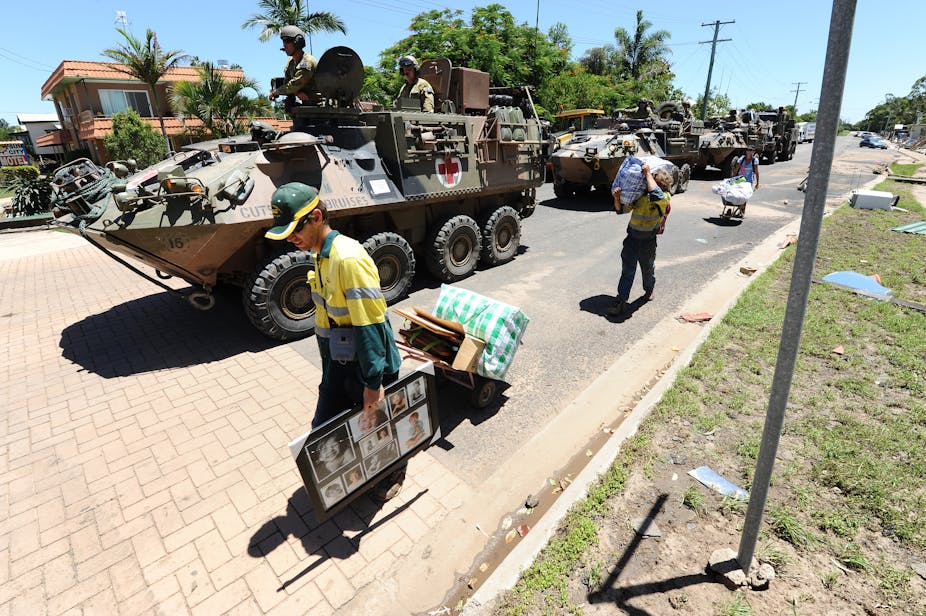
Following several years of devastation in Queensland, the state’s premier believes it’s time to “flood and disaster proof” as many towns and communities as possible. In Mr Newman’s words: “We can’t accept that’s how life has to be lived.” But climate change throws us into a world where the unacceptable may become unavoidable. So where do you start?
Research at the National Climate Change Adaptation Research Facility (NCCARF) is considering how to reduce the negative impacts of climate. In research parlance, this is known as adaptation. We have looked at past natural hazards and their disastrous outcomes to consider lessons for future adaptation.
A holistic and pragmatic approach
History does repeat. Even where there are adaptations to reduce disaster impacts, subsequent disasters can bring new challenges. Charleville, for example, is protected from river floods by a levee but in 2008 flash flooding from the town’s gully was not prevented by the levee.
Adaptation planning must consider all risks. There is no point taking an action to reduce the impact of one disaster type, if it exposes a community to worsened impacts of another. How does a house built to withstand high wind speeds behave in a heatwave or a fire, for example? So reducing disaster impacts (adaptation) is a complex decision-making process.
It may also call for several solutions – plus ongoing review and tweaking as new knowledge arises or circumstances change. Consider the Mississippi River in the US. Ongoing floodplain development has meant regular disastrous flood events. Each time these are responded to with higher and more levees, which are then over-topped or breached in the next floods.
With repeated disasters, significant investment and on-going financial loss, new approaches may be needed and some communities and governments may eventually have to face the reality that the risk is too high and relocation may be the only viable option.
Adaptations after disasters may include social change (such as preparation, planning and information) and hard solutions (such as infrastructure change, sea walls). Much of Australia’s current disaster management philosophy has a strong emphasis on building resilience long before a natural hazard occurs. We like to ensure communities are aware of risks and prepared to respond (see, for example, bushfire plans).
Cost-benefit-risk
Adaptation is costly, but the long-term costs of failing to adapt (such as on-going flood damage) may out-weigh these costs and vice versa. The Netherlands invested €9 billion in building flood defences to avoid a 1-in-10,000-year event following the deadly 1956 storm-surge. They are presently exploring far-future sea-level rise (up to 5m) at a cost of over €80 billion.
The government took a pragmatic approach to building a business case for adaptation investment. What price to prevent a repeat tragedy? For any government contemplating adapting to natural disasters there should always be an exercise in comparing acceptable risk and cost.
For Queensland, the cost of the flood disasters to government coffers since 2011 is in the order of $15 billion. If we are unwilling to face the same risk again, what will adaptation cost and how does it compare to the damage bill?
Consider a proposed flood levee for Roma costed at $20 million. Compared to an estimated $10 million spent on helicopter rescues alone during the 2011 floods – the argument to invest seems compelling. But the initial capital outlay in a time of fiscal restraint and conservancy will take an incredible amount of political (and public) will for an unquantifiable future risk. The acceptable risk threshold will have to be balanced against the willingness to bear costs.
If adaptation planning happens now, then disasters can be an opportunity to implement them. The Queensland Reconstruction Authority, overseeing the 2011 floods and cyclone recovery, undertook to “build back better”. Reconstruction was to current engineering standards as a minimum (which in some cases improved structural resilience), and where it “made sense” improvement of the rebuilt structure. There is considerable room to expand this policy.
Success and pitfalls
Adaptation following a disaster can be highly successful. After Cyclone Tracy, a methodical effort ensured houses are now designed to withstand the worst events rather than day-to-day weather. Houses built to these standards have proved much safer during recent cyclones.
“Disaster-proofing” means anticipating the worst possible scenario. Even without figuring in climate change, how do we ever know that we have experienced the worst record-breaking disaster? If a community believes its defences will hold – what catastrophe could be unleashed if they fail? This false sense of security could be called “perverse resilience”. Despite the level of investment, the Netherlands are now diversifying from pure-engineering solutions in the realisation that a lot was riding on engineering defences withstanding the worst. If a government gets it wrong, the liability could be phenomenal.
Queensland has already invested in an adaptation strategy, and adaptation research, including with NCCARF. The critical step now is to ensure the momentum of the disaster response translates into long-term planning and investment – but perhaps towards a resilient, well-adapted Queensland rather than a “disaster-proofed” one.
Steve Drummond
Retired (self funded)
During his extensive time as Lord Mayor of Brisbane, did Campbell Newman make any decisions to limit property development in flood prone areas of Brisbane or did he favor the property developers?
A floodplain is not all that difficult to determine but many Queenslanders chose to sell the lie that the Wivenhoe Dam had fixed the problem of Brisbane floods.
ernest malley
farmer
If ever there were a demonstration that whites have not yet adapted to the vicissitudes of Oz it has to be this insistence on building towns & cities on flood plains, fertile land & semi drained swamps then wailing & whining when Nature visits.
Read moreA perfect example is the central NSW town, Nyngan, on the confluence of two major inland rivers, at the bottom of the mostly denuded western slopes. The name, in the language of the original inhabitants, meant "BIG water" but - surprise, surprise - it floods…
Venise Alstergren
Venise Alstergren is a Friend of The Conversation.
photographer, blogger.
ERNEST MALLEY: You aren't related to EMC of Crikey fame?
Venise Alstergren
Venise Alstergren is a Friend of The Conversation.
photographer, blogger.
Excellent.
Geoff Henderson
Graduate
Now this is interesting - it would seem that a State government is proposing actions that acknowledge that climate change is real. That will be quite a road to follow.
Queensland is presently developing strategies to implement the findings of the Commission of Inquiry into floods (2011). The Final Report (16th March 2012) identified 123 items directly related to the State Government, and others to Federal and private enterprise.
Read moreOn June 7th 2012 the Premier said that:
“the Government will fully…
Kenneth Mazzarol
Kenneth Mazzarol is a Friend of The Conversation.
Retired
Shoot me down if you will (and you will) but I have said it once before and I will say it again; observe and learn from nature. Build Dome Homes on stilts. Nowhere in Mother Nature's beautiful designs do we see angles or flats; we see only articulated, compound geometry, well able to withstand natural, all but really violent forces. We are not going to change masculine, chest-thumping thinking however, which is to spend zillions of dollars building massive earthworks to stem the flow.
Felix MacNeill
Environmental Manager
I wouldn't - I'd like to see the figures, but what you say has some face validity.
Mat Hardy
Lecturer in Middle East Studies at Deakin University
"But the initial capital outlay in a time of fiscal restraint and conservancy will take an incredible amount of political (and public) will for an unquantifiable future risk. "
Unlikely in a state that kept touting its growth, growth, growth but did nothing at all to buy infrastructure to support it. It's much easier to go cap in hand to the federal government for short term disaster bail outs than to bite the bullet and do some pan-election cycle planning.
Michael Bolan
Systems practicioner
State and Local governments have been paying themselves millions of our dollars, and deciding where, when and how we should build our homes.
The results of their efforts have been disastrous in many cases.
Perhaps a class action might motivate them?
The old adage 'either lead, follow or get out of the way' applies to them I'd suggest.
Mat Hardy
Lecturer in Middle East Studies at Deakin University
"State and Local governments have been paying themselves millions of our dollars, and deciding where, when and how we should build our homes."
Are you saying that all that stamp duty, GST, building permit fees and kickbacks from developers weren't being used in the public's best interest?
Daniel Boon
logged in via LinkedIn
Yeah ... lets indirectly sue ourselves while they use our money to defend themselves ... sounds like a good plan..
Its simple really, vote Independent or Green to break the Labor / LNP monopoly ...
have local newspapers run a feature story on each candidate; it will increase readership as people find out what is on offer rather than blurbs written by spin-kings who mask sometimes brain-dead candidates chosen miles from the region by self-serving parties ...
Noel McFarlane
Cycling advocate
It seems from the incessant rant about ditching the price on carbon, and the predicted election of a federal government that says it will do just that, that the Australian voters are a long way from making wise long term decisions to change direction.
Whilst we can't by ourselves stop climate change, nor can anyone else by themselves.
Instead of paying more for carbon emissions we will be building sea walls and moving entire towns.
Donovan Burton
Climate Change Planning Specialist, PhD Candidate at Griffith University
Good article Sarah and I want to reiterate that adaptation can and does present trade offs. A well designed levee to stop down stream flows may trap or exacerbate storm tide flows coming upstream. We need adaptation but we should not dive into it in a way that the Premier is aiming to do. We need well-thought out adaptation plans, not knee-jerk reactions after an extreme event. We need to methodically map out triggers for change and explore the trade offs - then transparently agree on solutions - not focus on political favours.
Sorry but I do disagree with your comment about Queensland adapting. Queensland used to invest in climate change adaptation policy - that adaptation plan was written well before the Newman Government took office. I agree with Geoff Henderson's comments about the injurious affection clause, that only QLD seems to have, being a barrier to adaptation planning.
Felix MacNeill
Environmental Manager
Donovan, I was trying to frame an answer to Geoff agreeing that he'd identified a wicked problem, but suggesting that there must be some way to legislate a kind of 'from now on' process...but I keep hitting the wall with existing property...it could be done with new subdivisions and the like, where specifications about limits accoimpanied a parcel of land and there was fair caveat emptor...but what do you do with 'existing' property (which must be the overwhelming bulk) - you could say, no new develpment, but that would still disadvantage the investor who bought some undeveloped land in the reasonable expectation that urban expansion would soon enough increase its value...
Is there really anything that can be done other than cut the loss, by paying some level of compensation (not as much as the property owner would hope for, but all the community could really afford) the next tim the property is sold but attaching a huge caveat thereafter?
Rick Stone
Emergency manager at Tigertail Australia
NSW has adopted a successful program of progressively buying out houses that are repeatedly flooded. This has significantly reduced the response burden and the misery of flooding for many towns. The challenge is to sensibly manage development so Councils/State Governments don't create unacceptable new risks.
Ultimately, caveat emptor, but people need the knowledge to make sound decisions.
Tony Simons
Tony Simons is a Friend of The Conversation.
Accountant
Take a look at Hurricane Katrina and New Orleans which suffered much worse destruction due to clearing of 100 miles of the wetlands. In 2011 Brisbane CBD was inundated and police hq could not function. Cairns is built on a swamp. A storm surge in Trinity Bay would wipe out Cairns Hospital and Police, Fire and Ambulance services. It is only a matter of time before class actions are mounted against local government which has allowed development on flood plains in the last decade. .We must work with nature.
George Covas
Brain Surgeon
Tony wrote " It is only a matter of time before class actions are mounted against local government which has allowed development on flood plains in the last decade."
Good one.
But the greenies will continue to blame it on mythical AGW!
With a straight face even.
Robert McDougall
Small Business Owner
mythical? omg.. you been practising on yourself?
Trevor McGrath
Pharmacist Hobby:climatology
If you think AGW is mythical I would counsel against self-administration from your Dr's Bag. Cheers
Felix MacNeill
Environmental Manager
Can everybody please simply ignore George.
Past exprience shows that he will simply flood the page with endless reiterations of the same non-replies to any attempt anyone makes to reason with him.
He has a perfect right to post here, but attempting to engage in dialogue is demonstrably pointless.
Gordon Angus Mackinlay
Clinical Psychologist
After the Great Flood of 1893, and again after 1974 engineering and scientific discussion re Brisbane flooding looked at the water hydraulics - what was coming in and what was going out.
It considered on both occassions that the vast amount of silt in the Brisbane River and the adjoining water courses needed to be dredged in a major manner, in 1974 a very quick survey off the now long gone RAN Training establishment of HMAS Moreton on the Brisbane showed there a soft silt structure of 44 feet…
Read moreFelix MacNeill
Environmental Manager
Gordon, if you're so sure that your proposal would be doomed by nasty things you don't like, what was the point of even suggesting it?
A more balanced approach might be to acknowledge that there could be problems and valid concerns, so a proper scientific analysis would need to be conducted to make rational cost/benefit arguments. Evidence-based reasoning doesn't always win every time, but it stands a far better chance. It also has a way of getting around personal prejudice and determining, at least a bit more impartially, what are real issues and what are merely perceptions.
Sometimes the reason people won't do something is because it really IS a bad idea.
Comment removed by moderator.
Peter Bysouth
Semi-Retired
The NCCARF should start with a few simple axioms that will save everyone both angst and dollars. One such motto is that: "...Flood Plains are for Flood Plains..." There would be similar such undertakings in other such areas that can look at the lowest cost methods of achieving the most relative outcomes rather than have "spending announcements" as a measure of political success.
Chris Harries
logged in via Facebook
When an ant nest or a bee hive are damaged the occupants instinctively and immediately go about rebuilding, without looking to the cause. It seems that we humans share the same instincts.
With a little more intelligence, we have the capacity to look to the cause and so rebuild with intelligence.
It takes another jump in intelligence to work out whether our instinctive response is adequate to the scale of the threat. We have no choice but to try to cope with increasing levels of extreme weather as best we can, but to persuade ourselves that we can "disaster proof" ourselves against 4 degrees or more of global warming is a gross delusion.
Yet is seems to be a delusion that we are instinctively programmed to ignore, at our peril.
Comment removed by moderator.
Felix MacNeill
Environmental Manager
Chris, sometimes I wonder wether we're actually even AS smart as termites, let alone smarter - they seem to at least do solar passive better than 95% of our constructions!
Comment removed by moderator.
Robert McDougall
Small Business Owner
oh, sorry, you'd need to have a brain before you could practice on it
John R. Sabine
Scholar-at-Large
While climate change is undoubtedly causing problems, should we not also be asking - does it also offer opportunities? Australia is the driest of all the continents and its agriculture is totally dependent upon rainfall, rainfall that is in the right amount at the right place at the right time. And we're now complaining about too much rain, though obviously in the wrong place at the wrong time. But as the Snowy Moutains scheme so clearly showed, we can also move that water around over time and space.
How many years is it now since someone first propsed a series of dams in Queensland, east of the ranges, to capture exceess water and turn it inland? If we want a truly "balanced" approach to "adaptation" in the face of climate change, then we need to consider seriously opportunities as well as dangers. Such diversionary schemes are needed again, and variants on them, and for west of the divide. And in both Queensland and New South Wales.
Comment removed by moderator.
Peter Hansford
Director at Regional Cleantech Solutions
3 quotes
“We, the people, still believe that our obligations as Americans are not just to ourselves, but to all posterity.” “We will respond to the threat of climate change, knowing that the failure to do so would betray our children and future generations."
President Obama, Inauguration Speech
Scientists and communities acknowledge that climate change has the capacity to dramatically alter life as we know it – affecting the viability of regions, shifting our patterns of food supply, and…
Read moreVenise Alstergren
Venise Alstergren is a Friend of The Conversation.
photographer, blogger.
Excellent article Sarah.
Please could someone help me with a question.
Didn't the original European settlers of Brisbane flood-free their houses by building them on stilts? If so, WTF have present day occupants decided to ignore this principle? Or, did the QLD state government accept the folding stuff from developers to permit the construction of jerry-built homes? Or, perhaps I've been misinformed?
When talking about flood-proofing future constructions it might be contra-advantageous to peoples' interests to push for the building of a levee. A levee would almost certainly come out of the public purse. Rather, make it the responsibility of each household to pay for its own flood-proofing. No one has insisted on them living there. So why should the public pay?
Rick Stone
Emergency manager at Tigertail Australia
One also needs to beware of the false sense of security that a levee can bring. Unless it is built to withstand the probable maximum flood (PMF) it can still be over-topped. Levees are part of the answer. So is sensible building styles and materials. It's appropriate to share the mitigation cost burden; just as we should share the response/recovery cost burden. Unfortunately, these are complex balancing acts that our political and media system are not good at handling...
Venise Alstergren
Venise Alstergren is a Friend of The Conversation.
photographer, blogger.
Sensible building styles in the hands of developers? In Victoria, post-Black Saturday bush fires the developers had bribed the State government/local councils, to have buildings adjacent to national parks; in some cases there were housing estates, not only in national parks, but also complete with cul-des-sacs which prevented fire engines from accessing burning houses.
As for the media, they only want bad news-it sells better. With this combination of crooked pollies, developers and a rotten media; what chance has anyone got?
But, I take your point about a levee instilling a false sense of security. However, a large percentage of the population believe a roof over their heads is another form of security.
Geoff Henderson
Graduate
Felix MacNeill I have struggled with that too. A partial solution might be found using building regulations. e.g. in areas subject to inundation (as opposed to raging flood) an elevated house engineered specifically to cope may well provide an acceptable solution. The land may still be developed, but a caveat is added to the title relating to the nature of any building. A similar approach might be available in fire prone areas.
Felix MacNeill
Environmental Manager
Yeah, I guess the key is incremental 'restriction' on existing stuff - provided the restrictions are sensible, like building fire or flood resistant structures, what you're really doing is forcing the owner/developer to create something of more genuine, lasting value.
Of course, one could be very laissez faire and just sit back and let rising insurance premiums and the market take its course (I mean, who will really pay much for flood-prone land or buildings?). In the end, that would 'solve' the problem - but it would be pretty brutal and destroy a lot of value.
So, maybe we simply try to steer betwen the extremes of letting nature take its course on the one hand and bankrupting the whole community by trying to rescue everyone on the other. As you imply, if the regulations were sound and would lead to properties that were actually worth owning, even if they were more expensive, you would at minimum prevent a complete loss.
Eddy Schmid
Retired
I can't believe Australians are so mentaly challenged, they can't come up with an adaptive solution to this issue. Kinda reinforces my own beliefs, that folks these days simply cannot come up with an original idea if their lives deepended on it. No lateral thinking abilities whatever.
Read moreWe need only to look at another country that is BELOW SEA LEVEL,(and I'm not talking about New Orleans, thought they too, should look at this option) like Holland, where they have started to build ALL new homes on…
Alan Stenhouse
Chief Monkey
Ah, what about reducing coal exports etc in order to reduce the causal factors? Surely this has to also be considered as an adaptation?
If anyone's going to start mentioning the "economy", please compare governmental income from mining, exports etc and the costs associated with dealing with the problems - internalising at least some of the externalities. At least at step 1.
ernest malley
farmer
What was going on that resulted in so many comments removed by the moderator? Is this a record? What a shame on this, of all the sites, in all the Intertubes, such acrimony should intrude.
Geoff Henderson
Graduate
I dunno Ernest - I got flicked for asking who George Covas was. I did not say he was a tosser or anything rude.
I was referred to the site rules and supposed to understand what my offense was.
Without question the moderator is going too far and should be criticised for poor work. Maybe the mods first day on the job.
Chris Harries
logged in via Facebook
Ernest / Geoff,
One of my comments got the flick too but that was the right thing for them to do. In trying maintaining standards the editors deleted comments from a person who was particularly invasive and in deleting those comments it is only fair to that person that any responses to those comments also be removed.
I enjoy the Conversation because it is a rare site where one can have a sensible dialectic debate without it degenerating into a pointless ego spat. Trying to keep those standards is not an easy thing to do, and I respect the editors judgements as being fair and reasonable in this case.
Geoff Henderson
Graduate
That's pretty reasonable Chris, thanks for the perspective. Maybe I was being a bit precious... :)
I offer my apologies to the moderator involved.
Laurie Capill
Natural resources professional
Its clear that these extreme weather events are linked to climate change. The adaptation cost for Australia will be enormous - not onlymore intense and frquent cyclones, floods and bushfires, but also coastal erosion, drought, urban water supplies, biosecurity risks and greater incidence of tropical diseases.
Who should foot the bill? The perpetrators of global warming, in the first instance. Given that the principal driver of anthropogenic warming is the mining and burning of fossil carbon deposits…
Read moreGeoff Henderson
Graduate
Laurie I go along with the accountability theme, but ultimately the supply chain that is creating the pollution is supplying the consumers - you and me. If we stopped buying, those polluters would stop polluting. I suppose too that if there were not drug addicts there would be little scope for opium or cocaine producers.
Taxing the socks off the upstream suppliers ultimately impacts upon the consumers. If not, the suppliers go out of business because profits are necessary to sustain them.
So shouldn't we be targeting ourselves as the real agents for change? Certainly government globally is failing to address climate issues. This points towards a bottom-up fix where consumers demand responsible production (sustainable) and even empower government to help make it happen.
I'm not suggesting your approach is wrong Laurie, but with respect I think we consumers have a vital and active role to play.
Noel McFarlane
Cycling advocate
Indeed it would be nice to whack the coal miners. But it is all of us that need to consume less carbon-emitting goods and services. Hence the pricing of carbon emissions and then moving to an emission capping system makes a lot of sense.
In the context of looking for QLD specific solutions around flooding, we must consider, being a democracy, how the political will for genuine and targeted action is looking. Currently I'd say not too flash.
Geoff Henderson
Graduate
If we whack the Australian miner then the coal will be sourced elsewhere in the world and be burnt irrespective of it's origin. Curtailing our consumption will reduce the global burning of coal by an associated amount no matter where the coal is mined.
About flooding and a government response; can I quote from the Premier on 7 June 2013 as a response to the Final [Flood] Report
"the government will fully implement everything it is responsible for, and work in cooperation with Local Councils to deliver improved flood outcomes across the State"
Source: DSDIP 5/2/13.
There are other indications that the State will address flood and fire particularly.
Whilst I am as cynical as anyone I'm hopeful that the outlook is more hopeful than dismal.
Chris Harries
logged in via Facebook
Generally agree with these comments on the need for personal leadership.
Whilst I am a strong advocate of government leadership on climate change policy, and pressure on government and business to act decisively should be unrelenting, there are far too many middle class people who haughtily demand official action but who in their private lives have no trouble flitting off to Europe for a 2 week jaunt, or converting their comfortable 150 square metre home into a 300 square monster, or who drive…
Read moreFelix MacNeill
Environmental Manager
Thanks Chris - I think that pretty much nails it!
Comment removed by moderator.
Daniel Boon
logged in via LinkedIn
CanDo and Co are stressed ... that moment when one prevents oneself from choking the person who proposes stuff that doesn't make sense, only to find their own hands at their own throats ... there are ramifications for allowing developments to proceed in areas that will exasperate flooding and CanDo & Co know it ... two x one hundred year floods in two years ... these people are self-serving and stupid, but not that stupid ... or are they ?
Adaptation - like sustainability - is a much maligned word ...
And domed houses on stilts is just as absurd ...
Daniel Boon
logged in via LinkedIn
Elsewhere, Venise made an observation of houses on stumps; there are two reasons a) to keep creepy-crawlys out, but b) easier to put in stumps - at predetermined depths / heights to facilitate minimal ground works ...
Comment removed by moderator.