
Climate change is everybody’s business

Hurricane Sandy may or may not be a direct result of climate change, but what is certain is that the incidence of extreme climate events is increasing. Such events are predicted by climate models, according to the IPCC, which has warned that “a changing climate leads to changes in the frequency, intensity…

Ttf4nfxc-1357618360
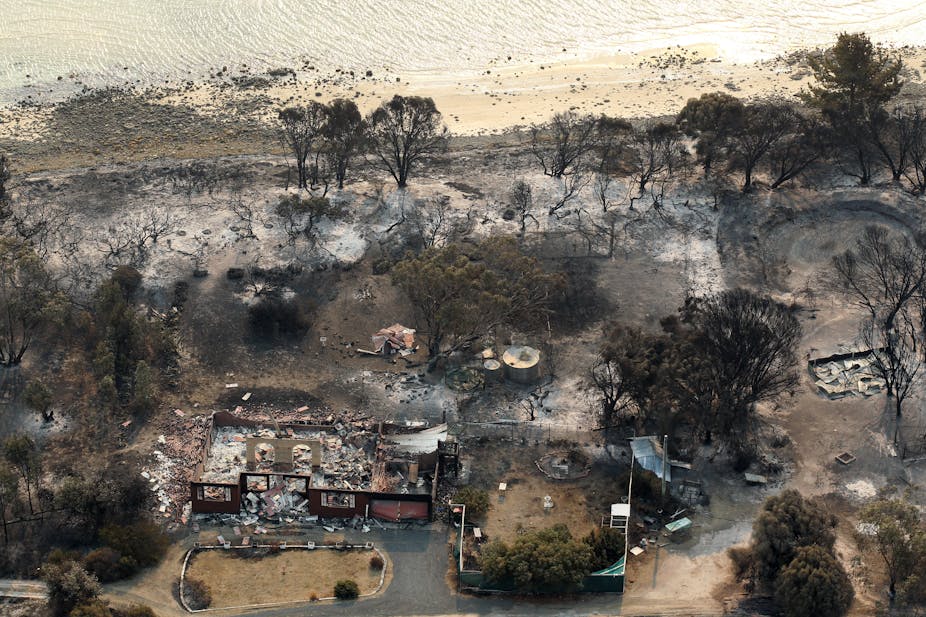
As natural disasters happen more often, rising insurance premiums will force the private sector to take action on climate change. AAP

Hurricane Sandy may or may not be a direct result of climate change, but what is certain is that the incidence of extreme climate events is increasing.

Such events are predicted by climate models, according to the IPCC, which has warned that “a changing climate leads to changes in the frequency, intensity, spatial extent, duration, and timing of extreme weather and climate events, and can result in unprecedented extreme weather and climate events”.

Breaking records in terms of wind ferocity, Hurricane Sandy hit land in a densely populated area on the East Coast of the US as well as devastating large parts of the Caribbean. The storm surge caused widespread flooding and damage. Not only was it a human tragedy, but property damage is likely to cost $50 billion. The direct costs to the insurance industry are lower, in the order of between $10 and $20 billion.

It should come as no surprise that with expected payouts escalating rapidly over the next few years, the insurance industry is ringing warning bells.

They are already too high, according to Swiss Re, which announced that “economic losses from natural catastrophes and man-made disasters will likely reach at least USD 140 billion in 2012”.

Munich Re, the world’s largest reinsurance company, published “Severe weather in North America”, which showed that during the past thirty years of weather-related disasters there was a clear rising trend for both extreme weather events and the costs of recovery. The report also identifies the probable cause for this trend. “The view that weather extremes are becoming more frequent and intense in various regions due to global warming is in keeping with current scientific findings.” Commenting on this report, Tony Kuczinski, CEO of Munich Re America warns: “What is clearly evident when the long-term data is reviewed is that losses from weather events are trending upward.”

The insurance industry faces another challenge. To stay commercially viable, actuaries need to be able to accurately calculate risks. In the past, they have calculated these risks by using historical data. For climate change, such data are seldom available, and so insurers will need to rely more on climate projections and models. Although these predictors are getting more reliable, they are nowhere as accurate as required. To play it safe, actuaries are likely to use conservative estimates of climate impact, meaning insurance costs will be based on the upper boundary of potential losses. That’s more bad news for business.

What all this means is that climate change presents unprecedented risks that the insurance industry may not be able or willing to cover. In areas that are particularly vulnerable, some insurance companies have already started to withdraw or steeply increase their premiums. For example, Allstate, a major US insurer, scaled back its insurance in the Gulf region due to “unacceptable” losses following Hurricane Katrina, dropping 16,000 commer­cial customers in 2005.

As disasters caused by climate change increase in frequency and intensity, insurance will become increasingly unavailable or unaffordable.

Unfortunately, the private sector is not paying sufficient attention. But what would happen if insurance premiums increased 50%? 100%? 200%? Companies would have the impossible choice of deciding whether to continue to accept increases in their overheads or operate without insurance (euphemistically referred to as “self-insuring). For most, either solution would not be sustainable.

The risk to the affordability of insurance should focus the minds of the private sector. And it should force it to revise its comfortable assumption that climate change is someone else’s problem. In fact, now is the time to realise that climate change is very much its problem.

Join the conversation

41 Comments sorted by

Comments on this article are now closed.

  1. Stewart Franks

    Professor School of Engineering at University of Newcastle

    "Such events are predicted by climate models" - they are also easily predicted without climate models - such events have always occurred and there is no significant change in frequency nor intensity.

    That said, we do need to learn how to cope with natural disasters and a more appropriate insurance system would be of some utility irrespective of the role of CO2

    report
    1. Dejan Tesic

      Former Lecturer at Charles Sturt University

      In reply to Stewart Franks

      "It is virtually certain that increases in the frequency and magnitude of warm daily temperature extremes and decreases in cold extremes will occur in the 21st century at the global scale. It is very likely that the length, frequency, and/or intensity of warm spells or heat waves will increase over most land areas".

      "It is likely that the frequency of heavy precipitation or the proportion of total rainfall from heavy falls will increase in the 21st century over many areas of the globe."

      "Average tropical cyclone maximum wind speed is likely to increase, although increases may not occur in all ocean basins".

      "There is medium confidence that droughts will intensify in the 21st century in some seasons and areas, due to reduced precipitation and/or increased evapotranspiration."

      Etc, etc. It's all there in the IPCC document accessible by the second link provided in this article.

      report
    2. David Gradden

      Mechatronic Engineer

      In reply to Dejan Tesic

      These events are not "predicted" by climate models, I don't recall seeing the IPCC report that predicted the Brisbane floods, or the Russian heatwave, do you?

      The IPCC GCM's do not produce predictions in the same way that short wave weather models do not produce forecasts or predictions. They provide information to the modellers or climate experts which they then use as a basis for their own statistical interpretation. The give away is the use of terms such as "Likely" or "medium confidence". These are not predictions, merely likely outcomes from modelled inputs. Single events such as the Vic fires or Cat 5 cyclones cannot be predicted by GCM's, only their likelihood of occurring on a more frequent basis.

      report
    3. Andrew Vincent

      Marketing . Communications . Multimedia

      In reply to Stewart Franks

      "such events have always occurred and there is no significant change in frequency nor intensity."

      I hear this line often but have not seen it substantiated with any data.. Please feel free to do so.

      report
    4. Felix MacNeill

      Environmental Manager

      In reply to David Gradden

      I don't think anyone has ever claimed that we had the capacity yet to predict specific events. Harry covered this pretty well in the article, where he observed:
      "In the past, they have calculated these risks by using historical data. For climate change, such data are seldom available, and so insurers will need to rely more on climate projections and models. Although these predictors are getting more reliable, they are nowhere as accurate as required."
      What the models do predict is simply that…

      Read more
    5. David Arthur

      n/a

      In reply to Stewart Franks

      Prof Franks writes: ""Such events are predicted by climate models" - they are also easily predicted without climate models - such events have always occurred and there is no significant change in frequency nor intensity", which begs the question:

      What part of "Munich Re, the world’s largest reinsurance company, published “Severe weather in North America”, which showed that during the past thirty years of weather-related disasters there was a clear rising trend for both extreme weather events and the costs of recovery. The report also identifies the probable cause for this trend. “The view that weather extremes are becoming more frequent and intense in various regions due to global warming is in keeping with current scientific findings”,

      which is clearly set out on this very page and may even have read prior to commenting, do you not understand?

      report
    6. David Gradden

      Mechatronic Engineer

      In reply to David Arthur

      One should exercise caution when using recovery cost data from Insurance Agencies as a proxy for extreme weather trends. There are a multitude of factors that contribute to the costs of extreme weather events (planning regs, urbanisation, changes to local topography). The suggestion that this data is 100% reliable is an exercise in causality at best. Sure AGW may be an intermediate factor but can it be quantified accurately when considering weather events such as fire, drought or flooding? Best to use quantifiable observational data rather than privately collated data from financial institutions.

      report
    7. David Gradden

      Mechatronic Engineer

      In reply to Felix MacNeill

      You have misinterpreted my comment. I was replying to Dejan Tesic who's comment implied that in order to find such predictions of climate catastrophe, one need only refer to the IPCC's documentation. Somewhat misleading given the context of the OP.

      report
    8. Stewart Franks

      Professor School of Engineering at University of Newcastle

      In reply to David Arthur

      One cannot attibute individual events to CO2, but nor can one attribute short-term trends (ie. 30 years) to CO2 either. Climate varies on every timescale. Such multi-decadal varaibility is largely unacknowledged but very apparent in timeseries of all natural events. Simple observation of short-term trnds is not attribution of cause

      report
    9. David Arthur

      n/a

      In reply to Stewart Franks

      With all due respect, Prof Franks, the claim that climate changes over periods as short as 3 decades cannot be attributed to changing CO2 is contradicted in the literature.

      For example

      Santer et al, "Identifying human influences on atmospheric temperature". PNAS, November 29, 2012 DOI: 10.1073/pnas.1210514109

      Stott et al, "Detection and attribution of climate change: a regional perspective". (Wiley Reviews Climate Science, wires.wiley.com/climatechange).

      At present rates of earth system…

      Read more
    10. Spiro Vlachos

      AL

      In reply to Andrew Vincent

      The author has not confirmed his claims with any data. Only there is a quote of the same report that has been trotted out often on this site, by the same insurance company that stands to make a killing with the higher premiums that it will charge.

      report
    11. Stewart Franks

      Professor School of Engineering at University of Newcastle

      In reply to David Arthur

      I disagree

      The Santer paper deals only with temperature - not climate extremes - they compare the models to the observations abd find some consistency. Given that the models do not simulate cloud/ocean variability well, then the only hypothesis evaluated is CO2. Even then, they note that the models tend to overestimate T in troposphere, and underestimate cooling in stratospehe. In a more rigorous sense, one could say that this demonstrates that the models are invalid.

      Stott is a largely uncritical…

      Read more
    12. Wade Macdonald

      Technician

      In reply to David Arthur

      David,

      How are these events assessed against human population sprawl and the fact that prior to any human presence, these events would have never caused damage to people/infrastructure in such areas?

      Who could quantify increased effect when prior to present day, no one existed in large areas of the globe and data was poor / non existent?

      report
    13. Wade Macdonald

      Technician

      In reply to David Gradden

      The biggest fire in Victoria happened in 1939 from memory? 30 people dead and three quarters of the state affected. Imagine the statitical comparison today if 'heaven forbid' the same thing transpired again?

      report
    14. David Arthur

      n/a

      In reply to Stewart Franks

      Thanks for pointing that out, Prof Franks, to which my response is based on first principles.

      Against a background of rising average temperatures, conditions for ignition and spread of fires will occur more frequently, both in terms of ambient temperature and of moisture content of fuel.

      Against a background of rising sea levels (a consequence of rising atmospheric CO2 levels), conditions for coastal flood events will occur more frequently. That is to say, even if storm events don't increase in intensity, the damage inflicted by storms will increase due to this increasing susceptibility.

      report
    15. David Arthur

      n/a

      In reply to Wade Macdonald

      Thanks Wade, you raise a good point. An exercise might be to normalise reportable storm event exposure per head.

      Another exercise might be to reflect on how rising temperatures are approaching ignition temperatures, and on how rising temperatures-decreased moisture content are approaching vegetation flammability limits.

      report
    16. Felix MacNeill

      Environmental Manager

      In reply to David Gradden

      I don't think I misinterpreted what you said, but rather you misinterpreted Dejan's comment. he referenced the IPCC material to refute Stewart Franks's claim that there was no change in frequency. He never suggested that any of that material could actually predict individual events. that was not the point of the comment, as I understood it and your noting that specific predictions could not be made didn't really have any relevance to Dejan's perfectly sensible retort to Franks.

      report
    17. Felix MacNeill

      Environmental Manager

      In reply to David Gradden

      David, costs were not being used as a proxy for severity or frequency of events. Data on the severity and frequency of recent, recorded events was used to make a judgement by the reinsurers on the severity and frequency of events.

      I don't know how much less 'proxy' you can get tha nthat.

      report
    18. Chris O'Neill

      Telecommunications Engineer

      In reply to Wade Macdonald

      "Britian is staring down the barrel of some climate extreme"

      Another person who has difficulty with the concept of the difference between weather and climate.

      report
  2. David Clerke

    Teacher

    When I was young I unfortunately my great grandmother was still alive because she was an old hag who believed getting cold, especially feet, caused colds. If she saw me without shoes and socks she would squawk "you will catch your death of cold" and should I sneeze sometime in the future she would assert that as proof of her prediction. Even if the sneeze were weeks months or years later. The parallels are obvious except now we can define and redefine what constitutes a sneeze. But at least the article seems to assume that we will all have to "suck it in princess" and learn to live with any climate change because no one has yet come up with a solution to third world development especially India and China.

    report
  3. Andrew Montford

    Blogger

    "...the incidence of extreme climate events is increasing"

    I don't think that's right. Per the IPCC SREX report:

    "There is medium evidence and high agreement that long-term trends in normalized losses have not been attributed to natural or anthropogenic climate change"
    "The statement about the absence of trends in impacts attributable to natural or anthropogenic climate change holds for tropical and extratropical storms and tornados"
    "The absence of an attributable climate change signal in losses also holds for flood losses"
    "Some authors suggest that a (natural or anthropogenic) climate change signal can be found in the records of disaster losses (e.g., Mills, 2005; Höppe and Grimm, 2009), but their work is in the nature of reviews and commentary rather than empirical research."

    report
    1. Mike Hansen

      Mr

      In reply to Andrew Montford

      No link - just some selective quoting from a very large report.

      From the IPCC SREX fact sheet.
      http://www.ipcc.ch/news_and_events/docs/srex/SREX_fact_sheet.pdf

      "Specific findings of the report

      Changing extreme events
      —Observations since 1950 show changes in some extreme events, particularly daily temperature extremes, and heat waves.
      —It is likely that the frequency of heavy precipitation will increase in the 21st century over many regions.
      —It is virtually certain that increases in…

      Read more
    2. Mike Hansen

      Mr

      In reply to Andrew Montford

      We can also now add the draft report of the U.S. Global Change Research Program (USGCRP), a collaboration of 13 federal science agencies.

      "Climate change is already affecting the American people. Certain types of weather events have become more frequent and/or intense, including heat waves, heavy downpours, and, in some regions, floods and droughts. Sea level is rising, oceans are becoming more acidic, and glaciers and arctic sea ice are melting. These changes are part of the pattern of global climate change, which is primarily driven by human activity."

      http://ncadac.globalchange.gov/download/NCAJan11-2013-publicreviewdraft-chap1-execsum.pdf

      report
    3. David Arthur

      n/a

      In reply to Andrew Montford

      Gday Andrew, you write that you think "...the incidence of extreme climate events is increasing" is not correct.

      The Good News is, there's a link to a report by some actuaries at Munich Re that will disabuse you of this thinking. Munich Re, as a large reinsurer, has a pecuniary interest in getting their assessments on this issue right.

      While their full report is not freely available, the executive summary is accessible at http://www.munichreamerica.com/pdf/ks_severe_weather_na_exec_summary.pdf

      report
    4. Spiro Vlachos

      AL

      In reply to David Arthur

      Any excuse to beef up those premiums and profits.

      report
    5. David Arthur

      n/a

      In reply to Spiro Vlachos

      Thanks Mr Vlachos. You're right, the insurance industry has a pecuniary interest in beefing up premiums and profits.

      One might expect, however, that an enterprising insurance company might test Munich Re's work, and find that it requires less reinsurance cover than Munich Re would have it believe.

      The same insurance company could then go and win business by offering lower premium rates per dollar insured risk.

      The decrease in business volumes experienced by Munich re, and by the competitor retail insurers, might cause the industry to realign itself accordingly.

      I think it's called 'competition'; to what extent has competition exposed risk overstatement in Munich Re's work?

      report
    1. David Arthur

      n/a

      In reply to Wade Macdonald

      Thanks Wade. Rather than follow your link, I went to the BoM site (http://www.bom.gov.au/climate/data/) and grabbed some monthly average minimum and maximum data for a Perth observatory (Perth Metro, station number 09225); it's been open since 1993.

      In the period Jan 1994 - Jul 2012, the monthly average minimum temperature has increased at a rate of 0.001 deg C per year - agreed, not at all significant.

      Over the same period, monthly average maximum temperature has increased at a rate 0f 0…

      Read more
    2. Wade Macdonald

      Technician

      In reply to David Arthur

      Thanks for that David.

      That makes sense to me as I remember these cold nights in my home town during the drought a few years back.

      Cheers

      report
  4. John Phillip

    John Phillip is a Friend of The Conversation.

    Grumpy Old Man

    Nowhere in this article does it mention the profit motive: "some insurance companies have already started to withdraw or steeply increase their premiums." How many insurance companies have withdrawn coverage vs. how many have increased their premiums? A cynical person might argue that insurance companies could use the predictions of climate 'disasters' to justify such increases. It's certainly hard to use the behaviour of insurance companies to justify taking action on climate change.

    report
    1. Leo Kerr

      Consultant

      In reply to John Phillip

      omg John - all is revealed once more by your insightful comment - geez I didn't realise these guys were just cashing in - now I understand. I'll tell Lord M on his next rock tour of Australia that's it's all about profit (and those nasty scientists making a quid out of it also - disgusting). I just hope the Nobel Laureate and House of Lords member doesn't get ideas about a cash-in either but I'm sure being a Viscount he's above all that (don't suppose you know how much Gina pays him for these gigs anyway).

      report
  5. Chris Harper

    Engineer

    "Hurricane Sandy may or may not be a direct result of climate change, but what is certain is that the incidence of extreme climate events is increasing"

    There is no such certainty at all.

    There is no observed long term increase in extreme weather events and this claim has no basis in observation.

    If such claims are going to be made than evidence is required.

    "Such events are predicted by climate models, according to the IPCC, which has warned that “a changing climate leads to changes in the frequency, intensity, spatial extent, duration, and timing of extreme weather and climate events, and can result in unprecedented extreme weather and climate events”."

    Another example of forecasts failing to match real world observation.

    report
    1. Mike Hansen

      Mr

      In reply to Chris Harper

      Who are you going to believe ?

      A climate science denier or the 240 scientists from 13 US federal agencies who have just finished the first draft of a climate change assessment report for the US Government.

      "Climate change is already affecting the American people. Certain types of weather events have become more frequent and/or intense, including heat waves, heavy downpours, and, in some regions, floods and droughts. Sea level is rising, oceans are becoming more acidic, and glaciers and arctic sea ice are melting. These changes are part of the pattern of global climate change, which is primarily driven by human activity."

      http://ncadac.globalchange.gov/download/NCAJan11-2013-publicreviewdraft-chap1-execsum.pdf

      report
    2. Felix MacNeill

      Environmental Manager

      In reply to Chris Harper

      Chris, I gather you didn't bother to check the references listed above by Messrs Hansen, Vincent, Macdonald and Arthur?

      I guess, as John Philip suggests, the reinsurers must just be making all the data up in order to give themselves an excuse to stop making profit sby insuring things?

      report
    3. Doug Hutcheson

      Poet

      In reply to Chris Harper

      Chris, we know that the Earth's energy budget is out of balance: more energy is going into the system that is being radiated out of it. The surplus energy is warming the oceans and melting the Arctic, both of which effects are leaving more energy in the global weather system. Given that, is it not reasonable to predict more extreme weather over time?

      You said "There is no observed long term increase in extreme weather events", but MunichRe seems to think otherwise and it is important to their business to be able to assess such things with some accuracy, however I do not know of any repository of observations which would prove this one way or the other. What we do know is record hot measurements are outnumbering record cold measurements, reflecting the more energetic weather system http://www.metoffice.gov.uk/news/releases/archive/2012/bams-state-of-the-climate .

      report
    4. Fred Pribac

      logged in via email @internode.on.net

      In reply to Chris Harper

      "There is no observed long term increase in extreme weather events and this claim has no basis in observation."

      This is an un-supported assertion that can be shown to be false simply by finding one article or research finding that does find an observed increase in extreme weather events. Here you go!

      For sea-level exceedence events (i.e. flooding from the sea due to storm events) analyzed for pre-1950s versus post 1950's tidal observations there is strong evidence that annual recurrence interval between flooding events (ARI's) have increased by a factor of three.

      http://staff.acecrc.org.au/~johunter/AMM_Church_et_al_2006.pdf

      For some reason, climate scientists have been hiding this sort of stuff in peer reviewed publications but it's really not very hard to find if you give it a go.

      report
  6. Alex Cannara

    logged in via LinkedIn

    And, the media concentration on climate disserves us all, because it oddly ignores the more imminent threat to billions around the world from ocean acidification. (References intentionally absent to encourage the writer & others to do some studying.)

    report