

The world is getting warmer and wetter, almost undoubtedly due to the fact that we are burning up fossil fuels at an incredible rate.
While this change in our climate will lead to some positive opportunities, such as better weather in Tasmania for growing grapes, a loss of biodiversity and human infrastructure is highly likely if we cannot halt climate change.
There are two issues. The first is whether we can stop climate change. The second is how to adapt.
Two views on stopping climate change
There are those who believe we can avert climate change by repenting of our sinful energy-guzzling ways. They advocate increasing the cost of activities that lead to carbon emissions.
They expect this will eventually lead us to new technologies that will make humans more carbon neutral. They think the carbon price will bring long-term changes in our use of energy.
Then there are those like me, who see no hope whatsoever in reducing emissions. I simply can’t see the rest of the world, who have more to worry about than climate change, moving towards energy prudence.
I think we will go through the cheapest means of energy first, only using the cleaner energy as those run out.
We all hope for technological breakthroughs, but there’s been no significant new technology in the last 50 years that comes close to out-competing coal and oil.
I am not holding my breath that the magic technological fix is around the corner.
In the most optimistic scenario, we’ll keep digging up coal and drilling for the last dregs of oil for a long time to come. The worse scenario is where bio-fuels become the cheaper option, so fuelling our cars goes at the expense of food for poor people.
That is a conversation for another day though.
So do we just sit back and let the chaos happen?
If you fully expect the climate to change and think of policies surrounding carbon emissions as feeble symbolic gestures, does this mean you want to do nothing?
The answer is no.
If there is a problem you can’t fix you learn to live with it and adapt to it, such that you minimise the loss and maximise the gain.
Let us remind ourselves what we are adapting to. As a rule of thumb, in the course of ten years we are talking about a warming of 0.1 degree celsius, an increase in sea levels by five centimetres, and about a 0.5% increase in rainfall per ten years.
Ocean acidification and the melting of the ice caps make up even slower changes in our climate.
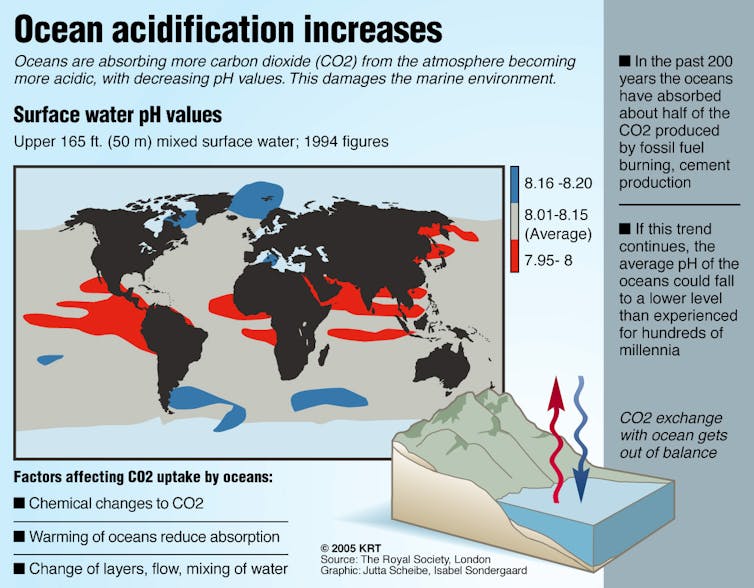
These changes are so slow that you would be forgiven for not noticing any in your lifetime. This is precisely why I deem it folly to expect the world to really get anxious about this.
For any investment that is usually written off in a matter of decades, which includes most existing housing and nearly all business investments, the slow change in climate means that taking account of climate change is irrelevant. There will be plenty of time in the future to redirect such investments when the climate is actually noticeably different.
For new housing, it makes sense to enforce building codes that take account of a greater likelihood of floods and storms.
What we should concentrate on
The things to really worry about are public investments with payoffs measured in centuries rather than decades. Governments have a particular role in fishing stocks, biodiversity, nature parks, coastal lands, and other public goods that are given down over generations.
Ocean acidification is a serious problem. If it goes on unchecked, in a century or so time the shells of many marine animals would dissolve. This means the end of them and things that feed on them.
How can governments react to the collapse in the stocks of those fish that would disappear in this case?
One question is whether acidification can be reversed by pumping more alkaline substances into the ocean.
How could we make a difference?
We could try to churn enough calcium in the oceans to prevent further acidification and Australia could lead research and international efforts that way.
If it turns out that acidification is unavoidable, we should think of ways of preserving the biodiversity.
Governments can:
extend the conservation areas in the oceans
set up “artificial reefs” on land that preserve some of the current marine diversity
set up gene banks for the many current marine life species.
The goal would be to preserve as much of the marine life diversity as possible in the cheapest way possible.
Apart from conservation, governments can also be more pro-active. If you take the warming and acidification of the oceans as inevitable, you can turn to the question how to re-stock the ocean with fish and other organisms that do well in warmer and more acid waters.
Nature will find ways but we can help
Nature itself will experiment and adapt, but governments can give nature a helping hand.
We can try to genetically engineer new fish species or mass breed those species which we know are more suited for the new climate.
Such initiatives would of course greatly benefit from having a database of ocean life conserved somewhere. And of course, it will be a case of hit-and-miss as the long history of introducing new species in Australia has shown.
There is a role for government in maintaining biodiversity and nature parks on land as well as water.
Gene banks, artificial species and artificial habitats are all obvious things governments can get involved in.
For instance, the Australian National Botanic Gardens already stores seeds of over 5000 different plants.
The two tasks, habitat conservation and habitat experimentation, are both long-term enterprises where the 10 billion dollars currently spent on symbolic measures would go a long way to helping us prepare for the inevitable problems we face.
Professor Paul Fritjers will be speaking on Monday 5 September at the Australian National University’s Crawford School Dialogue – Australia’s carbon price: good policy or not? in Canberra.
John C
logged in via email @gmail.com
Well Professor, your welcome to speak forth ... as I am (Im a non-professor).
But instead of just asserting that a carbon price is not the way to help, why not set out why ! ? ? Your a professor of economics arent you ?
While your at it, why not set out your appreciation of this statement from the USA's top professional body (US National Academies):
Key Findings - - - 'The most effective policy strategy for the United States is to pursue is a strong, economy-wide carbon pricing system (in…
Read moreStephen Prowse
CEO at Wound CRC
I would like to see more discussion like this on how we adapt to climate change and move to more sustainable living and tackle the significant environmental and economic issues facing society rather than the ongoing unhelpful argument about the contribution of human activity to global warming.
Ken Fabian
Mr
Ahh, the 'too hard, too expensive, don't bother' school of thought is doing extremely well at undermining the public will to take serious action on climate. The popularity of this type of thinking is a modern success story - a victory of PR, tankthink, advertising, lobbying and cash for comment over rational policy based on understanding how fossil fuel's waste products impact climate and environment. It feeds on it's own success by adding 'no public will to act' to the 'too hard, don't bother' view…
Read moreAndrew Glikson
Earth and paleo-climate scientist at Australian National University
I agree. It is kind of attitude which has led the environment into the predicament it is in.
Adaptation may be possible up to a point but open-ended carbon emission leads the environment to beyond human control. Very rarely do economists grasp the full meaning of a +4 degrees world, where the operative term will be 'survival' rather than 'economics'
Aaron Petty
Postdoctoral Fellow in Human Ecology at Charles Darwin University
What a dismal view of our future. Really much better (and cheaper?) to 'just' genetically engineer fish than to use available renewable technologies? (Actually, you would have to engineer the whole ecosystem, because acidification affects the bottom of the food chain). It does make sense to prepare for what is underway and to mitigate against what we've already done, but how does it make sense to continue a practice we know to be destructive, and make the problem vastly worse?
Another difficulty…
Read moreSteve Sherwood
Director, Climate Change Research Centre at University of New South Wales
Two brief comments.
1) your estimate of the warming rate is too low by about a factor of three.
2) anyone taking the "lets just adapt" view should be aware that the eventual result of this will likely be a planet much less habitable than today due to summertime heat stress alone--see
http://web.science.unsw.edu.au/%7Estevensherwood/PNAS-2010-Sherwood-0913352107.pdf
While economists may not care about anything that happens more than 30 years from now, I don't think that squares with the values of most people. Climate mitigation is really not a business decision.
Marc Hendrickx
Geologist
1. The long term trend of over the past 100 years is about 0.1 degrees per decade. What do you base your "factor of three" on? Climate models you yourself won't take with a grain of salt?
http://www.cosmosmagazine.com/news/4604/no-snow-more-drought-climate-report-warns
2. Humans have been modifying the planet to suit since agriculture was discovered, and adapting to the changes. Adapting to changes however they occur is part of our proven survival strategy and will (obviously) continue to happen…
Read moreMichael J. I. Brown
ARC Future Fellow and Senior Lecturer at Monash University
Paul Frijters rule of thumb estimate for global warming is lower than pretty much all the projections in the IPCC's AR4 Synthesis Report (http://www.ipcc.ch/publications_and_data/ar4/syr/en/mains5-4.html#table-5-1).
Justin Niven
Director
Hi Marc
I've read a lot of your comments on this and other articles.
Just curious, are you an "astro turfer"?
Kind regards
Doug Cotton
Maths and Physics university tutor
But Michael we do have some error problems in the IPCC models which you were going to look into. Also with Trenberth's curved trend now showing a decline in sea surface temperatures, that decline continuing with the last 12 months having been, on average, cooler than 2003 as anyone can check on the NASA website.
It is appropriate to consider sea surface temperatures because the oceans contain close to 90% of all heat above the crust and it is the surface temperatures which have the most influence…
Read moreDoug Cotton
Maths and Physics university tutor
A more detailed explanation of the temperature "support" mechanism is required because an objection is often raised that the net outward heat flow from the core is far too small to warm the atmosphere. Indeed that is the case, but over the course of even the last billion years there has been ample time for it to do so, especially with the aid of the Sun.
It may help to picture the whole distance from the liquid core to the top of the atmosphere (TOA.) We have no control over that relatively fixed…
Read moreMarc Hendrickx
Geologist
No, but I think Michael J I Brown. Ask him.
Marc Hendrickx
Geologist
is
Ken Fabian
Mr
Looking at NOAA's Global Ocean Heat Content and checking what ENSO - the single biggest reason for OHC's year to year ups and downs - was doing and I see El Nino at the beginning of your cherry picked period and la Nina at the end. In the absence of a warming trend it ought to have ended up lots cooler like back down to 2000 levels. But no, ocean heat content (of the top 700m) has effectively not dropped at all.
I expect a five year running mean would not merely show that the trend of warming has not stopped but would probably show acceleration.
Doug Cotton
Maths and Physics university tutor
There's a lot of debate about ocean heat content, and apparently some inaccurate measurements according to Knox and Douglass, who also questioned Trenberth's "missing energy" - see http://www.pas.rochester.edu/~douglass/papers/KD_InPress_final.pdf
Sea surface temperatures are more closely related to climate. NASA's website only does plots of sea surface data from 2003 to about two days ago. But Trenberth and Fasullo used sea surface data from 1994 to 2010 and apparently found that a curved trend fitted best with a maximum around 2006 and a slight decline ever since.
Doug Cotton
Maths and Physics university tutor
The March 1998-early 2000 El Niño was the biggest on record, but there have been plenty of others. Most others have had very little effect on sea surface temperatures and a one or two year running mean is quite OK with such temperatures as they vary less than land temps. Trenberth's trend smoothes out any El Niño / La Niña effects anyway. It was still declining during the July 2009-May 2010 El Niño.
El Niño: ... 1994-1995 and 1997-1998, 2002-2003, 2004-2005 and 2006-2007. July 2009-May 2010
La Niña: ...1988-1989 1995-1996 March 1998-early 2000. Late 2000-early 2001. 2007-2008. 2008-April 2009. July 2010 - Current
Doug Cotton
Maths and Physics university tutor
Correction: That should of course read "The 1997-1998 El Niño was the biggest on record ... "
The most appropriate trend analysis since the 1990's should probably eliminate that El Niño. Otherwise starting in 2003 after the large "noise" of 1998 to 2002 had passed is fair play I suggest.
Michael J. I. Brown
ARC Future Fellow and Senior Lecturer at Monash University
Marc Hendrickx's witticisms (astronomer = astroturfer, geddit?) are a poor substitute for factually based arguments.
I don't believe Marc Hendrickx is an astroturfer and I believe he is completely sincere in his beliefs on AGW (even if I disagree with his style of debate).
There certainly are a few astro turf organisations at work within the debate (i.e., fake grass roots organisations and/or organisations with hidden sponsorship). There has been some discussion of this recently with regards to windfarm opposition groups, and this was discussed on a recent episode of 4-Corners (http://www.abc.net.au/4corners/content/2011/s3274758.htm).
Derek Bolton
Retired s/w engineer
[continuing from 'scientists v. farmers' thread; can't reply there - something broken]
Read moreYour argument rests on the observed correlation between surface and subterranean temperatures, and your opinion that the surface temperature is not capable of exerting such an influence at such depths. But to get there you reinterpret the last part as the surface being unable to 'warm' the lower layers so much. What you persist in ignoring is that a warmer surface slows the loss of heat from underground, helping…
Doug Cotton
IT Manager
The key issue is the amount of conduction (or diffusion) between the land surface and the first 1mm of air, and also between the ocean floor and deepest water, and between the sea surface and air. I suggest that this is somewhat greater than the figure for "thermals" in the models. (We can reconcile the upwelling radiation by recognising that there is more coming from the lowest levels of the atmosphere than estimated, rather than directly from the surface.)
The point about the high level of conduction…
Read moreDerek Bolton
Retired s/w engineer
None of your response above addresses my objection to your inference from underground temperature profiles. I'm not interested in your other points until we have resolved that one. There cannot be any direct transfer between underground heat and atmospheric - it all has to pass through the surface along the way, so we can analyse cause and effect between surface and underground temperatures without having to think about the atmosphere.
According the basic science I laid out, core temperatures could vary because surface temperatures do (but only by the same few degrees - hardly significant in the core), because of changed conductivity, or because of changed rate of production in the core.
Given that it's produced by radioactive decay, the only conceivable reason for increased production would be the chance aggregation of a critical mass.
Mark Harrigan
Dr
This debate is silly - especially conducted on here. Neither of you appear to be trained climate scientists or fully qualified in the fields on which you are speculating.
If you believe you have a proper scientific contribution to make that will add to the current state of knowledge, or indeed alter the accepted understanding then submit a paper to a proper peer reviewed publication.
If it has something to offer it would be welcomed
Derek Bolton
Retired s/w engineer
Sorry Dr Mark - just trying to nail the incorrigible DC on one easily demonstrated flaw in his argument. But you're right, it only encourages him. I shall desist.
John C
logged in via email @gmail.com
Steve:
Im an economist. Dont tar me with your anti-Frijters statement.
Apart from that, I agree with you.
My posting above was prompted by Frijters' unprofessionalism - in just using assertions, rather than evidence, on a very important issue. He has debased the economics profession.
Blair Palese
CEO
I'm with Professor Sherwood - your figures are well down on what the reseasrch shows but that aside, why take the either/or - attempt to reduce emissions or adapt position? Clearly we will have to do both and from what I hear from every expert in the field - economists included - Australia's price on carbon proposal is a good option for several reasons:
1. It can get passed - it's not so alarming and radical that industry will not support it. In fact those on the business side say that 99% of Australian…
Read moreWendy Joy
logged in via Facebook
As an ordinary person I find this absolutely abhorrent. What immediately came to mind was Frankenstein planning his monster.
Nick Kermode
logged in via email @hotmail.com
This article seems a classic example of how economics and science are strangers.
Shane Perryman
logged in via email @gmail.com
Concur.
On reading statements like...
"We could try to churn enough calcium in the oceans to prevent further acidification and Australia could lead research and international efforts that way."
I realized just how detached from practical realities the author is. And where do we get the energy to mine, crush and transport all this lime? Do we we just burn some more carbon?
Similarly,
"set up “artificial reefs” on land that preserve some of the current marine diversity".
And how much energy is…
Read moreMark Harrigan
Dr
For some reason my inital response got pasted as reply to someone else (probably my own slip)
Try again
Basically - to be blunt - this article is a load of hogwash and shows very little understanding of the real world of nature.
Shane Perryman above says that pretty well I think.
I don't think much of the economics either.
Read moreWhilst the thesis that increased AGW is likely unable to be completely stopped no matter what we do is probably reasonable, I find the conclusion reached both based on a false…
Paul Whyte
logged in via email @gelworks.com.au
I'm a little disappointed that the Conversation posted this article with estimates of climate change and ocean acidification so far below published estimates.
Further the conclusions drawn from the very low rates are also rather limp.
I'm currently supervising the instalation of a bio-char oven for my production facility that will both generate income from selling bio-char and move the company towards much lower CO2 emissions. The project has been quite inexpensive and has already much improved…
Read moreMichael J. I. Brown
ARC Future Fellow and Senior Lecturer at Monash University
One thing that does puzzle me about this article is it lacks estimates of costs (particularly as it is written by an economics professor).
For example, the price of oil and the price of coal have increased over the past decade (e.g., http://en.wikipedia.org/wiki/Price_of_petroleum). If such a trend were to continue, alternative forms of energy generation will become increasingly competitive without requiring technological "magic bullets".
The costs of engineering the environment are also unclear from the article (e.g., genetically modified fish, artificial reefs). It is also unclear what the hidden costs could be, given tinkering with the environment can have significant consequences. For example, the introduction of rabbits into Australia initially cost little but the subsequent economic costs have been vast.
Nick Kermode
logged in via email @hotmail.com
Good comments Shane, Michael et al. Dont know if any of you are a fan of British humour but this article could easily be a transcript from Baldrick after uttering the famous words "I have a cunning plan".
Shane Perryman
logged in via email @gmail.com
I just spent 20 minutes reading to find that it was Percy not Baldrick that invented "<a href="http://www.suslik.org/Humour/FilmOrTV/BlackAdder/ba2-4.html">purest green</a>".
Nick Kermode
logged in via email @hotmail.com
Ah yes, a brilliant discovery (think I read about that in E&E) but Baldrick was all over him for consistancy lol
Doug Cotton
IT Manager
Michael, further to my as yet unanswered question about errors in radiation measurements and IPCC models, please see my post above in reply to Derek. I believe I have explained my hypothesis cogently and concluded with more detail about the errors.
Michael J. I. Brown
ARC Future Fellow and Senior Lecturer at Monash University
My answer is back at the discussion at http://theconversation.edu.au/when-it-comes-to-greenhouse-gases-carbon-dioxide-isnt-the-only-culprit-2729 where it is somewhat less off topic.
Andrew Glikson
Earth and paleo-climate scientist at Australian National University
Global climate change is not measured only by average temeprature levels but by:
1. The level of radiative forcings calculated from greenhouse gas levels, solar forcing, aerosols, ground reflection and other factors. At present the rise in +3.2 Watt/m2 since 1750, equivalent fo 2.3 degrees C, is masked by about 1.1C sulfur aerosol effect.
2. Variations in temepatures across the latitudes - being minimal over the topics and tropical islands and maximal over the poles, where T rise has reached +3 to +4 degrees C - with major consequences such as reported from Greenland: http://theconversation.edu.au/pics-of-greenland-glacier-melt-shocks-expert-3244#comments
3. Economists, making calculations divorced from the physical and chemical realities of the atmosphere-ocean-cryosphere system, are walking on thin ice.
Doug Cotton
Maths and Physics university tutor
Andrew. You seem keen to work with radiation figures so I'm hoping you might be the first in the world to explain a little dilemma for me ... refer first to ... http://www.agu.org/pubs/crossref/2004.../2003JD004457.shtml
The above reference talks about improvement by way of error reduction which is now down to 5-10 W/m2 at TOA and 10-15 W/m2 at surface.
It would appear then that, in calculating the difference between downwelling and upwelling radiation the models would have a total error of…
Read moreJohn Lang
Software Engineer
Doug, you seem to concede the greater accuracy of empirical measurements. The sensitivity of the climate to doubling of CO2 is not based solely on the models. Paleoclimate studies also confirm the +3W for doubling CO2 (http://www.columbia.edu/~jeh1/mailings/2011/20110118_MilankovicPaper.pdf). This serves to raise confidence in the models for trying to predict aspects of the climate, but the models are not the sole basis at all. So they do not have to "stand on their own" in order to "prove" the warming…
Read moreDoug Cotton
IT Manager
No I don't because the referenced article actually refers to such I now realise. I suggest the models have similar errors too. Please see my detailed post above in reply to Derek.
John Lang
Software Engineer
Why do you put so much emphasis on the models, and lay responsibility on these to "prove" the effect of GHG on warming, when there is other empirical evidence of the sensitivity of the climate to GHG?
Your suggestion "that this is somewhat greater than the figure for "thermals" in the models", I don't believe qualifies as debunking the IPCC claims. Do you have some published science to back this, or is it just a gut feeling?
Replace this "... but we simply cannot assume that the temperature of the liquid core has not and will not alter, at least a little, due to natural causes. (Some heat is thought to be generated by nuclear fission, for example, and there is a degree of randomness associated with such. Some heat is generated by friction in underground tides caused by the gravitational force exerted by the Moon, modified a little by that from the major nearby planets.)" with some links to real research please, because it sounds like psuedo-science to me.
Doug Cotton
IT Manager
No John, it's time for a new "trial" because there is new evidence and the old evidence never was evidence in the first place. The onus is still upon the IPCC to re-prove their case because this is basically what they claimed: carbon dioxide levels are increasing and so are temperatures. We can't think of any other reason for temperatures to rise, so it must be the carbon dioxide.
Well, there are other reasons and very basic physics relating to heat transfer mechanisms (certainly well documented…
Read moreJohn Lang
Software Engineer
No Doug, there IS evidence that supports the proposition that GHG's are responsible for the forcing that has lead to the observed temperature rise. Real climate skeptics have suggested other forcings (solar, clouds etc.), however the evidence has not been there in the end to support them, with the extended peer review process refuting them.
And No Doug, it is not up to the IPCC to "prove" anything to you, it is up to science to show evidence against the prevailing weight of evidence that shows something…
Read moreDoug Cotton
IT Manager
The very basic physics that establishes that variations in core temperatures can cause variations at the surface is explained at http://climate-change-theory.com and has been discussed on other threads here in great detail. We don't need further peer-review for physics: we just apply it appropriately. (Briefly, there is a temperature gradient from the core to space and the whole plot moves up or down as core heat changes, pivoting about the other end which is fixed at space temperature. (Compare…
Read moreMark Harrigan
Dr
Oh please! Self referenced rubbish.
Get it published in a peer reviewed paper or be silent.
On what basis do you claim that physics is not being applied properly to the science of AGW? What a joke. CO2 is well established as a source of the "Greenhouse effect" and has been well established by physics for more than a century.
It has been established time and time again that humans are the driving force behind the current increased temperature profile via increased fossil fuel emissions
Rosenzweig et al (2008). "Attributing physical and biological impacts to anthropogenic climate change"
Nature 453, 353-357.
Is just one paper that sets out the case unequivocally.
Every single national body of science supports this - but somehow you know better? Give it a break
John Lang
Software Engineer
Perhaps you misunderstood Doug ... I didn't ask you for the peer reviewed literature of basic physics. I asked you for the scientific literature that shows good evidence that variations in the core temperature is what is forcing the current climate change.
http://www.nature.com/nature/journal/v410/n6826/abs/410355a0.html , confirmed by http://spiedigitallibrary.org/proceedings/resource/2/psisdg/5543/1/164_1?isAuthorized=no , used satellite data to discern any changes in outgoing radiation over the 26 year period. What they found was a drop in outgoing radiation at the wavelength bands that GHG's absorb energy. Thus the paper found "direct experimental evidence for a significant increase in the Earth's greenhouse effect that is consistent with concerns over radiative forcing of climate".
Doug Cotton
IT Manager
Mark and John
I'm fully aware of TOA spectral analysis that but it doesn't prove anything other than that carbon dioxide concentrations have increased over the years.
Just because there are missing bands corresponding to carbon dioxide does not prove the heat is not getting to space by another route.
For example, some of the radiation that returns to the surface will warm it, along with direct solar insolation, especially in the mornings. That heat may well stay in the hot rocks, clay, sand…
Read moreMark Harrigan
Dr
Apparently you are only fully aware of your own self published uncredentialed nonsense and fully prepared to ignore proper peer reviewed evidence.
Publish or be silent
John Lang
Software Engineer
"No, of course there are no peer-reviewed papers about core heat forcing surface temperatures - not that I'm aware of anyway - I didn't copy or plagiarise anyone else's work in this original research." .... finally Doug ... so there is absolutely NOTHING in the literature to back your pet hypothesis.
Then how about you get out there and get it published so it can be added to the scientific debate. Until then, it is really just the ramblings of a home brew climate enthusiast. And please ... no more links to your own sites ... thanks.
Doug Cotton
IT Manager
There is physics in which I am sufficiently well versed. If you took the trouble to apply such you would see that what I am saying is really very basic and totally in line with thel laws of physics. The IPCC "theory" is not and I can show you where.
No one on any thread here has been able to show any error in the physics arguments which I have summarised in this thread. Nor has recent sea surface data shown any discrepancy with my projections which could have been done decades ago with the same…
Read moreMark Harrigan
Dr
So everyone else is wrong and you are right but you can't get it published?
Really? Credible?
"No one on any thread here has been able to show any error in the physics arguments"
Maybe you need to re-read the above more closely. Or might it be possible that you just don;t listen?
It's very convenient to argue with respect to Peer Review that "I am too cynical of the process to even bother"
Means you don't ever have to properly justify your pseudo-science efforts.
But if that gives you comfort - good luck to you :)
John Lang
Software Engineer
I see Doug, so you consider these forums and politicians to be a more rigorous test of your hypothesis than the formal scientific process.
Tell me Doug, the basic physics you talk about, did that come from the scientific method or did a politician whisper it in your ear?
You can't just pick and choose Doug. Science advances via the thorough testing of ideas, not by evangelists proselytizing their beliefs via the media.
Mark Harrigan
Dr
Look at Dr Glickson's post below - it completely debunks your absurd proposition
Heat flow outward from the earth is measured in milli-watts per square metre.
Heat from the Sun and impact from the Greenhouse effect is measured in Watts per square metre. That's 1000 times more.
Empirical facts.
What you are talking about has no influence.
You fail physics 101
Mark Harrigan
Dr
In light of no stinging rebuttal I say QED
Your case is rubbish, your physics childlike fiction. For shame if you continue to peddle such nonsense anywhere else
Andrew Glikson
logged in via email @iinet.net.au
4. The article reminds me of the new "school of thought", promulgated by Bjorn Lombog ("The skeptic environmentalist") in his last visit to Australia.
A. Minimize the current and projected effects of climate change.
B. Maximize estimates of the cost of mitigation
C. Don't mention the cost (not just in $$$ but in terms of lives) of continuing open-ended carbon emissions.
D. Talk about adaptation as if climate change was a linear gradual process, an assumption negated by the increasing frequency and intensity of extreme weather events around the globe as a direct result from increasing land and ocean tempratures.
None of the proponents of adaptation has looked into what global environments would look like under +4 degrees C, including tens of metres sea level rise.
Chris Brown
B. Comm
What a curious article! Although as someone trained in economics myself, it does not surprise me that it was authored by an economist. None-the-less, as an individual concerned about the future of the planet, there are so many aspects that I would like to explore further with the author. For example:
1/ Why do his calculations view climate change as a lineal threat when the science indicates that it is likely to accelerate?
2/ Why does he countenance efforts to alter the chemical balance of the…
Read morePhil Spencer
Planning Enegineer
I'm feeling a little nonplussed with these negative comments on economists when Ross Garnaut, treated as a major expert on these subjects by many, is one…
I’m afraid I agree with Paul's original premise that “… simply can’t see the rest of the world, who have more to worry about than climate change, moving towards energy prudence”, although I do think we need to be a little more pro-active in reducing our dependence on fossil fuels.
I'm afraid there is a great deal of wishful thinking by the proponents…
Read morewilma western
logged in via email @bigpond.com
Good points made by M J Brown& I can give examples of astroturf. However I'd like to point out that the economics prof apparently believes the only possible source of biofuels is crops grown on agricultural land. Lay people interested in this are aware of R&D on biofuel from algae grown in saline environments- one of the airlines already spruiks their trials of this.
Read moreAs for 'fake grass roots organisations' involved in climate change issues,try the following.
1. Spokesperson for anti-wind groups…
John C
logged in via email @gmail.com
Reposted due to some technical glitch.
Well Professor, your welcome to speak forth ... as I am (a non-professor).
But instead of just asserting that a carbon price is not the way to help, why not be professional about it, and set out why ? Your a professor of economics arent you ?
While your at it, why not set out your appreciation of this statement from the USA's top professional body (US National Academies):
Key Findings - - - 'The most effective policy strategy for the United States is…
Read moreAndrew Glikson
logged in via email @iinet.net.au
Comparison between geothermal heat flow and solar insolation:
GEOTHERMAL HEAT FLOW
Mean heat flow is 65 mW/m2 over continental crust and 101 mW/m2 over oceanic crust.[
Pollack, Henry N., et.al., Heat flow from the Earth's interior: Analysis of the global data set, Reviews of Geophysics, 31, 3 / August 1993, p. 273 doi:10.1029/93RG01249
REVIEWS OF GEOPHYSICS, VOL. 31, NO. 3, PP. 267-280, 1993. doi:10.1029/93RG01249
Heat flow from the Earth's interior: Analysis of the global data set
Read moreHenry N…
John C
logged in via email @gmail.com
Thanks Andrew.
But what does that mean, in plainer english please ?
John C
logged in via email @gmail.com
Repeated, due to Frijters lack of any response to the two questions here:
......
Well Professor, your welcome to speak forth ... as I am (a non-professor).
But instead of just asserting that a carbon price is not the way to help, why not be professional about it, and set out why ? Your a professor of economics arent you ?
While your at it, why not set out your appreciation of this statement from the USA's top professional body (US National Academies):
Key Findings - - - 'The most effective…
Read moreJohn C
logged in via email @gmail.com
I wrote directly to Paul Frijters to see if he had an answer to my questions (above) about the basis for his opinion that "a carbon price is not the way to help" with global warming.
He replied, but not with evidence (peer reviewed journal articles or other) to support his opinion.
So, his opining on this major public policy matter remains professionally unsupported here.
John C
logged in via email @gmail.com
More evidence pointing to the arbitrariness of Paul Frijters when he proclaims: "a carbon price is not the way to help".
From the OECD:
http://www.theage.com.au/business/oecd-push-for-price-on-carbon-20111124-1nww5.html
'A PRICE on carbon is essential to combating global warming, a report by the Organisation for Economic Co-operation and Development has found, giving a boost to the federal government after weeks of debate on the carbon tax.
As the international community prepares for the Durban…
Read more