What is the half life of a Paralympic legacy?

  1. Tracey J Dickson

    Associate Professor, Centre for Tourism Research, Faculty of Business, Government and Law at University of Canberra

Trafalgar Square Tracey J Dickson
According to the world of Wikipedia a half life is ‘the time required for a quantity to fall to half its value as measured at the beginning of the time period’.

I watched the Paralympic closing ceremony from Trafalgar Square with an enthusiastic crowd cheering the words of Lord Sebastian Coe and Sir Philip Craven about how great the Paralympics were and what a life changing event it was. I too applauded their words and hoped that the Paralympic glow would continue and grow.

How long did that feeling last for me? About 10 minutes before an overly aggressive (paid) steward at the BT Live Site abused me for wanting to take a photo when the show was over. Time was up and he wanted us to leave. No lingering…

Read full post

Inspired, Dazzled, Moved – part 11

  1. Keith Lyons

    Professor of Sport Studies, National Institute of Sports Studies at University of Canberra

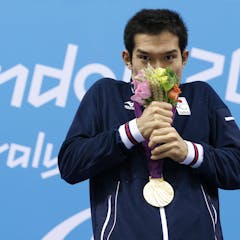
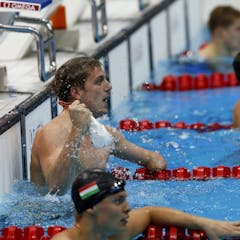
Japan’s Yasuhiro Tanaka celebrates after winning gold in the men’s 100m SB14 breastroke final. EPA/Jonathan Brady

The running title for my blog posts during the Paralympic Games was prompted by a line from Seb Coe’s opening speech at the Games.

Over 11 days of competition I have been inspired, dazzled and moved. As with the 2012 Olympic Games the availability of high quality broadcast images has transformed the representation of athletic performance and the mediation of our experience. My daily reviews tried to capture some of these moments.

On the final day of competition David Weir of Great Britain won an epic T54 Wheelchair Marathon in the closest of races from Marcel Hug (Switzerland) and Kurt Fearnley. The Australian Men’s Wheelchair…

Read full post

Inspired, Dazzled, Moved – part 10

  1. Keith Lyons

    Professor of Sport Studies, National Institute of Sports Studies at University of Canberra

China won four gold medals on the penultimate day of competition. EPA/Facundo Arrizabalaga

Day 10 was the penultimate day of competition at the Paralympic Games. There were 56 medal events in nine sports. At the end of the day 497 out of the 503 medals events at the Games had been completed.

China was in the final of all four remaining team events in Table Tennis and won four gold medals. Oscar Pistorius won the T44 400m in a Paralympic Record time. Brazil won the gold medal in the 5-a-side Football. Bosnia and Herzegov won the Men’s Sitting Volleyball final.

Australia won eight medals on Day 10. Evan O'Hanlon (T38 200m) and Prue Watt (SB13 Breastroke) were gold medallists. Rheed McCracken (T34 100m), Angie Ballard (T53 400m) and the…

Read full post

Paralympics vs Olympics coverage: uneven at best

  1. Gregor Wolbring

    Associate Professor, Faculty of Medicine at University of Calgary

The coverage given to the Paralympics was, in some countries, only 10% of that dedicated to the Olympics. The Department for Culture, Media and Sport

This is my last blog piece about the Paralympics and so I should finally look at the media coverage. Sitting in North America is was nearly a non-event given the invisibility in the traditional media. The below is a summary of the Paralympics television coverage in Canada:

The Games will kick-off with a two-hour Opening Ceremony extravaganza on August 29, which will be carried live on RDS2 beginning at 3:30 p.m. EST (plus an encore presentation on RDS on August 30 at 6:30am EST), and later in the day at 9 p.m. EST on TSN2 and on AMI with described video.

CTV will also air the Opening…

Read full post

Inspired, Dazzled, Moved – part 9

  1. Keith Lyons

    Professor of Sport Studies, National Institute of Sports Studies at University of Canberra

The Netherlands' Esther Vergeer hasn’t been defeated since January 2003. robbiesauras

On Day 9 of the Games there were 12 sports on the program with 51 medal events in 9 sports. One of the medal events was the final of the Women’s Wheelchair Tennis Singles. Esther Vergeer won the event. All the medals in this event were won by the Netherlands. Esther has not been defeated in 470 matches, since January 2003. This is her fourth consecutive Paralympic Tennis Singles gold medal.

At Brands Hatch, Alessandro Zanardi won his second gold medal in the H4 class. This time in the road race.

China had another successful day at the Athletics Stadium. There were five gold medallists. One of them was won by Zhiming Wang in the Men’s F40 Javelin competition…

Read full post

Where will it end: enhancement-lympics?

  1. Gregor Wolbring

    Associate Professor, Faculty of Medicine at University of Calgary

Technology might soon allow us to go beyond our ‘species-typical’ abilities. PBS NewsHour

The Paralympics seems to define itself as representing the below species-typical, impaired people and the Olympics are the species-typical although on the upper end of the bell curve (see my blog To define oneself as less able). In this the Paralympics follows the prevailing meaning of health which is benchmarked to the normal or species-typical body.

We expect certain abilities in members of a species; we expect humans to walk but not to fly, but a bird we expect to fly. If the bird cannot fly, we perceive it as impaired and if humans cannot walk, we perceive them as impaired. It also follows an understanding of ableism that perceives species-typical…

Read full post

Inspired, Dazzled, Moved – part 8

  1. Keith Lyons

    Professor of Sport Studies, National Institute of Sports Studies at University of Canberra

David Weir picked up his third gold medal from the London Paralympics overnight. EPA/Andy Rain

There were 48 medal events in 7 sports on Day 8 of the program in London. There were 14 sports in total.

One of the early highlights of the day for me was the success of the Australian Women’s Wheelchair Basketball team, the Gliders, in their semi-final against the USA. The USA outscored the Gliders by 9 points in the final quarter to set up an exciting, if nervous, finish to the game. The Gliders won by one point and will play in the final against Germany.

The Rollers, the Men’s Wheelchair Basketball team, won through to the final of their competition with a nine-point victory over the United States.

There were two penalty shoot outs in the…

Read full post

As we head for the last lap, what will we remember and what will we do?

  1. Tracey J Dickson

    Associate Professor, Centre for Tourism Research, Faculty of Business, Government and Law at University of Canberra

The last lap being signalled for Michael Gallagher at Brands Hatch in the road race Tracey J. Dickson

As we reach the ‘final lap’ of the London 2012 Paralympics the thing that has stood out for me are the many stories behind the athletes being eligible to be here competing.

Alex Zanardi said his motor racing crash was his ‘ticket to the Paralympics’. For others the ‘ticket’ to the Paralympics was issued at birth or due to disease, medical mishap, workplace incidents and motor vehicle incidents. There are also others who have been called up due to terrorism, war and even shark attack.

But what this totally biased observer will remember (what can I say, I enjoy sport!), is that these elite athletes have been inspiring, challenging…

Read full post

Back on the Track

  1. Keith Lyons

    Professor of Sport Studies, National Institute of Sports Studies at University of Canberra

Alessandro Zanardi won gold in London, 11 years after suffering a horrific injury as a racecar driver. EPA/Daniel Karmann

Shortly after I posted my wrap for Day 7 of the Games, Greg Blood shared with me his highlight of the day: Alessandro (Alex) Zanardi’s gold medal in the Men’s Individual H4 Road Cycling Time Trial.

The Road Cycling events are being held at Brands Hatch Motor Racing Circuit. Brands Hatch hosted 12 British Formula One Grand Prix between 1964 and 1986.

Alessandro was a Formula One and CART racing driver. He suffered an horrific accident in a race in Germany in 2001.

Alessandro’s is one of the 4,200 stories of the Games. I am mindful in listening to these stories of Gregor Wolbring’s discussions of identity in his Paralympic…

Read full post

Inspired, Dazzled, Moved – part 7

  1. Keith Lyons

    Professor of Sport Studies, National Institute of Sports Studies at University of Canberra

Having claimed 20 medals, including 11 gold, Matt Cowdrey is Australia’s most successful Paralympic athlete. EPA/Tal Cohen

Day 7 of the Games saw the arrival of wheelchair rugby into the program. There were 16 sports in the day’s program with 65 medals available in 8 sports.

Cyclists moved from the velodrome to the Brands Hatch motor racing circuit. There were 18 time trial finals over seven hours of racing. Competition at the Athletics events ended with the T42/46 men’s 4x100m relay. The race rematched Alan Oliveira and Oscar Pistorius. South Africa won the gold medal in a world record time.

During the day there were two clean sweeps of medals at the Athletics Stadium. Algerian athletes won gold, silver and bronze in the men’s T32…

Read full post

Marketing: does size matter?

  1. Tracey J Dickson

    Associate Professor, Centre for Tourism Research, Faculty of Business, Government and Law at University of Canberra

Approaching Olympic Park from Stratford Station Tracey J Dickson

As you approach Olympic Park you cannot but be impressed by the image of UK’s Ellie Simmonds who, at 17 years, is swimming at her second Paralympics. So far she has won 2 golds, 1 bronze and a lot of hearts. But she is not the only UK Paralympian benefiting from sponsors' support. There are many others in print and TV who are enjoying their moment in the sun.

The challenge for athletes, and sponsors alike, is will this Paralympic marketing golden era continue when it is no longer a home Games and the focus shifts to Sochi 2014 and Rio 2016?

Read full post

Vision impaired athletes dazzle with athleticism

  1. Meri Vukicevic

    Lecturer, Faculty of Health Sciences at La Trobe University

There are three different classes for visually-impaired athletes. Kerim Okten/EPA

I am in awe of the Australian Paralympic athletes! Such enthusiasm and excitement at being at the event. Not a tear in sight at winning silver or bronze instead of gold, but instead they are enjoying the competition and atmosphere.

Yes, as observers we’re all struggling a bit with the classification system and Keith Lyons has helped to de-mystified it in his article Explainer: what is ‘classification’ at the Paralympics. I agree with Keith, the classification system is complex but shouldn’t and doesn’t take away from the overall enjoyment of the games. You just can’t help but respect the athletic performance.

As a classifier of vision impaired athletes…

Read full post

What are the Olympic and Paralympic mascots for?

  1. Tracey J Dickson

    Associate Professor, Centre for Tourism Research, Faculty of Business, Government and Law at University of Canberra

A statue of the Paralympics mascot, Mandeville. Tracey Dickson

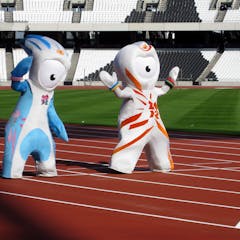
When the mascots for the Olympics (Wenlock) and Paralymics (Mandeville, above) were announced, the response was somewhat cool, if not downright negative. And while we may eventually warm to the one-eyed cousins of Gumby, what they may also do is be a reminder of the important role England has played in the creation of the Modern Olympics and the Paralympics.

At an exhibition at the British Museum, visitors are reminded that Pierre de Coubertin, who is often credited with the founding of the modern Olympics in 1896, was greatly influenced by the “Olympian Games” that had been run in the town of Much Wenlock, Shropshire, since 1850.

Dr William Penny Brookes began the Olympian…

Read full post

Inspired, Dazzled, Moved – part 6

  1. Keith Lyons

    Professor of Sport Studies, National Institute of Sports Studies at University of Canberra

South Africa’s Natalie du Toit claimed her 12th Paralympic gold medal overnight, winning the women’s S9 400m freestyle. EPA/Kerim Okten

Day 6 had 14 sports on the program with 52 medal events in 8 sports (including the first day of medals in Boccia and Wheelchair Fencing). There are just two sports that are yet to start competition (road cycling and wheelchair rugby). Both sports start their games on Day 7.

At the start of Day 6 I saw a replay of Ahmed Kelly’s SB3 50m Breastroke and his Oceania Record in his heat (on Day 5). Ahmed finished fourth in the final. He has become a very popular athlete in Australia following his appearance in the ABC’s Race to London.

The first gold medal of the day was won by Michele George of Belgium in…

Read full post

Inspired, Dazzled, Moved – part 5

  1. Keith Lyons

    Professor of Sport Studies, National Institute of Sports Studies at University of Canberra

After five days of competition, Australia’s Jacqueline Freney has five gold medals. EPA/Andy Rain

Day 5 of the Games had 14 sports in the program with 50 medal events across seven sports. Australia won five medals.

Russell Short won a bronze medal in the F11/12 shot put and achieved a season’s best.

Brad Scott won a silver medal in the T37 1500m in a season’s best time. Brad is a University of Canberra student and is coached by Iryna Dvoskina.

Matt Levy won a silver medal in the S7 100m freestyle in an Oceania record.

Jacqueline Freney added to her gold medal haul with her victory in the S7 Freestyle 100m in a Paralympic Record. Later in the evening she was a member of the 4x100m relay team that won gold in a world record time.

Thirteen…

Read full post

What is the Paralympics really about?

  1. Tracey J Dickson

    Associate Professor, Centre for Tourism Research, Faculty of Business, Government and Law at University of Canberra

It’s what happens around and after the Games that really matters. chrisdonia

It’s not about gold medals, it’s not about prosthetic designs: it’s the legacies that remain. The IPC’s charter say the broad area of legacies are:

  1. accessible infrastructure
  2. development of disability sport
  3. attitudinal change regarding disability
  4. “opportunities for people with a disability to become fully integrated … and to reach their full potential in aspects of life beyond sports”.

It is what happens in the “gaps” between the Games regarding attitudes, opportunity and inclusion that ultimately counts.

If the IPC can achieve these through events such as the Paralympics, then that would be fantastic!

Read full post

Pistorius and prosthetics: what about athletes that can’t change blade length?

  1. Tracey J Dickson

    Associate Professor, Centre for Tourism Research, Faculty of Business, Government and Law at University of Canberra

Leg prosthetics are supposed to ensure both legs are of equal length … but not provide any other assistance. Will Clayton

The debate about Pistorius’s comments about blade length is very interesting.

He has recently apologised for the timing of the comments. In my humble observation, it is only double-leg amputees who can “benefit” from lengthening their blades as a single-leg amputee can only have a blade that is the same length as their remaining leg. As these “blades” have developed one would guess there is some advantage over previous prosthetics.

The blades can vary in length, stiffness, angle, rebound etc.. It must be a nightmare for the IPC as they seek to ensure that you gain no advantage from the technology and to ensure…

Read full post

Australia’s 1,000th Summer Paralympics medal

  1. Keith Lyons

    Professor of Sport Studies, National Institute of Sports Studies at University of Canberra

A medal at the pool takes Australia’s summer Paralympics total to 1,000. Welsh Government / Llywodraeth Cymru

In keeping with the achievements of all Australian Paralympic medal winners, the 1,000th medal was a team gold medal in the men’s 4x100m freestyle relay in a Paralympic record time of 3:50:17.

An APC media release notes:

Led off by Andrew Pasterfield in a time of 52.82, Matthew Levy (1:01.42) and Blake Cochrane (1:00.75) composed the team in the middle legs before Paralympic legend Matthew Cowdrey (55.18) came home over the top of Brazilian Caio Oliveria to win his 10th gold medal and 19th overall.

Matt Cowdrey has four more events to win a gold medal that will establish him as Australia’s leading gold medal winner of all…

Read full post

Hooray for the ABC – a triumph in Paralympics broadcasting

  1. Richard Cashman

    Director, Australian Centre for Olympic Studies; Adjunct Professor, Faculty of Business at University of Technology, Sydney

The ABC’s Paralympic panel discussions, as well as their event coverage, have been terrific. ABC

The ABC has come up trumps both in terms of the quantity and quality of its TV coverage of the Paralympic Games.

The quantity is evident in the amount of time devoted to the Paralympics. Sports fans are able to enjoy nine-and-a-half hours of coverage, much of it taking place during convenient time slots. There is an extended sessions from 4 to 8.30am each morning and another from 7 to 11 pm in the evening. There is also a slick one-hour highlights package from 6 to 7 pm.

As a result, more sports are now covered in depth. While perennial favourites, such as wheelchair basketball, are featured, the ABC coverage also includes unique and unusual…

Read full post

Inspired, Dazzled, Moved – part 4

  1. Keith Lyons

    Professor of Sport Studies, National Institute of Sports Studies at University of Canberra

Maddison Elliott (left) picked up a bronze medal over the weekend, making her Australia’s youngest ever Paralympic medallist at 13. AAP Image/Alan Porritt

Day 4 of the Games had 16 sports in the program. There were 60 medal events in eight sports.

Rowing

There were four Rowing finals at Eton Dorney. As with all Paralympic sports, rowers are classified in terms of their functional ability. There are three classes in rowing, two of which (TA and LTA) involve male and female rowers in the same boat:

AS: athletes can only use their arms and shoulders to accelerate the boat. AS athletes compete in a single scull boat in men’s and women’s events.

TA: athletes can use their shoulders, trunk and arms to accelerate the boat. TS athletes…

Read full post

Why does one boost? An under-researched area

  1. Gregor Wolbring

    Associate Professor, Faculty of Medicine at University of Calgary

Would you sit on a pin if it helped you win a gold medal? ~seb,

The BBC recently had a story Paralympic athletes who harm themselves to perform better which described various ways how disabled athletes try to boost their performance level. Common boosting techniques (boosting is prohibited by the International Paralympics Committee (IPC),) highlighted by the articles are:

  • Overfilling the bladder, by clamping a catheter
  • Sitting on a drawing pin
  • Use of tight leg straps
  • Twisting and/or sitting on the scrotum
  • Cracking or breaking a bone

In a survey of 60 Beijing Paralympics athletes, the IPC found that 17% had tried boosting — and the real number may be higher than that self-reported percentage.

Boosting was also covered in recent…

Read full post

Inspired, Dazzled, Moved – part 3

  1. Keith Lyons

    Professor of Sport Studies, National Institute of Sports Studies at University of Canberra

Wheelchair rugby is one of a handful of sports yet to ger underway at the Paralympics. Atti-la

Day 3 of the Games had 16 sports in the program. There were 49 medal events in seven sports.

After today there are just four sports yet to start competition: Boccia; Road Cycling; Wheelchair Fencing; and Wheelchair Rugby.

Twitter

The #paralympics tag is producing some great current news and reflections. From yesterday I liked @BlueBaby67’s tweet:

That’s amazing blind GB footballer scores and runs to hug team-mate but hugs ref instead

and @GordonMacMillan’s observation:

Amazing stat: Athens pre-sold 1,000 Para Games tickets. Beijing 5,000. London pre-sold 2.3 million tickets.

Kath Proudfoot

Kath competed in the women’s discus (F35-36…

Read full post

To define oneself as less able: a prerequisite for a Paralympian?

  1. Gregor Wolbring

    Associate Professor, Faculty of Medicine at University of Calgary

How can one fulfill the mission of inspiring the world if one first has to self-identify as less able than others? Defence Images

I should right away say that I think the answer to the question should be ‘No!’ The column highlights some wording in the classification code I see as problematic and not-needed.

Now the blog piece.

Keith Lyons in his column gives a short history of disabled people including Paralympians that also participated in the Olympics all the way back to 1904. Very likely that was news to many given that Pistorius so dominated the coverage the last 4 years. He highlighted two disabled people that were competing in the 2012 Olympics, Oscar Pistorius who received a lot of media coverage and Natalia Partika a table tennis…

Read full post

Inspired, Dazzled, Moved – part 2

  1. Keith Lyons

    Professor of Sport Studies, National Institute of Sports Studies at University of Canberra

Winning a bronze medal at 13, Maddie Elliott has become Australia’s youngest Paralympic medallist. Australian Paralympic Committee

There were fourteen sports on the Day 2 program at the Games. There were 40 medal events.

It was a busy day for bloggers too. Amongst them was the Australian Federal Minister for Sport, Kate Lundy. She wrote about the Paralympic history project. John Kessel wrote a fascinating post about Sitting Volleyball. His post was completed just after the remarkable game between USA and China in the women’s competition. The game lasted 99 minutes. Laura Hale continued her Wikinews project and has written a large number of Did You Know posts about the Games (most recently about Nick Taylor and Kristy Pond).

At the Games…

Read full post

Inspired, Dazzled, Moved – part 1

  1. Keith Lyons

    Professor of Sport Studies, National Institute of Sports Studies at University of Canberra

Libby Kosmala, in her 11th Paralympics, was just one of the inspiring performers on day 1 of competition. Australian Paralympic Committee

I was enthralled by the Paralympic Opening Ceremony and staggered by the scale of the event. I found myself thinking back to the newsreel images of the 1948 Stoke Mandeville Games that I had seen in cinemas in the 1950s.

One line from Sebastian Coe’s speech had a particularly strong impact on me. He asked us to be prepared to be inspired, dazzled and moved during the Games. I thought I would used this advice in my blog post titles for the Games (IDM).

Reading Gerard Goggin’s account of the ceremony in this morning’s Conversation has helped me clarify my thoughts about how I might do this. Gerard concludes…

Read full post

Not all Paralympians are created equal (welcome to classification roulette)

  1. Tracey J Dickson

    Associate Professor, Centre for Tourism Research, Faculty of Business, Government and Law at University of Canberra

Australia’s Jacqueline Freney won gold in the women’s 100m Backstroke – S7 … but it’s hard to know what “S7” means if the media doesn’t tell us. EPA/Kerim Okten

Day 1 of competition and already 2 USA swimmers have been reclassified while a 3rd has had her appeal upheld until she is reassessed later. The purpose of classification is to ‘to minimise the impact of impairments on the activity … Having the impairment … is not sufficient’. The aim is to create a more level playing field across a very diverse range of impairments.

E.g. the S7 category, in which Australian Jacquie Freney won gold in the backstroke, includes ‘athletes with one leg and one arm amputation on opposite sides, double leg amputations or a paralysis…

Read full post

Paralympians who are also Olympians

  1. Keith Lyons

    Professor of Sport Studies, National Institute of Sports Studies at University of Canberra

Polish table tennis player Natalia Partyka has represented her country at both Olympic and Paralympic level. Gaël Marziou

Two athletes who competed at the London 2012 Olympic Games, Oscar Pistorius and Natalia Partika will also compete in the Paralympic Games in London.

Oscar will compete in the T44 class in Athletics (400m, 200m, 100m and relay) and Natalia in the class 10 table tennis (singles and team).

Oscar’s participation in the Olympics attracted a great deal of attention. Natalia received less publicity even though these were her second Olympics. In 2008, she and Natalie Du Toit became the first Paralympians to compete at both the Olympic Games and the Paralympic Games in the same year. Natalie Du Toit is swimming in this year…

Read full post

The London Paralympic Games – legacies for all?

  1. Richard McGrath

    Lecturer in Health Sciences at University of South Australia

Will the Paralympics inspire greater social inclusivity for people with impairments? Rushbypics

The London Paralympic Games is now upon us. The Opening Ceremony has been held with all the pomp and ceremony of any other major event.

But what does this event do for promoting the inclusivity of people with impairments into daily life?

None…some?

Should we expect it to?

It will be interesting to see how the general media and the associated blogging/tweeting/Facebooking discusses and digests the London Paralympic Games.

Will we see the usual grandiose statements about “Overcoming adversity” or “Heroic triumphs” being connected to elite athletes. Athletes who are focused on participating and achieving the best they can (like all elite…

Read full post

Paralympics Opening Ceremony: I think I may be a Philistine!

  1. Tracey J Dickson

    Associate Professor, Centre for Tourism Research, Faculty of Business, Government and Law at University of Canberra

Watching the opening ceremony at Trafalgar Square. Tracey Dickson

I was really excited to be able to watch the Paralympics Opening Ceremony with hundreds of others at the BT Live site at Trafalgar Square.

I secured a great position about 90 minutes before it began. I enjoyed the beginning, the story, the music, the artistry, and then the athlete procession began, and it went on and on and on.

I know it’s a fantastic thing to be there, I know it’s a wonderful opportunity for the athletes and the team supporters to enjoy the crowds, but as a spectacle, while standing outside in the cooling London air, I found it hard to stay focused; it helped that Australia comes out early in the parade of nations.

So I returned to my hotel to continue…

Read full post

Expectations of the Paralympics

  1. Gregor Wolbring

    Associate Professor, Faculty of Medicine at University of Calgary

Will you watch as much of the Paralympics as you did of the Olympics? Yannig Van de Wouwer

What do disabled people in the UK and the non-disabled British Public expect from the Paralympic Games?

Let me give you some results of different polls reflecting the British public and disabled people’s and their families attitudes toward and views of the Paralympics.

Poll of the British Public

A UK poll performed by COMRES/ ITV NEWS reveals:

  • 10% say they are planning to watch more of the London 2012 Paralympic Games on TV than they did the Olympics, 45% plan to watch about the same amount and 37% plan to watch less of the Paralympics coverage.

In the UK the coverage seems to be extensive. However what is the coverage outside the UK especially…

Read full post

Getting to the starting line at the Paralympics: easier for some than others

  1. Simon Darcy

    Professor & Co-Director Cosmopolitan Civil Societies Research Centre - UTS Business School at University of Technology, Sydney

Will boccia – which is played by athletes with cerebral palsy – get the same media coverage as other, higher-profile sports? Comisión Nacional de Cultura Física y Deporte

In watching the opening ceremony of the Paralympics I can’t help but be struck by a number of divides and how these may or may not play out over the coming weeks. The first involves the divide between developed and developing nations with respect to the science of sport performance and sport technology. The second involves the relative coverage of disability type and disability sports across the games.

Just as we observed with the Olympics, we see a divide between the developed nations and the developing nations where in some sports the developing nations cannot get…

Read full post

It’s deja vu (all over again)!

  1. Dave Arthur

    Sport Business, SC Business School at Southern Cross University

Peter Norfolk (nicknamed “The Quadfather”) is one of the athletes to watch at this year’s Paralympics. robbiesaurus/Flickr

As I write this, the Paralympic opening ceremony is in full throes with the athletes streaming into the stadium in the traditional march-on. This year will see 4,200 athletes and 166 national Paralympic committees represented and there is much to look forward to with the Games. It seems that the British public, so engaged and passionate during the Olympics, will do this event similar justice.

The opening ceremony was sold out and many of the events over the 11 days will be similar or at high capacity with around 2.5 million tickets already sold.

There are 502 gold medals to be won so what and who should…

Read full post

Missing the Olympics? Never fear, the Paralympics are here

  1. Matthew Taylor

    Lecturer in Biomechanics at University of Essex

Don’t fret: the Paralympics is just around the corner! Kalexanderson

If you have PODS – Post-Olympic Depression Syndrome – don’t fear: the Paralympics are almost here. It looks as though this will be first Paralympic games to be a sell out, with an unprecedented demand for tickets.

Unlike the Olympics I actually have more than one ticket (four in fact) for the Paralympics. My Olympic blogs focused on athletics and in particular sprinting and I will have the same focus for the Paralympics.

I have a particular interest in amputee sport and there is always an interest in Oscar Pistorius (a double-amputee sprinter) – the only amputee with a prosthesis to compete at both the Olympics and Paralympics.

If we’re being pedantic we should probably…

Read full post

One more sleep until the Paralympic Games

  1. Keith Lyons

    Professor of Sport Studies, National Institute of Sports Studies at University of Canberra

Get ready for a couple more weeks of disrupted sleep. Neil. Moralee

No sooner had we gotten back into something resembling a normal sleeping pattern after the Tour de France and the London Olympics, than the Paralympic Games are set to begin.

This year’s Games in London will see 4,200 athletes from 166 countries compete in 21 sports. These Games have the highest ever participation by female athletes: 1,513.

One of these athletes is Hellen Saohaga from the Solomon Islands. Hellen is the country’s first Paralympian and their only competitor at the Games.

I am looking forward to learn more about the athletes and their performances as the Games unfold. I have been following Australian Paralympians for the last year through a project to…

Read full post

Classifying Australia’s vision-impaired Paralympians

  1. Meri Vukicevic

    Lecturer, Faculty of Health Sciences at La Trobe University

Goalball competitors wear goggles, reducing their vision completely. World of Good

As an orthoptist and academic in the Department of Clinical Vision Sciences at La Trobe University, I also volunteer my time as a National Classifier of vision impaired athletes for the Australian Paralympic committee. I am really looking forward to watching how the team performs in London this year!

Australian Paralympic Classifiers are trained and certified officials who assess athletes to determine their sport class and sport class status, in accordance with the classification rules for their particular sport. Each classifier has medical or technical qualifications and are trained and certified by sports federations and work in a voluntary capacity with…

Read full post

An ongoing association with the Paralympics and sport for people with disabilities

  1. Simon Darcy

    Professor & Co-Director Cosmopolitan Civil Societies Research Centre - UTS Business School at University of Technology, Sydney

Louise Sauvage wins the women’s 800m wheelchair demonstration event at the Sydney Olympics.

I have had a long-term interest in the Olympics and Paralympics since the NSW government submitted a bid for the Sydney 2000 Olympic Games in 1990 and the subsequent announcement in 1993 by Juan Antonio Samaranch that the winning bid was “Syydddnnnnnnnneeeeyyyy”.

It wasn’t until two years later in 1995 that Sydney confirmed they would hold the Paralympic Games. As the history of the Paralympic Games shows, it was not until quite recently that the Paralympics were confirmed to be held in the same city as the Olympics. In Sydney, like other cities, this became a negotiation after the announcement of Sydney as the 2000 Olympic city.

In the lead up to the…

Read full post

Do the Olympics and Paralympics really leave a social legacy?

  1. Tracey J Dickson

    Associate Professor, Centre for Tourism Research, Faculty of Business, Government and Law at University of Canberra

Volunteers are essential to the smooth-running of the Olympics and Paralympics. astronomy_blog

The discourse around events like the Olympics or Paralympics is frequently that the bid committees and the politicians promote the potential legacies for the communities.

These can include built legacies such as new stadia (Beijing), urban redevelopments (London and Sydney), and increased stocks of hotel rooms (Barcelona). Some environmental legacies can include protecting endangered species (Sydney), and showcasing environmental best practice (Vancouver).

Finally, social legacies are discussed such as increased sport participation (Sydney and London) and a volunteer legacy beyond the games (Vancouver, London and Sochi). For London, hunger…

Read full post

Putting Paralympics media coverage in the spotlight

  1. Gregor Wolbring

    Associate Professor, Faculty of Medicine at University of Calgary

Oscar Pistorius has received much media attention in recent years and this is likely to continue. Global Sports Forum

The Paralympics is certainly a big event in the calendar of disabled sportspeople. But the Paralympics are also a time of uneven and problematic reporting. Media coverage during the Paralympics will be one focus of mine, comparing London 2012 coverage with the coverage generated around former Paralympics to ascertain whether improvements can be observed.

I will tap into the observations of my students who, like me, work on the topic of sport participation among disabled people. Another focus will be the coverage of the “blade runner”, Oscar Pistorius, at the Paralympics, which seems to be an ongoing saga.

I’m also keen…

Read full post