
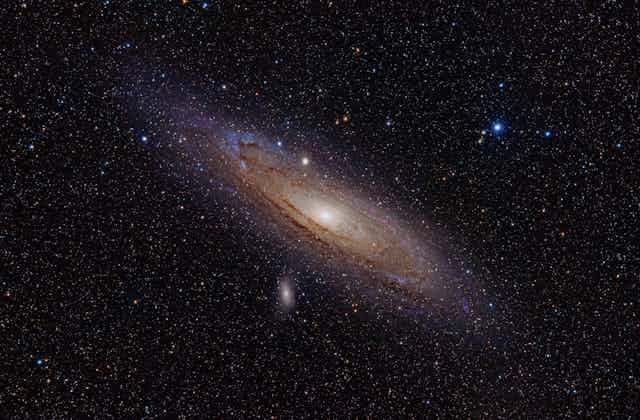


Deep images of the sky reveal that the universe contains billions of galaxies. Some, such as our own Milky Way, are immense, containing hundreds of billions of stars. Most galaxies, however, are dwarfs, being much smaller and with only a few billion stars.
Modern cosmology has proved to be amazingly accurate in predicting how galaxies are scattered through the universe. Instead of being randomly thrown about, galaxies seem to live together, some in clusters of a thousand individual systems, but most in groups of tens or hundreds.
But new research on dwarf galaxies by my colleagues and me – published in the journal Nature – seems to present a major challenge to ideas of how the universe actually works.
After more than a decade of study, we’ve discovered that small galaxies that accompany the nearest spiral galaxy to our own – the Andromeda Galaxy – are dancing together in a vast plane.
To understand why this is significant, we need to begin with what we know about the universe and our own cosmic backyard.
Local galaxies
The Milky Way is located in the “Local Group”, a small patch of the universe it inhabits with the similar-sized Andromeda Galaxy, and a smaller spiral known as the Triangulum Galaxy.
Accompanying these larger systems are almost 100 dwarf galaxies. Those of us lucky enough to be living in the Southern Hemisphere can clearly see two of these dwarf galaxies in the night sky, namely the Large and Small Clouds of Magellan.
These many Local Group dwarfs tend to be grouped around the larger galaxies, precisely as predicted by our understanding of the expansion of the universe and the growth of cosmic structure. But it is precisely these dwarf galaxies that are proving to be a serious headache for the cosmological models they appear to be supporting.
Where are all the galaxies?
The first problem, known as the “missing satellite problem”, has been known for more than a decade. While the almost-100 galaxies in the Local Group may sound impressive, this is far fewer than the several thousand predicted by cosmological theories.
Some believe that our diminutive dwarf galaxy population is a crippling blow to the prevailing “cold dark matter” model of galaxy formation – that is, the idea that dominant component of mass in the universe is invisible to us, the scary-sounding dark matter which shepherds atoms into the stars and galaxies that we see.
Others, however, think there is no crisis, suggesting the dwarfs are out there as starless dark matter halos, having lost their gas – the raw material for forming new stars – due to the explosions of super-stars in the very early universe.
This neatly brings us to our result in the Nature paper.
PAndAS
For more than ten years I have been part of a collaboration that has been trying to map out the extensive stellar halo of Andromeda.
This tenuous distribution of stars, which extends hundreds of thousands of light years away from the Andromeda Galaxy, is made from the remnants of small galaxies that have strayed too close and have been cannibalised by the larger galaxy.
Over the years, our collaboration has used large telescopes and sensitive instruments to map out the immense portion of the sky that encompasses Andromeda’s halo. Since 2008, we have used the 3.6m Canada-France-Hawaii Telescope to undertake the Pan-Andromeda Archaeological Survey (or, more cutely, PAndAS).
Now that the data-taking and processing is complete, the scientific results from PAndAS are starting to flow. As well as the stellar halo, there are large, extended shreds of stars, the ongoing cannibalisation of other systems and lots of globular clusters – small balls of a million stars living together.

Within PAndAS we found almost 30 dwarf galaxies orbiting Andromeda, most of which were identified only in the past few years. With the quality of the PAndAS data, PhD student Anthony Conn was able to accurately measure the distances to each of the dwarf galaxies and, for the first time, we knew the three-dimensional distribution of dwarf galaxies surrounding Andromeda.
Randomly distributed?
What do our theoretical models for the structure and evolution of galaxies tell us about the expected distribution of dwarf galaxies around large galaxies? While we know there are not as many dwarfs as predicted, our models tell us that the ones we do see should be buzzing around randomly like a swarm of angry bees.
So, what do we see with the dwarfs orbiting Andromeda? On the face of it, it seems that the theoretical predictions are borne out, with the dwarfs seemingly distributed at random.
But we decided to look a little deeper and see if there was any underlying structure in the dwarf galaxy population. Instead of considering the entire dwarf population, we instead looked for structure subsamples of galaxies, comparing the actual distributions to many thousands of randomly generated samples.
What we found surprised us, with 13 dwarf galaxies lying in an extremely thin plane, 45,000 light years thick, but immense in size – 1.2 million light years in diameter. Such a configuration would appear extremely rarely in a randomly distributed population of dwarfs.
Rather strangely, the edge of this plane points towards the Milky Way; the plane could have been oriented in any direction, but is this mysterious alignment telling us something about the planes origin?

Only the beginning
But there were more surprises to come. As the dwarfs were initially discovered, they became the targets of the world’s largest telescopes, using the Doppler shift of light to measure the velocities of the individual galaxies. What we found stopped us in our tracks.
The dwarfs north of Andromeda were moving towards us, while those in the south were moving away from us. That is, this vast plane of dwarfs is rotating!
Remember, nothing like this plane is predicted in our cosmological models.
The mystery deepens when we look closer to home where there has been growing evidence that the Milky Way possesses its own plane of dwarf galaxies, known as Vast Polar Structure (VPoS).
Perversely, studying our own galaxy’s stellar halo is more challenging than that of Andromeda as we need to image the entire sky, but the evidence is growing stronger that the Milky Way and Andromeda possess unexplained planes of dwarf galaxies.
What are they doing there?
Tidal dwarfs?
Some have suggested that what we see are not normal dwarf galaxies, but are actually “tidal dwarfs”, small agglomerations of stars that form from the debris when a large galaxy tears apart a smaller one.
But such dwarfs are transitory and quickly disperse, so such planes should be rare and we would be extremely lucky to see them in both the Milky Way and Andromeda at the same time.
Furthermore, if what we are seeing are truly tidal dwarfs then we are missing even more of the satellite galaxies predicted by our theories for the growth of structure in the universe.
Hence we are faced with a serious cosmological conundrum, a problem that our current theoretical models have to explain if we are to have faith that they are an accurate description of the universe around us.
And if they cannot, well, we mightn’t have to go right back to the drawing-board, but we will need to question our underlying assumptions on things like the nature of dark matter.
Some already think the existence of these planes is telling us that we should be questioning the more fundamental properties of the universe, including the very existence of dark matter and even the action of gravity.
So, what is the solution? Honestly, I do not know, but it is going to be fun trying to find out.