
Crops hit by drought and biofuel policy: another food price crisis?

Not so long ago, things were looking good. The UN’s Food and Agriculture Organization (FAO) had announced on the 5th of July that the FAO food price index had been falling for the third consecutive month and that in May of this year the index had been at its lowest since September 2010. But the optimism…

5rmjzgxh-1343713531
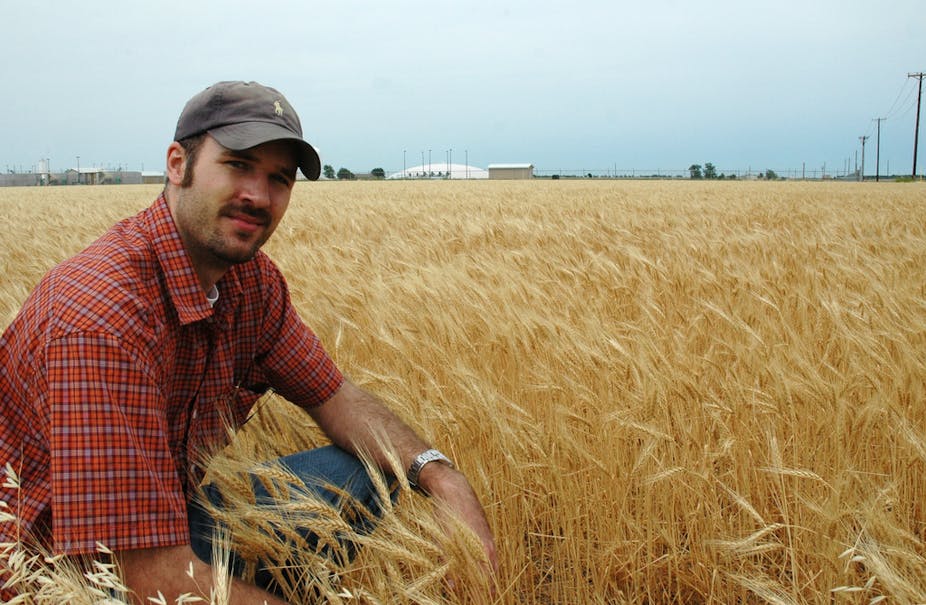
The rains came too late for these Texas wheat crops, which are stunted and thin. But there’s more to rising food prices than bad weather. Flickr/agrilifetoday

Not so long ago, things were looking good. The UN’s Food and Agriculture Organization (FAO) had announced on the 5th of July that the FAO food price index had been falling for the third consecutive month and that in May of this year the index had been at its lowest since September 2010. But the optimism may be short-lived.

The adverse weather of continuing drought in the USA and in particular in most of the major corn-growing regions, is bringing volatility back on international food prices, an untenable situation for world food security and in particular for developing or emerging economies.

Droughts hitting crops

According to the statistics services of the United States epartment of Agriculture (USDA), by the end of last week 45% of the US corn and 35% of soybean crops had been rated of very poor condition, the worst US crop result since 1988. Wheat is the next crop to be affected but if rainfall comes (as forecasted by the USDA) this may ease the tension a little. While the rain forecast may be too little too late for the corn and soybean crops, the fate of wheat has yet to be decided.

On the other side of the planet, Russia has had to re-align its forecast of wheat production, also caused by drought conditions. But so far, the Russian government has not banned wheat exports as it did in 2010.

The fluctuation of commodity prices on international markets reflects the volatile nature of agricultural markets. Corn and soybean are now trading 30% higher than what they were only a month ago.

Biofuel demand driving crop prices higher

US federal ethanol mandates (requiring fuel distributors to use a certain amount of ethanol each year) have played an important role in the increase of corn prices. The US policy has driven an artificial demand for corn. When first introduced in 2005, ethanol production accounted for 5% of the demand for corn. Today about 40% of the US corn production is used for biofuels.

The mandatory increased production of ethanol has had a large impact on corn prices because of the fixed nature of the demand. In a free market environment, if the price of a commodity goes up, demand goes down, naturally re-adjusting the price signals. But the ethanol mandates require the same amount of ethanol to be used irrespective of corn prices.

Ohio corn: about 40% of US corn goes not to food production but to use in biofuels. Flickr/Graylight

Are we entering a new food price crisis?

There is little doubt that the liberalisation of trade and investment (understand financial speculation on agricultural commodity markets) are key ingredients for turning any large supply shocks into a world food crisis.

The global restructuring of the agri-food business has led to the depletion of international stocks since the beginning of the millennium. Large precautionary inventories commonly held by governments and private grain dealers (to absorb supply shocks) were allowed to shrink as everyone had come to believe that countries suffering crop failures could always import the food they needed.

As a result, whilst international cereal stock levels corresponded to about 110 days of consumption in the late 1990s, by 2007, these had dropped to only 50 days, sacrificing food reserves for corporate “food security”. The forecast for 2012 is that world cereal stocks represent about 70 days of consumption.

The domino effect is in operation. High corn prices are putting pressure on other agricultural commodities as well. Wheat, soybeans and other crops are now being used as feed substitutes to corn, pushing their prices even higher.

The global wheat supply and demand has tightened recently and Australian wheat growers may well cash on it and pick up a large slice of the upside trend.

Complex international markets

On the other hand, it is unlikely that the Australian corn producers will benefit greatly from the rise of international corn prices. In fact, the 2012 Australian maize production (similar to the 2011 crop) will be around 350,000 tonnes, a sufficient quantity for the national 320,000 tonnes domestic and feedstock usage.

The soybean situation is different as the bulk of the international production comes from the USA, China, and Brazil with Australia being a net importer to an annual value of $100 million.

One important outcome of these long-term structural adjustments is that most countries and in particular developing and transitional economies have suffered significant degradation of their agricultural sectors and are no longer self sufficient.

The loss of national food self-sufficiency compounded with low global stock-levels provides a favourable environment for what some scholars refer to as a “perfect storm”, a situation for which the dangerous combination of different developments, in this instance supply shortfalls combined with low stock-levels, leads to an unavoidable state of crisis.

Rising food prices sparked riots in Haiti in 2008. AAP/EPA/Kena Betancur

International agricultural commodity prices have many pressure points. Obvious ones range from growing demand for food to poor harvests caused by climatic events. But some of these pressure points are not as visible, but are as powerful. Government policy is an example. It is likely that the US federal policy on biofuels is felt all over the world from Japan to African countries when importing corn.

The productivist logic underlying the restructure of the international agri-food system has widened the gap between the “haves’” and the “have not”. Whilst Australian wheat growers may be enjoying the rising demand for wheat today, the euphoria may not be shared by the Egyptian people who rely largely on imported wheat to complement their diet.

The food price spikes of 2007/2008, 2010/2011, and a possible 2012, occurring in short succession make clear that not enough is done to ensure that enough food is accessible and available for all.

Comments welcome below.

Join the conversation

21 Comments sorted by

  1. Geoff Russell

    Computer Programmer, Author

    If you are concerned about the road toll should your concern be for the big causes (motorcars) or the little contributors (bicycles)? If somebody wrote an article purporting to be about the problems of the road toll without mentioning motorcars and concentrating on bicycles, you'd be a little suspicious of their motives or their intelligence. Yes?

    So here we have an article showing concern about food prices, presumably because of the toll on the hungry and considers the smallest of the diversions of food production capacity ... biofuels and ignores the biggest unnecessary diversion, the use of food and food production capacity to feed livestock. This makes no sense either from the general environmental perspective , from the greenhouse gas perspective or the health perspective.

    So I'm guessing the author eats meat but doesn't use biofuel.

    report
    1. Matthew Wyres

      Mechanical Engineer

      In reply to Geoff Russell

      Firstly, if the author has a car in Australia, it is unlikely that she has escaped the use of biofuel.

      But also, I would suggest its more likely that the author has a very limited amount of space to discuss a single issue, and while livestock may be a more significant issue in the debate, it is not a new issue.

      As someone who was familiar with the livestock issue, but was not familiar with the impact of biofuels on food supply, I beleive it was an interesting read.

      report
    2. Tim Scanlon

      Debunker

      In reply to Geoff Russell

      Geoff's points are largely irrelevant to the discussion.

      Biofuels are projected to grow at 4.8 to 5% pa between now and 2021. That means we'll see a doubling of biofuels, much of it government mandated. This has price, environmental, production and food supply pressures.

      Given the use of biofuel and its displacement of food from the productive land, which we have less of and will continue to have less of, the trade off in acceptable use of land is the issue. Food grains, feed grains, grazing and horticultural lands are already going to be under enormous pressure to be productive and feed the growing population of people. This is without the looming issue of climate change impacts, which are likely to be substantial given the changes that have already occurred.

      This report has more on the production outlooks: http://www.oecd.org/site/oecd-faoagriculturaloutlook/

      report
  2. Ron Chinchen

    Retired (ex Probation and Parole Officer)

    The thing is that when the US introduced its ethanol policy, a policy somewhat copied in other nations such as Brazil. it seemed bleeding obvious that this would have an impact on food production. But cars and big business are more important than human lives arent they?

    report
  3. David Leigh

    logged in via Facebook

    The problem has always been food or biofuel, right? Well, it doesn't have to be that way. Grow commercial hemp, extract biofuel from the seeds, use the meal for food (actually, very good for you) and you still have the fibre... Simple really. The US needs to change its tack on the hemp plant, because oil is running out and therefore so is the waste. The giant conglomerates that control policy in the US will also need to find another source of fibre. They will suddenly find that hemp is not the wicked, evil monster that is going to destroy civilisation. It grows in all soil conditions and temperature zones. It requires less water, no pesticides or herbicides and grows in a business cycle. Moses really knew what he was doing when he showed the Israelites mana.

    report
  4. Little Survivors

    logged in via Twitter

    All of the factors that cause depleted food supplies and increased food prices need to be given attention and addressed by all relevant organisations, including the FAO and national governments.

    The best the public is able to do is ask their governments to give the issue of food security the attention it deserves. Not-for-profit organisation Little Survivors International has started a petition on change.org, please cna all those interested in this issue please look at the petition and sign if you agree. The petition is directed to the Indian Government because of their bold plans for use of biofuel, however the petition letter can also be sent to other nations if relevant.

    The link is: http://www.change.org/en-AU/petitions/prime-minister-use-biofuel-without-depleting-food-supplies

    Thanks!

    report
    1. Geoff Russell

      Computer Programmer, Author

      In reply to Little Survivors

      Do you also object to using food as feed? Australia feeds about 12 million tonnes of grain annually to livestock. Globally the tally is about 800 million tonnes. In developing countries livestock typically grazes crop stubble depressing productivity and leaving the soil bare for erosion. They also foul water supplies which leads to all manner of childhood health issues.

      Sure, biofuel is a problem deserving of attention, but why not deal with the big and simple issues first? Livestock in developed countries easily outbids the poor for food. Checkout a bag of chook pellets at a grain store, ~15% protein, laced with vitamins and minerals and often special enzymes to aid energy extraction.

      https://www.mja.com.au/open/2012/1/2/plant-based-diet-good-us-and-planet

      report
    2. Tim Scanlon

      Debunker

      In reply to Geoff Russell

      You still haven't read the variety guides I sent you the links to yet Geoff. Please read them as they point out the difference between feed varieties and food varieties of various crops and how they are not necessarily suited to the same agricultural lands. You cannot just assume that all feed grains could be used by humans, that is not the case.

      report
  5. Ewen Peel

    Farmer

    The Author here has touched on some very relevant issues but might have overlooked some of the key drivers of the current problem.
    Last year most grain growers basically worked for nothing and after all the costs of production were taken into account, unless yields were very good most growers were lucky to break even. Prices were poor, and here in Australia with the high dollar it was even more painful.
    So not wanting to face this outcome again growers reduce the areas planted, use less inputs…

    Read more
  6. Gerard Dean

    Managing Director

    Ms Busicchia

    Good article explaining the increasing pressure on the earth's natural resouces. I don't believe bio mass (corn, wheat stubble, sugar cane waste, algea) derived bio fuel can come close to providing the transport energy we need.

    Firstly, the net energy output for the bio fuel process is marginal to average. Depending on the crop and season, it may take as much energy to grow and process the biomass as the fuel produced. Even in good years, the return may be only 100 to 200% which…

    Read more
  7. Gil Hardwick

    Anthropologist

    Brigit, we are reasonably entitled to expect better than this by now. In 2007 enough food was produced to feed 12 billion people, currently I understand 11 billion people.

    There is no 'food crisis', especially as the result of land being used for biofuel crops or whatever other use to which land may be being put including housing development and urban expansion.

    Even here in Australia, with soil quality and land productivity at around 10% of the best land in Europe, Central and East Asia and North America, we still manage to feed 60 million people before breakfast every morning.

    If you want to have a look at real food crises, direct your attention toward politics, take Egypt as an example which has traditionally been the food bowl of the North African Mediterranean yet still suffered food riots.

    In the meantime, farmers are well within their rights to diversify, and produce whatever crops for which there is a market.

    report
    1. Michael Silverton

      logged in via Facebook

      In reply to Gil Hardwick

      No one is questioning the right of farmers to meet the market. The issue with biofuels is whether it is appropriate to artificially create a market through a government mandate.

      report
    2. Colin David Butler

      Professor

      In reply to Gil Hardwick

      Dear Gil, I would appreciate a reference for your statement that in 2007 enough food was grown to feed 12 billion people; it seems a little high to me (even if we were all to be eat plant foods or grass-fed animal products.) Thanks.

      report
  8. David Boxall

    logged in via Facebook

    I've often wondered about the sense and ethics of devoting valuable, arable land to growing crops for the production of a low-grade biofuel like ethanol. The same goes for using valuable nutrients to produce a low-grade biofuel like methane. When, as in the US, the crops used to produce ethanol are grains, it's hard to comprehend.
    If that's what we want to do, then there are far more efficient and effective ways to use nutrients in producing biofuels. There's no need to tie up valuable land in the process.
    As I understand it, the real problem is not so much a shortage of food as getting enough food to the right places. In the final analysis, priority must go to producing enough food and getting it to where it's needed. As for biofuels, we'll just have to learn to work within the limits of what we can produce from the resources that are left over.

    report
  9. Gerard Dean

    Managing Director

    A thought on jet biofuel. I was just referred to the Algae Tech site by another blogger who wanted to demonstrate that there is a sustainable alternative to hydrocarbon JetA1 fuel (my favourite rant).

    Algae Tech have just commissioned their first algae system in NSW and intend to produce bio diesel, bio jet fuel and industrial feed stocks. Their press release mentions that each 40 foot shipping container can produce up to 250 tonnes of algae per year. The process requires carbon dioxide from…

    Read more
    1. David Boxall

      logged in via Facebook

      In reply to Gerard Dean

      A bit early in the game to be coming to any conclusions. Do you deny that it's a proof of concept; a demonstration of possibilities?

      report
  10. Gerard Dean

    Managing Director

    A late one, so hopefully the Red Tickers won't notice.

    Seriously, I have been checking out Australia's liquid fuel usage with a view to see if replacing it with biofuel is practical. It's scary. I used corn as an indicator, other crops will provide more or less energy per hectare.

    Australia uses 49.5 Giga Litres of Fuel, (petrol, diesel, LPG and CNG gas and Jet fuel) annually. The only current biofuel technology making useable fuel is ethanol production. Brazil is the largest producer, but…

    Read more
    1. David Boxall

      logged in via Facebook

      In reply to Gerard Dean

      Many years ago, the ABC aired a documentary on oil; 'Crude' was the title. In that, the world's oil consumption was given as 4.5 cubic kilometres per year.
      Has anybody said that it will be easy? Has anybody said that we won't have to make changes to the way we do things? Has anybody said that it can't be done?
      I see opportunities galore.

      report
    2. Gerard Dean

      Managing Director

      In reply to David Boxall

      I take your point Mr Boxall

      report
    3. Gerard Dean

      Managing Director

      In reply to Gerard Dean

      Why did someone give me a Red Tick when I agreed with Mr Boxall

      Some people are very hard to please

      Gerard Dean

      report