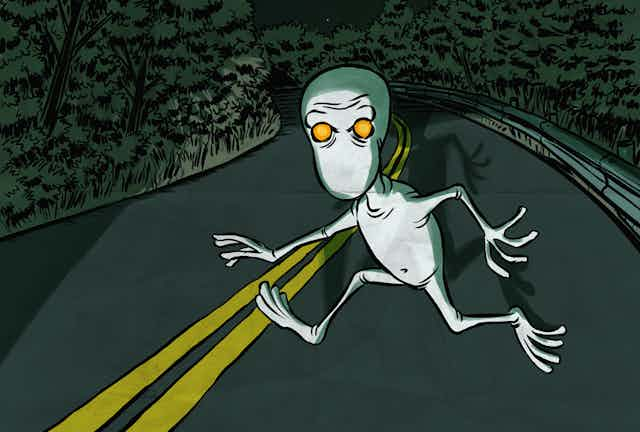
Cryptozoology? No need for an apology

All forms of science are reliant on facts, hard evidence and statistics to maintain relevance and credibility. But what of the legitimacy of the so-called “pseudosciences”? A warning: I’m going to pick on cryptozoology here – the study of hidden, extinct or mythical creatures. Creatures dear to the…

Yyhm8psp-1361840357
Claims of mysterious creature sightings dominate cryptozoology – but where is the evidence? Chi-Yun

All forms of science are reliant on facts, hard evidence and statistics to maintain relevance and credibility. But what of the legitimacy of the so-called “pseudosciences”?

A warning: I’m going to pick on cryptozoology here – the study of hidden, extinct or mythical creatures.

Creatures dear to the cryptozoologist’s heart include: the kraken, ogopogo, Nessie, the chupacabra, yowies, mermaids, orang pendek, and the coolest of them all, the Mongolian Death Worm. If you’re interested in these and others, Wikipedia will keep you busy for hours.

Despite the (lack of) plausibility, one of the main criticisms levelled at scientists is that we won’t investigate cryptozoologists' claims. As Australian cryptozoologist Rex Gilroy said:

Go and search for the evidence rather than be critical. I have struck a lot academic criticism over the years by people who stick to a textbook and who are glued to their office desk.

Why not go and search?

I can already hear the dull chanting of Carl Sagan’s “extraordinary claims require extraordinary evidence”. But this is not why we don’t investigate strange ideas.

To publish or not to publish

Scientists consider strange ideas all the time. Indeed, we make up most of them. If we lived by Sagan’s mantra, scientific inquiry would never happen.

The reason research is not done on extraordinary claims is quite simple: “publish or perish”.

Let me explain.

If you want to be a professional scientist, you need to do science. This means formulating questions to answer, doing the research, and then, publishing the work.
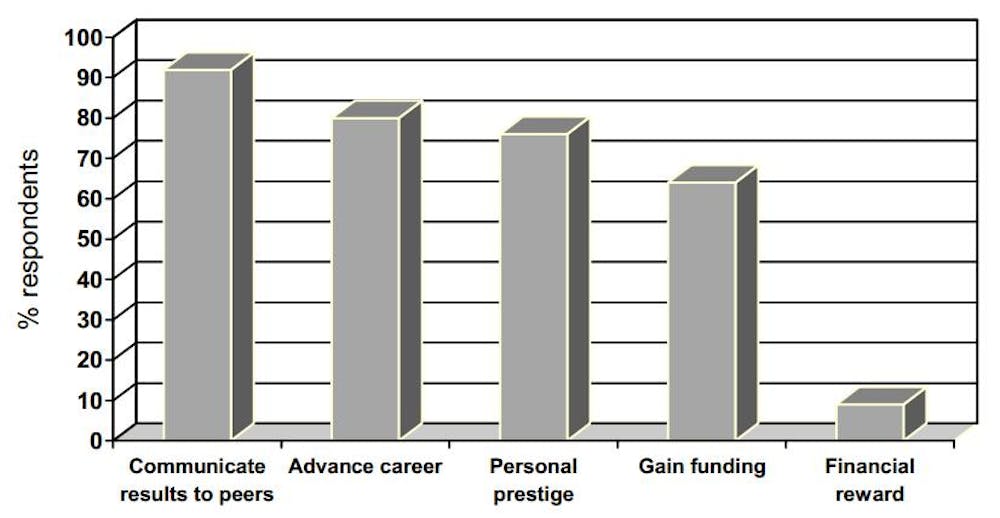
Why do researchers publish their work? Alma Swan

As you can imagine, doing research costs money. This means going on bended knee to those holding the purse strings. They evaluate your project and your ability – that is, your published research – to carry out the project.

It is basically a catch-22 situation. Without a good publishing history, you will likely not get funded. But you can’t do much research without the funding. And around we go.

Hence the phrase, publish or perish.

You would think then that making a big discovery would be great for a scientific career. It absolutely is!

No scientist, ever, would turn down discovering a new species, especially something such as Bigfoot. It would be an instant publication in a major journal, and research funding would flow like the Amazon River.

As such, scientists are not shying away from strange claims because they don’t want to make discoveries. They shy away because of the plausibility and probability of making the discovery.

Let’s take Bigfoot as an example.

Bigfoot, a 500-kilo bipedal primate standing 3.0 metres, is biologically possible. Other than the bipedal locomotion, a primate from South-eastern Asia, gigantopithecus, would have fit the bill – if it hadn’t gone extinct 100,000 years ago.

But given biogeography and population biology, such a species is not plausible.

Bigfoot’s biggest bunions are his biggest supporters, the Bigfoot hunters. Sightings of the creature have come from all over North America.
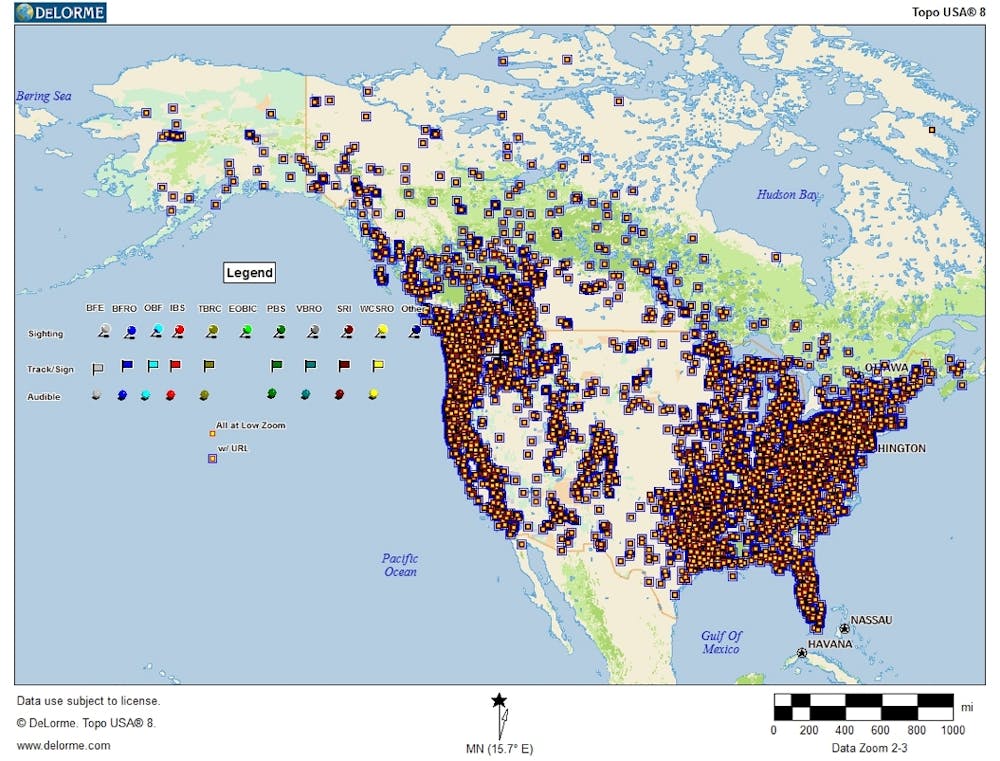
Bigfoot sightings in Northern America – seems like you can’t go outside without running into him. Mangani's Bigfoot Maps

Yet any species with a huge distribution would consist of a large number of individuals, and therefore, we would have plenty of physical evidence.

Proponents justify this lack of evidence by claiming Bigfoot is low in numbers, and they bury their dead, and …

Whoa Nelly! You’re telling me in a country where there are 88 guns for every 100 people no one has shot and recovered the body.

Until 2009, there were no sightings of pygmy hippos in all of Australia, nevertheless a NT hunter managed to shoot one.

You can’t have it both ways. The Bigfoot population cannot stretch across North America enabling sightings every other Tuesday, and be in such low numbers that solid evidence never materialises.

In Bigfoot’s case, scientists don’t look because he is simply not plausible.

Dealing with claims

Not all claims are in this canoe though. If tomorrow’s newspaper headline was: “Panther found in Australia”, I wouldn’t be surprised.

Wildlife trafficking is one of the three largest crimes in the world and large cats are certainly on the price list. If you do a search of “exotic” animals in Australia, you quickly realise Australia is not immune from the industry.

Regardless of whether animals are being kept legally or illegally, escapes can and do happen. In 2008, a 1.5 metre alligator was found in Pambula, on the south coast of New South Wales.

Though a big cat living in Australia is as plausible as a hippo or alligator, to commit research time and funding to finding it is too much of a gamble.

If one could be found, great! But what if nothing is found? Years could pass without finding a thing – and that translates to not publishing a thing.

And for a scientist, that’s game over.

Cryptozoologists shouldn’t be too concerned. Scientists are doing research all over Australia: if strange critters are out there, they will be detected incidentally.

The ‘rediscovered’ yellow-spotted bell frog in NSW.

At the end of the day, it’s encouraging that passionate, amateur zoologists are out looking for animals. I, for one, would rather they look for Bigfoot than sit at home watching Big Brother. And if they find solid evidence, a scientist will always be keen to have a look.

When it comes to scientists conducting research, it boils down to a simple calculation that everyone recognises:

What do we spend our finite resources on?

Odd animals may exist, but there are certainly many that need our attention now. And in the meantime, let’s see what else we come across.

Further reading:
The bigger the Bigfoot claim, the bigger the need for evidence

Join the conversation

15 Comments sorted by

  1. Tim Traynor

    Rocket Surgeon

    Dustin, I'd love to see an analysis of Melba Ketchum's paper based on its content / conclusions, rather than on its dodgy road to publication. I'll pay the $30 to get you a copy if you'll do it.

    report
    1. Stephen John Ralph

      carer

      In reply to Dustin Welbourne

      I must say that since reading The Conversation and noting the qualifications and jobs of many of the contributors, I am amazed at just what is taught at Universities.

      Given the range of subject matter, I would have thought that Cryptozoology would be quite at home on a university curriculum.

      No wonder kids can't read these days when so much money is spent on the most esoteric subjects.

      let's get back to a few basics...........

      report
  2. Mat Hardy

    Lecturer in Middle East Studies at Deakin University

    And what if somebody did discover a panther living in the Blue Mountains? It wouldn't exactly be a finding that would show some sort of great research breakthrough anyway. Just proof that one had been introduced and got free.

    Now a Yowie or bunyip would be another story....

    report
    1. Geoffrey Edwards

      logged in via email @gmail.com

      In reply to Mat Hardy

      "Just proof that one had been introduced and got free."

      I wouldn't call it proof. Capturing one would only proove that there was one. Not where it came from.

      Not saying the exotic import scenario would not be the most plausible explanation, just discussing what the evidence actually tells us.

      And if you do catch my panther, I want it back.

      report
    2. Sebastian Poeckes

      Retired

      In reply to Geoffrey Edwards

      Actually, some crypto groups, such as "The Search for Thylacoleo" do some useful work with remote cameras in the bush. Occasionally they come up with interesting sightings of rare animals in unexpected places. No thylacoleos though.

      report
    3. Peter Campbell

      Scientist (researcherid B-7232-2008)

      In reply to Mat Hardy

      Exactly, a population of some large animal such as panthers or yowies that is maintaining itself (a lot more than one individual breeding, eating, dying, moving about) but had escaped notice previously would be much bigger news than finding one lonely escaped animal. It would be news because it is so improbable.
      On the sasquatch genome paper thing, I had just assumed it was someones idea of a clever parody of a serious research paper but apparently the authors were serious.

      report
  3. Tim Traynor

    Rocket Surgeon

    In case anyone cares, here's the backstory of the Ketchum paper.

    A group called "The Erickson Project" claim to have a few clear, unedited, not shaky, not blurry, high def videos of an adolescent female Sasquatch. The short "sleeping" video included in the Ketchum paper (and now on Youtube) is a snippet / teaser of part of the video. The rest of the video shows the creature sleeping, including her face when waking up. They also (claim to) have film of her walking towards the camera.

    Some…

    Read more
  4. john ocallaghan

    professional skeptic

    I heard recently of strange sightings of creatures prowling around a mysterious land called Canberra,apparently they are called Journalists and Politicians ,but dont quote me on that,and these creatures can be very hard to communicate with,many people have tried, but the language they speak can only be understood by their own species,it's like they have a symbiotic relationship and the bond is very hard to break. Scientists have been studying these strange creatures for a long time,but still dont understand why they are here,are they dangerous,and will they at some time in the future explain to the rest of us what their intentions really are,for me,i think we should have a vote on it.

    report
    1. Mike Jubow

      forestry nurseryman

      In reply to john ocallaghan

      G'Dat John, You have accurately described Striped Triwoppetygongs and Spotted Fopdooies. I first heard of them some sixty years ago in primary school and I was assured that they emerge out of Lake Burley-Griffin and occupy nearby buildings for weeks at a time then disappear back into the lake. The father of a school friend said his second cousins mother-in-law lived near there and could verify it. Reckoned they were a nuisance and should all be locked up in cages.

      report
  5. Antonio

    logged in via Twitter

    Fascinating. You combine thirst for lucre/professional accolades with the BELIEF that absence of evidence equals unequivocal evidence of absence. I'm glad you never met a young Albert Einstein.

    report
    1. Dustin Welbourne

      PhD Candidate in Biogeography + Science Communicator at University of New South Wales

      In reply to Antonio

      Thanks Antonia for taking the time to comment. It did give me a little chuckle, if I had a thirst for "lucre" as you put it, science would not be the first point of call. Regarding you statement about "absence of evidence ... ". This is an area I deal with all the time in my research. For example, if in our animal survey we don't detect long nose bandicoots, does this mean the bandicoots are not there or just our techniques didn't detect them. So we use other methods to detect them. So it is a true theoretical statement. But when it comes to practice, where we often work with conditional probability, an absence of evidence is evidence for absence.

      So the statement is a theoretically true statement, but in practice we can deal with this problem.
      Here is a link to a bit more on that
      http://oyhus.no/AbsenceOfEvidence.html

      Thanks again for taking the time to comment
      Dustin

      report