


The Mars Science Laboratory, otherwise known as the Curiosity rover, has safely landed on the red planet. While NASA engineers can now breath a sigh of relief, for a small army of people, the work on Mars has really just begun.
For the foreseeable future a group of scientists, engineers and rover drivers will, in a sense, not be living on our planet.
They will be undertaking shifts in line with Mars-time, sufficiently out of sync with us here on Earth to make the experience feel like permanent jet-lag. A day, or Sol, on Mars is 24.6 hours (37-and-a-half minutes longer than an Earth day) so over two weeks they will be nine hours out of sync with Earth.
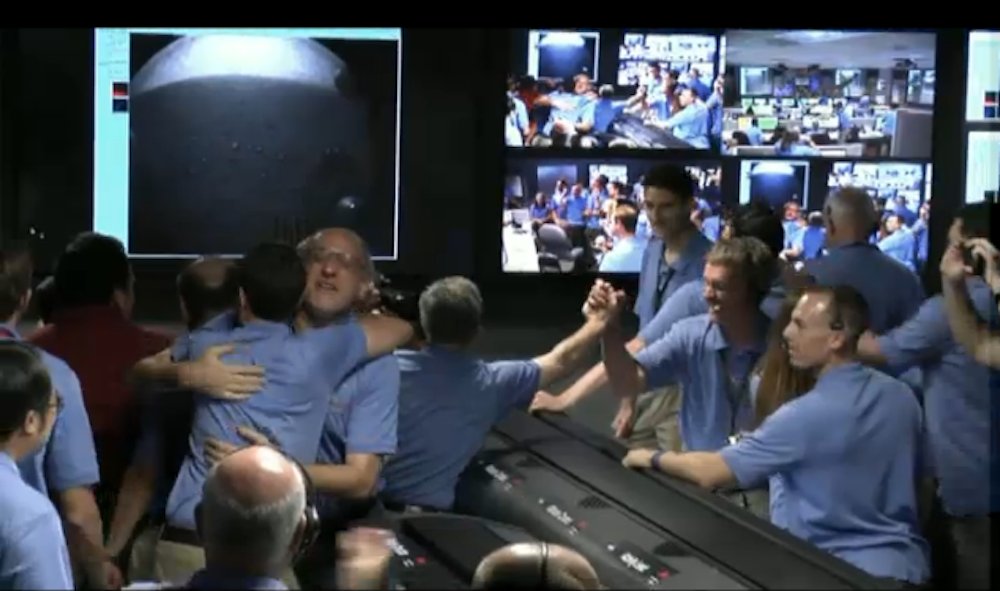
The shifts will last for the whole of the primary mission, planned over a whole Martian year (687 Earth days). These scientists, engineers and rover drivers are in it for the long haul, and if Curiosity has anywhere near the success of Sprit and Opportunity then the mission could last longer.
Both of the Mars Explorer Rovers were pitched to last 90 sols and now, eight Earth years later, Opportunity is still working away.

So who are this intrepid army? Well firstly there are the rover drivers. Surely the coolest job in the world? Not only do they get to DRIVE A ROVER ON MARS (I’m sorry it needed saying again, because it really is that amazing) but they also get to build little bits of Mars here on Earth.
Because it takes seven minutes for the control signal to reach Curiosity on Mars, they need to be super sure they are not sending the rover down a ravine by mistake. Using the images from Curiosity they construct obstacle courses, on Earth, that replicate the surroundings of the rover on Mars.
Then with a model rover, which they call the Scarecrow as it has no brain, they can plan the route they want Opportunity to take on the red planet. This means they can anticipate the obstacles the rover will face.

As well as rover drivers, it will be scientists making up the numbers of those will be living on Martian time. As I’ve written about before, Curiosity is packed with a number of science gadgets, and the data on the rocks surrounding the rover will be rich pickings.
Take the ChemMin instrument. This will take diffraction and fluorescence images of samples the rover picks up. Each of these will require analysis and interpretation to find what minerals give rise to these images, and whether they are purely one thing or (more likely) a complex mixture of interesting materials.
Even when we do know what minerals are in each sample there’s still the big job of deducing what that means, and how it fits into the Martian geology picture.
The same goes for all of Curiosity’s eleven science packages, with each of them having a dedicated science team behind them.
Now Curiosity is safely on the Martian surface, she and the people behind her can get on with the hard grind of being a Martian rover. And you thought landing the thing was the hard part!
Further reading: NASA’s Curiosity is on Mars safely – so now what?