


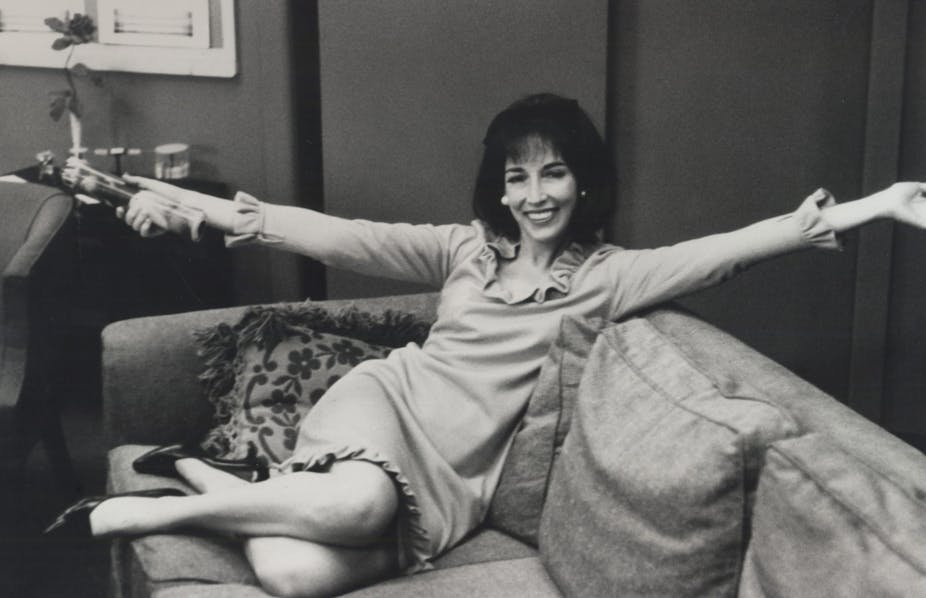
The opening round of respectful tributes have been flowing through the media after the death of Helen Gurley Brown.
The original Sex and the City girl died in New York on Monday, aged 90. Long-reigning editor of Cosmopolitan magazine from 1965 till 1997, patron saint of do-me feminism and post-feminist girl power, Brown will no longer watch over the “fun, fearless female” circling the globe in 64 editions, and counting.
Cosmopolitan and its editor have always been easy targets, from the religious right to radical feminists, and death won’t save them. The second round of media coverage will, inevitably, bring critique. So let me pay my respects before the jackals feed off her cadaver. In the mid-60s, before Women’s Liberation, before the sexual revolution, before Cosmo played out its inevitable second act as farce, Helen Gurley Brown was radical.
Sex and the Single Girl (1962), Brown’s best-selling book, laid down the blueprint for the Cosmo philosophy. Her advice to women was simple yet subversive. Say yes to sex. Work on your assets – body, charm, sexual skills and career. Cherish your independence. Get an apartment of your own and paint the walls cream (flattering for the complexion!).
Traditional women’s magazines, still advising young women to save their virginity for marriage, were “a right royal pain in the ass”, said Brown.
The sexual double standard made her fume. Why should men have all the fun? And for the next 32 years she made sure that Cosmo instructed its readers in the arts of equal opportunity sexual pleasure. She introduced her readers to the female erotic gaze, convincing Burt Reynolds to be the world’s first nude male centrefold in April 1972. Brown disconnected sex and desire from love, from romance, from shame and from marriage. Something that men had been doing forever.
The Cosmo girl was accused of simply pandering to Playboy’s image of the fantasy woman. But over at Playboy HQ, as Sex and the Single Girl hit the best-seller list, the boys were confronted with the anxious reality of their own sexual fantasies – the sexually available woman made flesh. A conference of male magazine editors was held. Editor of Life magazine, Alexander King, said:
This absolute, unquestioned equality is a great mistake and in violation of all natural laws. It is a mistake because democracy is all right politically, but it’s no good in the home.
If she was nothing else, Helen Gurley Brown was a sexual democrat. But there was a more strategic side to this philosophy than women’s equal right to sexual pleasure. There was a caveat. The Cosmo girl was not encouraged to have sex with just anyone. Sex, for Brown, was tied to a desire for upward social mobility. Richer men could help a girl on her way to the middle class American dream in a way that poorer men could not. (Better a tycoon than a truck driver, she said.) She was, after all, a lower middle class girl from Little Rock, Arkansas, and she spoke for the rest of her life to those “mouseburgers” dreaming of a way out, their “noses pressed against the glass”. The Cosmo story, the HGB story, is a narrative of escaping class as destiny.
Her 1964 book, Sex and the Office, made this use of sex for social mobility explicit. Brown advocated using feminine sexual wiles to get ahead. A woman’s sexual power could be a way to smash to glass ceiling. Female sexuality could be powerful, and Brown encouraged women to use it during working hours. If men could use the workplace as a site for sexual conquest, so could women. Brown was railing against the sexual double standard, but also against the harsh reality of life for working women in an era of unequal and ghettoised pay. The book was considered an outrage and categorised as pornography.
Brown wrote a risky prescription in an era when women were discouraged from pursuing an education or career, when most women had few options for a life without poverty apart from a virginal past, then dutiful marriage. Trading on the power of skilled female sexuality, saying yes to sex before marriage, as Brown was advising, could soil the goods and lower the market value. But the risk was worth it. The reward was pleasure and independence – and if the strategy worked, upward mobility.
The philosophy of the Cosmo Girl seems almost quaint now in the post-feminist raunch culture of the West, as Cosmo itself now reads like an ironic piss-take of itself. The sealed section of this month’s issue screams, “Cosmo’s biggest, raunchiest, horniest, dirtiest, sexiest, naughtiest, cheekiest, sauciest, most orgasmic sealed section ever”.
But it’s difficult for those under a certain age to imagine the deep structural misogyny of the world before the second wave of feminism, a world that kept women cowering in sexual ignorance and economic precariousness.
Helen Gurley Brown and Cosmopolitan magazine provided a monthly means of escape, a fantasy of difference, and perhaps inspiration enough to change lives.
Helen, Let others criticise you, in your fishnets and miniskirts in your 80s, unable to fathom the boundaries between old age and youth. You were fabulous.
Vale Helen Gurley Brown.