
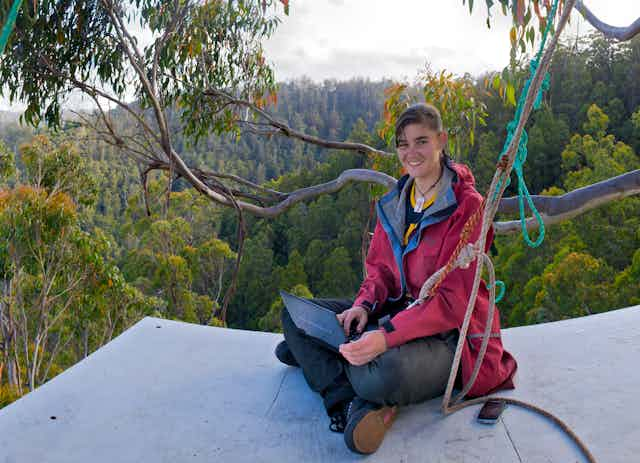




Environmental protest was once a gritty, combative affair, mediated through an often-hostile press. But these days, even a tree-sitter in the most far-flung wilderness can control her own media image and speak to people all over the world.
As of today (December 14), Miranda Gibson has lived on a 60-metre-high platform in a gum tree for an entire year. She has braved sun, wind, rain and snow, protected only by a small canopy. Living in “the Observer Tree” in the Styx Valley in the remote southwest of Tasmania, she plans to mark the anniversary with a “world wide cyber event”.
Gibson is a trained schoolteacher representing the grassroots activist group Still Wild Still Threatened. She is attempting to protect the area from logging and draw widespread attention to the destruction of native forests in the island state.
This task has been lent added impetus by the proposed Tasmanian forestry “peace deal”, recently announced. This deal aims to protect over half-a-million hectares of forest, but the implementation process leaves enough uncertainties to keep Gibson up the tree for the time being.

The Observer Tree is a useful barometer for how the relationship between environmental activism and media has evolved over the past two decades. Gibson is the most remarkable individual to emerge over the course of our ARC funded research project, Changing Landscapes: Online Media and Politics in an Age of Environmental Conflict. Her case highlights the continuity and discontinuity generated by Internet-based and mobile media tools during long-running environmental disputes such as the one in Tasmania.
Reports about Gibson have appeared in the mainstream news media, including The Guardian in the UK, CNN in the US, and Al Jazeera English. This international coverage has been accompanied by reports in Australian newspapers, Channel Seven’s Today Tonight, and ABC radio’s AM program. Gibson also asked a video question via Skype from the tree’s platform during an episode of Q&A.
Stories and programs directed at mass audiences are complemented by targeted online messages delivered to activist and environmentalist communities. Armed with a laptop and mobile phone, Gibson writes a blog, sends emails, maintains Facebook and Twitter profiles, and distributes photographs and short videos shot from her platform.
She also coordinates a cyber-action campaign targeted directly at the Japanese buyers of controversial forest products. Using both Skype and her phone, she converses with Australian and international journalists, fellow activists, political figures, students, interested onlookers, family members and friends. It is difficult to fathom the sophistication of these diverse media practices when standing at the base of her tree in muddy boots in the middle of a remote forest.
Only in service since 2009, a nearby 3G mobile service tower in Maydena (population 245) enables a variety of digital media activities that were once unthinkable from this elevated position.

Yet, it also needs to be remembered that the novelty of the Observer Tree is embedded in a long-established protest tactic – the tree sit. Predating broadband internet and consumer 3G networks, scaling a tree to prevent its felling is a long-standing method of halting the progress of loggers and attracting the attention of journalists.
For instance, the Observer Tree’s Facebook profile features a message of support from Julia “Butterfly” Hill. Fifteen years earlier, Hill occupied a 1,500 year-old redwood tree – dubbed “Luna” – in California for a record 738 days, using solar-powered cell phones to conduct interviews with reporters.
Gibson has also not had it all her own way. Piggybacking on the publicity generated by the Observer Tree, a newly formed pro-logging group, Give it Back, set up a counter-vigil at the base of the tree. Reported widely in Tasmanian media, this peaceful action sought to “get another side of the story across to the public” and “fight for Tasmania’s resources”.
Gibson personifies the way in which the long, slow march of environmentalism is now closely linked to the quickstep of networked digital communications, media and infrastructure. This connection is producing a mixture of innovation and reliance on familiar protest techniques. These methods are executed strategically in the course of disputes occurring simultaneously in the physical environment, on-screens, on-air and in newspapers.
Green politics are now negotiated and fought in the interactions between these very different “environments”.