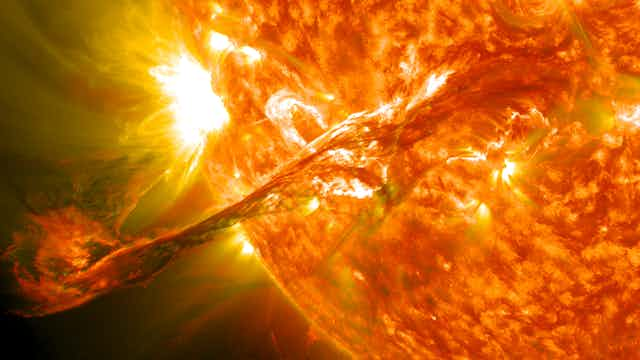

Divert power to shields – the solar maximum is coming

Over the past few months our planet has been impacted by an increasing number of solar explosions that have erupted from the sun’s surface. Even though next year’s predicted solar maximum – the period of greatest activity in the sun’s 11-year cycle – is expected to be smaller than its predecessor a…

Npw3xds8-1355117479
The impact on society from the next solar maximum is predicted to be worse than the last. NASA

Over the past few months our planet has been impacted by an increasing number of solar explosions that have erupted from the sun’s surface.

Even though next year’s predicted solar maximum – the period of greatest activity in the sun’s 11-year cycle – is expected to be smaller than its predecessor a decade ago, the impact on society over the coming months could be worse than in the past.

The main reason for this is that there has been an increase in society’s dependence on space-based services that are severely influenced by these disturbances.

The effect that space weather has on our everyday lives resides in our reliance on technology, in particular electricity grids, radio communications and satellite-based services.

While our reliance on electric power is obvious, our reliance on radio communications may not be.

Difficult positions

By “radio communications” I don’t just mean walkie-talkies and two-way radios. Military organisations around the world, including Australia’s defence forces, heavily utilise ground-based radar surveillance for routine border protection, and have done so since the end of the second world war.

An additional aspect of our current technology that is strongly influenced by space weather events is satellite communications. This not only includes both satellite phones and TV broadcasting, but also satellite positioning services, such as the Global Positioning System (GPS).

The direct effects of space weather events on our satellite communications are twofold:

1) Satellites are subjected to high radiation doses from the space environment that can cause hardware faults and failures.

2) Satellite-transmitted radio signals are manipulated by the layer of partially ionised gas in Earth’s upper atmosphere – the ionosphere.

One example in which satellites succumbed to the sun’s wrath was the loss of two Canadian telecommunications satellites that were subjected to an intense geomagnetic disturbance in 1994. The satellites were replaced at a cost of about US$400 million.

Earth’s ionosphere is a dominant source of error in GPS positioning due to its effects on radio signals passing through the atmosphere. The commercial “SATNAVs”, and more recently smartphones, that people commonly use for navigation across town are accurate to within a few tens of metres, and therefore a drop in accuracy using these devices during geomagnetic storms may not be obvious.

But industries that conduct high-precision (centimetre-level) positioning operations, such as surveying and exploration mining, are strongly impacted by space weather disturbances.

Drag and drop

A less direct space weather effect on our technological infrastructure is the dramatically increased level of atmospheric drag experienced by low-Earth orbiting satellites as the upper atmosphere swells due to the increased heating during geomagnetic storms.
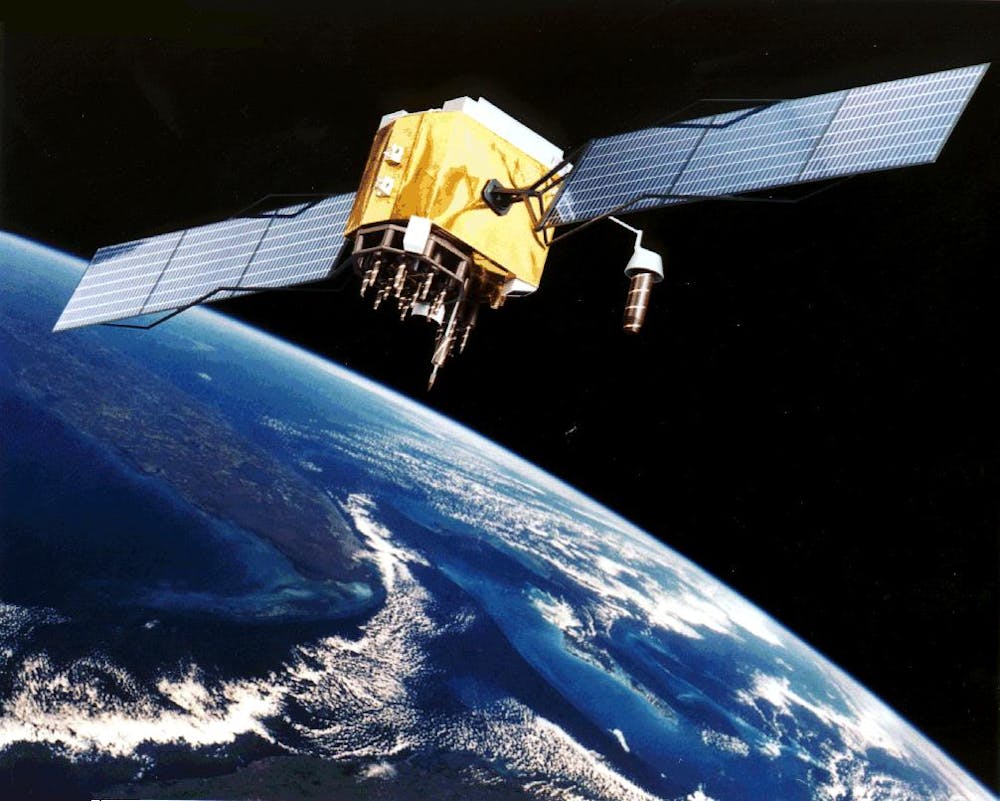
Artist’s interpretation of a GPS satellite. NASA

Low-Earth orbit satellites reside (generally speaking) at altitudes lower than 2,000km and a large portion of those are Earth Observation Satellites (or EOS for short).

Many Australians would be unaware of how much our government departments and organisations rely on EOS in their day-to-day operations. The Federal Government spends about A$100 million per year on EOS data acquisition.

The services provided with this data contribute A$3.3 billion towards the annual Australian gross domestic product (GDP). This means the government gets more than a 30-fold return on its EOS data investment, despite not owning any EOS currently in orbit.

So even though Australia owns very few orbiting satellites, its economy is actually rather heavily reliant on space-based services.

An example of the adverse impact that satellite data gaps have on Australia is the LANDSAT EOS data loss due to retiring and malfunctioning satellites.

This costs Australia an estimated A$100 million in the first year – the federal government’s entire yearly investment – with flow-on effects expected in subsequent years until replacements are launched.

Lost in space

Readers may remember back to 1989 when a large geomagnetic storm destroyed power transformers in Canada, and caused widespread blackouts and circuit trips across Northern America.

But one problem caused by this geomagnetic storm that was far less publicised at the time was that around 1,500 orbiting objects were completely lost by the North American Aerospace Defense Command (NORAD).

Composing the vast majority of these lost objects were space debris or “space junk”.

The rest were operational satellites worth millions of dollars. One of the lost objects was later found to be orbiting at an altitude 30km lower than it was prior to the storm. It took NORAD more than seven days to find all of the objects again and to resume normal operations.

Maintaining focus

From the LANDSAT example above, it is easy to see how vulnerable the Australian economy is to the loss of EOS, due to collisions with space debris, in particular during the days following a large geomagnetic disturbance.

Space weather prediction is a challenging task that a number of organisations around the world specialise in. Those organisations include, but are not limited to, the NOAA Space Weather Prediction Center in the USA, the Solar Influences Data Analysis Center in Belgium and the Australian Space Forecast Centre – the space weather branch within the Bureau of Meteorology.

The importance of the work these organisations do is significantly increasing as we become more heavily reliant on technology into the future.

It is therefore important that space scientists and space weather forecasters internationally remain focused on studying these impacts in the context of providing accurate forecasts for individuals and industries that rely on these technologies.

The next solar maximum will be a testing time.

Sign in to Favourite

Want to follow The Conversation?

Sign up to our free newsletter to get the day's top stories in your inbox each morning, with a special wrap on Saturday.

Spinner
Help us have better conversations — donate

Join the conversation

46 Comments sorted by

  1. Ron Chinchen

    Retired (ex Probation and Parole Officer)

    Though its quite logical to use space as a means of effective world wide communication and information, I must admit that I also have wondered at the vulnerability of such systems, Not only to natural processes such as solar energy output, but also to human interferences should disputes arise in future between powers that have effective means of intercepting or shutting down a satellite's purpose. Unlike ground basd systems, there seems little effective means at this time to protect, what is increasingly…

    Read more
    1. Kim Peart

      Researcher & Writer

      In reply to Ron Chinchen

      I quite agree Ron, that in the event of a global conflict, the eyes in the sky would be targeted.

      China shattered any illusions on this when they blew up one of their own satellites in 2007.

      The outcome would lock the gates to space, by filling the celestial realm with space junk.

      I see our best bet for a space future is to secure peace on Earth.

      I explored this in my 2006 document ~ 'Creating A Solar Civilization' ~ revised in 2012 and found in our website.

      This could be achieved…

      Read more
  2. Kim Peart

    Researcher & Writer

    What an amazing image of the Sun.

    We certainly underestimate the power of our star, which is slowly getting hotter and heading toward becoming a red giant over the next 5 billion years, expanding to the orbit of the Earth.

    The 1989 Canadian experience revealed just how vulnerable our civilization is to a good dose of solar flare and it could happen again at any time.

    If it is possible to take the overview, should we invest in planet Earth defence.

    Adjustable shields in space would help…

    Read more
  3. Sean Lamb

    Science Denier

    I understand that the earth has reversed magnetic polarity once every million years or so. Ie an extremely rare, unpredictable but not an entirely unforeseeable event.
    What would be the effect of an event like that on our modern electronic systems? I suggested once in jest that all the Eagles tapes would start playing their Satanic recordings forwards - but I assume that all our different types of magnetic storage would not be affected.

    report
    1. Ron Chinchen

      Retired (ex Probation and Parole Officer)

      In reply to Sean Lamb

      My understanding about Magnetic Field Reversals is not so much the change in polarity, but the period in between when the magnetic field generally weakens, apparently over decades or even centuries, during which time the amount of radiation penetrating would substantially increase. Under those circumstances as well as increased UV radiation etc, the potency of normal solar activity would be such that virtually no electronic equipment unprotected could be sustained and certainly man made satellites, as they exist today would be totally unworkable.

      report
    2. Ron Chinchen

      Retired (ex Probation and Parole Officer)

      In reply to Sean Lamb

      Sean. What I understand about the lack of an effective magnetosphere, and please understand I'm no scientist, is that the primary problem is charged particles in the solar wind. One of the consequences its suggested of having no magnetosphere or ionosphere is that the solar wind over a long period of time would gradually wear away the atmosphere...I'm talking perhaps hundreds of millions or billions of years. Of course it hasnt affected Venus, which has a negligible magnetosphere but a very dense…

      Read more
    3. Kim Peart

      Researcher & Writer

      In reply to Sean Lamb

      Ron Chinchen writes ~ "Of course it hasnt affected Venus, which has a negligible magnetosphere but a very dense atmosphere, so its obviously very long term."

      I was fascinated to read that Venus once had as much water as Earth, but this was not original water, as both Earth and Venus began their planetary careers as bubbling cauldrons of molten rock.

      The water of Venus and Earth came later, from asteroids and comets.

      While Earth kept her waters, Venus became stressed out by heat, causing…

      Read more
    4. Alex Cannara

      logged in via LinkedIn

      In reply to Sean Lamb

      Ron, just a small correction to "charged particles getting through the magnetosphere and overloading electrical components"

      The magnetic fields of planets deflect the charged solar wind, which is mostly protons running at 100k to 1 million mph. With no magnetic field, the protons just impact atmospheric atoms and knock them away. With a field, some particles just get bounced off into space, while others spiral around the field lines and get dumped downward toward the poles, ionizing the atmosphere…

      Read more
    5. Sean Lamb

      Science Denier

      In reply to Sean Lamb

      It seems to me then, that a constant decline in strength of the magnetosphere - such as we have been experiencing for some time - might easily contribute in some small way to rising atmospheric temperatures. Just factoid 307 which climate scientists haven't thought to include in their modelling to distract them from their monomanic pursuit of carbon dioxide.

      Strictly speaking this should go here:
      Human role in climate change now virtually certain: leaked IPCC report : Comments on this article…

      Read more
    6. Kim Peart

      Researcher & Writer

      In reply to Sean Lamb

      Sean Lamb ~

      Are you factoring in the detail that the Sun is getting warmer, now 25% hotter than at the dawn of life 3.5 billion years ago and continuing to warm toward becoming a red giant 5 billion years from now, when our central power supply will expand to the orbit of the Earth?

      Is anyone denying this fundamental serve of science?

      Another fact of consequence is the detail that Venus, which is nearly the same size as Earth, once had as much water as our planet now possesses, but after…

      Read more
  4. Alex Cannara

    logged in via LinkedIn

    Very true concern, considering the amazing past event was in 1859 when only telegraph systems were around to be damaged. Google "Carrington Event of 1859"

    The estimate today is that unprotected grid components will be damaged across the world, requiring about a decade for repairs costing $trillions.

    Forget satellites & personal electronics.
    ;]
    Then there are the asteroids, one coming by soon between us & the moon...
    http://www.spaceweather.com/

    report
    1. Brett Carter

      Postdoctoral Researcher in Space Weather and Ionospheric Physics at RMIT University

      In reply to Alex Cannara

      Hi Alex,

      It is difficult to know how devastating a Carrington- like event would be nowadays. My personal impression is that there isn't really much we can do to prevent mass loss to power systems around the globe in such an event. All we can do now is take some comfort from the fact that in the 400 or so years of sunspot monitoring, this large-scale event only occurred once, and it hopefully won't occur again until we do have the capabilities to cope with it.

      Interestingly, the solar maximum close to the time of the 1859 event was not particularly high, clearly indicating that the intensity of the solar maximum does not necessarily mean stronger disturbances! All we need is a complex group of sunspots that flare up and eject a heap of solar material our way, and that is it!

      report
    2. Alex Cannara

      logged in via LinkedIn

      In reply to Alex Cannara

      Very true, Brett -- the way in which a mass ejection heads out makes all the difference. The Spaceweather site includes a tool to see those paths when ejections occur.

      One coming the right way will give us some hours to wrap all our goodies in foil. Fortunately, newer grid transformers have low frequency & DC detection & shutdown systems.
      ;]

      report
    3. Kim Peart

      Researcher & Writer

      In reply to Alex Cannara

      Brett Carter ~

      As humans we make unusual decisions.

      Imagine if the 7 million tons of bombs and all the energy related to delivering the means to exterminate a couple of million Vietnamese, had been directed into building solar power stations in space?

      Rather than lose a war at great expense, we would have launched industry beyond Earth and developed much more advanced technology, which of necessity, would be hardened against radiation by one means and other.

      As humans, I wonder if we will wake up and decide to catch up to the future that we dropped on Vietnam.

      Hopefully, we will awaken and act on investing in our cosmic survival, before a solar flare melts our capacity to be civilized.

      Kim Peart

      report
    4. Doug Hutcheson

      Poet

      In reply to Alex Cannara

      Alex et. al., a Carrington event (http://en.wikipedia.org/wiki/Solar_storm_of_1859) about now would go some way towards mitigating our carbon footprint for a while, as advanced 'Western' civilisation would come to an untimely halt. An EMP great enough would fry all our electronic doo-dads, from my LED torch, to the computer I am using right now, up to the largest of our power generation plants.

      Not only would everything electronic be fried, but all the technology we would use to repair the mess…

      Read more
    5. Kim Peart

      Researcher & Writer

      In reply to Alex Cannara

      Doug Hutcheson ~

      All very chilling and thanks for the link to the 1859 event.

      I know it is more fun to end the world in a grand disaster, but it's a bit more challenging to figure out and describe how we could get ahead of the game, whether a magnificent solar flare, a monster asteroid strike, a tsunami caused by the collapse of a volcanic peak such as in the Canary Islands, or a good old fashioned super-volcano, like that bubbling away beneath Yellowstone.

      Considering the fragility of our…

      Read more
    6. Doug Hutcheson

      Poet

      In reply to Alex Cannara

      Kim, you are correct that the best way to ensure survival of our species is to break our dependence upon the life-support systems of Earth.

      As you point out, the world economy is not in good shape to support the kind of species-wide project needed to implement an interstellar capability.

      In addition, the science required to build space-hardened habitats capable of supporting life indefinitely, independently of Earth, let alone propel those habitats towards other stars, is in its infancy…

      Read more
    7. Alex Cannara

      logged in via LinkedIn

      In reply to Alex Cannara

      DougH, indeed, we've overextended in many dimensions. The 1859 solar event appears to happen about every 150 years or so -- oops!

      Here in Calif. we have the Mammoth Lakes caldera, which now has fresh magma rising yearly. Last time it went off ~760,000 years back, it did a fine job on half the US...
      http://en.wikipedia.org/wiki/Long_Valley_Caldera

      Then there was Yellowstone, which was bigger, much more recent, and making rumblings...
      http://news.nationalgeographic.com/news/2012/09/120920-yellowstone-supervolcano-prediction-volcanoes-science-environment/

      So, plenty of aluminum foil will help your iGadgets in a solar event, but not much recourse for supervolcanos. Another Carrington Event is estimated to damage power grids to the tune of $trillions, requiring a decade to repair.

      Edison was wise when electrifying the first 'grid' in NYC -- he put his wiring through old gas-lamp pipes and generated DC.

      report
    8. Doug Hutcheson

      Poet

      In reply to Alex Cannara

      Alex, thanks for the links. I knew a little about Yellowstone, but Long Valley is news to me. Thousands of feet of ash would certainly spoil our party.

      When we look at all the ticking time-bombs around the planet, we could be excused for becoming a little apprehensive, I guess. Our urbanised existence has insulated many of us from dealing with Nature in the raw, but a decent-sized volcano, or damaging earthquake, seems to happen only often enough for us to say 'tut tut', as we sip our lattes while reading our newspapers.

      The "it couldn't happen to me" response must be the only thing keeping us going, in the face of all the dangers that surround us. Perhaps that ability to ignore threats we cannot actually see in front of us, is what underlies the way some people can ignore the evidence for global warming: they just assume that something that big couldn't happen to them.

      Let's hope for a safe and earthquake/asteroid/volcano free New Year.

      report
    9. Alex Cannara

      logged in via LinkedIn

      In reply to Alex Cannara

      DougH, we not only put threats out of our minds here, we build where they'll doi the most damage -- our Calaveras Fault is due to go any time now, with hospitals, schools, universities, etc. all right atop it. The Calif. School for the Deaf is on it too -- they, at least, won't hear all the commotion.
      ;]

      report
    10. Doug Hutcheson

      Poet

      In reply to Alex Cannara

      Alex, denying threats seems to be a whole industry! Isn't half of California due to slide into the sea at some point? Harking back to other conversations we have had, I googled 'fukashima fault' and found a Tokyo Times report that a number of faults have been 'found', or re-examined, near Japanese nuclear plants. Of course, Japan is so small and active that it must be hard to find somewhere NOT close to a fault. http://www.tokyotimes.com/post/en/2321/Utilities+research+finds+14+fault+lines+near+Japan+s+nuclear+plants.html

      report
    11. Alex Cannara

      logged in via LinkedIn

      In reply to Alex Cannara

      Yes, Doug, we have lots of faults, not all centered in Orange County politics or Hollywood behavior.

      However, we have mostly strike-slip faults -- little vertical movement, so houses aren't lifted off foundations, etc. The few vertical faults under our coastal mountains have indeed done more damage, so are to be avoided. And, when undersea, these make tsunami, as the Japanese must always worry about -- 3 such faults come together SE of Tokyo -- not good, since an event there was made more likley when the Tohoku quake released its stored energy.

      By the way, these plate-boundaries are where carbon is naturally recycled to depth, via limestone from sea life detritus being subducted. Tsunami are, in a sense, our long-term friends, which is why Sendai plains should never have been built upon, as Japanese ancestors warned hundreds of years ago.

      It pays to understand Nature.

      report
    12. Ron Chinchen

      Retired (ex Probation and Parole Officer)

      In reply to Alex Cannara

      Are you guys still at it? Why not sit back and enjoy the sky?

      I understand the Comet Ison coming in October-December is going to knock your socks off (Kahoutek all over again...hope not). But they reckon especially in the northern hemisphere it will be the best comet sight in living memory.

      Mind you, portend of disaster perhaps?

      report
    13. Kim Peart

      Researcher & Writer

      In reply to Alex Cannara

      Doug Hutcheson ~

      Our problems on Earth at present are a direct consequence of seeking to do all our business on one planet.

      By building solar power stations in space, we will have access to the unlimited energy-well of our star and will be able to use stellar energy to extract excess carbon from the air and sea, to win back a safe Earth.

      With a view to unlimited stellar energy, we can begin the work now on designing a stellar economy without poverty.

      This simple vision will lead to a…

      Read more
  5. Dave Phillips

    logged in via Facebook

    Ahhh once again puny humans tie themselves to one methodology of use in a system, with no redundancies or back up. Slavish devotion to everything mobile and electronic to make huge profits, all the while ignoring the known vulnerabilities and faults that arise when the solar events occur, another known quantity ignored by those making the money, because spending money to prevent loss of service "sometime in the future" isn't in their mindset, it is full steam ahead now and someone else can worry about the stuff hitting the fan down the track. As for us plebes in suburbia, maybe a follow up article on what practical measures we can take to ensure our little piece of earthy domain is at least prepared for power outages, loss of electronic access to money and food/water?

    report
  6. Alex Cannara

    logged in via LinkedIn

    Sean Lamb says "the magnetosphere" is in "constant decline" -- really, Sean? Why show your lack of science & understanding so freely?

    He also concocts a 'formidable' indictment of IPCC folks: "their monomanic pursuit of carbon dioxide" -- thanks for inventing "monomanic", Sean. It sounds like it describes the way deniers & gafact avoiders operate.

    So again, we see a fact avoider monomanically hiding in the straw men of "models", and imagined evil bureaucracies, like the IPCC.

    All the while, the oceans rise, get warmer, evaporate more moisture to increase storms & strengths, and the CO2 in the seas begin to damage sea life & food chains.

    Sure, Sean, "monomanic" indeed describes a narrowness of thinking -- yours (and some others').

    But, be careful, handlers don't like it when deniers display easily discovered monomanicness.
    ;]

    report
    1. Kim Peart

      Researcher & Writer

      In reply to Alex Cannara

      Alex Cannara ~

      I wonder if we should be more concerned about the deeper level of denial that I raise in my response to Sean Lamb.

      If I am right, then climate change denial may be no more than a smoke screen that hides our view of the deeper level of this problem and the pathway to winning back a safe Earth.

      This smoke screen serve the carbon energy industries well, as they press onto to fracking and drawing on the shale oil deposits.

      In the light of Nature's hammer blow from Arctic greenhouse gases, we do not have the luxury of endless debates, before we get serious about investing in our cosmic survival.

      When we have a solution to the carbon crisis that is actually going to work, then all climate change and science denial will be swept aside in the race for survival.

      Kim Peart

      report
    2. Alex Cannara

      logged in via LinkedIn

      In reply to Alex Cannara

      Kim, the problem is that the combustion folks have already won, decades ago.

      Having swamped the natural carbon cycle by a factor of about 30 for decades, we're now committing our descendents to thousands of years of extraourdinary challenges.

      We had the solution in hand in the '60s & '70s, and blew it in several ways -- here's one example that would have eliminated combustion power by 2000...
      http://tinyurl.com/6xgpkfa
      http://tinyurl.com/73p7ler

      To understand how we've let the combustion…

      Read more
    3. Kim Peart

      Researcher & Writer

      In reply to Alex Cannara

      Alax Cannara ~

      In The Conversation of 30 October Bert Roberts wrote that the Toba super-eruption in Indonesia around 73,880 years ago served in, "reducing the population to such a small size than our ancestors were squeezed through a genetic bottleneck?"

      Bert also suggests that the Toba eruption caused the beginning of the last Ice Age.

      We very nearly didn't survive.

      Threats today in addition to another super-volcano, include asteroids, solar flares and the potential of a volcanic outcrop…

      Read more
    4. Alex Cannara

      logged in via LinkedIn

      In reply to Alex Cannara

      Got you going, eh Kim!? Yes, "we are all guilty of the carbon crisis." -- some much more than others. And the solution isn't moving to other imagined worlds to continue to display the sad difference between humans and people.

      report
    5. Kim Peart

      Researcher & Writer

      In reply to Alex Cannara

      Alex Cannara ~

      Would we be "moving to other imagined worlds" by developing human society beyond Earth?

      When I look at the vast shopping malls in our cities and suburbs, I see an environment that could just as easily be located in space.

      It could have an Earth gravity, by the environment being located in a wheel in space that rotates and we would think we were on Earth, if it were not for the curve in the floor of the wheel.

      If the warning about dying oceans releasing toxic hydrogen sulphide…

      Read more
    6. Alex Cannara

      logged in via LinkedIn

      In reply to Alex Cannara

      Sorry Kim, I'll be staying down here -- it was quite fine up until a hundred or so years ago!
      ;]

      report
    7. Kim Peart

      Researcher & Writer

      In reply to Alex Cannara

      Alex Cannara ~

      It is not what we do personally, but what we fight for.

      We have been the criminal in collusion with the carbon energy industries.

      Now we must become the collective surgeon to heal the Earth.

      The operation will need to be swift and radical to minimise further damage.

      In 1969 it was as if the planet was pregnant with new potential and ready to give birth.

      Now we have caused a stillbirth, putting both mother and child at great risk.

      We must open the womb and release…

      Read more
    8. Ron Chinchen

      Retired (ex Probation and Parole Officer)

      In reply to Alex Cannara

      I guess who really knows what the future of humankind is to be. I dont think its predestined so it can probably take many roads, some to disaster others to as yet unknown and undiscovered wonders.

      Certainly at the moment we seem to be making a serious mess of things and there are many, especially in positions of power, who would prefer to keep their head in the ground and not see what approaches.

      As I see it there are so many potential options. Kim's movement out to the stars is obviously one…

      Read more
    9. Kim Peart

      Researcher & Writer

      In reply to Alex Cannara

      Alex Cannara ~

      We can share that which we have been doing for years.

      Unfortunately, the end result of all our efforts is currently a planet in peril.

      We need a plan that will actually deliver a safe Earth and human survival.

      We need to share and improve that plan.

      Kim Peart

      report
    10. Kim Peart

      Researcher & Writer

      In reply to Alex Cannara

      Alex Cannara ~

      The link offered goes to the MySpace music site of Meatdraw.

      I don't see a plan there to win back and maintain a safe Earth.

      Kim Peart

      report
    11. Sean Lamb

      Science Denier

      In reply to Alex Cannara

      "Sean Lamb says "the magnetosphere" is in "constant decline" -- really, Sean? Why show your lack of science & understanding so freely?"

      Golly, well the fact is I had no idea I could charge for it. Anyone thanks for the heads up about my handlers, my performance appraisal is due a few months, so its good to be prepared.

      Although from the context is should have been obvious, perhaps I should have said the strength of the magnetic field has been in continuous decline for the last 150 years or…

      Read more
    12. Alex Cannara

      logged in via LinkedIn

      In reply to Alex Cannara

      Where to start, Sean!? You provide so many opportunities!

      "my principal components analysis" -- high-falutin' terms for someone who seems to ignore real scientific data.

      ""the strength of the magnetic field has been in continuous decline for the last 150 years or so?" --yes, Sean, and do you know why? Do you know what happens every 70,000 years or so? Hint: look up Earth magnetic-field reversals.

      But you conclude, from your PCA, that: " declining magnetic field strengh could only, according…

      Read more
    13. Sean Lamb

      Science Denier

      In reply to Alex Cannara

      "- high-falutin' terms" - no its an eigenvector-vector based multivariate statistical method. Basically it provides a method to assess the likely contribution of a number of variables to an output.
      "Hint: look up Earth magnetic-field reversals." - a rather odd remark since this only sub-discussion arose when I asked what would be the effect of a magnetic field reversal. Even odder, it seems a non-sequiter, since no matter how it arises has no bearing on whether or not it might result in a degree…

      Read more
    14. Alex Cannara

      logged in via LinkedIn

      In reply to Alex Cannara

      Sean, you seem to think you can use terms you obviously don't understand, maybe to snow others and push a phony argument through.

      All you do is expose your lack of understanding. If you were a statistician, you'd know the assumptions underlying PCA don't support your claimed use of it. I teach stat. I've an advanced degree in stat. You're no statistician.

      You're also no scientist or engineer, no matter how you fluff up your massive prose here to mislead others.

      report
    15. Sean Lamb

      Science Denier

      In reply to Alex Cannara

      Mr Cannara, there are few things I am more in awe of than a publications list that finished in 1975 with a thesis concerning experiments in computer use by children.
      Leaving aside your apparent lack of recognition of the term PCA, you are right in one thing - I did bodge one aspect.
      The problem with CO2 is it not only it influences climate, its level is influenced by climate - this is probably more an issue with paleoclimate than the recent decades. Was this what you had in mind?

      My solution…

      Read more
    16. Alex Cannara

      logged in via LinkedIn

      In reply to Alex Cannara

      Aha, Sean, you've discovered a key component of spying & computer security -- the "honeytpot"!

      So you went off, unsuspectingly, and found some info about me, to use, because your arguments are vapid.

      Good! Now we all know you'll go after the carrot, unquestioningly, and report back as if you've discovered a great truth.

      See, what you found out about me, and where, allows me to discover your integrity.

      Now, you were given plenty of links to scientific papers on climate, oceanic chemistry…

      Read more